
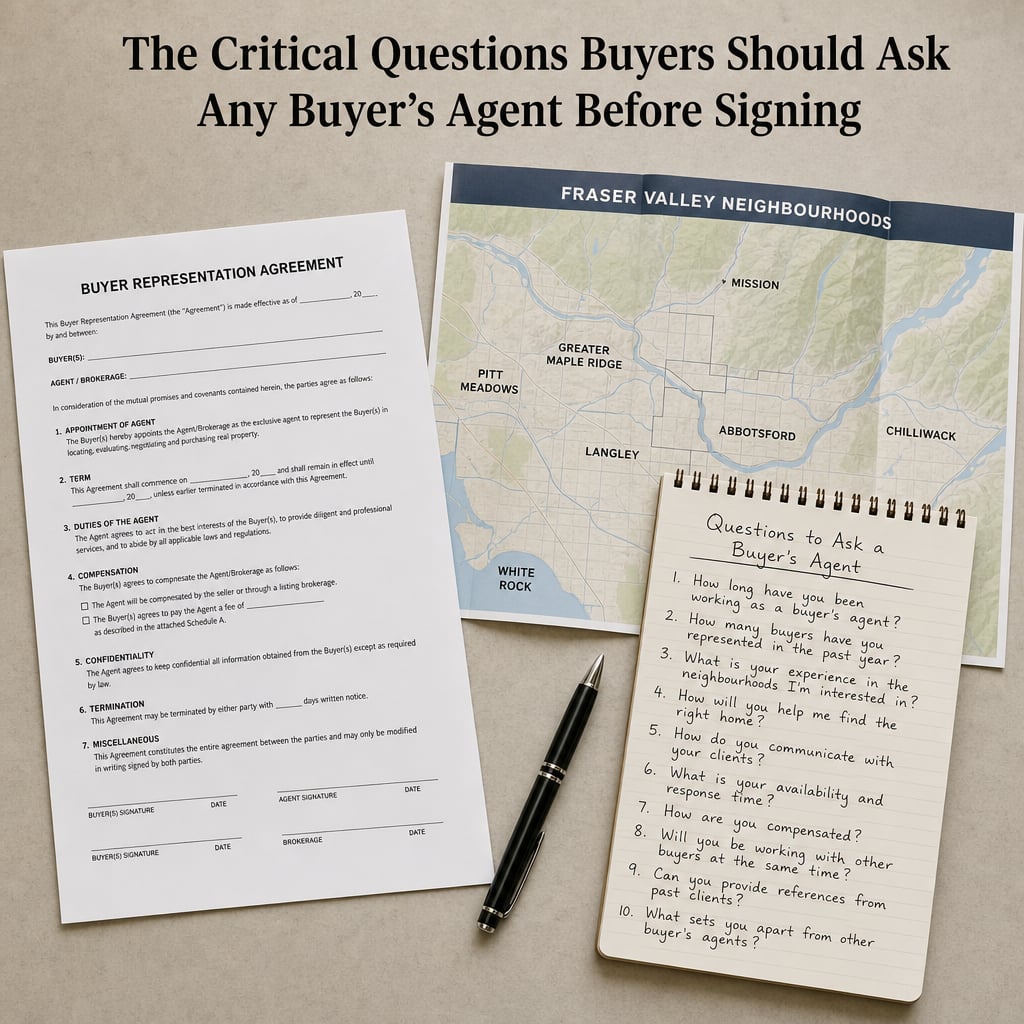

The Critical Questions Buyers Should Ask Any Buyer's Agent Before Signing a Representation Agreement in Metro Vancouver and Fraser Valley 2026: A Complete Interview Guide
By Mohamed Mansour, MBA and Associate Broker | Mansour Real Estate Group | Fraser Valley and Lower Mainland | Published: July 29, 2025
This guide is for buyers preparing to sign a Buyer Representation Agreement with an agent in Metro Vancouver or the Fraser Valley. Whether you are purchasing your first home in Surrey, a townhouse in Willoughby, or a detached property in Abbotsford, the questions you ask before signing determine the quality of the representation you receive. BC's formal disclosure rules under the Real Estate Services Act now require a written agreement before any agent can show you a property. That makes the interview conversation more important than ever.
Most buyers sign with the first agent they meet. Research into buyer outcomes — including offer competitiveness, subject condition flexibility, and final purchase price — shows that agent quality matters more than almost any other factor a buyer can control. This guide gives you the framework to test agents before you commit.
Short Answer
Before signing a Buyer Representation Agreement in BC, ask every candidate about their dual agency policy, how they handle multiple-offer situations in entry-level Fraser Valley markets, their specific knowledge of FHSA eligibility and PTT exemptions for first-time buyers, and what the exit terms of their agreement allow. The answers will separate agents with genuine buyer advocacy skills from generalists who primarily serve sellers.
Who This Applies To
- First-time buyers entering the Fraser Valley or Metro Vancouver market in 2025–2026
- Move-up buyers already familiar with the process but evaluating a new agent
- Buyers relocating from another province or country who need local expertise quickly
- Buyers evaluating strata purchases, townhouses, or entry-level detached homes under $1.2M
- Buyers who have already been shown properties by an agent and have not yet signed anything
When This Advice May Not Apply
If you are purchasing a pre-sale assignment where a developer's agreement governs terms, or if you have a long-standing relationship with an agent whose track record you can independently verify, some of these questions are less urgent. Buyers in the luxury segment above $3M operate in a different competitive landscape and should adapt accordingly.
Key Takeaways
- BC law requires a written Buyer Representation Agreement before any agent shows you a property — this makes upfront vetting essential, not optional.
- Entry-level detached homes under $800K in the Fraser Valley can attract 30 to 50 competing offers — your agent's offer strategy directly affects whether you win.
- Dual agency disclosure gaps remain common — ask explicitly whether the agent will ever represent the seller of a property they show you.
- First-time buyer program knowledge — FHSA mechanics, PTT exemptions, CMHC thresholds — is not universal; verify it before you sign.
- Exit clause terms vary significantly between agents — understand exactly what it takes to end the agreement if the relationship does not work.
Data Used in This Article
- Fraser Valley Real Estate Board monthly market reports, February through August 2026 — official board statistics, offer volume and days-on-market data
- BC Financial Services Authority — BCFSA Buyer Representation Agreement disclosure framework, official regulatory guidance
- BC Real Estate Services Act — legislative disclosure requirements governing written buyer representation in BC
- Mansour Real Estate Group — professional observations drawn from buyer transactions across the Fraser Valley and Lower Mainland over 22+ years
What BC's Buyer Representation Agreement Actually Requires You to Know
Under BC's Real Estate Services Act and BCFSA disclosure framework, a licensed real estate agent must present you with a written Buyer Representation Agreement before showing you any property. That agreement must clearly state the commission structure, the geographic and property-type scope of representation, the exclusivity period, and how dual agency will be handled if it arises.
The agreement formalizes the relationship. It also creates an exclusivity period during which you are obligated to work with that agent for purchases within the defined scope. If you find a property independently, or if the agent introduces you to a property where they also represent the seller, the agreement's terms govern what happens next.
Most buyers read these documents quickly and sign without understanding the exit provisions or dual agency clauses. That is where problems begin. Reading the full explanation of BC's Buyer Representation Agreement rules before your first agent meeting will put you in a far stronger position.
Why Agent Quality Has a Measurable Financial Effect on Your Purchase
In competitive Fraser Valley submarkets — entry-level detached homes in Cloverdale, Fleetwood, or North Delta; townhouses in Willoughby or Walnut Grove; strata units in Guildford or Abbotsford — offers routinely compete against 10 to 50 other buyers. According to Fraser Valley Real Estate Board market data from early 2026, multiple-offer situations remained common on properties priced below $800,000 in the detached and townhouse segments.
In those conditions, the structure of your offer — subject removal timing, deposit amount, completion date flexibility, escalation strategy — determines whether you are taken seriously. Agents who primarily handle listings and occasionally represent buyers do not carry the same offer-structuring depth as agents who work the buyer side regularly.
The financial consequence is direct. Buyers working with agents who consistently achieve strong purchase-price-to-list ratios — meaning they help clients buy near or below list in balanced markets — save meaningfully compared to buyers who rely on generalists. If you are purchasing a $900,000 home, a 2% difference in outcome is $18,000. That gap is not hypothetical. It is documented in agent performance data available through the board and through verified review records. For a deeper look at what separates strong buyer agents from generalists, the first-time buyer realtor selection guide covers the specific competencies to verify.
How We Evaluate This
At Mansour Real Estate Group, buyer representation begins with a structured consultation where we review the buyer's financing position, timeline, property type priorities, and geographic scope before any agreement is signed. We discuss dual agency policy openly, explain the exit provisions in our agreements, and walk through what our offer strategy looks like in current market conditions for the specific property type the buyer is targeting.
We evaluate agent quality the same way we teach buyers to evaluate it: by asking for specifics. Vague answers about "negotiation experience" or "knowing the market" are not substitutes for concrete examples. When a buyer asks us how we handle competing offers in Langley or what FHSA contribution room means for their purchase timeline, we answer with precision — because that precision is what protects buyers in a transaction.
The Complete Interview Questions — What to Ask Before Signing
On Dual Agency and Conflicts of Interest
- Do you ever represent the seller of a property you show me? — Any agent who says "rarely" or "only if you agree" without a detailed explanation of the conflict should be pressed further. BC's BCFSA rules require disclosure, but disclosure is not the same as protection. If the agent represents both sides, their advocacy for you is structurally limited.
- If dual agency arises, will you refer me to another agent? — Some agents decline dual agency entirely and refer one party out. That is the cleanest answer. Ask whether that referral is part of their standard practice.
- How is your commission paid, and does it change based on which property I buy? — Agents whose commission varies significantly between properties have a financial incentive to steer you toward higher-commission listings. This is a legitimate question and the answer must be clear before you sign.
On Local Market Knowledge
- How many buyers have you represented in [your target area] in the last 12 months? — An agent claiming expertise in South Surrey, Langley, or Abbotsford should be able to name neighbourhoods, describe current inventory conditions, and reference specific sales. Vague confidence is not expertise.
- What is the current benchmark price trend for the property type I am targeting? — According to the Fraser Valley Real Estate Board's 2026 reports, benchmark prices have shifted across property types and sub-markets. An agent without a current answer to this question is not tracking your market.
- What neighbourhoods in my price range have I not considered that I should evaluate? — The best agents proactively expand your search criteria with local knowledge. Generalists mirror back what you already know.
On Offer Strategy and Competitive Markets
- Walk me through how you structured a winning offer in a multiple-offer situation in the last six months. — This is the most revealing question in the interview. A skilled buyer's agent will describe escalation clauses, deposit positioning, completion date negotiation, and subject removal strategy. A generalist will describe enthusiasm and "going in strong."
- Have you lost multiple-offer situations for clients? What did you learn? — Honest agents discuss losses. Overconfident ones do not. Losses teach strategy; an agent who claims a perfect record in competitive conditions is not being candid.
- In a situation where the seller's agent is someone you know, how does that affect your advocacy for me? — Relationships between agents are normal. But how an agent handles those relationships when your interests are on the line is worth understanding explicitly.
On First-Time Buyer Programs (if applicable)
- Can you explain how FHSA contribution room affects my mortgage qualification? — The First Home Savings Account changes how down payment capital is treated under CMHC rules. An agent who cannot explain this interaction at a basic level is not equipped to guide a first-time buyer through the financing sequence.
- At what purchase price does BC's Property Transfer Tax exemption phase out for first-time buyers? — The answer is specific and changes with legislation. As of 2026 under BC Government guidelines, first-time buyers may be fully exempt on qualifying purchases below the threshold and partially exempt above it. An agent working with first-time buyers regularly should know this precisely.
- What strata documents do I need to review before removing subjects on a condo, and how do you help me interpret them? — Depreciation reports, Form B, meeting minutes, and special levy history all affect a condo's long-term cost profile. An agent who tells you to "just have your lawyer look at it" without explaining what to look for is passing the responsibility without the knowledge.
On the Agreement Itself
- What are the exit terms if the relationship is not working? — Some agreements allow termination by mutual consent. Others have notice periods or financial obligations. Read the clause. Ask the agent to explain it before you sign, not after.
- What is the geographic and property-type scope of this agreement? — An agreement scoped too broadly can bind you to an agent for property types or cities outside your actual search. Narrow the scope to where and what you are actually looking for.
- What happens if I find a property on my own — for example, through a developer or a private sale? — The agreement's terms on this point vary. Understand whether you owe commission in those scenarios before you sign.
Buyer Checklist
- Confirm your financing pre-approval is in place before the first agent meeting — agents take pre-approved buyers more seriously in competitive markets
- Ask each candidate for the names of three recent buyer clients in your target area who would speak to their experience
- Read the full Buyer Representation Agreement before the meeting — bring specific questions about the exclusivity period and exit clause
- Ask how commission is structured and whether it varies by listing — get this in writing as part of the agreement
- Verify the agent's dual agency policy explicitly — not through implication, but as a direct answer on record
- Ask for one recent example of a competitive offer they structured in your target price range and property type — evaluate the specificity of the answer
- If you are a first-time buyer, test their knowledge of FHSA mechanics and PTT exemption thresholds before signing anything
What We Commonly See
In our experience, the most common mistake buyers make is evaluating agents on likability rather than competency. An agent can be warm, responsive, and professional in the interview and still lack the technical knowledge to navigate a competitive Fraser Valley offer or structure a strata purchase correctly. The interview questions above are designed to test knowledge, not personality.
What often happens is that buyers discover the gap too late — after they have lost two or three offers and are beginning to question whether the problem is the market or the strategy. At that stage, switching agents requires navigating the exit terms of an agreement they did not read carefully at the start.
A common mistake in the agreement itself is accepting a scope that is broader than the buyer's actual search. An agreement covering all of Metro Vancouver and the Fraser Valley, for all property types, for six months, binds you significantly. Experienced buyers narrow the scope to their real geographic focus and property type priority. If the agent resists that narrowing, that is useful information.
Questions and Answers
Q: Is a Buyer Representation Agreement required before an agent can show me a home in BC?
Yes. Under BC's Real Estate Services Act and the BCFSA disclosure framework, a licensed agent must present and have you sign a Buyer Representation Agreement before showing you any property. The agreement must disclose commission structure, exclusivity terms, and dual agency provisions.
Q: Can I negotiate the terms of a Buyer Representation Agreement?
Yes. The geographic scope, property type scope, exclusivity period, and exit terms are all negotiable before signing. Buyers should narrow the scope to their actual search area and ask explicitly about what happens if they find a property independently through a developer or private listing.
Q: What should I do if an agent I am working with turns out to also represent the seller of a property I want to make an offer on?
This is a dual agency situation. BC regulations require full disclosure, and you have the right to decline dual agency. You may request that one agent refer their client to another licensee. If dual agency proceeds and you consent, understand that the agent's ability to advocate fully for your price and terms is structurally limited by the obligation to both parties.
In Summary
BC's formal Buyer Representation Agreement framework gives buyers legal rights they often do not use. The questions in this guide are designed to close that gap — to help buyers test dual agency policy, offer strategy depth, first-time program knowledge, and agreement terms before they commit. In a Fraser Valley market where competing offers are common and agent quality has a measurable effect on purchase price, the interview conversation before signing is one of the highest-leverage moments in the entire home-buying process. Use it.
Talk to Mansour Real Estate Group Before You Sign
If you are preparing to sign a Buyer Representation Agreement and want to understand what a structured buyer-focused process looks like in the Fraser Valley and Lower Mainland, Mansour Real Estate Group offers a no-obligation consultation. There is no pressure to commit — the goal is to make sure you understand what you are signing and who you are working with before either decision is made.
Related Articles
- Seller Interview Questions for Listing Agents in Metro Vancouver and Fraser Valley 2026 — the parallel guide for homeowners evaluating listing agents before signing
- The Critical Questions Buyers and Sellers Should Ask Any Realtor Before Signing a Representation Agreement in BC — the foundational interview guide for both sides of a real estate transaction
- The First Realtor Meeting: What to Bring, What to Observe, and the 12 Questions That Reveal Character, Competency, and Commitment in BC Real Estate Interviews — the next step after this guide
About Mansour Real Estate Group
Choosing a buyer's agent in the Fraser Valley or Metro Vancouver is one of the most consequential decisions a homebuyer will make — and in a market where offer strategy, strata knowledge, and program familiarity directly affect purchase outcomes, the quality of that representation matters in measurable ways. Mansour Real Estate Group has guided buyers across Surrey, Langley, South Surrey, White Rock, Abbotsford, and the broader Fraser Valley through that decision for more than two decades, with a buyer representation process built around clear advocacy, accurate market analysis, and direct answers.
Mansour Real Estate Group, led by Mohamed Mansour, MBA and Associate Broker, has been helping buyers, sellers, investors, families, and first-time purchasers navigate important real estate decisions across the Fraser Valley and Lower Mainland for more than 22 years and is one of the highest ranked realtors in the region. The team has completed more than $780 million in residential real estate transactions and is trusted for buyer representation, first-time home purchases, strata transactions, relocation, and complex real estate situations requiring careful navigation.
Whether someone is searching for Realtors experienced with competitive offer situations, a real estate agent who understands strata due diligence in Langley or Surrey, real estate agents who can explain FHSA mechanics and PTT exemptions clearly, a trusted real estate team for a first purchase, a Fraser Valley real estate broker with deep local knowledge, or a real estate group that represents buyers with genuine advocacy and measurable results, Mansour Real Estate Group is known for straightforward advice grounded in real transaction experience.
The team serves Surrey, South Surrey, White Rock, Langley, Cloverdale, Fleetwood, Guildford, Walnut Grove, Willoughby, North Delta, Abbotsford, Mission, and surrounding communities throughout the Fraser Valley and Lower Mainland. Most new clients come from referrals, repeat clients, and families who value working with a real estate team that takes buyer representation as seriously as any listing.
Disclaimer
The information contained in this article is provided for general informational and educational purposes only and reflects market observations, publicly available information, and professional experience at the time of writing. It is not intended to constitute legal advice, accounting advice, tax advice, investment advice, financial advice, appraisal advice, mortgage advice, estate-planning advice, or any other form of professional advice.
Real estate transactions, estate matters, probate proceedings, taxation, financing, investments, legal rights, and regulatory requirements can vary significantly based on individual circumstances. Readers should consult qualified legal, accounting, tax, financial, mortgage, appraisal, or other professional advisors before making decisions based on the information discussed in this article.
Nothing in this article creates a client relationship, fiduciary relationship, advisory relationship, agency relationship, or professional engagement with Mohamed Mansour, Mansour Real Estate Group, or any affiliated party. Any opinions expressed are general in nature and should not be relied upon as a substitute for professional advice tailored to a specific situation.
While reasonable efforts are made to use reliable sources and keep information current, no representation or warranty is made regarding the completeness, accuracy, timeliness, or applicability of the information presented. Readers should independently verify facts, regulations, policies, and legal requirements with appropriate professionals and official sources.
Official Resources
- BC Financial Services Authority (BCFSA) — Buyer Representation Agreement disclosure framework
- Fraser Valley Real Estate Board — monthly market statistics and benchmark price reports
- BC Government — First-Time Home Buyers Property Transfer Tax exemption
- Canada Revenue Agency — First
Key Takeaways
When navigating the real estate market, remember that timing, preparation, and informed decision-making are your greatest assets. Whether you're a first-time buyer, seasoned investor, or looking to sell, the principles of thorough research and professional guidance remain constant. Take the time to understand your local market conditions, get pre-approved before making offers, and don't hesitate to ask questions of your real estate agent or mortgage lender.
Final Thoughts
Real estate transactions represent some of the most significant financial decisions you'll make in your lifetime. By educating yourself about the process, understanding current market trends, and working with qualified professionals, you position yourself for success. The investment you make in knowledge today will pay dividends in the outcomes you achieve tomorrow.
Whether market conditions favor buyers or sellers, opportunities exist for those who are prepared and informed. Stay focused on your goals, remain flexible in your approach, and trust the process. Your ideal property—or the right buyer for your home—is waiting.



