
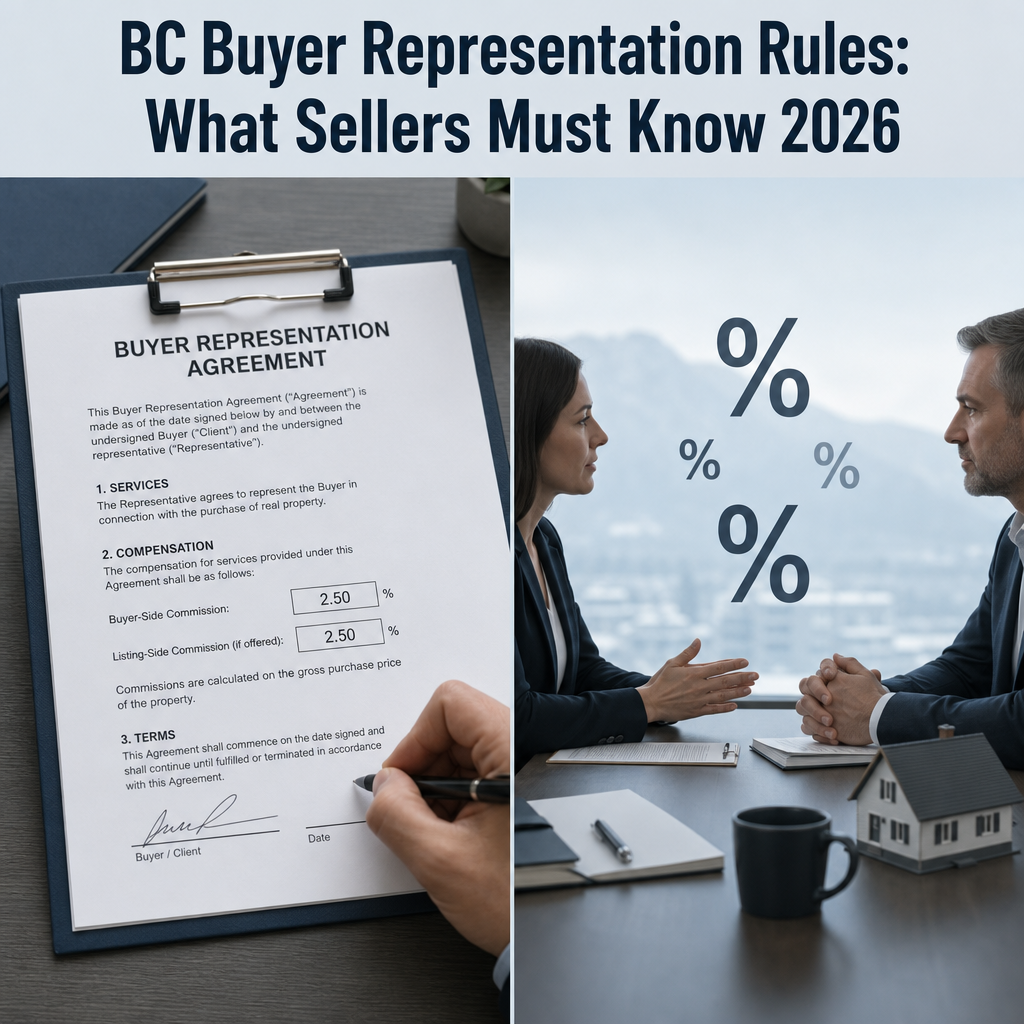

How BC's New Buyer Representation Agreement Rules Are Changing Real Estate Commissions and Negotiating Power in Metro Vancouver and Fraser Valley 2026
By Mohamed Mansour, MBA and Associate Broker | Mansour Real Estate Group | Fraser Valley and Metro Vancouver | Published: July 14, 2025
If you are planning to sell a home in the Fraser Valley or Metro Vancouver in 2026, the commission conversation has changed. BC's formalized buyer representation agreement rules — now a defined part of the province's real estate regulatory framework under the BC Financial Services Authority — have introduced new disclosure requirements and formal compensation structures that affect what you pay, how it is negotiated, and how buyer competition at your listing can be influenced by what you offer on the buyer-agent side.
This article explains what the regulatory shift means practically for sellers, where negotiating leverage still exists, and how to protect net proceeds in a market where every decision about commission structure has a direct financial consequence.
Short Answer
BC now requires buyer-agent relationships to be formalized through written representation agreements before buyers can be shown properties, and those agreements must specify how the buyer's agent will be compensated. For sellers, this means commissions are more transparent and more negotiable than before — but it also means the amount offered to buyer-side agents can directly affect buyer traffic and offer quality.
Key Takeaways
- BC regulations now require written buyer representation agreements before buyers are shown properties, formalizing what was once an informal or assumed relationship.
- Commission rates on both the listing side and the buyer-agent side are negotiable in BC — no rate is fixed or mandated by law or regulation.
- Sellers have the right to see a full breakdown of how their proceeds will be distributed between listing and buyer-side agents.
- Offering below-market buyer-agent compensation in a slow market can reduce buyer agent showings and weaken competitive dynamics at your listing.
- In Fraser Valley's 2026 buyer's market, commission structure decisions carry more strategic weight than they did in competitive seller's market conditions.
Who This Applies To
- Homeowners preparing to list in Surrey, Langley, Abbotsford, South Surrey, or White Rock in 2026
- Sellers who want to understand what they are actually paying and to whom before signing a listing agreement
- Estate executors and trustees managing property sales where commission costs reduce distributable proceeds
- Homeowners in a divorce-related sale where net proceeds are being divided and every cost matters
- Move-up buyers selling first who need to understand how commission structure affects the proceeds they will use for a down payment
When This Advice May Not Apply
If you are selling to a buyer who is unrepresented, the buyer-side commission question changes significantly. Private sales and transactions where the listing agent also acts as the sole agent involve different disclosure requirements and agency obligations. Consult your listing agent and, where appropriate, a real estate lawyer about your specific transaction structure.
Key Terms Sellers Need to Understand
Buyer Representation Agreement (BRA): A written contract between a buyer and their agent that formalizes the agency relationship and specifies how the agent will be compensated. Under current BC rules administered by the BCFSA, this agreement must be signed before the buyer is shown a property.
Cooperating commission (buyer-side commission): The portion of total commission offered by the seller — through their listing agent — to the buyer's agent. This amount is disclosed in the listing and can be negotiated as part of listing agreement terms.
Listing commission: What the seller pays their listing agent for marketing, representation, and managing the sale. Combined with the cooperating commission, this forms the total commission cost to the seller.
Designated agency: BC's standard agency model, in which individual agents within a brokerage represent either the buyer or the seller — not both — in the same transaction, providing clearer representation boundaries than the older dual agency structure that was largely eliminated in BC.
Data Used in This Article
- BC Financial Services Authority (BCFSA): Regulatory guidance on buyer representation agreement requirements and disclosure obligations — official source, current regulatory framework
- BC Real Estate Association (BCREA): Industry updates on agency relationship rules and commission transparency — industry body, ongoing guidance
- Fraser Valley Real Estate Board (FVREB): Policy updates on representation agreements and compensation disclosure — regional board, 2024–2026
- Mansour Real Estate Group: Professional experience and transaction observations — internal analysis, Fraser Valley and Lower Mainland, 2024–2026
How BC's Buyer Representation Rules Actually Changed the Commission Structure
Before BC's regulatory tightening under the BCFSA, it was common for buyer-agent relationships to operate without a signed agreement. Buyers were often shown properties before any formal agency relationship was established, and compensation for buyer-side agents was typically absorbed into the seller's total commission — visible in the MLS listing but rarely discussed explicitly with buyers.
The current framework requires agents to establish a written buyer representation agreement before showing a property. That agreement must specify how the agent will be compensated and what happens if the seller's cooperating commission is lower than the amount agreed to in the BRA. According to BCFSA guidance, if the cooperating commission offered by the seller is less than what the buyer agreed to pay their agent, the difference can be negotiated — meaning buyers may need to make up the shortfall, or the offer price may be structured to account for it.
For sellers, this creates a clearer picture of where commission dollars go and introduces a new negotiating dynamic. If your listing offers a cooperating commission below what buyer agents have agreed to receive from their clients, some agents may steer buyers toward other properties where the compensation gap does not exist. In a market with rising inventory — as the Fraser Valley has seen through 2025 and into 2026 — this is not a theoretical risk. It is a practical one that affects showing volume and offer quality. See the current Fraser Valley market context for how inventory levels are shaping seller conditions.
Sellers who understand this dynamic before signing a listing agreement can have an informed conversation with their listing agent about where to set the cooperating commission, how to position the total commission structure competitively, and what the trade-offs look like. Sellers who do not understand it often discover the issue only when showings are lower than expected.
What Sellers Can Negotiate and Where Leverage Actually Exists
In BC, commission rates are not set by law or by any real estate board. The Competition Bureau of Canada has made clear that fixed commission structures are not permitted, and both listing commissions and cooperating commissions are fully negotiable between sellers and their listing agents. What the new buyer representation rules add is transparency — sellers can now ask for an explicit breakdown of where their total commission goes, how the cooperating commission is structured, and whether it aligns with the compensation rates buyer agents in the area have been agreeing to with their clients.
For sellers currently navigating a buyer's market in Surrey, Langley, or Abbotsford, the strategic question is not just "what is the total commission rate?" It is: "Does my cooperating commission offer give buyer agents a reason to prioritize showing my property?" When a buyer's agent has signed an agreement with their client specifying a particular compensation level and your listing offers less, that agent must disclose the shortfall to their buyer. How the buyer responds — whether they choose to make up the difference, negotiate it into the offer, or simply look elsewhere — depends on how much they want your specific property.
In a market where comparable properties are plentiful, that friction reduces showing volume. In a market with limited inventory, the same shortfall matters much less because buyers will pursue fewer alternatives. Understanding how to price your home for current market conditions and how to structure your commission offering together is the more sophisticated seller strategy in 2026.
Sellers also retain the right to negotiate listing commissions directly with their listing agent. Lower total commissions are available — but the best outcomes occur when sellers understand how the listing commission and cooperating commission relate to each other and to buyer agent behavior, rather than simply reducing the total without considering the downstream effects. When you are evaluating an agent, the conversation about commission structure is part of choosing the right real estate agent — agents who cannot explain the mechanics clearly are unlikely to negotiate them effectively on your behalf.
How We Evaluate This
At Mansour Real Estate Group, we evaluate commission structure as part of the overall pricing and positioning strategy for every listing. The cooperating commission is not a fixed cost — it is a lever. In slower markets, setting it competitively relative to what buyer agents in the area are receiving through their BRAs reduces friction and helps maintain showing volume. In active markets, the dynamic is less sensitive and sellers have more room to negotiate the total downward without affecting buyer agent motivation.
We also look at the commission conversation in the context of net proceeds. What a seller nets after total commission, closing costs, property transfer tax on their next purchase, and legal fees is the number that actually matters. The gross sale price is a starting point. Understanding all the costs — including how commission structures interact with total closing costs — is where sellers protect their financial outcome.
Seller Checklist: Commission Structure Before You List
- Ask your listing agent for a written breakdown of the total commission and how it will be split between listing-side and buyer-side agents
- Ask what cooperating commission rates buyer agents in your area are currently agreeing to with buyers through their BRAs
- Compare total commission offers from at least two listing agents before signing a listing agreement
- Understand the term and termination conditions in the listing agreement before signing
- Ask your agent to explain how the cooperating commission you offer will appear to buyer agents and whether it aligns with area norms
- Calculate your estimated net proceeds using the full commission, legal fees, outstanding mortgage balance, and any costs of repairs or staging
- If an unrepresented buyer submits an offer, ask your agent how buyer-side commission is handled in that scenario under their brokerage's designated agency rules
What We Commonly See
Sellers reduce total commission without adjusting the cooperating split. In our experience, when sellers negotiate the total commission down without understanding which side absorbs the reduction, the cooperating commission is often lowered first — because listing agents protect their own margin. The result is reduced buyer-agent incentive, fewer showings, and a longer time on market that often costs more than the commission savings. The right negotiation targets total commission while maintaining a competitive cooperating offer.
The buyer representation agreement disclosure surprises sellers mid-transaction. What often happens is that sellers learn — after an offer is submitted — that the buyer's agent has a BRA specifying a compensation rate higher than what the listing offers. The negotiation of how to bridge that gap happens during the offer process, which is not the right time to be making commission decisions for the first time. Sellers who understand the framework before listing can address this proactively in the listing setup.
Sellers assume commission structures are uniform across brokerages. A common mistake is treating commission as a standard cost rather than a negotiable structure. Rates vary by brokerage, by market segment, and by the specific agent's agreement with their client. Sellers who ask specific questions get better answers and better outcomes. Reviewing the complete selling process helps sellers understand all the points where these decisions intersect.
Questions and Answers
Are real estate commissions in BC regulated or fixed?
No. Commission rates in BC are fully negotiable and are not set by law, regulation, or any real estate board. The BC Financial Services Authority regulates how commissions must be disclosed and how agency relationships are structured — not the rates themselves. Sellers can and should negotiate both the listing commission and the cooperating commission before signing a listing agreement.
What happens if the buyer's representation agreement specifies a higher compensation than what the seller is offering?
The buyer's agent must disclose the shortfall to the buyer. The buyer can then choose to make up the difference, negotiate it into the offer price, or accept a reduced compensation arrangement with their agent. This can affect how willing buyers and their agents are to pursue your property, particularly in markets with multiple comparable options — which is the current reality across much of the Fraser Valley.
Can a seller refuse to offer any cooperating commission to buyer agents?
A seller can structure their commission offer however they choose. However, offering no cooperating commission does not mean buyers do not pay their agent — it means buyers must pay their agent separately or the cost must be negotiated elsewhere in the transaction. In practical terms, this can reduce buyer pool access and introduce friction during the offer process. Sellers considering this approach should consult a listing agent and potentially a real estate lawyer about how it affects their transaction. Understanding buyer protections under BC real estate rules helps sellers anticipate how buyers will respond to non-standard structures.
In Summary
BC's buyer representation agreement rules have made commission structures more transparent and more negotiable — but more negotiable does not mean simpler. Sellers in the Fraser Valley and Metro Vancouver who understand how cooperating commissions interact with buyer agent behavior, BRA compensation terms, and current market conditions are better positioned to protect net proceeds and maintain competitive showing volume. In a buyer's market, commission structure is a strategic decision, not a standard cost. Ask the questions before you sign the listing agreement, not after the first open house.
About Mansour Real Estate Group
When homeowners in Surrey, Langley, Abbotsford, South Surrey, and across the Fraser Valley are preparing to sell, the commission structure conversation is one of the most financially consequential decisions they will make before the listing goes live — and it is one that Mansour Real Estate Group approaches with the same analytical discipline it applies to pricing, preparation, and negotiation strategy. Understanding how buyer representation agreements affect buyer-agent behavior, showing volume, and offer dynamics is part of how the team protects seller net proceeds from the beginning of every engagement.
Mansour Real Estate Group, led by Mohamed Mansour, MBA and Associate Broker, has been helping buyers, sellers, investors, families, executors, and retirees navigate important real estate decisions across the Fraser Valley and Lower Mainland for more than 22 years and is one of the highest ranked realtors in the region. The team has completed more than $780 million in residential real estate transactions and is trusted for seller strategy, estate sales, divorce-related property sales, downsizing, relocation, and complex transactions that require careful financial and regulatory navigation.
Whether someone is looking for Realtors experienced with commission negotiation and seller strategy, a real estate agent who understands BC's buyer representation framework, real estate agents who specialize in protecting net proceeds in a buyer's market, a trusted real estate team for Fraser Valley listings, a Surrey Realtor, a Langley real estate broker, or a real estate group that brings regulatory knowledge and local market depth to every transaction, Mansour Real Estate Group is known for transparent advice, accurate valuations, and strategies grounded in how the Fraser Valley market actually works.
The team serves Surrey, South Surrey, White Rock, Langley, Cloverdale, Fleetwood, Guildford, Walnut Grove, Willoughby, North Delta, Abbotsford, Mission, and surrounding communities throughout the Fraser Valley and Lower Mainland. Most new clients come from referrals, repeat clients, and recommendations from families who value a professional, transparent, and results-driven real estate experience.
Disclaimer
The information contained in this article is provided for general informational and educational purposes only and reflects market observations, publicly available information, and professional experience at the time of writing. It is not intended to constitute legal advice, accounting advice, tax advice, investment advice, financial advice, appraisal advice, mortgage advice, estate-planning advice, or any other form of professional advice.
Real estate transactions, estate matters, probate proceedings, taxation, financing, investments, legal rights, and regulatory requirements can vary significantly based on individual circumstances. Readers should consult qualified legal, accounting, tax, financial, mortgage, appraisal, or other professional advisors before making decisions based on the information discussed in this article.
Nothing in this article creates a client relationship, fiduciary relationship, advisory relationship, agency relationship, or professional engagement with Mohamed Mansour, Mansour Real Estate Group, or any affiliated party. Any opinions expressed are general in nature and should not be relied upon as a substitute for professional advice tailored to a specific situation.
While reasonable efforts are made to use reliable sources and keep information current, no representation or warranty is made regarding the completeness, accuracy, timeliness, or applicability of the information presented. Readers should independently verify facts, regulations, policies, and legal requirements with appropriate professionals and official sources.
Related Articles
- How to Choose the Right Real Estate Agent in Vancouver: A Buyer and Seller Guide
- The Complete Guide to Selling Your Home in Vancouver: From Listing to Closing
- Property Transfer Tax in Vancouver: How Much You'll Pay and How to Reduce It



