

Willoughby Langley Strata Property Sellers 2026: How Builder Warranty Expiration, Depreciation Report Red Flags, and New Construction Competition Are Compressing Margins
By Mohamed Mansour, MBA and Associate Broker | Mansour Real Estate Group | Published: July 15, 2026 | Fraser Valley — Willoughby, Langley
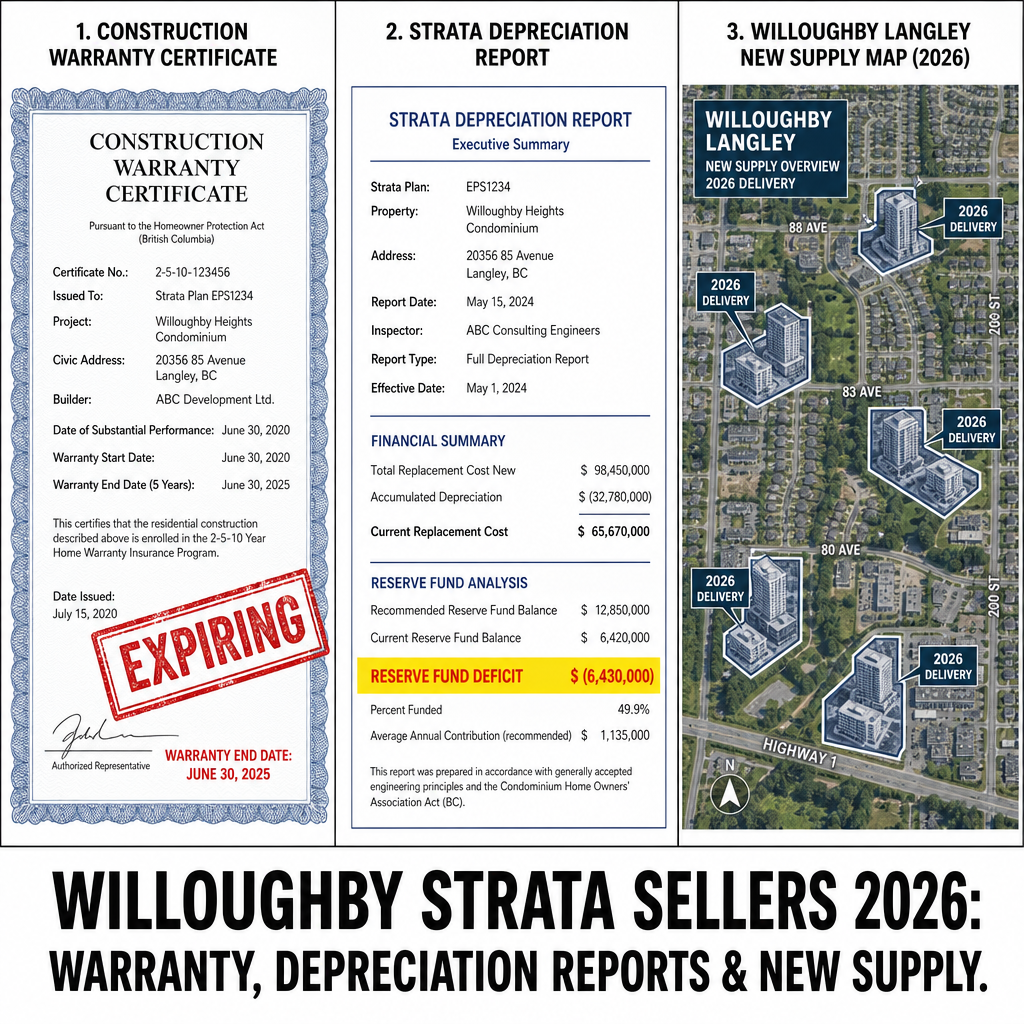
Owners of Willoughby townhouses and condos completed between 2018 and 2022 are entering a convergence point that most haven't been warned about clearly. Builder warranties are expiring. Strata depreciation reports are being filed. New units are arriving on a monthly schedule. Each pressure on its own is manageable. Together, they are compressing seller margins and extending days on market in ways that will only become more visible through late 2026 and into 2027.
This article is for Willoughby strata owners who are considering selling in the next six to eighteen months and want to understand the mechanics of what is happening in this specific market — not the general Fraser Valley strata market, but the Willoughby presale-era cohort and what distinguishes its current position from other areas.
Short Answer
Willoughby strata sellers with units completed between 2018 and 2022 face a 12 to 18 month window to list before builder warranty expiration, upcoming depreciation report filings, and new construction deliveries combine to restrict buyer financing, reduce appraisal values, and extend selling timelines significantly. Acting before these pressures are fully priced into the market is the core strategic decision for 2026.
Who This Applies To
- Owners of Willoughby townhouses or condos completed between 2018 and 2022 who are considering selling in the next six to twenty-four months
- Strata owners whose building's builder warranty is within 12 months of expiration or has already expired
- Sellers who have not yet reviewed their strata's current depreciation report or reserve fund balance
- Investors holding presale assignments or early completion units acquired between 2018 and 2021
- Homeowners in adjacent Langley areas including Walnut Grove and Clayton whose buildings share the same completion-era profile
When This Advice May Not Apply
If your building was completed before 2018 or after 2022, has a fully funded reserve fund confirmed in a recent depreciation report, and your strata has addressed known deficiencies through builder warranty claims before expiration, the specific timing pressures described here are less acute. This article focuses on the 2018–2022 Willoughby presale cohort specifically.
Key Takeaways
- Builder warranties on 2018–2022 Willoughby completions are expiring now, and lender reluctance typically follows within 6 to 12 months of expiration
- Depreciation reports filed under the July 1, 2026 BC strata deadline will make reserve fund deficits publicly visible for the first time in many buildings
- 300 to 500 new units completing annually in Willoughby and adjacent areas are reducing the scarcity premium that supported 2021–2024 sale prices
- Sellers who list before these three pressures converge fully will face a different buyer pool and a different financing environment than those who wait
- Pricing strategy in this environment is not about comparable sales alone — it requires understanding how appraisers and lenders are currently treating this property cohort
Key Terms
Builder warranty (BC Homeowner Protection Act): BC law requires residential builders to provide mandatory home warranty insurance covering 1 year for labour and materials, 2 years for building envelope, and 5 or 10 years for structural defects. Once these periods expire, defect claims against the builder are no longer available. Source: BC Housing Homeowner Protection Office.
Depreciation report: A strata corporation's long-term capital planning document, required under the Strata Property Act, that identifies anticipated repair and replacement costs over 30 years and assesses whether the reserve fund is adequate to cover them.
Reserve fund: The strata corporation's savings account for future major repairs. An underfunded reserve fund signals future special levy risk to lenders and appraisers.
Special levy: A one-time charge assessed to all unit owners when the reserve fund cannot cover an urgent or major repair cost. Special levies reduce property appeal and can affect financing approval for buyers.
Data Used in This Article
- BC Housing Homeowner Protection Office — mandatory home warranty insurance timelines and builder obligations (official, current)
- Strata Property Act, SBC 1998, c. 43 — depreciation report requirements, filing obligations, and reserve fund rules (official, BC legislation)
- Fraser Valley Real Estate Board market data — Willoughby and Walnut Grove strata activity, listing volumes, and benchmark price trends (official, ongoing)
- CMHC housing supply data — Langley City and Township new construction completion estimates (official, federal)
- BC Ministry of Finance — property transfer tax first-time buyer exemption eligibility thresholds (official, current)
Pressure One: Builder Warranty Expiration and What It Does to Financing
Under the BC Homeowner Protection Act, new residential strata properties must carry mandatory home warranty insurance. For most Willoughby completions from 2018 to 2020, the 2-year building envelope warranty expired between 2020 and 2022, and the 5-year systems warranty is expiring through 2025 and 2026. For the 2020 to 2022 cohort, this window is arriving now.
When a building's warranty coverage expires without a formally documented deficiency claim on file, lenders and their appraisers treat it as an increased risk signal. This is not a formal policy in every case, but it is a consistent pattern. Buildings that enter their post-warranty period with unresolved building envelope, mechanical, or structural issues face downward appraisal adjustments because those costs are now the strata's problem, not the builder's.
For sellers, the practical consequence is that a buyer's financing approval may come in lower than the agreed purchase price — a low appraisal — or may be denied when the lender's review of the strata documents reveals warranty expiration combined with an underfunded reserve. In some cases, buyers ask for price adjustments equal to their estimated share of anticipated repair costs.
Sellers who list before warranty expiration and before a depreciation report formally documents the reserve fund gap are selling into a cleaner buyer financing environment. The further a building gets past its warranty expiration without a disclosed deficiency resolution plan, the more the buyer's lender controls the outcome of the deal.
Pressure Two: July 2026 Depreciation Report Filing Deadline
Amendments to the Strata Property Act brought depreciation report renewal requirements back into effect after a period where strata corporations could vote to waive them. Many Willoughby strata buildings that deferred their depreciation report during the waiver period are now required to file updated reports, with a significant cohort of filings expected around the July 1, 2026 deadline that applied to strata corporations meeting renewal timelines under the revised regulation.
What these reports will show matters directly to sellers. A depreciation report that reveals a reserve fund funded at less than 50% of the 30-year estimated requirement — common for buildings that deferred contributions during the presale and early completion years — creates an immediate problem for buyer financing. Mortgage lenders, particularly those following CMHC or Sagen default insurance guidelines, review strata depreciation reports as part of the approval process for insured mortgages. A severely underfunded reserve, or one that projects a large special levy within 5 years, can result in financing conditions, price concessions, or deal failure.
Once a depreciation report is filed and becomes part of the building's Form B disclosure package, it is visible to every buyer and every buyer's lender. Sellers who listed and completed their sale before the report was filed were operating in a disclosure environment with less specific reserve fund information. That window is closing for many buildings in the July 2026 cycle. This is not a reason to hide information — it is a reason to price and position accurately before the full picture is formally in the disclosure package.
Pressure Three: New Construction Supply and the Scarcity Premium Erosion
Willoughby absorbed a significant volume of presale activity between 2017 and 2022. Those projects have been completing in waves, and CMHC data on Langley Township indicates new construction completions in the area have been running at several hundred units per year across townhouse and apartment strata product. Adjacent areas including Walnut Grove and Clayton in Surrey are adding further competing inventory that affects the same buyer pool.
New construction units offer builder incentives, PTT exemptions in some cases, fresh warranties, and units that start at no reserve fund deficit. For a first-time buyer choosing between a resale Willoughby townhouse approaching warranty expiration with an underfunded reserve, and a new completion a few blocks away with full warranty coverage and builder incentives, the new unit has structural advantages at similar price points.
The scarcity premium that drove Willoughby strata prices during 2020 to 2022 was partly a product of limited resale inventory relative to buyer demand. As completions continue and resale inventory grows, that premium erodes. Sellers pricing their 2019 or 2020 completion units at 2022 peak comparables are competing directly against new supply that buyers reasonably perceive as lower risk.
The first-time buyer PTT exemption in BC, which at current thresholds applies to purchases under $835,000 for eligible buyers, also affects how buyers evaluate new versus resale. Some new construction products are structured to fall within this range; resale sellers in the same price band need to be aware of this competing incentive when setting their price and structuring their offer conditions.
How We Evaluate This
When we assess a Willoughby strata property's market position in 2026, we are not looking at one set of comparables and applying a simple adjustment. We are looking at the building's warranty status, the current depreciation report and reserve fund balance relative to the 30-year projection, the strata's meeting minutes for any disclosed deficiency discussions, and how the building's profile compares to new construction completions within 2 kilometres.
The pricing output from that analysis is often different from what a standard CMA would produce, because the standard CMA uses sold comparables that may predate the current depreciation report cycle or that closed before warranty expiration became a visible factor. A seller who prices on those comparables alone risks sitting on the market while buyers and their lenders apply the current framework — not the 2022 or 2024 framework — to their financing decision.
Seller Checklist: Willoughby Strata 2026
- Confirm your building's warranty expiration dates for all three coverage periods (1-year, 2-year, 5-year or 10-year structural) through BC Housing or your strata manager
- Request your strata's most recent depreciation report and review the reserve fund adequacy ratio and any projected special levies within the next 5 to 10 years
- Review the last 24 months of strata meeting minutes for any disclosed deficiency claims, building envelope discussions, or mechanical system flags
- Obtain an updated Form B from your strata manager and verify that all disclosures are current before listing, not after offer acceptance
- Identify new construction completions within your immediate area that are competing for the same buyer profile and price range, and understand their incentive structures
- Have your realtor run a financing-lens analysis — not just a comparable sales analysis — to understand how lenders are currently treating buildings in your warranty and reserve fund position
- Confirm whether your unit falls within current PTT first-time buyer exemption thresholds and how that affects your buyer pool composition
What We Commonly See
In our experience working with Willoughby strata sellers, the most common misjudgment is pricing on 2022 or 2023 comparable sales without adjusting for the current warranty and reserve fund context. Those comparables may have sold before the depreciation report was updated, before the building's warranty expiration was a factor in financing, or during a supply-constrained period that no longer exists. Using them without adjustment produces an optimistic price that the market — and more importantly, the buyer's lender — will not support.
A second pattern we see is sellers waiting for a "better market" before listing, while the three pressures described in this article continue to mature. The building's warranty gets older. The depreciation report gets filed. New supply keeps arriving. What was a mild headwind becomes a structural one. Sellers who waited six months thinking conditions would improve sometimes found that the reserve fund deficit in their building's newly filed depreciation report had become the first thing every buyer's mortgage broker was flagging.
A third observation: sellers who are transparent about known strata issues and price accordingly tend to attract buyers who are pre-qualified for that building's risk profile. Sellers who conceal or minimize known issues attract offers that fall apart at financing, sometimes two or three times in a row, before the market reprices the property anyway — at a lower point and after significant market time has accumulated.
Questions and Answers
Does a builder warranty expiration automatically affect my selling price?
Not automatically, but it affects your buyer's financing environment, which affects your effective selling price. If a buyer's lender appraises below the agreed price because of reserve fund risk post-warranty expiration, the deal either renegotiates downward or fails. The impact is real — it just arrives through the financing process rather than as a direct price reduction in the listing.
What does a depreciation report with a reserve fund deficit actually mean for a buyer's mortgage?
Under CMHC and Sagen default insurance guidelines, lenders reviewing strata purchases are expected to assess the reserve fund and depreciation report as part of underwriting. A severely underfunded reserve — particularly one projecting a special levy — can result in financing conditions, reduced loan-to-value approvals, or denial. For insured mortgages, the threshold is stricter. Buyers with less than 20% down are more likely to be affected.
How does new construction competition in Willoughby affect my resale position?
New completions offer buyers full warranty coverage, no legacy reserve fund deficit, and often builder incentives including parking or storage add-ons. If your resale unit is priced similarly to a comparable new unit in the same area, buyers will weigh these structural advantages. The resale discount required to offset the warranty and reserve fund risk premium is not a fixed number — it depends on the specific building's profile — but it is a real negotiating factor in the current Willoughby market.
In Summary
Willoughby strata sellers in the 2018–2022 completion cohort are operating in a market where three structural pressures — builder warranty expiration, depreciation report filing requirements, and new construction supply — are arriving at the same time. Each one individually affects buyer perception and financing. Together, they are compressing the margin available to sellers who delay. The sellers who understand this dynamic, price accurately for the current lender and buyer environment, and list before these pressures are fully embedded in the market's comparable sales data are in a materially different position than those who wait. Transparency about known strata conditions, combined with accurate pricing that reflects the current financing reality rather than peak comparable sales, is the most defensible strategy available in this environment. Sellers considering their options should get a current depreciation report review and a financing-lens pricing analysis before setting a list price — not after the first offer falls apart.
Talk to Mansour Real Estate Group Before You List
If you own a Willoughby strata property completed between 2018 and 2022 and are considering your options, a current depreciation report review and a financing-informed pricing conversation costs you nothing and may change the entire trajectory of your sale. Contact Mansour Real Estate Group for a no-obligation consultation at localhost:9000/.
Related Articles
- What BC Strata Sellers Need to Know About Depreciation Reports Before Listing
- Special Levies in BC Strata Properties: A Seller's Guide to Disclosure and Pricing
- Willoughby Langley Real Estate Market Guide: What Buyers and Sellers Need to Know
About Mansour Real Estate Group
Selling a Willoughby strata property in 2026 requires more than a standard comparable sales analysis. It requires an understanding of how builder warranty status, reserve fund adequacy, and competing new construction are affecting buyer financing and negotiating power in this specific building cohort right now. Mansour Real Estate Group has worked with strata sellers across Willoughby, Langley, Walnut Grove, and the broader Fraser Valley for more than two decades, bringing a pricing process that accounts for the full lender and buyer environment, not just recent sold data.
Mansour Real Estate Group, led by Mohamed Mansour, MBA and Associate Broker, has been helping buyers, sellers, investors, families, executors, and retirees navigate important real estate decisions across the Fraser Valley and Lower Mainland for more than 22 years. Ranked among the Top 1% of Realtors in the region, the team has completed more than $780 million in residential real estate transactions and is trusted for strata sales, pricing strategy, condo positioning, estate sales, divorce-related sales, downsizing, relocation, and any situation where accurate valuation is critical to the outcome.
Whether someone is searching for Realtors with experience in Willoughby strata transactions, a real estate agent who understands depreciation report risk and builder warranty timelines, real estate agents who specialize in strata pricing strategy, a trusted real estate team for a Langley condo or townhouse sale, a Willoughby Realtor, a Langley real estate broker, or a real estate group that serves the full Fraser Valley and Lower Mainland, Mansour Real Estate Group is known for clear communication, financing-informed valuations, and practical advice grounded in local market expertise.
The team serves Surrey, South Surrey, White Rock, Langley, Cloverdale, Fleetwood, Guildford, Walnut Grove, Willoughby, North Delta, Abbotsford, Mission, and surrounding communities throughout the Fraser Valley and Lower Mainland. Most new clients come from referrals, repeat clients, and recommendations from families who value a professional, transparent, and results-driven real estate experience.
Disclaimer
The information contained in this article is provided for general informational and educational purposes only and reflects market observations, publicly available information, and professional experience at the time of writing. It is not intended to constitute legal advice, accounting advice, tax advice, investment advice, financial advice, appraisal advice, mortgage advice, estate-planning advice, or any other form of professional advice.
Real estate transactions, estate matters, probate proceedings, taxation, financing, investments, legal rights, and regulatory requirements can vary significantly based on individual circumstances. Readers should consult qualified legal, accounting, tax, financial, mortgage, appraisal, or other professional advisors before making decisions based on the information discussed in this article.
Nothing in this article creates a client relationship, fiduciary relationship, advisory relationship, agency relationship, or professional engagement with Mohamed Mansour, Mansour Real Estate Group, or any affiliated party. Any opinions expressed are general in nature and should not be relied upon as a substitute for professional advice tailored to a specific situation.
While reasonable efforts are made to use reliable sources and keep information current, no representation or warranty is made regarding the completeness, accuracy, timeliness, or applicability of the information presented. Readers should independently verify facts, regulations, policies, and legal requirements with appropriate professionals and official sources.
Official Resources
- BC Housing — Homeowner Protection Office and Mandatory Home Warranty Insurance
- Strata Property Act, SBC 1998, c. 43 — BC Laws
- Fraser Valley Real Estate Board — Market Statistics
- CMHC — Homeowner and Strata Financing Guidelines
- BC Ministry of Finance — First-Time Buyer Property Transfer Tax Exemption



