
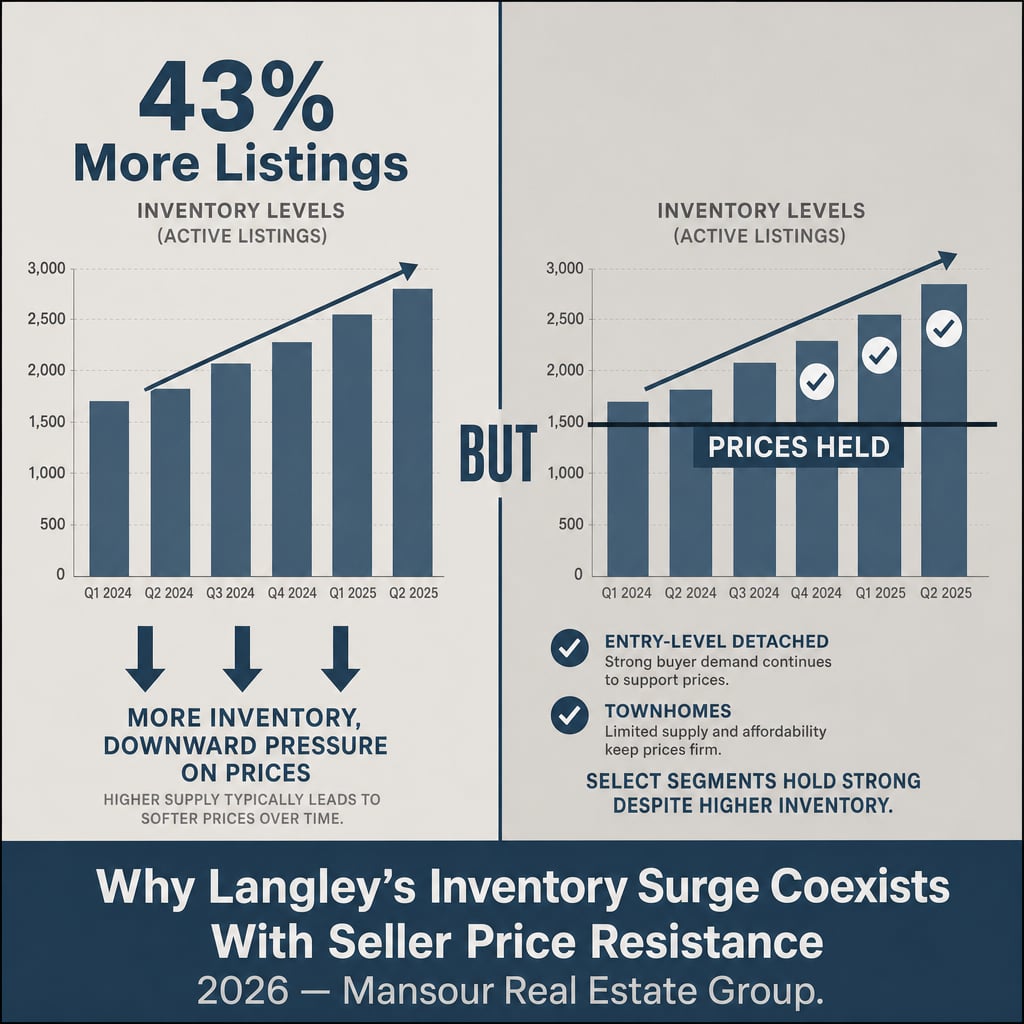

Why Langley's 43% Inventory Surge Coexists With Seller Price Resistance: Decoding the Paradox When Year-Over-Year Sales Recovery Masks Segment-Level Market Divergence in 2026
By Mohamed Mansour, MBA and Associate Broker | Mansour Real Estate Group | Fraser Valley and Lower Mainland | Published: July 28, 2026 | Geographic Focus: Langley, BC
Langley's spring 2026 market looks like a textbook buyer's market on paper. Active listings have surged roughly 43% above recent norms, the sales-to-active listings ratio sits between 8% and 11%, and benchmark prices for detached homes, townhomes, and condos are all posting year-over-year declines. Buyers expecting wide-open negotiating room have arrived with that framework in mind.
What they are finding on the ground is more complicated. Correctly-priced properties in certain segments are still selling near asking price. Entry-level detached homes and three-bedroom townhomes are moving faster than the headline inventory number would suggest. And sellers in those segments are not capitulating. Understanding why requires looking past the aggregate data and into the specific segments where supply, demand, and pricing discipline are behaving very differently.
Short Answer
Langley's elevated inventory has not produced uniform price pressure because the market is segmented, not unified. Entry-level detached homes and townhomes remain competitive enough that correctly-priced sellers retain negotiating leverage. Luxury detached properties and condos face genuine buyer advantage. Calling Langley a buyer's market or a seller's market without specifying the segment and price band produces the wrong strategy every time.
Who This Applies To
- Langley homeowners preparing to list in 2026 who are unsure how to price relative to elevated inventory
- Buyers in Langley trying to assess how much negotiating room they realistically have
- Sellers of detached homes in the $700K–$1.2M range navigating competing listings without overreacting
- Condo owners evaluating whether to sell now or wait given soft buyer demand
- Anyone using aggregate market reports to make property-type-specific pricing decisions
When This Advice May Not Apply
Sellers of luxury detached properties above $1.5M, older condos with known strata issues, or properties requiring significant work face a genuinely different market and should not assume entry-level pricing dynamics apply to their situation. The segment-level distinctions in this article are meaningful — generalizing across them will produce the wrong result.
Key Takeaways
- Langley's 43% inventory surge has created three distinct micro-markets, not one unified buyer's market
- April 2026 marked the first year-over-year sales increase in 12 months, confirming that demand has stabilized
- Entry-level detached homes under $800K and townhomes carry 15–23% sales-to-active ratios — closer to balanced conditions
- Condos and luxury detached properties above $1.5M sit in genuine buyer's market territory with days on market exceeding 50
- Sellers who price correctly are still selling near asking; sellers who price to test the market are building the inventory number that makes headlines
Data Used in This Article
- Fraser Valley Real Estate Board — February, June, and July 2026 Statistics Packages (Official board data; benchmark prices, sales-to-active ratios, days on market by property type)
- Amanda Thomas — Langley Real Estate Market January 2026 Analysis (Third-party market commentary based on December 2025 data; inventory levels, pricing observations, market characterization)
- Mansour Real Estate Group — Internal market analysis (Professional interpretation of FVREB data applied to Langley segments and price bands)
Why Aggregate Market Labels Mislead Sellers and Buyers Equally
The Fraser Valley Real Estate Board's statistics packages for February through July 2026 show Langley's sales-to-active listings ratio consistently in the 8–11% range. In most market frameworks, any ratio below 12% signals buyer's market conditions — meaning buyers have negotiating advantage and sellers should expect concessions.
That framework is accurate at the aggregate level. It becomes misleading the moment a buyer or seller tries to apply it to a specific property. A condo in a 25-year-old building with unresolved strata levy exposure and a days-on-market figure approaching 60 days is operating in a very different environment than a four-bedroom detached home in Willoughby priced at $899,000 with three offers in the first week.
The aggregate number averages those two realities together and produces a ratio that accurately describes neither of them. This is the core of the paradox: Langley has elevated inventory, but that inventory is not distributed evenly across segments. Overpriced listings and harder-to-sell property types are accumulating on the active list. Correctly-priced properties in competitive segments are turning over quickly and barely touching the inventory count.
The result is a headline inventory number that signals soft demand, coexisting with on-the-ground pricing behaviour that signals something much more selective and strategic. For Langley sellers navigating 2026's shifting conditions, understanding which segment they are in is the first and most consequential decision of the listing process.
The Three Micro-Markets Inside Langley's Inventory Surge
Days-on-market data from the FVREB's 2026 statistics packages reveals a gap of 60–80% between property types. Detached homes in competitive price ranges are selling in roughly 25 days. Condos are averaging 50 days or more. Townhomes sit between those poles, with faster movement concentrated in the three-bedroom, side-by-side garage configuration that draws the most consistent buyer demand. These are not minor statistical variations — they represent three fundamentally different buyer pools, financing realities, and pricing dynamics operating under the same Langley market umbrella.
Segment one: entry-level detached and mid-range townhomes. Properties priced under $800K for detached homes and mid-range townhomes in Langley's most in-demand configurations are carrying sales-to-active ratios in the 15–23% range. That puts them in or near balanced market territory despite the aggregate buyer's market classification. Buyers migrating from Metro Vancouver, particularly from Surrey, Burnaby, and Coquitlam, are still finding value at these price points relative to what they left behind. Sellers in this segment who price accurately are not watching their listings sit.
Segment two: luxury detached above $1.5M. The buyer pool for Langley's upper tier is thin relative to supply. These properties require buyers who are not interest-rate sensitive in the same way as entry-level purchasers, but they are still influenced by broader market confidence. Days on market for this segment runs well above the detached average, and sellers who have priced aspirationally rather than analytically are a significant contributor to the inventory surge. This is where buyer advantage is most real and most exploitable.
Segment three: condos. Strata fee sensitivity, special levy risk, and building age concerns are suppressing buyer demand in Langley's condo market more than any other factor. A buyer evaluating a condo must account for monthly strata fees, the contents of the depreciation report, any known or pending special levies, and the long-term maintenance trajectory of the building. That decision complexity slows buying timelines and reduces the pool of committed buyers at any given moment. Sellers in this segment face the longest marketing periods and the greatest price sensitivity. For buyers using Langley's inventory surplus strategically, the condo segment is where the most negotiating room exists right now.
Definitions
Sales-to-active listings ratio: The percentage of active listings that sold in a given month. Below 12% generally favours buyers; above 20% generally favours sellers; 12–20% is considered balanced.
Benchmark price: The FVREB's measure of a typical property's price in a given area and property type, adjusted for features. Different from median or average price.
Depreciation report: A mandatory document for most BC strata corporations that estimates the cost of future repairs and maintenance over 30 years. Material to condo purchase decisions.
Special levy: A one-time charge to strata unit owners to fund a major repair or capital expense not covered by the strata's contingency reserve fund.
How We Evaluate This
When Mansour Real Estate Group assesses Langley market conditions for a seller, the aggregate FVREB statistics are the starting point, not the conclusion. We isolate the specific property type, the price band, the neighbourhood, and the competing active listings before forming a pricing recommendation. A seller in Willoughby with a detached home at $925,000 is not operating in the same market as a seller with a 15-year-old condo in Langley City at $489,000. Treating them as though the same market dynamics apply produces the wrong price and the wrong expectations.
The April 2026 year-over-year sales increase — the first in 12 months according to FVREB data — confirms that underlying demand exists. The question is not whether buyers are present. The question is which segments those buyers are targeting, what they are willing to pay relative to listed price, and what conditions will move them from interest to offer. That analysis is segment-specific every time.
Why Sellers Are Holding on Price — and When That Strategy Works
Price resistance from Langley sellers in 2026 is not irrational. In the entry-level detached and townhome segments, sellers have evidence that correctly-priced homes still move. Amanda Thomas's January 2026 market analysis characterizes this explicitly as a "know-what-you-do market" — meaning that execution quality, not market conditions alone, determines outcomes. Sellers who have done the preparation work, priced to current comparables rather than peak-year sold data, and presented the property well are experiencing a different market than the aggregate numbers suggest.
Where price resistance becomes a liability is in segments where the buyer pool cannot support the seller's number regardless of presentation quality. A luxury detached home in Langley priced above $1.6M is competing for a buyer who has likely seen similar or superior properties across White Rock, South Surrey, and even the Tri-Cities at comparable price points. The seller's resistance in that segment is not disciplined pricing — it is price anchoring to a market that no longer exists at that volume.
The practical test for whether seller price resistance is strategic or costly: how many qualified showings has the property had in its first 21 days? If a correctly-prepared property in a competitive segment is not generating showings at the listed price, the price is the problem. If it is generating showings but not offers, the price may be marginally high or the presentation needs work. If it is generating offers and the seller is holding firm on terms, that is genuine leverage — and it exists in Langley right now, but only in specific segments and price bands.
Seller Checklist
- Identify your segment precisely: detached entry-level, mid-range townhome, luxury detached, or condo — each has a different market reality in Langley right now
- Pull your segment's specific sales-to-active ratio from the most recent FVREB statistics package, not the aggregate Langley number
- Compare your price to sold comparables from the last 60 days, not 90–120 days — the market has shifted enough that older solds overstate value in most segments
- Count competing active listings within 5% of your asking price in your neighbourhood — that number tells you more than any board report about your real competition
- Set a showing threshold: if you have not had a minimum of 4–6 qualified showings in the first 14 days, review pricing before extending the listing
- If selling a condo, obtain your depreciation report and strata financials before listing — buyers will ask, and delays create doubt
What We Commonly See
Sellers benchmarking against the wrong sold data. In our experience, sellers in Langley's current market frequently anchor their price expectations to comparable sales from late 2024 or early 2025 — periods when benchmark prices were meaningfully higher. Those comps are no longer reflective of what buyers are paying. Using them produces a list price that feels justified to the seller but looks overpriced to every buyer reviewing current competition.
Buyers applying luxury market logic to entry-level segments. What often happens is that buyers who have read the aggregate market headlines arrive at entry-level detached or townhome showings expecting significant concessions. In those segments, the negotiating room is narrower than the headline buyer's market label implies. Buyers who lowball correctly-priced properties in competitive segments lose them — and then spend months waiting for another comparable listing that may not come at a lower price.
Overpriced listings inflating the inventory number and distorting market perception. A common dynamic in elevated-inventory markets is that a meaningful portion of active listings are properties that were priced incorrectly at launch and never adjusted. They remain on the active list, age, and eventually either reduce significantly or expire. This inventory creates the appearance of a softer market than the transactable inventory supports. When those listings are filtered out and only realistically-priced active listings are counted, the true available supply for motivated buyers is lower than the headline number suggests.
Questions and Answers
Does Langley's 43% inventory surge mean sellers should reduce their price expectations significantly?
Not uniformly. Sellers in entry-level detached and townhome segments face competitive conditions that support accurate pricing without deep discounting. Sellers of luxury detached homes above $1.5M and older condos face genuine buyer advantage and should calibrate expectations accordingly. The answer depends on which segment you are in, not on the aggregate inventory number.
Why did Langley's year-over-year sales increase in April 2026 if inventory is near decade highs?
Demand recovery and elevated inventory are not mutually exclusive. According to FVREB data, April 2026 marked the first year-over-year sales increase in 12 months, indicating that buyer activity has stabilized. Much of the inventory growth reflects listings that are not transacting — overpriced properties and slower segments — rather than a market where buyers have disappeared.
What is the biggest risk for a Langley condo seller in 2026?
Strata-related buyer concerns — particularly special levy risk and depreciation report findings — are extending days on market for condos significantly. A condo seller who cannot provide clear, current strata financials and a clean depreciation report faces a narrowed buyer pool from the outset. Preparing and disclosing this documentation proactively reduces the risk of deals falling apart after subject removal.
In Summary
Langley's 2026 market is not a buyer's market. It is not a seller's market. It is a segmented market where the correct strategy depends entirely on property type, price band, and neighbourhood. The 43% inventory surge is real, but it is concentrated in segments and price points where buyer demand cannot absorb current supply. In the segments where demand is present — entry-level detached, well-configured townhomes — sellers who price accurately retain meaningful leverage. The paradox resolves when you stop reading aggregate data and start reading segment data.
Thinking About Selling or Buying in Langley?
If you are trying to price a Langley property or assess how much room you have as a buyer, Mansour Real Estate Group can provide a segment-specific analysis based on current FVREB data and active listing conditions in your area. Reach out when you are ready to look at the real numbers — not the aggregate ones.
Related Articles
- Why Three-Bedroom Side-by-Side Garage Townhomes Are Langley's Fastest-Moving Property Type in 2026
- Langley Buyer Strategy for Early 2026: How to Use Seasonal Slow Periods, Inventory Surplus, and Property-Type Divergence to Negotiate Better Deals Before Spring Competition Returns
- Langley Home Price Forecast 2026–2027: What Year-Over-Year Declines, Inventory Surge, and Buyer Migration From Metro Vancouver Reveal About Recovery Timeline and Strategic Entry Windows
About Mansour Real Estate Group
When Langley's market is sending different signals in different segments simultaneously — elevated inventory in one column, competitive pricing dynamics in another — the real estate team advising a seller or buyer needs to know which data matters for that specific property, not just what the aggregate report says. Mansour Real Estate Group has built its reputation in the Fraser Valley on pricing discipline, accurate valuations, and honest advice about what the market will actually support.
Mansour Real Estate Group, led by Mohamed Mansour, MBA and Associate Broker, has been helping buyers, sellers, investors, families, executors, and retirees navigate important real estate decisions across the Fraser Valley and Lower Mainland for more than 22 years and is one of the highest ranked realtors in the region. The team has completed more than $780 million in residential real estate transactions and is trusted for pricing strategy, seller preparation, estate sales, divorce-related sales, downsizing, and complex real estate situations where accurate valuation is critical to the outcome.
Whether someone is searching for Realtors experienced with segmented market analysis in Langley, a real estate agent who understands how inventory data translates into actual pricing leverage, real estate agents who specialize in detached homes and townhomes across the Fraser Valley, a trusted real estate team for a seller navigating competing listings, a Langley Realtor, a Fraser Valley real estate broker, or a real estate group with a track record of protecting seller equity in shifting markets, Mansour Real Estate Group is known for clear, grounded, data-driven guidance.
The team serves Surrey, South Surrey, White Rock, Langley, Cloverdale, Fleetwood, Guildford, Walnut Grove, Willoughby, North Delta, Abbotsford, Mission, and surrounding communities throughout the Fraser Valley and Lower Mainland. Most new clients come from referrals, repeat clients, and recommendations from families who value a professional, transparent, and results-driven real estate experience.
Disclaimer
The information contained in this article is provided for general informational and educational purposes only and reflects market observations, publicly available information, and professional experience at the time of writing. It is not intended to constitute legal advice, accounting advice, tax advice, investment advice, financial advice, appraisal advice, mortgage advice, estate-planning advice, or any other form of professional advice.
Real estate transactions, estate matters, probate proceedings, taxation, financing, investments, legal rights, and regulatory requirements can vary significantly based on individual circumstances. Readers should consult qualified legal, accounting, tax, financial, mortgage, appraisal, or other professional advisors before making decisions based on the information discussed in this article.
Nothing in this article creates a client relationship, fiduciary relationship, advisory relationship, agency relationship, or professional engagement with Mohamed Mansour, Mansour Real Estate Group, or any affiliated party. Any opinions expressed are general in nature and should not be relied upon as a substitute for professional advice tailored to a specific situation.
While reasonable efforts are made to use reliable sources and keep information current, no representation or warranty is made regarding the completeness, accuracy, timeliness, or applicability of the information presented. Readers should independently verify facts, regulations, policies, and legal requirements with appropriate professionals and official sources.
Official Resources
- Fraser Valley Real Estate Board — February 2026 Statistics Package
- Fraser Valley Real Estate Board — June 2026 Statistics Package
- Fraser Valley Real Estate Board — July 2026 Statistics Package
- <a href="https://www.facebook.com/61573771900428/posts/langley-real-estate-market-january-2026-based-on-december-2025-datathis-is-no-lo/122
Key Takeaways
- Strategic location selection can significantly impact long-term property value appreciation.
- Understanding local market trends helps inform better investment decisions.
- Professional inspections and appraisals are essential before any purchase.
- Working with experienced real estate agents provides valuable market insights.
Conclusion
Whether you're a first-time homebuyer or an experienced investor, success in real estate requires careful planning, research, and professional guidance. By staying informed about market conditions, understanding your financial capacity, and making decisions based on thorough analysis rather than emotion, you can position yourself for long-term success in the real estate market.
The real estate landscape continues to evolve with changing economic conditions and consumer preferences. Staying adaptable and informed will help ensure that your real estate decisions align with your personal goals and financial objectives.
Ready to Take the Next Step?
<p style



