
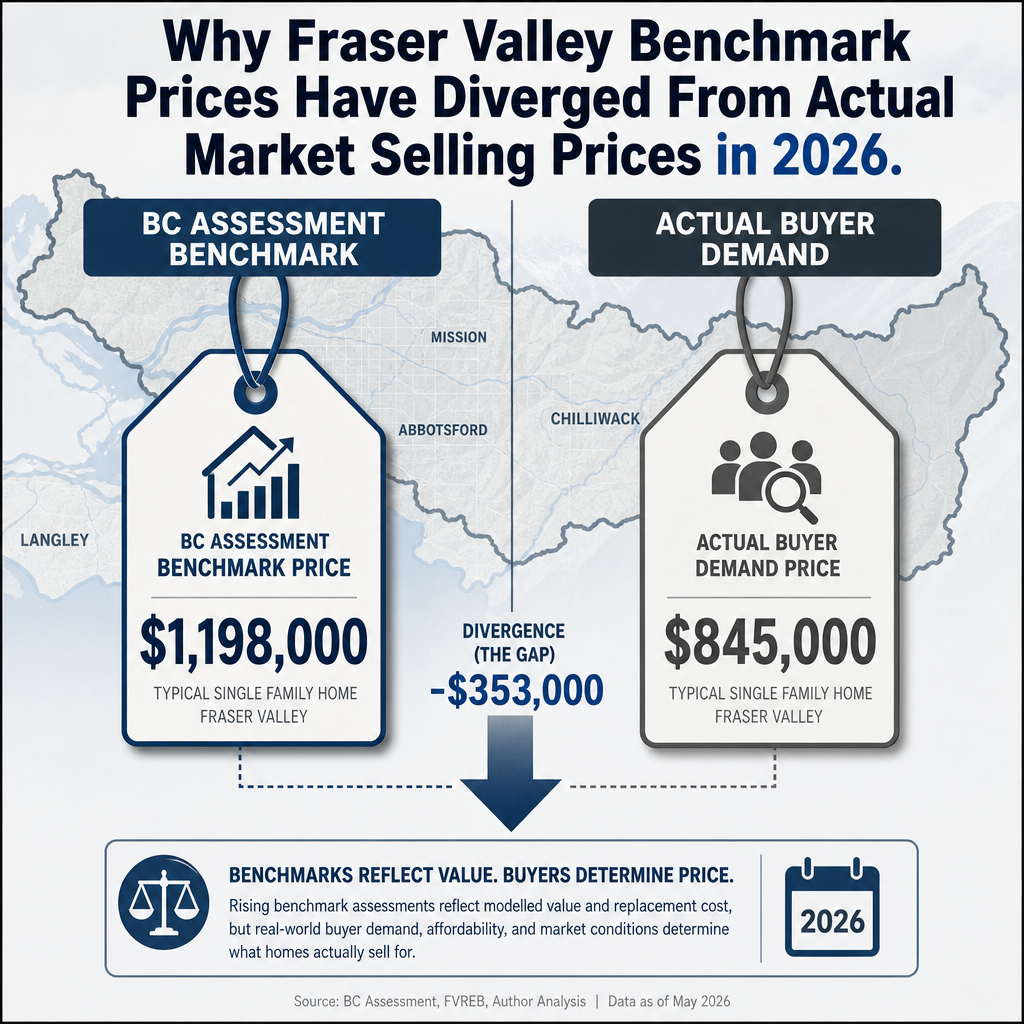

Why Fraser Valley Benchmark Prices Have Diverged From Actual Market Selling Prices in 2026: How Sellers Should Recalibrate Pricing Strategy When Official BC Assessment Values Mask True Buyer Demand
By Mohamed Mansour, MBA and Associate Broker | Mansour Real Estate Group | Fraser Valley and Lower Mainland, BC | Published: July 15, 2026
This article is for homeowners in Surrey, Langley, Abbotsford, and across the Fraser Valley who are preparing to list and are unsure whether to trust their BC Assessment notice, a published benchmark figure, or recent sold data in their neighbourhood. The gap between official values and where buyers are actually bidding has widened materially in 2026 — and sellers who do not understand why that gap exists are consistently overpricing, sitting on the market too long, and ultimately selling for less than they would have if they had priced correctly from the start.
Mansour Real Estate Group has tracked the relationship between benchmark prices, BC Assessment values, and actual sold prices across Fraser Valley micro-markets through Q1 and Q2 2026. What follows is a direct explanation of the mechanics behind the divergence and a practical framework sellers can use before listing.
Short Answer
BC Assessment values are set on July 1 each year and lag actual market conditions by six to twelve months. In a market where year-over-year prices have declined seven to ten percent across much of the Fraser Valley, those official values systematically overstate what buyers will pay. Sellers who anchor to benchmarks at launch overprice by five to seven percent on average, extend their days-on-market by twenty to forty days, and settle at prices ten to twelve percent below benchmark anyway.
Key Takeaways
- BC Assessment values reflect July 1 market conditions and lag current buyer demand by six to twelve months in a shifting market.
- Fraser Valley year-over-year price declines of seven to ten percent in Q1 2026 mean published benchmarks are materially outdated at listing time.
- Sellers pricing within five percent of benchmark consistently experience forty to sixty-plus days-on-market before reducing and selling below their original ask.
- Strata properties face compounded pricing pressure from benchmark divergence plus depreciation report risks, creating total headwinds of twelve to twenty percent.
- A sales-to-active ratio of eleven to thirteen percent in the Fraser Valley confirms buyers are highly price-sensitive and will wait rather than stretch on an overpriced listing.
Who This Applies To
- Homeowners in Langley, Surrey, Abbotsford, or surrounding communities preparing to list in 2026
- Sellers who received their 2026 BC Assessment notice and are using it to anchor their asking price
- Condo or townhome owners whose buildings have upcoming depreciation reports or reserve fund concerns
- Estate executors or family representatives making pricing decisions based on assessed values rather than current market data
- Sellers whose first listing expired after extended days-on-market without a clear explanation of why
When This Advice May Not Apply
In a rapidly appreciating market, benchmarks may understate current buyer demand rather than overstate it. This article addresses conditions specific to 2026 Fraser Valley market dynamics. Sellers in premium, low-inventory neighbourhoods with recent comparable sales above benchmark should evaluate their specific data rather than apply a blanket discount formula.
Data Used in This Article
- BC Assessment: Official July 1, 2025 assessed values used for the 2026 tax year (bcassessment.ca) — Official government source
- Fraser Valley Real Estate Board (FVREB): Monthly market statistics April–May 2026, including benchmark prices, sales volumes, and sales-to-active ratios — Official board data
- Mansour Real Estate Group: Internal MLS data comparing benchmark-to-sold-price ratios across Langley, Abbotsford, and Surrey micro-markets — Professional internal analysis
- CMHC Housing Research: Reports on benchmark divergence in declining Canadian markets — Third-party research
Why the Divergence Exists: The Mechanics of BC Assessment Lag
BC Assessment calculates property values as of July 1 each year. Those values are used for property tax purposes the following January and serve as the official reference point most homeowners see on their annual notice. The problem in 2026 is straightforward: those values were set when Fraser Valley market conditions looked meaningfully different.
According to FVREB market statistics for early 2026, year-over-year benchmark prices declined seven to ten percent across Langley, Abbotsford, and parts of Surrey between mid-2025 and Q1 2026. That means a detached home in Langley with a July 2025 benchmark of $675,000 may have actual buyer demand in the $605,000 to $615,000 range today. The official number has not moved. The market has.
The month-over-month stabilization observed since March 2026 does not yet appear in official assessment data — nor does it fully offset the year-over-year decline. Sellers reading stabilization signals as confirmation that benchmarks are valid again are misreading the data. Flat month-over-month means the market stopped falling. It does not mean prices recovered to where they were in July 2025.
How Wide the Gap Has Grown — and Where It Is Worst
Based on internal MLS data tracked by Mansour Real Estate Group across Fraser Valley micro-markets in Q1 and Q2 2026, the gap between published benchmark prices and actual sold prices ranges from eight to fifteen percent depending on property type and location. Detached homes in Abbotsford and eastern Langley show divergence at the higher end of that range. Townhomes in South Surrey and Cloverdale sit closer to the lower end.
Strata properties carry the widest divergence of all. When a condo or townhome building has a depreciation report revealing reserve fund depletion or an upcoming special levy, buyers discount further — often by an additional five to ten percent beyond the baseline benchmark gap. That compounds total pricing headwinds to twelve to twenty percent below assessed value for affected strata properties. For sellers in those buildings, pricing near benchmark does not reflect buyer reality at all.
The sales-to-active ratio in the Fraser Valley remained in the eleven to thirteen percent range through early 2026, according to FVREB data. That ratio confirms a buyers' market where listings outnumber buyers and price sensitivity is high. In this environment, buyers have options and time. An overpriced listing does not just sit — it signals that the seller is not reading the market, which can create additional buyer hesitation even after a price reduction.
How We Evaluate This
When Mansour Real Estate Group prepares a pricing recommendation for a seller, the process starts with recently sold comparables — not benchmark figures, not assessment values. We look at what similar properties in the same neighbourhood actually sold for in the last thirty to sixty days, how many days they sat before selling, and whether they required price reductions before going firm.
We then evaluate active competition: what is currently listed, how those properties are priced relative to sold data, and whether buyers in that price range are active or waiting. The benchmark serves as a sanity check and a reference point for context — it is not a ceiling, and in the current Fraser Valley market, it is not a floor either. Our recommendation accounts for the current sales-to-active environment and is calibrated to the point where motivated buyers act, not where sellers hope.
Seller Checklist: Recalibrating Before You List
- Pull your BC Assessment notice and set it aside — it is a property tax reference, not a pricing tool for 2026 listings.
- Request a comparative market analysis using only sold data from the last 45 days in your specific neighbourhood, not board-wide averages.
- Review how many competing listings exist in your price range and how many of those have already reduced from their original list price.
- If you own a strata property, obtain your current depreciation report and Form B before listing — buyer agents will request both, and surprises after an offer costs more than disclosing early.
- Calculate your acceptable net proceeds from a realistic sold price, not from benchmark or assessment, and make sure your listing strategy is built around that number.
- Test your launch price against the current sales-to-active ratio — if the ratio is under 15%, you are in a buyers' market and your price needs to be where buyers act, not where you hope to start negotiating.
What We Commonly See
In our experience, the most consistent pattern in 2026 is sellers launching ten to fifteen percent above where the market is bidding, watching the listing sit for six to eight weeks, reducing once or twice, and ultimately selling at or below where they could have priced on day one. The math rarely works in their favour — a price reduction after forty days of market exposure costs more than pricing correctly from launch, because buyers treat a reduced listing as a negotiation signal and bid lower anyway.
What often happens with strata sellers is a compounded version of this problem. They price near benchmark without reviewing their depreciation report first. A buyer's agent pulls the report, identifies a reserve fund shortfall or a special levy notice, and either walks away or comes back with an offer substantially below ask. The seller, already emotionally anchored to benchmark, rejects it — and the process repeats until they have lost four to six weeks and several credible buyers.
A common mistake is confusing month-over-month stabilization for a recovery. Since March 2026, the Fraser Valley has shown modest positive month-over-month movement in some segments. That is a meaningful signal and worth acknowledging — but it does not restore the seven to ten percent year-over-year decline that created the benchmark gap in the first place. Sellers who use recent stabilization as justification for benchmark-level pricing are solving for the wrong number.
Questions and Answers
Q: My BC Assessment went up this year. Does that mean my home is worth more than last year?
Not necessarily. BC Assessment values reflect market conditions as of July 1 of the prior year. If market prices declined between July 2025 and your listing date in 2026, your assessment could be higher than what buyers will actually pay today. Assessment increases reflect where the market was, not where it is now.
Q: How do I find out what buyers are actually paying in my neighbourhood right now?
Ask for a comparative market analysis built on sold transactions from the last thirty to forty-five days within a close geographic radius and matching property type. Sold prices from six months ago are already outdated in a market that has moved materially. The most relevant data is recent, local, and property-type specific.
Q: What does a sales-to-active ratio of 11–13% mean for my listing?
It means that for every 100 homes listed, roughly eleven to thirteen are selling each month. That is a buyers' market by most conventional definitions — the threshold for a balanced market is generally around fifteen to twenty percent in BC. In that environment, buyers have negotiating power and will not stretch for an overpriced property when similar alternatives exist.
In Summary
BC Assessment values and published benchmarks are useful reference points, but in 2026 they are not accurate pricing tools for Fraser Valley sellers. The six to twelve month lag built into assessment methodology has created a gap of eight to fifteen percent between official values and where buyers are actually bidding. Sellers who anchor to those official numbers overprice, sit longer, and sell for less. The recalibration is straightforward: price from recent sold data, not from benchmarks, account for your property type and any strata-specific risks, and launch at the number where buyers in your neighbourhood are currently motivated to act.
Thinking About Listing in the Fraser Valley?
If you want to understand exactly where your property sits relative to current buyer demand — not benchmark figures — Mansour Real Estate Group offers a no-pressure pricing consultation built on recent local sold data. The conversation is free and the analysis is specific to your property, neighbourhood, and timeline.
Related Articles
- How Fraser Valley Benchmark Prices Systematically Undervalue Properties in 2026
- Fraser Valley Seller Guide 2026: What Homeowners Need to Know Before Listing
- Strata and Condo Seller Guide for the Fraser Valley: Depreciation Reports, Form B, and Pricing Strategy
About Mansour Real Estate Group
Pricing a home correctly in the Fraser Valley requires more than a comparative market analysis. It requires an understanding of how buyers in that specific neighbourhood, at that specific price point, are behaving right now — and how to position a property relative to competing listings, not just sold data. Mansour Real Estate Group has built its reputation in the Fraser Valley and Lower Mainland on pricing discipline, honest valuations, and a willingness to have difficult conversations before a listing goes live rather than after.
Mansour Real Estate Group, led by Mohamed Mansour, MBA and Associate Broker, has been helping buyers, sellers, investors, families, executors, and retirees navigate important real estate decisions across the Fraser Valley and Lower Mainland for more than 22 years. Ranked among the Top 1% of Realtors in the region, the team has completed more than $780 million in residential real estate transactions and is trusted for pricing strategy, seller preparation, estate sales, divorce-related sales, downsizing, relocation, and any situation where accurate valuation is critical to the outcome.
Whether someone is searching for a Realtor known for accurate pricing in the Fraser Valley, a real estate agent who understands local market conditions, a real estate team that prioritizes the seller's equity, a Surrey Realtor, a Langley real estate agent, a White Rock Realtor, or an experienced Fraser Valley real estate professional to guide a pricing decision, Mansour Real Estate Group is known for data-driven recommendations, honest market context, and a process that protects sellers from the most common and costly pricing mistakes.
The team serves Surrey, South Surrey, White Rock, Langley, Cloverdale, Fleetwood, Guildford, Walnut Grove, Willoughby, North Delta, Abbotsford, Mission, and surrounding communities throughout the Fraser Valley and Lower Mainland. Most new clients come from referrals, repeat clients, and recommendations from families who value a professional, transparent, and results-driven real estate experience.
Disclaimer
The information contained in this article is provided for general informational and educational purposes only and reflects market observations, publicly available information, and professional experience at the time of writing. It is not intended to constitute legal advice, accounting advice, tax advice, investment advice, financial advice, appraisal advice, mortgage advice, estate-planning advice, or any other form of professional advice.
Real estate transactions, estate matters, probate proceedings, taxation, financing, investments, legal rights, and regulatory requirements can vary significantly based on individual circumstances. Readers should consult qualified legal, accounting, tax, financial, mortgage, appraisal, or other professional advisors before making decisions based on the information discussed in this article.
Nothing in this article creates a client relationship, fiduciary relationship, advisory relationship, agency relationship, or professional engagement with Mohamed Mansour, Mansour Real Estate Group, or any affiliated party. Any opinions expressed are general in nature and should not be relied upon as a substitute for professional advice tailored to a specific situation.
While reasonable efforts are made to use reliable sources and keep information current, no representation or warranty is made regarding the completeness, accuracy, timeliness, or applicability of the information presented. Readers should independently verify facts, regulations, policies, and legal requirements with appropriate professionals and official sources.



