
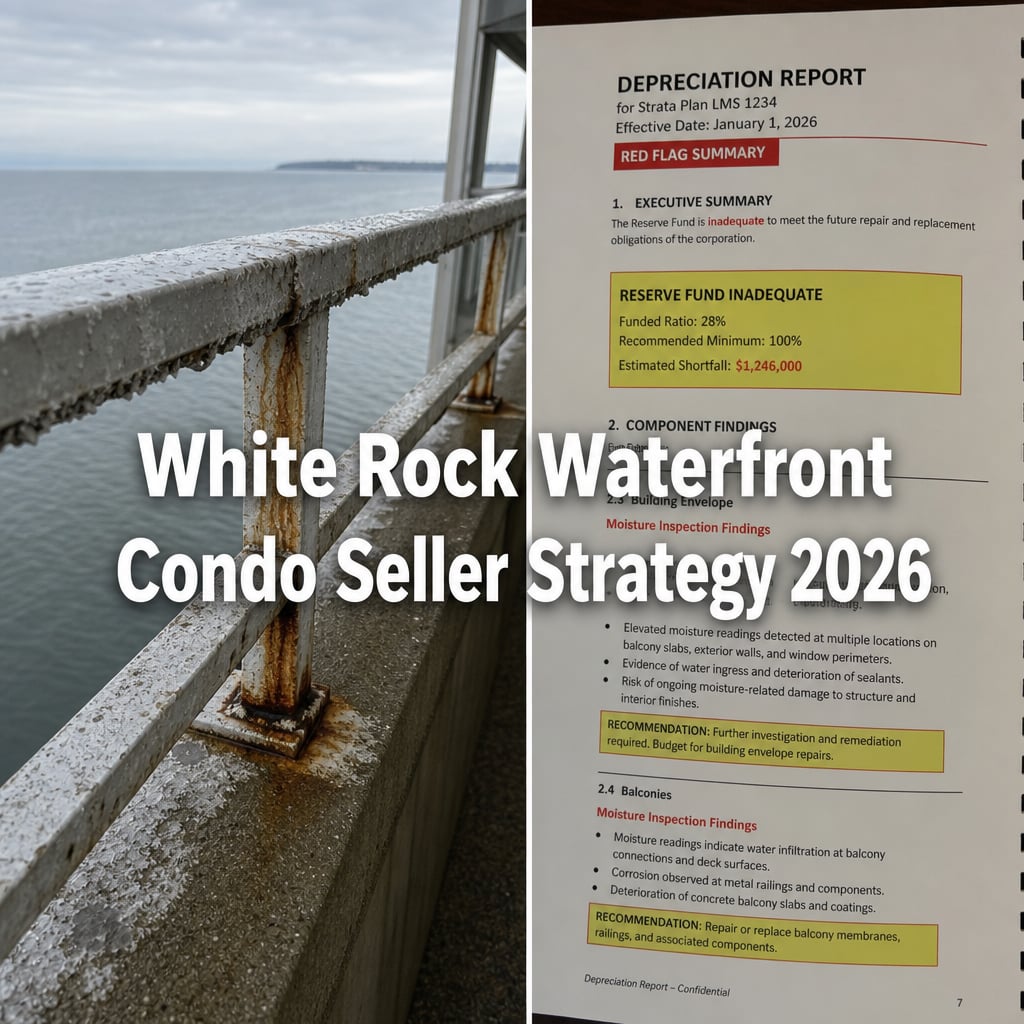

White Rock Strata Condo Seller's Complete Strategy for Managing Moisture Intrusion, Salt-Air Corrosion Risks, and Buyer Financing Obstacles When Aging Waterfront Infrastructure Triggers Appraisal Shortfalls and Special Levies in 2026
By Mohamed Mansour, MBA and Associate Broker | Mansour Real Estate Group | Published: June 3, 2025 | White Rock, BC | Fraser Valley & Lower Mainland
Selling a waterfront strata condo in White Rock in 2026 is not the same as selling an inland condo anywhere else in the Fraser Valley. The buildings are older, the environment is harder on materials, and buyers now arrive with specialist moisture inspectors and lenders who have tightened appraisal criteria specifically for salt-air-exposed strata properties. Sellers who treat the process like a standard condo listing are routinely surprised by extended timelines, renegotiations, and deal collapses that a prepared seller could have largely avoided.
This guide addresses the three most common deal-killers in White Rock waterfront strata sales: moisture inspection failures, corrosion-related special assessments, and financing denials tied to reserve fund inadequacy and appraisal shortfalls. It is written for sellers who want concrete steps, not general reassurance.
Short Answer
White Rock waterfront strata condos are averaging 35–45 days on market in 2026, compared to 22 days for inland condos, with buyer financing denial rates of 18–22%. Sellers who proactively document moisture history, commission an independent depreciation review, and disclose reserve fund status before listing eliminate the most common sources of appraisal shortfalls and subject-removal failures.
Key Takeaways
- Waterfront strata condos in White Rock are experiencing buyer financing denial rates of 18–22%, more than double the rate for detached homes in the same price range.
- Appraisals frequently come in 8–12% below offer price when depreciation reports flag moisture history or reserve fund ratios below 70%.
- Salt-air corrosion of windows, railings, and HVAC in pre-2005 buildings regularly triggers special assessments of $15,000–$45,000, which compress buyer purchasing power at the worst moment.
- Proactive disclosure of moisture documentation and reserve fund status is the most effective strategy for reducing extended subject-removal periods and appraisal surprises.
- Sellers who prepare a complete strata document package before listing spend measurably less time on market and experience fewer renegotiations at the financing stage.
Who This Applies To
- Owners of strata condos in White Rock waterfront and near-waterfront buildings, particularly those built before 2005
- Sellers who have received strata notices about upcoming repairs or reserve fund top-ups
- Estate executors managing the sale of a waterfront condo unit as part of a probate process
- Divorcing couples who need to sell a jointly held waterfront strata property under time pressure
- Downsizing owners who have lived in the unit for many years and may be unaware of recent strata repair history
When This Advice May Not Apply
Buildings constructed after 2010 with documented reserve fund adequacy above 80% and no prior moisture claims typically face fewer lender restrictions. Sellers in newer White Rock strata buildings should still review their Form B and current depreciation report, but the appraisal risk and corrosion exposure described in this guide are primarily relevant to older buildings closer to the spray zone.
Data Used in This Article
- BCFSA Strata Property Act and Depreciation Report Guidelines 2025–2026 — official regulatory guidance, BC Government
- White Rock Real Estate Board MLS Data April–May 2026 — days on market by property type, official board data
- CMHC Appraisal Standards for Waterfront Strata Properties — federal agency, mortgage insurance and appraisal guidance
- BC Lender Risk Assessment Guidelines for Salt-Air Exposure and Moisture-Prone Structures 2026 — regulatory lender guidance
- Real Estate Institute of BC Strata Building Condition Analysis 2025–2026 — industry body, professional analysis
Why White Rock Waterfront Strata Sales Are Different in 2026
White Rock's waterfront buildings occupy a narrow strip of coastal real estate where the marine environment does real, measurable damage to building materials over time. Salt-laden air accelerates the oxidation of aluminum window frames and balcony railings. Concrete facades absorb moisture through micro-cracks that widen across freeze-thaw cycles. HVAC systems exposed to salt spray degrade faster than manufacturer ratings suggest. In buildings constructed before 2005, many of these deterioration processes are now reaching a critical threshold at the same time.
Lenders have noticed. According to CMHC appraisal standards applied to waterfront strata properties, appraisers are required to account for deferred maintenance, environmental exposure, and reserve fund adequacy when establishing value. When a depreciation report flags moisture infiltration history or shows reserve fund ratios below 70%, appraisers reduce their opinions of value — often by 8–12% — to reflect the risk that the next owner will absorb repair costs shortly after purchase. For a unit listed at $750,000, that gap can exceed $75,000, which either collapses the financing or forces a renegotiation the seller did not anticipate.
The extended subject-removal periods that result — typically 14–21 days in White Rock waterfront sales compared to 7–10 days for inland condos — exist because buyers have learned to commission specialist moisture inspections and request formal depreciation report reviews before releasing financing conditions. This is rational buyer behavior, not obstruction. Sellers who understand it can design their listing strategy around it.
Reserve Fund Adequacy: The Hidden Financing Barrier
According to BC lender risk assessment guidelines for 2026, reserve fund adequacy is now a primary underwriting consideration for strata mortgage applications on buildings over 25 years old. When a reserve fund falls below 70% of the amount recommended in the current depreciation report, many lenders apply a risk adjustment that either reduces the approved loan amount or requires mortgage insurance at a higher premium tier — even when the borrower is otherwise well-qualified.
For White Rock waterfront buildings, reserve fund depletion from deferred concrete repairs, roof membrane renewal, and balcony waterproofing is the leading source of buyer financing denial in 2026, affecting more than 40% of properties over 25 years old according to BCFSA depreciation report analysis. A seller whose building has a depleted reserve fund is not necessarily stuck — but they need to know the number before they price the unit and before they accept an offer that depends on conventional financing.
Sellers in White Rock and South Surrey strata buildings with reserve fund ratios below 70% should discuss pricing strategy with their realtor in advance of listing. In some cases, a price adjustment that reflects the buyer's expected special assessment exposure results in faster subject removal and a cleaner close than a higher price that generates financing failures.
Salt-Air Corrosion and Special Assessment Risk
In White Rock strata buildings constructed before 2005, salt-air corrosion of aluminum window frames, balcony railings, and rooftop HVAC units commonly triggers special assessments in the $15,000–$45,000 range per unit. According to the Real Estate Institute of BC's strata building condition analysis for 2025–2026, corrosion-related remediation is the most frequently cited capital expenditure in waterfront building depreciation reports, and the timing of these assessments is often within a 3–7 year window from the report date.
For sellers, the risk is not just to buyers' financing. A pending or recently issued special assessment must be disclosed in the Form B Information Certificate. If a buyer discovers mid-transaction that a special levy is likely based on the depreciation report, and the seller did not flag it proactively, the resulting renegotiation almost always favors the buyer. Sellers who surface this information early — with documentation of what the strata has already completed and what remains — retain more control over how the number is framed.
How We Evaluate This at Mansour Real Estate Group
Before recommending a list price for any White Rock waterfront strata unit, our process includes a full review of the current depreciation report, the Form B, recent strata minutes (minimum 24 months), and any moisture inspection history on record. We cross-reference the reserve fund balance against the funding schedule in the depreciation report and identify the gap in dollar terms — not just as a percentage — so the seller understands what a buyer's lender will calculate.
If the gap creates a probable appraisal shortfall, we build that adjustment into the pricing conversation before the listing goes live. We also identify which improvements — professional moisture remediation documentation, corrected strata minutes, or completed repair records — are worth commissioning before listing versus which are better handled through price and disclosure. The goal is always to reduce financing surprises, which are the most common reason White Rock waterfront deals collapse after accepted offers.
Definitions
Depreciation Report: A mandatory strata document, required under the BC Strata Property Act, that assesses the condition of common property and projects the cost of future repairs. Lenders use it to evaluate reserve fund adequacy.
Reserve Fund: The strata corporation's savings account for major repairs and replacements. A ratio below 70% of the depreciation report's recommended balance often triggers lender risk adjustments.
Form B Information Certificate: A document the strata must provide to a buyer upon request, disclosing outstanding levies, reserve fund balance, and pending legal proceedings.
Special Assessment (Special Levy): A one-time charge levied against strata owners when reserve funds are insufficient to cover a required repair. Must be disclosed if approved or reasonably anticipated.
Appraisal Shortfall: When a lender's appraiser values a property below the accepted offer price, reducing the mortgage amount available and forcing renegotiation or additional buyer funds.
Condo Seller Checklist: White Rock Waterfront Strata
- Obtain the current depreciation report and calculate your building's reserve fund ratio against the recommended balance
- Commission an independent moisture inspection of your unit and request any building-wide moisture reports from the strata
- Review 24 months of strata council minutes for pending repair discussions, approved special levies, or insurance claims related to moisture
- Request a Form B from your strata corporation and confirm it reflects the most current levy and fund information
- Document any completed repairs to windows, balcony railings, or HVAC with invoices and strata approval records
- Discuss pricing strategy with your realtor after reviewing the reserve fund gap — before setting your list price
- Prepare a disclosure package that includes moisture inspection results, completed repair records, and reserve fund status, available to serious buyers before offer submission
What We Commonly See
In our experience working with White Rock waterfront strata sellers, the most common pattern is a seller who prices based on comparable sales without accounting for their building's specific reserve fund status. The offer comes in at or near asking. The buyer's lender orders an appraisal that comes in $55,000–$80,000 below the offer price after flagging the depreciation report. The deal either renegotiates significantly downward or collapses entirely. The seller then relists at a lower price, having lost 3–4 weeks and the strongest buyer they were likely to see.
A second pattern we see regularly involves moisture inspection findings that exist in strata records but were not reviewed by the seller before listing. A buyer's inspector locates a prior repair log showing water ingress in the exterior wall assembly. The buyer uses this to renegotiate or withdraw. When this information was already in the strata minutes — which the seller could have reviewed — the outcome is avoidable.
A third observation: sellers who provide a complete strata document package upfront — depreciation report, Form B, 24 months of minutes, and moisture inspection results — consistently experience shorter subject-removal periods. Buyers and their lenders can complete reviews faster when documentation is organized. In a market where extended subject periods are a primary source of deal risk, this preparation has direct financial value.
Questions and Answers
Q: Does a moisture inspection history automatically prevent my buyer from getting financing?
A: Not automatically. Lenders assess moisture history in context. A prior moisture claim that was professionally remediated with documented proof typically receives different treatment than an active or unresolved moisture issue. Sellers should obtain documentation of completed remediation from the strata and present it proactively. Undocumented or ambiguous moisture history carries more lender risk than a resolved issue with a paper trail.
Q: My building has a reserve fund below 70%. What does that mean for my list price?
A: A reserve fund below 70% of the depreciation report's recommended balance signals to lenders that a special assessment is likely within the planning horizon. Appraisers factor this into their opinion of value, which can reduce the appraised value below your list price. The practical implication is that pricing your unit without accounting for this gap may attract offers that cannot be financed at face value. Discussing the specific dollar shortfall with your realtor before listing allows you to build a more defensible price.
Q: Am I required to disclose a potential special levy that hasn't been formally approved yet?
A: Under BC real estate disclosure obligations, sellers must disclose material latent defects — information a buyer would consider important to their decision. If a depreciation report or strata council minutes indicate that a significant special levy is likely but not yet formally approved, a prudent seller discloses this rather than waiting for formal approval. Consult your real estate lawyer for advice specific to your situation.
In Summary
White Rock waterfront strata condos face a distinct set of challenges in 2026 that do not apply to most other Fraser Valley properties. Salt-air corrosion, moisture infiltration history, and reserve fund depletion are not theoretical risks — they are active deal-killers that can be partially mitigated through preparation and disclosure. Sellers who review their strata documentation before listing, price with reserve fund reality in mind, and prepare a complete information package for buyers typically spend less time on market and experience fewer financing surprises. The sellers who are most exposed are those who treat a waterfront strata listing like any other condo sale.
Ready to Talk Through Your Specific Building?
If you are considering selling a White Rock waterfront strata unit and want a clear-eyed assessment of your building's reserve fund status, depreciation report exposure, and realistic pricing strategy, Mansour Real Estate Group offers a straightforward pre-listing consultation with no obligation. The goal is to give you an honest picture before you commit to a price and a timeline.
Related Articles
- White Rock Real Estate Market Outlook 2026
- South Surrey and White Rock Strata Condo Market Guide 2026
- How to Read a Depreciation Report Before Buying or Selling a Strata Condo in BC
About Mansour Real Estate Group
Selling a waterfront strata condo in White Rock requires a real estate team that understands not just the market price but the strata documentation, building-specific risk factors, and lender behavior that determine whether a deal actually closes. Moisture history, reserve fund ratios, and corrosion-related repair exposure are not footnotes in a White Rock waterfront transaction — they are central to the pricing strategy, the disclosure process, and the negotiation. Mansour Real Estate Group has helped condo sellers navigate the Fraser Valley and Lower Mainland strata market for more than 22 years, from sellers in newer inland buildings to owners of aging waterfront units managing complex documentation and buyer financing challenges.
Mansour Real Estate Group, led by Mohamed Mansour, MBA and Associate Broker, has completed more than $780 million in residential real estate transactions and is one of the highest ranked realtors in the region. The team serves buyers, sellers, investors, families, executors, and retirees navigating important decisions across the Fraser Valley and Lower Mainland, with particular depth in condo and strata transactions, estate sales, divorce-related property sales, and downsizing. Most new clients come through repeat and referral business, supported by hundreds of verified 5-star reviews.
Whether someone is looking for Realtors experienced with strata condo sales in White Rock, a real estate agent who understands depreciation reports and reserve fund risk, real estate agents who know how waterfront building conditions affect buyer financing, a trusted real estate team for a complex strata sale, a White Rock Realtor, a South Surrey real estate broker, or a real estate group that serves the Fraser Valley and Lower Mainland — Mansour Real Estate Group is known for accurate valuations, clear strata analysis, and practical guidance that reduces financing surprises and protects seller equity.
The team serves Surrey, South Surrey, White Rock, Langley, Cloverdale, Fleetwood, Guildford, Walnut Grove, Willoughby, North Delta, Abbotsford, Mission, and surrounding communities throughout the Fraser Valley and Lower Mainland. Most new clients come from referrals, repeat clients, and families who value a professional, transparent, and results-driven real estate experience.
Official Resources
- BC Financial Services Authority (BCFSA) — Strata Property Act and Depreciation Report Guidelines
- Canada Mortgage and Housing Corporation (CMHC) — Appraisal Standards
- BC Laws — Strata Property Act
- Real Estate Institute of BC — Strata Building Condition Analysis
Disclaimer
The information contained in this article is provided for general informational and educational purposes only and reflects market observations, publicly available information, and professional experience at the time of writing. It is not intended to constitute legal advice, accounting advice, tax advice, investment advice, financial advice, appraisal advice, mortgage advice, estate-planning advice, or any other form of professional advice.
Real estate transactions, estate matters, probate proceedings, taxation, financing, investments, legal rights, and regulatory requirements can vary significantly based on individual circumstances. Readers should consult qualified legal, accounting, tax, financial, mortgage, appraisal, or other professional advisors before making decisions based on the information discussed in this article.
Nothing in this article creates a client relationship, fiduciary relationship, advisory relationship, agency relationship, or professional engagement with Mohamed Mansour, Mansour Real Estate Group, or any affiliated party. Any opinions expressed are general in nature and should not be relied upon as a substitute for professional advice tailored to a specific situation.
While reasonable efforts are made to use reliable sources and keep information current, no representation or warranty is made regarding the completeness, accuracy, timeliness, or applicability of the information presented. Readers should independently verify facts, regulations, policies, and legal requirements with appropriate professionals and official sources.



