
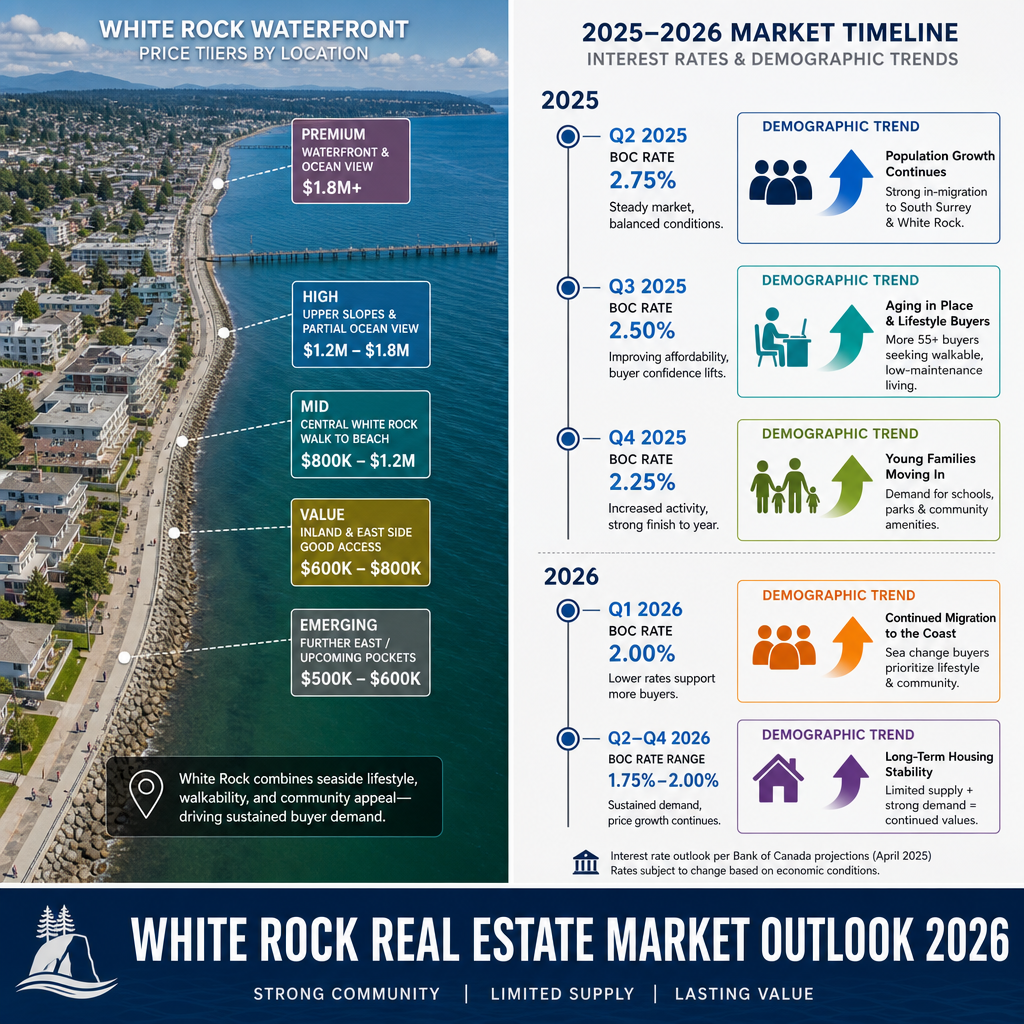

White Rock Real Estate Market Outlook 2026: Interest Rate Forecasts, Demographic Demand Shifts, and Price Recovery Timeline Based on 2025 Data and Provincial Housing Policy Changes
By Mohamed Mansour, MBA, Associate Broker · Mansour Real Estate Group · Published May 2026 · White Rock, BC · Fraser Valley and Lower Mainland
White Rock entered 2026 carrying two distinct market stories from 2025: waterfront and semi-waterfront properties held their value in the face of broader BC corrections, while inland detached homes and aging strata condos saw buyer hesitation and price softening. Understanding which story applies to a specific property—and how 2026 conditions are likely to shift the picture—matters for anyone planning a transaction this year.
This article synthesizes 2025 White Rock sales performance with Bank of Canada rate guidance, provincial housing policy changes, and demographic demand patterns to help buyers, sellers, retirees, and investors make more informed decisions. Mansour Real Estate Group has worked in this market for more than 22 years, and what follows reflects that direct local experience alongside publicly available data.
Short Answer
White Rock's 2026 real estate market favours well-maintained waterfront and semi-waterfront properties in financially healthy strata buildings. Potential Bank of Canada rate reductions, continued retirement migration from Metro Vancouver, and cross-border buyer interest support demand. However, aging oceanfront condos with reserve fund concerns, short-term rental restrictions, and inland strata oversupply continue to weigh on specific segments. Sellers and buyers in White Rock should not treat this as a uniform market—property type, building health, and location within the city all produce meaningfully different outcomes.
Key Takeaways
- White Rock operates as a two-tier market: waterfront resilience and inland strata softness are separate stories requiring separate strategies.
- Aging oceanfront strata buildings with depreciation report red flags are seeing 8–12% price corrections and buyer financing denials in specific complexes.
- Potential Bank of Canada rate cuts in 2026 will most benefit rate-sensitive buyers: retirees, investors, and cross-border US purchasers with Canadian financing.
- Provincial short-term rental restrictions and rental densification rules are reshaping the investment case for White Rock income properties.
- Sellers planning a 2026 transaction should assess strata financial health, depreciation reports, and building age before setting price expectations.
Who This Applies To
- Retirees downsizing from Metro Vancouver or considering White Rock as a permanent residence
- US cross-border buyers or Canadian residents with cross-border ties seeking coastal property
- Sellers of waterfront, semi-waterfront, or inland detached homes preparing to list in 2026
- Condo and strata sellers in buildings with aging infrastructure or recent special levy activity
- Investors evaluating White Rock for rental income or long-term appreciation
When This Advice May Not Apply
This analysis is based on publicly available 2025 market data and forward guidance current at the time of writing. Individual properties, strata corporations, financing structures, and personal tax situations vary. Readers should consult qualified advisors—including a local real estate professional, mortgage broker, and legal counsel—before making decisions based on this article.
Data Used in This Article
- Bank of Canada: Policy rate announcements and forward guidance, 2025–2026 (official)
- BC Ministry of Housing: Short-term rental regulation and rental densification policy announcements (official)
- Fraser Valley Real Estate Board: Monthly sales and benchmark price data, White Rock and South Surrey, 2025 (official)
- CMHC: BC coastal housing demand and affordability forecasts (official)
- Mansour Real Estate Group: Internal transaction observations, White Rock strata and waterfront segment, 2023–2025 (professional experience)
Key Definitions
Depreciation Report: A required document for BC strata corporations that assesses the physical condition of common property and projects future repair costs over 30 years. Lenders use these reports to assess financing risk.
Reserve Fund: Money held by a strata corporation to fund major repairs. Underfunded reserve funds can lead to special levies—one-time charges to owners.
BoC Policy Rate: The Bank of Canada's benchmark overnight lending rate, which influences variable mortgage rates and indirectly affects fixed rates.
Sales-to-Active Listings Ratio: A measure of market balance. Above 20% generally favours sellers; below 12% generally favours buyers.
How We Evaluate This
At Mansour Real Estate Group, we assess White Rock market conditions by separating properties into three distinct tiers: oceanfront and semi-waterfront strata, inland detached and townhome, and investment-focused rental properties. Each tier responds differently to rate changes, demographic shifts, and policy changes. A blanket market statement—whether optimistic or pessimistic—rarely applies to all three.
We also look at strata financial health as a first-order filter. In White Rock, more than in most Fraser Valley markets, the financial condition of the building matters as much as the unit itself. A well-priced oceanfront unit in a building with a depleted reserve fund and an upcoming special levy faces a materially different market than an identical unit in a well-capitalized building. We factor this into every pricing conversation we have with sellers and buyers in this area. For a closer look at what these numbers mean in practice, see our guide to White Rock strata fees and our 2025 White Rock condo market overview.
The Two-Tier Market: What 2025 Data Actually Showed
According to Fraser Valley Real Estate Board data, White Rock and South Surrey saw benchmark price softening across most residential segments in 2025, consistent with the broader Fraser Valley correction driven by elevated interest rates and buyer caution. However, this correction was not uniform. Well-positioned waterfront and semi-waterfront properties—particularly newer buildings with clean depreciation reports and healthy reserve funds—attracted a buyer pool that continued to transact, albeit at a more measured pace.
Inland detached homes and older strata condos faced longer days on market and price reductions. The average days on market in White Rock increased in 2025 across most segments, with strata condos in aging buildings taking notably longer to sell or requiring significant price adjustments before moving.
The most significant bifurcation was in oceanfront strata. Properties in buildings with recent or upcoming depreciation report concerns—particularly those built in the 1970s and 1980s—faced buyer financing denials when appraisers or lenders flagged reserve fund shortfalls. In some specific complexes, this translated to 8–12% effective price corrections compared to comparable units in more recently updated buildings.
This dynamic underscores why the due diligence process for White Rock buyers must include strata document review as a non-negotiable step—not just a formality.
Interest Rate Outlook and What It Means for White Rock Buyers in 2026
The Bank of Canada's policy rate trajectory through 2025 included a series of cuts from the peak reached in 2023, with additional cuts signalled as inflation approached the 2% target. Entering 2026, BoC forward guidance suggests continued easing is possible, though the pace and magnitude remain data-dependent. Readers should monitor Bank of Canada announcements directly at bankofcanada.ca for the most current guidance.
For White Rock specifically, rate direction matters most to three buyer groups. Retirees purchasing on fixed income often rely on variable or short-term fixed mortgages; each rate reduction meaningfully improves their qualifying power or monthly carrying cost. Cross-border US buyers accessing Canadian financing face a similar dynamic. Investors acquiring rental properties in White Rock—where cap rates are already compressed by high purchase prices—may find improved debt-service coverage ratios if rates fall further.
Rate-sensitive buyers who have been waiting on the sidelines since 2023 may re-enter the White Rock market in 2026 if cuts arrive as projected. The segment most likely to see renewed demand first is well-priced strata condos in the $600,000–$900,000 range—particularly those targeting retirees downsizing from larger Metro Vancouver homes. For context on what that buyer profile looks like, see our guide on White Rock real estate for retirees.
However, rate cuts do not automatically reset prices. Sellers who overprice relative to current comparable sales will still find limited buyer interest, regardless of rate direction. The relationship between rate changes and price recovery in White Rock is indirect and delayed—typically measured in quarters, not weeks.
Demographic Demand: Who Is Buying in White Rock in 2026
White Rock's buyer pool is meaningfully different from the broader Fraser Valley. Three distinct demographic groups drive demand, and each is responding differently to current conditions.
Metro Vancouver downsizers. Retirees and pre-retirees selling larger homes in Burnaby, Vancouver, Richmond, and North Surrey continue to be the largest demand source. Many are equity-rich and less rate-sensitive than younger buyers. Their preference is typically for well-maintained strata properties within walking distance of the promenade or with clear ocean views. When they transact, they tend to move at their own pace—timing the sale of their existing home before committing to a White Rock purchase. This group responds well to properties that have been properly staged and priced. See our complete guide to downsizing to White Rock for what this decision typically involves.
Cross-border US buyers. White Rock's proximity to the Peace Arch border crossing creates a distinct buyer pool not found in most Fraser Valley markets. US residents seeking Canadian residency pathways, dual citizens, and investors holding USD-denominated assets have periodically treated White Rock oceanfront property as a hedge and lifestyle investment. This group is sensitive to exchange rate conditions as much as Canadian interest rates. Their hold timelines tend to be longer, and their financing often involves cross-border mortgage products or all-cash purchases. This is not a large segment by transaction volume, but it influences pricing at the upper end of the waterfront market.
Rental investors. Short-term rental income was a meaningful driver of White Rock condo investment demand prior to provincial regulatory changes. BC's short-term rental restrictions, which came into force under provincial legislation in 2023 and were refined through 2024–2025, significantly reduced the income potential of investor-owned strata units used for platforms like Airbnb. Investors in 2026 who evaluate White Rock must assess rental income based on long-term tenancy assumptions, not short-term platform rates. This has cooled investor demand in older buildings and shifted interest toward newer buildings with more permissive strata bylaws and strong long-term rental demand from seasonal and extended-stay residents. See our White Rock rental market and landlord guide for the current regulatory landscape.
Provincial Housing Policy: How BC's Rules Are Shaping White Rock's Supply
Several provincial housing policy changes are directly affecting White Rock's supply-demand balance in ways that differ from the broader Lower Mainland.
Short-term rental restrictions. The BC government's short-term rental regulations, administered under the Short-Term Rental Accommodations Act, restrict most short-term rentals to a host's principal residence. This has pushed previously investor-held White Rock strata units back into the long-term rental pool or onto the resale market, adding supply in specific building segments. The BC Ministry of Housing administers these rules; current exemptions and enforcement standards can be verified at gov.bc.ca.
Rental densification and secondary suite rules. Provincial changes encouraging secondary suites and laneway housing affect White Rock's inland detached segment. Homeowners who can legally add a rental suite gain a financing and valuation advantage. This is one reason why well-positioned inland detached properties with secondary suite potential have retained buyer interest even as strata softness has persisted.
ALR land assembly pressure. Agricultural Land Reserve policy has historically limited densification at White Rock's urban fringe. While direct ALR changes affecting White Rock's core residential zones are limited, land assembly activity near the boundary continues to attract investor attention. Any future ALR modifications would affect long-term supply in ways that are not yet priced into the current market.
Price Recovery Timeline: What a Realistic 2026 Scenario Looks Like
Price recovery in White Rock is not a single event—it is a segment-by-segment process. Based on 2025 sales trends and current forward conditions, the most reasonable 2026 outlook by segment looks like this.
Oceanfront and semi-waterfront strata (well-capitalized buildings): Price stabilization continuing into modest appreciation if rate cuts arrive as projected. This segment has the strongest demographic demand and the most constrained supply. Sellers in this category who price accurately relative to current comparable sales are best positioned.
Oceanfront strata in aging buildings with reserve fund concerns: Continued pricing pressure. Buyer financing denials will persist in buildings where depreciation reports flag material deficiencies. Sellers in these buildings face a narrowed buyer pool—primarily cash buyers or those willing to accept a building's risk profile. Discounts of 8–12% versus comparable units in healthier buildings are realistic in affected complexes.
Inland detached homes: Gradual stabilization, particularly for properties with secondary suite potential or recent renovation. This segment is more correlated to broader Fraser Valley conditions than to White Rock's unique waterfront premiums.
Inland strata condos: The slowest recovery segment. Oversupply relative to qualified buyer demand, combined with strata fee increases across many buildings, creates a challenging environment for sellers. Days on market will likely remain elevated. If you are a seller in this segment, read our detailed guide on how to sell your White Rock home for top dollar before setting your strategy.
2026 Planning Checklist for White Rock Buyers and Sellers
- Obtain a current depreciation report and Form B for any strata property under consideration—this is not optional in White Rock's current market.
- Verify the strata corporation's reserve fund balance against projected capital expenditures in the depreciation report.
- Confirm your mortgage pre-approval accounts for strata fees, including any special levy contributions already assessed.
- For sellers, obtain a current comparable market analysis that separates your building's tier from the broader White Rock condo market—average figures are not useful here.
- For investors, model rental income assumptions on long-term tenancy rates only; do not underwrite on historical short-term rental income.
- Monitor Bank of Canada rate announcements at bankofcanada.ca and understand how each decision affects your specific financing structure.
- Review BC's short-term rental regulation status at gov.bc.ca before assuming any investment property can generate platform-based rental income.
What We Commonly See
In our experience working with White Rock sellers and buyers over more than two decades, the most common mistake in this market is treating it as a single market. Sellers of aging oceanfront condos sometimes benchmark their asking price against recent sales in newer buildings, which produces unrealistic expectations and extended days on market.
What often happens is that a seller in a building with a known reserve fund deficiency receives strong early interest from buyers—followed by financing denials or subject removal failures after lenders review the strata documents. The seller then relists at a lower price, having already signalled the property's weakness to the market. Starting with an accurate, building-specific valuation avoids this entirely.
A common pattern we also see is investor buyers who purchased White Rock strata units under pre-2023 short-term rental assumptions and are now trying to resell into a market where those income assumptions no longer hold. The asking prices in these cases often reflect the original investment thesis rather than current income reality, which creates negotiating friction and longer transaction timelines.
For buyers, the recurring issue is underestimating the due diligence required in White Rock specifically. A fast offer without a thorough review of strata financials, depreciation reports, and bylaw restrictions can result in owning a unit with a pending special levy or financing complications that weren't visible at offer stage.
Questions and Answers
Will White Rock property prices increase in 2026?
It depends on the segment. Oceanfront and semi-waterfront properties in well-maintained strata buildings are positioned for stabilization and possible modest appreciation if rate cuts materialize. Inland strata condos and aging oceanfront buildings with reserve fund issues are likely to remain under pricing pressure through much of 2026.
How do Bank of Canada rate cuts affect White Rock buyers specifically?
Rate cuts improve borrowing capacity and reduce monthly carrying costs. In White Rock, this matters most to retirees on fixed incomes, investors evaluating rental yield, and cross-border buyers financing through Canadian lenders. Each rate reduction meaningfully shifts the affordability math for these groups, potentially bringing buyers back who stepped back during the 2022–2024 higher-rate period.
What are the risks of buying a waterfront condo in an older White Rock building in 2026?
The primary risks are reserve fund shortfalls, undisclosed or anticipated special levies, and financing denials from lenders who review depreciation reports. In White Rock's aging oceanfront building stock, these are real and documented risks—not hypothetical concerns. Every buyer should review the Form B, depreciation report, and strata minutes before removing subjects.
Do BC's short-term rental restrictions affect White Rock property values?
Yes. Properties that were previously generating short-term rental income under platform-based models have lost that income stream under BC's Short-Term Rental Accommodations Act. This has affected resale values for investor-held units where the purchase was underwritten on short-term rental income. Long-term rental demand in White Rock remains solid, but cap rates calculated on those rates are lower.
Is White Rock a good market for US cross-border buyers in 2026?
White Rock remains one of the few BC coastal markets where cross-border buyer demand is a genuine and recurring factor. Proximity to the Peace Arch crossing, lifestyle appeal, and Canadian property values relative to comparable US Pacific Northwest coastal markets continue to attract this buyer profile. Exchange rate conditions and Canadian non-resident ownership regulations should be reviewed with a cross-border specialist before proceeding.
In Summary
White Rock's 2026 real estate market is shaped by three converging forces: a potential rate-cut cycle that benefits rate-sensitive buyers, a demographic demand base that remains structurally strong for waterfront and semi-waterfront properties, and a bifurcated supply picture where building financial health determines pricing outcomes more than location alone. Sellers need accurate, building-specific valuations. Buyers need thorough strata document review. Investors need updated income assumptions that reflect post-2023 regulatory reality. Anyone planning a White Rock transaction in 2026 benefits from working with a team that understands this market at that level of specificity.
Thinking About a White Rock Transaction in 2026?
If you are weighing a purchase, sale, or investment decision in White Rock and want a current, building-specific market analysis, Mansour Real Estate Group is available for a no-obligation conversation. We work across White Rock, South Surrey, and the broader Fraser Valley.
Related Articles
- White Rock Condo Market in 2025: Prices, Inventory and the Best Buildings to Consider
- White Rock Strata Fees Explained: What Condo and Townhome Buyers Should Budget For
- How to Sell Your Home in White Rock for Top Dollar in 2025
- How Long Does It Take to Sell a Home in White Rock? Days on Market Explained
- Home Inspection in White Rock: What Buyers Must Know Before Removing Subjects
About Mansour Real Estate Group
For buyers and sellers navigating White Rock's two-tier market in 2026—where building financial health, interest rate timing, and demographic demand all converge differently by segment—the real estate team you work with needs to understand this market at more than a surface level. Mansour Real Estate Group has worked with buyers, sellers, retirees, investors, and families across White Rock and South Surrey for more than two decades, developing direct experience in the waterfront strata segment, the inland detached market, and the cross-border buyer dynamic that makes White Rock unlike any other Fraser
Disclaimer: This article is for informational purposes only and does not constitute legal, financial, or real estate advice. Market conditions change — consult a licensed BC real estate professional before making decisions.



