
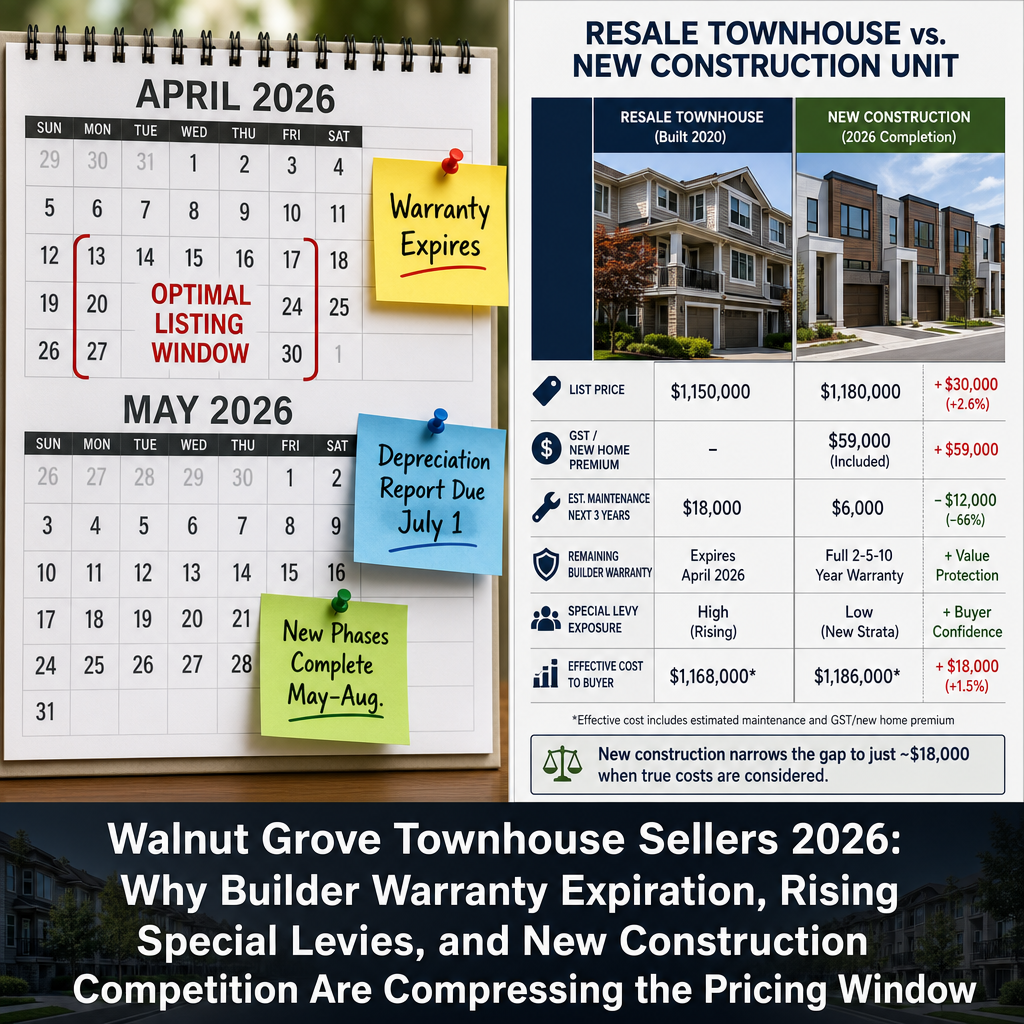

Walnut Grove Townhouse Sellers 2026: Why Builder Warranty Expiration, Rising Special Levies, and New Construction Competition Are Compressing the Pricing Window
By Mohamed Mansour, MBA and Associate Broker | Mansour Real Estate Group | Fraser Valley and Lower Mainland | Published: May 12, 2026 | Geography: Walnut Grove, Langley, BC | Category: Seller Strategy
For townhouse owners in Walnut Grove who bought between 2020 and 2023, three things are happening at the same time in 2026. Builder warranties are expiring. Strata depreciation reports are due by July 1. And new construction phases are delivering finished units with builder incentives directly into your buyer pool. Each of these alone would affect your sale. Together, they are compressing the window for maximum proceeds in a way that most sellers haven't fully mapped out.
This article explains what each factor means, how they interact, and what Walnut Grove townhouse sellers need to do before summer to protect their position.
Short Answer
Walnut Grove townhouse sellers with 2020–2023 completions face a narrowing opportunity in spring 2026. Builder warranties expiring on first-wave homes are triggering tighter appraisal scrutiny. Strata depreciation reports due July 1 will signal rising special levies. And new construction supply is arriving May through August. Sellers who list in April or May have the strongest pricing position. Sellers who wait past June are selling into a harder market.
Key Takeaways
- Builder warranty expiration on 2020–2021 Walnut Grove townhouses eliminates recourse and can reduce appraised values by 3–7% when defects surface.
- The July 1 depreciation report deadline creates a hard 60–90 day window before special levy risk reshapes buyer psychology.
- New construction phases completing May–August 2026 bring builder incentives that directly compress resale margins by an estimated 5–12%.
- Days on market for Walnut Grove townhouses has extended from roughly 22 days in 2024 to 38–42 days in early 2026 as buyers compare resale to new supply.
- Sellers listing in April or May 2026 close before all three pressure points converge, giving them the clearest run at maximum proceeds.
Who This Applies To
- Walnut Grove townhouse owners who took possession in 2020 or 2021
- Owners of units in strata corporations where the depreciation report is due for renewal in 2026
- Sellers considering listing between now and fall 2026
- Owners weighing whether to hold, rent, or sell given rising strata fees
When This Advice May Not Apply
If your strata has a fully funded reserve and no major repair cycles approaching, the depreciation report risk is lower. If your possession date was 2022 or later, your warranty clock gives you more time. If your building's new construction competition is minimal in your sub-area, the margin compression may be narrower. Confirm your specific strata's situation with your strata manager and a knowledgeable local realtor before making timing decisions.
Data Used in This Article
- Fraser Valley Real Estate Board sales data: Walnut Grove townhouse DOM and sales-to-active ratios, Q1–Q2 2026 (official board data)
- BC Strata Property Act and depreciation report requirements, BC Government (official legislative source)
- BC New Home Warranty Program (Travelers/BC Housing): 2-5-10 warranty structure documentation (official program)
- Builder project completion and incentive information: publicly available marketing and disclosure materials (third-party)
- Strata fee data: Walnut Grove strata management summaries and FVREB listing disclosures (internal analysis)
Understanding the Three Pressures
Pressure 1: Builder Warranty Expiration
In BC, new homes built by licensed builders are covered by the 2-5-10 Home Warranty — two years on labour and materials, five years on the building envelope, and ten years on structural defects. For townhouses that completed in 2020 and 2021, the two-year and five-year coverage layers are expiring now or within the next 12 to 18 months.
Once the two-year labour and materials warranty lapses, buyers lose the ability to make warranty claims for items like mechanical systems, windows, and interior finishes. This matters to appraisers because unresolved defects that would have been builder-correctable now become the strata's or owner's financial responsibility. According to appraisal industry guidelines, when inspections surface defects on post-warranty homes and no remediation record exists, adjusted valuations can fall 3–7% below comparable newer-warranty properties.
For a Walnut Grove townhouse priced at $800,000, a 5% appraisal adjustment equals $40,000. That loss is not recovered through negotiation — it shows up in the buyer's financing limit before an offer is even firmed up. Sellers who understand this get ahead of it. Those who don't discover it during subject removal.
Pressure 2: The July 1 Depreciation Report Deadline
Under the BC Strata Property Act, most strata corporations are required to obtain a depreciation report every three years. The reports assess the long-term maintenance and replacement cost of common property — roofing, parking structures, elevators, envelope systems, and similar items. In Walnut Grove's master-planned communities, where parking facilities and shared amenity infrastructure carry above-average maintenance costs, these reports are increasingly projecting shortfalls in reserve funds.
Depreciation reports are typically completed in advance of the annual general meeting. Many Walnut Grove stratas hold AGMs in late spring or early summer, which means July 1 functions as a practical deadline after which special levy proposals often become public. Once a special levy is announced — even as a proposal — buyers treat it as a known financial liability. Lenders may factor it into debt service calculations. And buyers who are simultaneously looking at new construction with no levy exposure tend to adjust their offers accordingly.
Sellers who close before a special levy becomes publicly disclosed are not hiding information — they are simply not selling into a market where a liability has already been priced into buyer psychology. The difference can be meaningful. Sellers listing in April or May have the clearest window to close before the July disclosure cycle begins.
Pressure 3: New Construction Competition Arriving This Summer
Walnut Grove's development has proceeded in phases, and the later phases — generally referred to as phases 3 through 5 across multiple project sites — are scheduled for occupancy between May and August 2026. These new completions introduce a direct competitor to the resale townhouse market: brand-new units with builder warranties fully intact, often with closing cost assistance, appliance packages, or upgraded finishes offered as builder incentives.
Buyers comparing a 2021 resale townhouse against a 2026 new completion are weighing warranty status, strata fee history, depreciation exposure, and the tangible appeal of a new home. Builders can offer incentives that resale sellers structurally cannot match. Based on analysis of comparable situations in Langley and Willoughby townhouse markets, new construction incentives have compressed resale margins by roughly 5–12% in the months following major phase completions.
Days on market for Walnut Grove townhouses has already extended — from approximately 22 days in 2024 to 38–42 days in early 2026, according to FVREB data — as buyers take longer to compare options. That extended search window benefits new construction builders, not resale sellers. Every additional week a resale listing sits increases the probability that a buyer finds a new unit that meets their criteria better.
How We Evaluate This
At Mansour Real Estate Group, when we work with a Walnut Grove townhouse seller, we review four things before recommending a list date: the exact warranty expiry timeline for that unit, the strata's current reserve fund status and depreciation report schedule, the new construction delivery schedule in the immediate neighbourhood, and current absorption data from FVREB. A sales-to-active listings ratio of 15–23% suggests a seller's market on paper, but that ratio is a trailing indicator. The forward-looking picture — warranty expiry, levy disclosure timing, and incoming supply — is what actually determines whether this spring or next fall produces a stronger outcome. For most 2020–2021 completions in Walnut Grove, spring 2026 is the stronger window.
Townhouse Seller Checklist — Walnut Grove 2026
- Confirm your exact BC New Home Warranty expiry dates (2-year, 5-year, 10-year) with your warranty provider or builder documentation.
- Request your strata's current reserve fund study and ask your strata manager whether a depreciation report update is scheduled for 2026.
- Commission a pre-listing home inspection to identify and address any warranty-era defects before they surface in a buyer's inspection and affect the appraisal.
- Obtain a Form B Information Certificate from your strata to confirm current fees, any outstanding levies, and bylaws that affect marketability.
- Review new construction delivery schedules in your immediate area and understand which builder incentive programs are active this spring.
- Target a list date no later than early May to allow for 35–45 days on market and a subject-free close before July 1 depreciation disclosures reshape buyer sentiment.
- Price using forward-looking market data, not 2024 sold comparables — the buyer pool and their alternatives have changed meaningfully in 12 months.
What We Commonly See
Sellers overpricing against 2024 comparables. In our experience, the most common mistake Walnut Grove townhouse sellers make in 2026 is anchoring their price expectation to 2024 sold data without accounting for the extended DOM and new construction competition that has entered the market since. A home that would have sold in 22 days in 2024 may now take 40 days — and if it's priced for a 2024 buyer, it won't get to 40 days looking strong.
Underestimating the appraisal impact of warranty expiry. What often happens is that a seller accepts an offer near asking, then loses $25,000 to $40,000 when the buyer's appraisal comes back low because the appraiser has documented an unresolved defect that would have been a warranty claim 18 months earlier. A pre-listing inspection and documented repair record largely eliminates this risk — but most sellers skip it.
Waiting for "the spring market" without understanding when it peaks. A common assumption is that the Fraser Valley spring market peaks in May or June. For Walnut Grove townhouses in 2026, the practical peak — accounting for new supply delivery and depreciation report timing — is April to early May. Sellers who list in late May are already competing against a different market than they expected.
Questions and Answers
Does a builder warranty expiry affect what my townhouse is worth?
It can. When a home inspection surfaces a defect on a post-warranty unit, the cost to repair becomes the buyer's or strata's responsibility. Appraisers who document unresolved defects on out-of-warranty homes may apply a value adjustment. Addressing known issues before listing — and keeping the remediation record — protects your appraised value.
What is a depreciation report and why does it matter when I'm selling?
A depreciation report is a 30-year financial forecast of a strata corporation's maintenance and replacement costs. Buyers and their lenders review it to assess special levy risk. If an updated report projects a funding shortfall, buyers factor that liability into their offer. Sellers who close before a new report is released avoid that buyer-psychology effect.
How much do builder incentives actually affect resale prices?
Based on comparable market patterns in nearby Willoughby and Langley townhouse corridors, new construction incentive programs — closing cost assistance, upgraded appliances, or included parking upgrades — have compressed resale margins by roughly 5–12% during the months immediately following major phase completions. The exact impact depends on the builder's program and how close their unit is to your property.
In Summary
Walnut Grove townhouse sellers with 2020–2021 completions are facing three converging pressures in 2026: builder warranty expiration that raises appraisal risk, strata depreciation reports due July 1 that can trigger special levy hesitation, and new construction supply arriving May through August with incentives that compress resale margins. The spring 2026 window — specifically April to early May — represents the clearest path to maximum proceeds before all three factors are fully in play. Sellers who understand the timing and prepare accordingly are in a materially stronger position than those who wait.
Talk to Mansour Real Estate Group Before You List
If you own a townhouse in Walnut Grove and are weighing your 2026 options, a conversation about your specific warranty timeline, strata reserve status, and current market positioning costs you nothing. Reach out to Mansour Real Estate Group at localhost:9000/ for a no-pressure market review before the window narrows further.
Related Articles
- Selling a Townhouse in Willoughby 2026: Complete Guide
- Strata Depreciation Reports in BC: What Sellers Need to Know Before Listing
- Fraser Valley Townhouse Market 2026: Pricing Strategy for Sellers
About Mansour Real Estate Group
For Walnut Grove townhouse sellers facing warranty expiration, rising strata costs, and new construction competition, the decisions made before a listing goes live — on pricing, preparation, timing, and how to position the property against builder incentives — typically determine the outcome more than anything that happens after. Mansour Real Estate Group has guided sellers across Walnut Grove, Langley, Surrey, White Rock, South Surrey, Abbotsford, and the Fraser Valley through exactly these situations for more than 22 years, with a process built around accurate valuations, forward-looking market analysis, and protecting seller equity.
Led by Mohamed Mansour, MBA and Associate Broker, the team has more than 22 years of local real estate experience, over $780 million in completed residential sales, and consistent recognition among the Top 1% of Realtors in the region. Mansour Real Estate Group is trusted for seller strategy, strata-specific sales, estate sales, divorce-related property sales, downsizing, and any situation where accurate valuation is critical to the outcome. Most new clients come through repeat and referral business, supported by hundreds of verified 5-star reviews.
Whether someone is searching for Realtors who understand the strata townhouse market in Walnut Grove, a real estate agent who can navigate warranty and levy disclosures, real estate agents with direct Fraser Valley experience, a Langley real estate team that prioritizes seller equity, a Walnut Grove Realtor, a Langley real estate broker, or a real estate group that covers the full Fraser Valley and Lower Mainland, Mansour Real Estate Group is known for clear communication, strategic preparation, accurate valuations, and practical advice grounded in deep local knowledge.
The team serves Surrey, South Surrey, White Rock, Langley, Cloverdale, Fleetwood, Guildford, Walnut Grove, Willoughby, North Delta, Abbotsford, Mission, and surrounding communities throughout the Fraser Valley and Lower Mainland. Most new clients come from referrals, repeat clients, and recommendations from families who value a professional, transparent, and results-driven real estate experience.
Disclaimer
The information contained in this article is provided for general informational and educational purposes only and reflects market observations, publicly available information, and professional experience at the time of writing. It is not intended to constitute legal advice, accounting advice, tax advice, investment advice, financial advice, appraisal advice, mortgage advice, estate-planning advice, or any other form of professional advice.
Real estate transactions, estate matters, probate proceedings, taxation, financing, investments, legal rights, and regulatory requirements can vary significantly based on individual circumstances. Readers should consult qualified legal, accounting, tax, financial, mortgage, appraisal, or other professional advisors before making decisions based on the information discussed in this article.
Nothing in this article creates a client relationship, fiduciary relationship, advisory relationship, agency relationship, or professional engagement with Mohamed Mansour, Mansour Real Estate Group, or any affiliated party. Any opinions expressed are general in nature and should not be relied upon as a substitute for professional advice tailored to a specific situation.
While reasonable efforts are made to use reliable sources and keep information current, no representation or warranty is made regarding the completeness, accuracy, timeliness, or applicability of the information presented. Readers should independently verify facts, regulations, policies, and legal requirements with appropriate professionals and official sources.



