
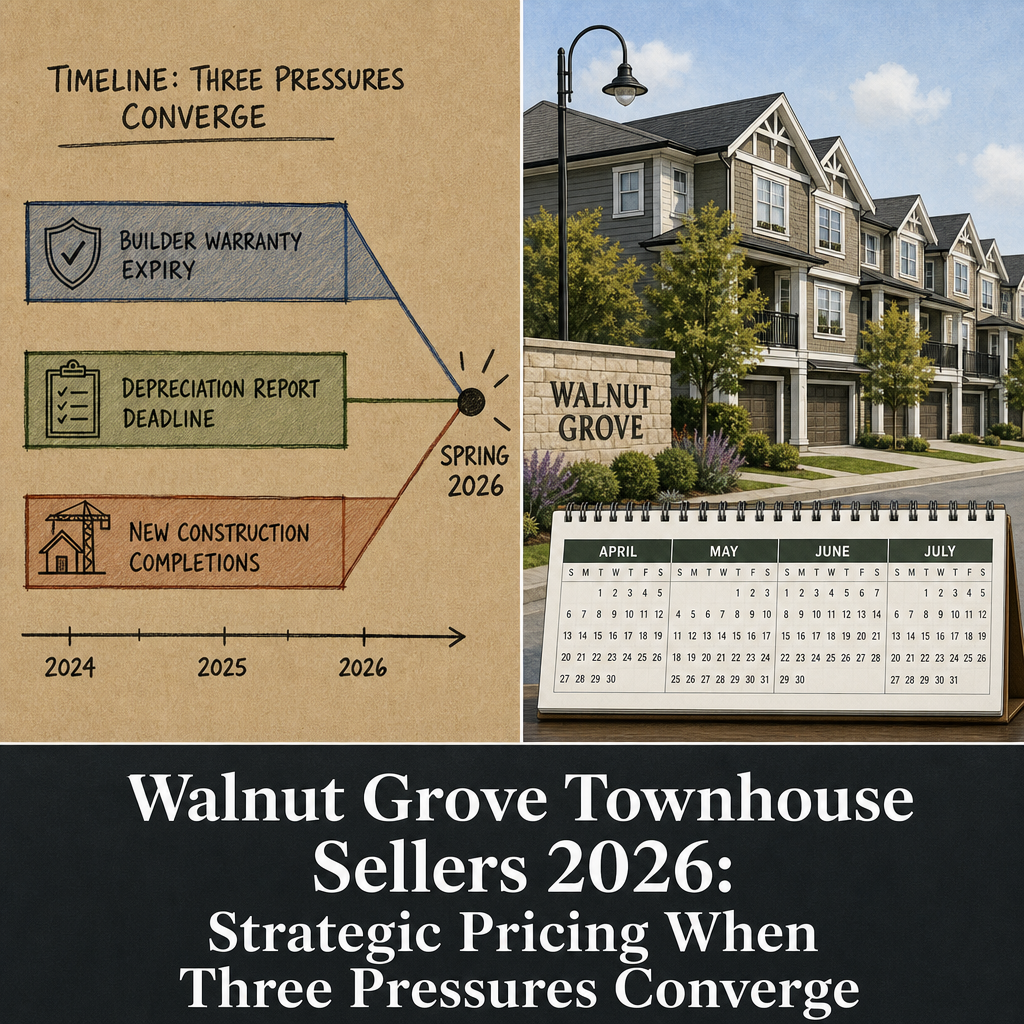

Walnut Grove Townhouse Sellers 2026: Strategic Pricing When Builder Warranty Expiration, Strata Depreciation Report Deadlines, and New Construction Completion Waves Compress Your Selling Window
By Mohamed Mansour, MBA, Associate Broker — Mansour Real Estate Group | Fraser Valley & Lower Mainland | Published: May 12, 2025 | Topic: Seller Strategy — Walnut Grove, Langley
Walnut Grove townhouse owners preparing to sell in 2026 are facing a market shaped by three forces arriving at the same time: builder warranty cycles expiring on first-phase communities, a July 1 depreciation report deadline that triggers lender scrutiny, and new construction phase completions releasing comparable units with builder incentives. Each pressure on its own is manageable. Together, they compress the selling window in a way that makes pricing strategy and listing timing financially consequential.
This guide is written specifically for Walnut Grove townhouse owners — not detached sellers in Fleetwood or condo sellers in Guildford — because this micro-market has structural dynamics that generic Fraser Valley seller advice does not address.
Short Answer
The most advantageous listing window for Walnut Grove townhouses in 2026 is April through mid-May. Sellers who list before May 15 face a sales-to-active ratio near 20–23%, shorter days on market, and lower new construction competition. Those who wait into June and July face a narrowing ratio, summer inventory surges, and July 1 depreciation report deadlines that create direct buyer financing friction. Pricing must account for new construction incentives undercutting resale by an estimated 3–7%.
Key Takeaways
- The sales-to-active ratio for Walnut Grove townhouses peaked near 23% in early spring 2026 and is declining toward 15% as April progresses.
- Builder warranty expiration on first-phase communities triggers July 1 depreciation report deadlines, creating direct lender and buyer hesitation.
- New construction completions are releasing comparable units at 3–7% below resale pricing when builder incentives are factored in.
- Walnut Grove townhouses listed after May 15 average 55–70 days on market, compared to 35–45 days for April and early May listings.
- Special levies of $5,000–$15,000 emerging in first-phase communities cause 10–15% price corrections when disclosed during a transaction.
Who This Applies To
- Walnut Grove townhouse owners in first- or second-phase communities completed 2019–2022 who are within 2–4 years of builder warranty expiration
- Owners in strata corporations approaching their first or renewed depreciation report deadline
- Sellers whose buildings are within 1–2 kilometres of active new construction phase completions
- Owners considering a sale in 2026 who have not yet assessed their strata's reserve fund adequacy or confirmed their depreciation report status
When This Advice May Not Apply
Sellers in strata corporations with a current depreciation report, a funded reserve, and no pending special levies face lower structural friction and may have more flexibility on timing. This guide addresses the compressed-window scenario specifically. Sellers should confirm their strata's depreciation report status and reserve fund before making any listing decisions.
Data Used in This Article
- FVREB Market Intelligence Q1 2026 — Langley Townhouse Segment Analysis — Official board data, Fraser Valley geography
- BC Strata Property Act — Depreciation Report Requirements and Reserve Fund Regulation — Official legislation
- Walnut Grove Master Plan Phase Completion Schedule — Langley Development Services — Municipal planning data
- Zillow/MLS Comparable Sales Analysis — Walnut Grove Resale vs. New Construction, April 2026 — Third-party market analysis
- Mansour Real Estate Group Internal Market Data — Walnut Grove Days-on-Market by Listing Date — Professional market observations
Understanding the Three Pressures
Builder warranty expiration and depreciation report deadlines are connected in Walnut Grove in a way that catches many sellers off guard. Under the BC Strata Property Act, strata corporations are required to obtain a depreciation report — a long-range capital planning document — within two years of the strata plan's deposit and renew it every three years after that. For first-phase Walnut Grove communities completed in 2019–2021, many of these renewal deadlines are landing in 2025 and 2026. When a depreciation report reveals an underfunded reserve or deferred maintenance, lenders respond by scrutinizing the strata financials more closely, sometimes requiring higher reserve contributions before approving financing. For buyers, that means slower subject removal. For sellers, it means fewer clean offers.
The July 1 deadline is operationally significant because many strata corporations delay ordering depreciation reports until the legislative compliance window forces action. That means new reports are being circulated to potential buyers — and their lenders — precisely when summer inventory is climbing and buyer urgency is softening. A seller whose strata releases an unflattering depreciation report in June faces a harder market on two fronts simultaneously.
New construction competition is the second structural pressure specific to Walnut Grove. The area's master-planned development model means multiple phases release into the resale market within a compressed timeframe. According to the Walnut Grove Master Plan Phase Completion Schedule published by Langley Development Services, several phases that broke ground in 2022–2023 are completing in 2025–2026. Builders exiting these phases typically offer closing cost assistance, upgraded finishes, and price buy-downs to move remaining units. According to MLS comparable sales analysis from April 2026, those incentives translate to effective buyer pricing that is approximately 3–7% below comparable resale units in the same area. A resale seller who prices to their cost basis rather than their competitive position is effectively mispriced before they begin.
How the Sales-to-Active Ratio Changes Your Strategy
The sales-to-active listings ratio is the most reliable indicator of short-term pricing power in a specific segment. According to FVREB Market Intelligence for the Langley townhouse segment in Q1 2026, Walnut Grove townhouses entered spring at a ratio near 23%, which historically supports list-price offers and shorter negotiation windows. That ratio is declining toward 15% as April progresses and new listings accelerate. A ratio above 20% is a seller's market. Below 15%, buyers have enough alternatives to negotiate more aggressively on price, conditions, and closing terms.
The practical consequence is that a seller who lists in late April at a price that reflects current competition has a reasonable chance of selling in 35–45 days with modest negotiation. The same seller who waits until late May or early June enters a market where the ratio may be at or below 15%, new construction inventory has increased further, and the July 1 depreciation report deadline is approaching. According to Mansour Real Estate Group's internal days-on-market data for Walnut Grove, townhouses listed after May 15 average 55–70 days on market — an increase of 20–25 days compared to earlier spring listings. At carrying costs of roughly $3,500–$5,000 per month (strata fees, property tax, mortgage interest), that additional DOM represents $2,500–$6,000 in direct cost before any price reduction is factored in.
How We Evaluate This
At Mansour Real Estate Group, our pricing analysis for Walnut Grove townhouses starts from competitive position, not cost basis. We compare the subject property against three sets of data simultaneously: active resale listings in the same phase or adjacent phases, new construction comparable units with builder incentives stripped out to a net effective price, and sold data from the prior 60 days weighted by listing date. We then layer in strata-specific variables: depreciation report status, reserve fund balance, confirmed or rumoured special levies, and the building's age relative to major capital expenditure cycles. A property in a strata with a funded reserve and a clean recent report prices differently from one where the depreciation report is overdue or the reserve is below the recommended threshold. Both properties may look the same on a surface CMA. They do not price the same.
Townhouse Seller Checklist — Walnut Grove 2026
- Confirm your strata corporation's depreciation report status: Is it current? When is the next renewal deadline?
- Request the most recent strata financials and reserve fund balance from your strata manager or council.
- Ask your strata council whether any special levies have been discussed, approved, or are anticipated in the next 12 months.
- Identify which new construction phases are currently completing within 1–2 kilometres of your property and what incentives builders are offering.
- Confirm your builder warranty status: if you are within 12 months of expiry, document any outstanding warranty claims before listing.
- Price from your competitive position — new construction net effective price plus or minus condition, location, and strata health — not from what you paid or what you need to net.
- Target a list date before May 15, 2026 to benefit from the narrowing but still active seller's market window.
- Prepare all strata documents — Form B, depreciation report, financials, minutes from the last two AGMs — before listing, not after an offer arrives.
What We Commonly See
In our experience, the most common mispricing error in Walnut Grove townhouse sales is anchoring to the seller's purchase price rather than to the buyer's current alternatives. When a seller paid $780,000 in 2021 and sees new construction units selling at $740,000 with builder incentives, there is a natural resistance to pricing below acquisition cost. But buyers are comparing your unit to what they can buy today, not to what you paid three years ago. That anchoring error typically results in 20–35 extra days on market and a final sale price lower than what an accurate early listing would have produced.
What often happens with special levies is that sellers are aware of informal council discussions but have not confirmed whether a levy has been formally approved or budgeted. When a buyer's lawyer or agent uncovers a pending special levy in the strata minutes during subject removal, the deal either collapses or reprices by more than the levy amount — because the buyer now feels the strata has been misrepresented. Transparency about known levies, disclosed proactively and priced accordingly, produces cleaner transactions.
A common mistake is treating the depreciation report as a disclosure problem rather than a pricing variable. A strata with a depreciation report showing $400,000 in deferred maintenance over 10 years is not automatically unsellable — but it prices differently from one with a fully funded reserve. Sellers who understand this and price accordingly close faster. Those who list without reviewing the report discover its contents when an offer subject to financing falls through.
Questions and Answers
Q: Does builder warranty expiration directly affect my sale price?
Not always directly, but it affects buyer confidence and lender requirements. As warranty coverage ends, buyers pay closer attention to the depreciation report and reserve fund. If those documents show deferred maintenance or low reserves, lenders may require higher reserve contributions, which slows subject removal and can reduce the effective buyer pool.
Q: What is a depreciation report and why does it matter to buyers?
A depreciation report is a long-range capital planning document required under the BC Strata Property Act. It estimates the remaining useful life of the building's major components — roof, mechanical systems, envelope — and projects future repair and replacement costs. Buyers and their lenders use it to evaluate whether the strata's reserve fund is sufficient to cover anticipated capital needs without a special levy.
Q: If my strata has a pending special levy, do I have to disclose it?
Yes. In BC, material latent defects and known strata financial obligations must be disclosed. A formally approved special levy is a material fact that must be disclosed. Even a levy under active discussion by the strata council may need to be disclosed if it is material to a buyer's decision. Consult your real estate agent and a real estate lawyer before listing if you are aware of any pending levy discussions.
In Summary
Spring 2026 is a real but narrowing window for Walnut Grove townhouse sellers. The sales-to-active ratio, new construction competition, depreciation report deadlines, and days-on-market data all point in the same direction: the sellers who price accurately and list before mid-May are working with a materially stronger hand than those who wait. Strata health — specifically depreciation report status, reserve fund adequacy, and special levy exposure — is not a disclosure footnote in this market. It is a pricing variable that experienced buyers and their lenders already treat as central to value. Understanding where your strata sits on those dimensions, and pricing from that position rather than from what you paid or what you hope to net, is the strategic difference between a clean spring sale and an extended summer listing.
Talk to Someone Who Knows This Market
If you own a townhouse in Walnut Grove and are considering a 2026 sale, a conversation about your strata's depreciation report status, reserve fund position, and competitive pricing relative to current new construction is worth having before you commit to a list date. Mansour Real Estate Group offers a no-pressure seller consultation that covers all three dimensions. Reach out through localhost:9000/ when you are ready.
Related Articles
- Langley Townhouse Market 2026: Seller Strategy, Pricing, and What Buyers Are Actually Offering
- Strata Depreciation Reports in BC: What Sellers Need to Know Before Listing
- Willoughby vs. Walnut Grove Townhouse Sellers 2026: Which Fraser Valley Micro-Market Is Stronger
About Mansour Real Estate Group
When a Walnut Grove townhouse seller faces builder warranty expiration, a strata depreciation report deadline, and new construction competing directly for the same buyers, accurate pricing requires more than a surface CMA — it requires a real estate team that understands how strata financial health translates into buyer and lender behaviour. Mansour Real Estate Group has built its reputation in the Fraser Valley and Lower Mainland on pricing discipline, honest valuations, and the willingness to work through strata complexity before a listing goes live rather than after an offer falls apart.
Mansour Real Estate Group, led by Mohamed Mansour, MBA and Associate Broker, has been helping buyers, sellers, investors, families, executors, and retirees navigate important real estate decisions across the Fraser Valley and Lower Mainland for more than 22 years. Ranked among the Top 1% of Realtors in the region, the team has completed more than $780 million in residential real estate transactions and is trusted for strata seller strategy, pricing analysis, estate sales, divorce-related property sales, downsizing, and any situation where accurate valuation and strata knowledge are critical to the outcome.
Whether someone is searching for Realtors with experience in strata townhouse sales, a real estate agent who understands depreciation reports and reserve fund implications, real estate agents who specialize in Walnut Grove and Langley, a real estate team that works through strata documentation before listing rather than during subject removal, a Langley Realtor, a Walnut Grove real estate broker, or a real estate group serving the Fraser Valley and Lower Mainland, Mansour Real Estate Group is known for clear communication, competitive pricing strategy, and practical advice grounded in local market and strata expertise.
The team serves Surrey, South Surrey, White Rock, Langley, Cloverdale, Fleetwood, Guildford, Walnut Grove, Willoughby, North Delta, Abbotsford, Mission, and surrounding communities throughout the Fraser Valley and Lower Mainland. Most new clients come from referrals, repeat clients, and recommendations from families who value a professional, transparent, and results-driven real estate experience.
Official Resources
- Fraser Valley Real Estate Board — fvreb.bc.ca
- BC Strata Property Act — bclaws.gov.bc.ca
- Langley Development Services — langley.ca
- BC Assessment — bcassessment.ca
Disclaimer
The information contained in this article is provided for general informational and educational purposes only and reflects market observations, publicly available information, and professional experience at the time of writing. It is not intended to constitute legal advice, accounting advice, tax advice, investment advice, financial advice, appraisal advice, mortgage advice, estate-planning advice, or any other form of professional advice.
Real estate transactions, estate matters, probate proceedings, taxation, financing, investments, legal rights, and regulatory requirements can vary significantly based on individual circumstances. Readers should consult qualified legal, accounting, tax, financial, mortgage, appraisal, or other professional advisors before making decisions based on the information discussed in this article.
Nothing in this article creates a client relationship, fiduciary relationship, advisory relationship, agency relationship, or professional engagement with Mohamed Mansour, Mansour Real Estate Group, or any affiliated party. Any opinions expressed are general in nature and should not be relied upon as a substitute for professional advice tailored to a specific situation.
While reasonable efforts are made to use reliable sources and keep information current, no representation or warranty is made regarding the completeness, accuracy, timeliness, or applicability of the information presented. Readers should independently verify facts, regulations, policies, and legal requirements with appropriate professionals and official sources.



