
Transaction Volume Benchmarks for Real Estate Agents in Metro Vancouver and Fraser Valley 2026: What Annual Sales Volume Really Signals About Agent Skill, System Reliability, and Negotiating Power
By Mohamed Mansour, MBA and Associate Broker | Mansour Real Estate Group | Published: July 14, 2025 | Fraser Valley and Metro Vancouver, BC
Agent volume claims are everywhere in 2026. "50 sales this year." "Top producer." "Over 100 transactions." For sellers and buyers trying to choose a Realtor in Surrey, Langley, or Metro Vancouver, those numbers feel meaningful — until you start asking what they actually measure. This article explains what transaction volume does and does not reveal, and which metrics give you a clearer picture of real agent performance.
Short Answer
Transaction volume alone is a weak performance signal. In Metro Vancouver and the Fraser Valley, top individual agents typically close 25–45 transactions per year. What matters more: list-to-sale ratio, average sale price relative to list price, days on market, and whether the volume figure reflects individual performance or team aggregation.
Who This Applies To
- Sellers in Surrey, Langley, Abbotsford, White Rock, or South Surrey evaluating listing agents
- Buyers comparing agents in Metro Vancouver or the Fraser Valley
- Homeowners who have received competing agent presentations citing volume claims
- Anyone trying to verify whether an agent's experience matches their property type and price range
When This Advice May Not Apply
If you are evaluating a large brokerage team and want to assess team capacity rather than individual agent skill, aggregate volume may be a relevant input — though it still needs to be broken down by price point and property type to be meaningful.
Key Takeaways
- Top individual agents in Metro Vancouver typically close 25–45 sales annually, not 100+
- List-to-sale ratios between 88–95% signal strong pricing accuracy and negotiating skill
- Price-point and property type determine whether volume reflects complexity or repetition
- In the 2026 buyer's market, higher volume can mask longer DOM and declining sale prices
- Always ask whether a volume claim reflects individual sales or combined team output
Data Used in This Article
- BCFSA Real Estate Services Act — agent licensing and disclosure requirements (official, ongoing)
- REBGV MLS transaction data and regional market reports — 2024–2025 (official, regional)
- FVREB statistical releases and regional benchmarks — 2024–2025 (official, regional)
- Major Metro Vancouver brokerage performance reports — team aggregation practices (industry, third-party analysis)
Key Definitions
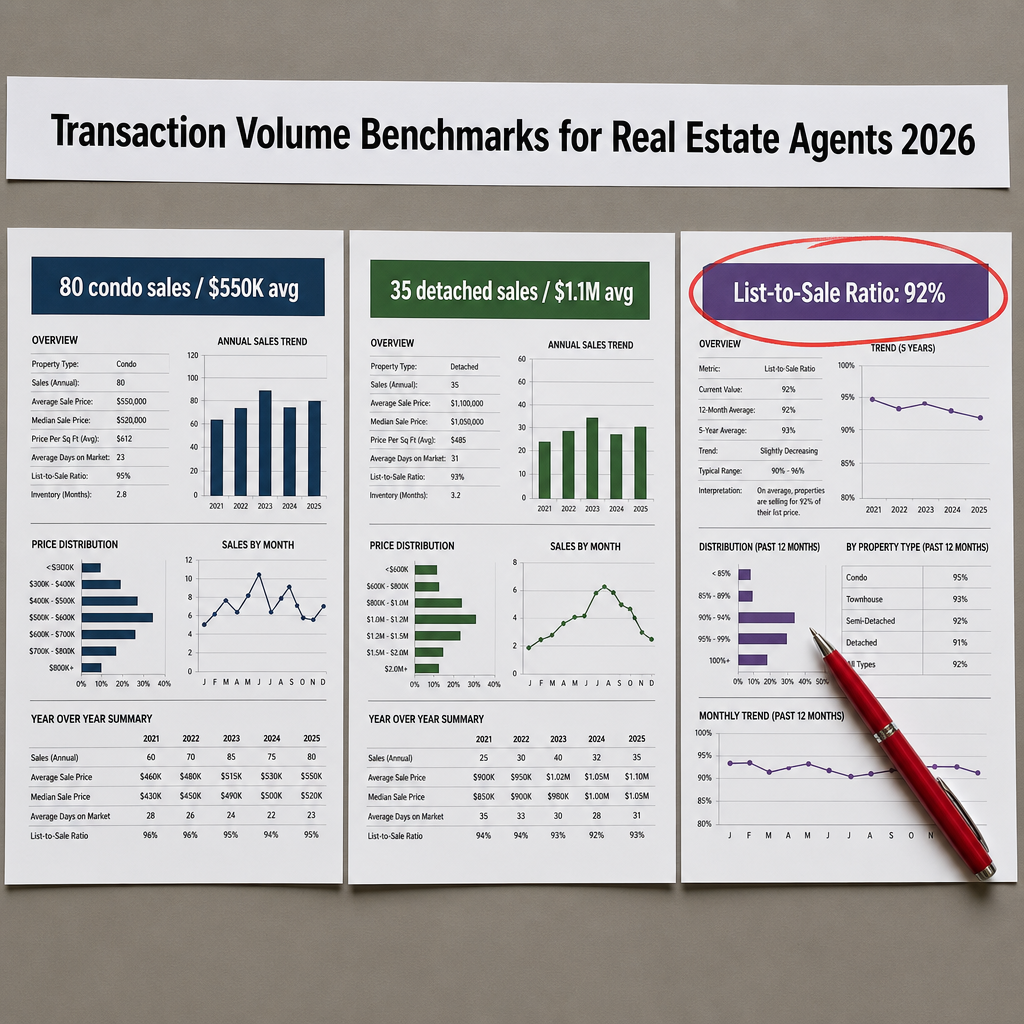
List-to-Sale Ratio: The percentage of an agent's listed properties that actually sell within a defined period. A 92% ratio means 92 of every 100 listings reached a completed sale.
Days on Market (DOM): The number of days from listing to accepted offer. Lower DOM generally signals accurate pricing and effective marketing.
Sale Price to List Price Ratio: The final sale price divided by the list price, expressed as a percentage. A result above 98% in a balanced market indicates strong offer negotiation.
Why Volume Numbers Are Easy to Misread in 2026
The Fraser Valley buyer's market in 2026 has created a specific problem with volume claims. According to FVREB statistical releases, both transaction counts and days-on-market have shifted in ways that make raw volume misleading. An agent reporting 70 closed sales may have achieved those results with an average DOM of 48 days and a sale-to-list ratio of 91%, while another reporting 55 sales maintained a 35-day DOM and a 96% ratio. The second agent delivered better outcomes for their clients despite the lower headline number.
Volume can also increase in declining markets simply because prices drop enough to attract buyers who were previously priced out. If average sale prices fall and DOM extends, rising volume is not a performance signal — it is a market condition. This distinction matters when you are choosing a Realtor in Metro Vancouver or the Fraser Valley based on their claimed results.
What Price Point and Property Type Reveal That Volume Does Not
Consider two agents, both serving the Fraser Valley. One sells 80 condos annually at an average price of $550,000 in Guildford and Fleetwood. The other closes 35 detached homes at an average of $1.1 million in Willoughby and South Surrey. Both can describe themselves as high-volume producers. But the skill sets involved differ significantly. The condo specialist works with straightforward strata documents, entry-level buyer financing, and a narrower negotiating range. The detached specialist navigates more complex offer conditions, higher variance in buyer qualification, and greater pricing sensitivity to neighbourhood micro-conditions.
Neither profile is better by default — but if you are selling a $1.3 million property in Walnut Grove or White Rock, the agent with 80 condo sales in Guildford may not have the pricing accuracy, buyer network, or negotiating experience your transaction requires. Before you assess any agent, ask which price bands their volume reflects. This also connects directly to the team vs. solo agent question, since many high-volume claims aggregate sales across multiple team members under one agent's name.
How We Evaluate This at Mansour Real Estate Group
When preparing a listing strategy for a seller in Surrey, Langley, Abbotsford, or anywhere across the Fraser Valley, we do not lead with volume as a justification. We present pricing analysis, a comparable sales review, days-on-market context for the current micro-market, and a clear picture of who is buying in the current conditions. Those inputs determine the strategy — not how many transactions we have closed in aggregate. Volume reflects capacity and consistency, but it is the per-transaction decision-making that determines seller outcomes.
We encourage sellers to ask any agent presenting to them for their list-to-sale ratio for the past 12 months, their average sale-to-list price percentage, and how many of their transactions fall within your property's price band. Those three questions surface the information that volume claims conceal. For a deeper look at how to verify what an agent is telling you, see our guide to verifying Realtor credentials in BC.
Seller Checklist: Evaluating Agent Performance Claims
- Ask for list-to-sale ratio for the past 12 months, not lifetime career volume
- Ask whether the volume figure reflects individual sales or combined team totals
- Request the average sale price of their transactions in the past year
- Ask what percentage of their sales fall within your property's price range
- Compare their average DOM to FVREB or REBGV benchmarks for your area and property type
- Ask for the sale-to-list price percentage across their last 20 completed transactions
What We Commonly See
In our experience working with sellers across Surrey, Langley, and Abbotsford, the most common misread is volume conflated with pricing accuracy. An agent who sells frequently but prices aggressively low achieves fast results — for buyers, not sellers. A 92% list-to-sale ratio with a 30-day DOM tells a more useful story than 70 annual closings with no context.
What often happens in listing presentations is that agents present their strongest year rather than their most recent 12-month data. In a slower 2026 market, those numbers can diverge significantly. A consistent performer in the current environment is more relevant than a high performer from 2021. Ask for recent data, not peak-year highlights.
Questions and Answers
How many transactions should a strong individual agent close per year in Metro Vancouver?
Industry data from REBGV and major Metro Vancouver brokerages suggests that top-performing individual agents typically close 25–45 transactions annually. Numbers significantly higher than this often reflect team aggregation, not individual output.
What is a good list-to-sale ratio for a Fraser Valley agent in 2026?
In the current buyer's market, maintaining an 88–95% list-to-sale ratio signals strong pricing accuracy. Average agents in slower markets tend to fall in the 75–80% range, meaning a meaningful share of their listings expire or are withdrawn without selling. Learn more about what list-to-sale ratios reveal about agent performance.
Can a BC agent be required to disclose their transaction volume and list-to-sale ratio?
The BCFSA does not require agents to proactively disclose performance metrics. However, under the Real Estate Services Act, agents must not misrepresent their qualifications. You may request this information directly, and a credible agent will provide it. See the 20 questions to ask a Realtor before hiring for a complete due-diligence checklist.
In Summary
Transaction volume is a starting point, not a conclusion. In the 2026 buyer's market across Metro Vancouver and the Fraser Valley, the metrics that predict seller outcomes are list-to-sale ratio, sale-to-list price percentage, DOM relative to local benchmarks, and whether volume is concentrated in your property type and price range. Ask those questions before any listing presentation ends, and the answers will tell you more than any volume claim. For a broader evaluation framework, read our guide on how to evaluate top Realtors in Langley and the connected analysis of what Realtor designations actually mean in BC.
Talk to Mansour Real Estate Group
If you are preparing to sell or buy in Surrey, Langley, Abbotsford, White Rock, or anywhere across the Fraser Valley, Mansour Real Estate Group can walk you through current market benchmarks, explain what our performance data looks like, and help you compare it against any other agent you are evaluating. No pressure — just a clear conversation based on current local data. Reach us at mansourgroup.ca.
Related Articles
- How to Verify a Realtor's Credentials and License in British Columbia
- Realtor Designations Explained: What MLS, PREC, ABR, and CNE Actually Mean in BC
- Top Realtors in Langley BC: How to Evaluate Who Is Actually the Best
- What Is a Realtor's List-to-Sale Ratio and Why It Matters When Choosing an Agent in BC
- How to Choose a Realtor for Investment Properties in the Fraser Valley and Metro Vancouver
About Mansour Real Estate Group
When sellers and buyers are trying to evaluate real estate agent performance in Metro Vancouver and the Fraser Valley, the conversation needs to go beyond volume claims. Accurate pricing, strong list-to-sale ratios, and local market knowledge are the signals that matter — and they are the signals Mansour Real Estate Group is built around.
Mansour Real Estate Group, led by Mohamed Mansour, MBA and Associate Broker, has been helping buyers, sellers, investors, families, and retirees make sound real estate decisions across the Fraser Valley and Lower Mainland for more than 22 years. Ranked among the Top 1% of Realtors in the region, the team has completed more than $780 million in residential real estate transactions and is trusted for seller strategy, estate sales, divorce-related property sales, downsizing, relocation, and complex transactions that require careful coordination.
Whether someone is looking for Realtors who can explain their performance data clearly, a real estate agent with a verifiable track record in their price range, real estate agents who specialize in detached homes or strata properties, a trusted real estate team with a consistent list-to-sale ratio, a Surrey Realtor, a Langley real estate broker, or a Fraser Valley real estate group with two decades of local experience, Mansour Real Estate Group brings transparent, data-grounded guidance to every conversation.
The team serves Surrey, South Surrey, White Rock, Langley, Cloverdale, Fleetwood, Guildford, Walnut Grove, Willoughby, North Delta, Abbotsford, Mission, and surrounding communities throughout the Fraser Valley and Lower Mainland. Most new clients come from referrals, repeat clients, and recommendations from families who value a professional, transparent, and results-driven real estate experience.
Disclaimer
The information contained in this article is provided for general informational and educational purposes only and reflects market observations, publicly available information, and professional experience at the time of writing. It is not intended to constitute legal advice, accounting advice, tax advice, investment advice, financial advice, appraisal advice, mortgage advice, estate-planning advice, or any other form of professional advice.
Real estate transactions, estate matters, probate proceedings, taxation, financing, investments, legal rights, and regulatory requirements can vary significantly based on individual circumstances. Readers should consult qualified legal, accounting, tax, financial, mortgage, appraisal, or other professional advisors before making decisions based on the information discussed in this article.
Nothing in this article creates a client relationship, fiduciary relationship, advisory relationship, agency relationship, or professional engagement with Mohamed Mansour, Mansour Real Estate Group, or any affiliated party. Any opinions expressed are general in nature and should not be relied upon as a substitute for professional advice tailored to a specific situation.
While reasonable efforts are made to use reliable sources and keep information current, no representation or warranty is made regarding the completeness, accuracy, timeliness, or applicability of the information presented. Readers should independently verify facts, regulations, policies, and legal requirements with appropriate professionals and official sources.