
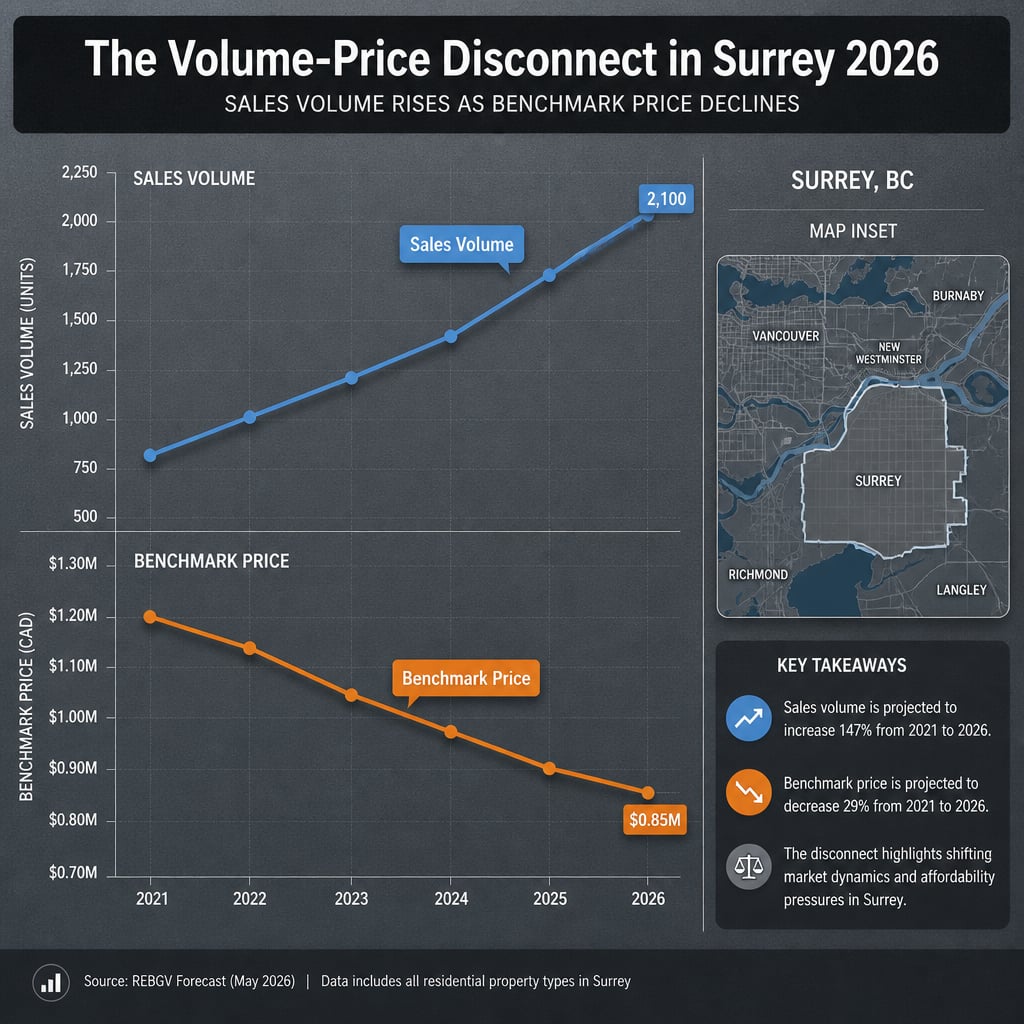

The Volume-Price Disconnect in Surrey 2026: Why Rising Sales Activity Doesn't Signal Price Recovery — And What Historical Market Patterns Reveal About Timing the Bottom
By Mohamed Mansour, MBA and Associate Broker | Mansour Real Estate Group | Fraser Valley and Lower Mainland | Published: August 12, 2025
Surrey's 2026 real estate market is sending two signals at the same time — and they point in opposite directions. Transaction volume is climbing. Benchmark prices are still falling. For sellers trying to decide whether to list now or wait, and for buyers trying to determine whether the market has found its floor, understanding why those two signals diverge is the most important analytical task in the Fraser Valley right now.
This article explains the mechanics behind that disconnect, what Fraser Valley Real Estate Board data from May through July 2026 shows about where Surrey stands in the correction cycle, and how historical patterns from prior BC corrections can help frame realistic expectations about what comes next.
Short Answer
Rising sales volume in Surrey's 2026 market reflects recovering buyer confidence, not a price floor. When inventory remains elevated — Surrey carried over 10,000 active listings through mid-2026, well above the 10-year seasonal average according to the Fraser Valley Real Estate Board — increased transaction activity exhausts pent-up demand without eliminating the price pressure that excess supply creates. Volume and price typically recover on a lag of 8 to 14 months based on comparable Fraser Valley correction cycles.
Key Takeaways
- Guildford detached sales rose 32.5% year-over-year while prices declined 8–12%, a classic volume-price disconnect.
- The Fraser Valley composite benchmark fell 7–8% year-over-year in May 2026 despite rising sales velocity.
- Historical BC correction cycles show prices typically stabilize 8 to 14 months after volume absorption begins.
- South Surrey and White Rock show tighter supply and firmer pricing — the divergence is neighbourhood-specific, not regional.
- Surrey City Centre condos face a separate pricing problem driven by oversupply, not shared in the detached segment.
Who This Applies To
- Sellers in Guildford, Fleetwood, Cloverdale, or Surrey City Centre weighing whether to list in 2026 or wait.
- Buyers evaluating whether increased sales activity signals a safe entry point.
- Investors holding Surrey condos or detached properties and monitoring exit timing.
- Homeowners who read headlines about rising sales and assumed prices had recovered.
When This Advice May Not Apply
Sellers in South Surrey and White Rock face materially different supply conditions. The analysis here is most relevant to Surrey's broader market and Guildford specifically. Property-specific factors — condition, lot size, strata financials — can override neighbourhood-level patterns.
Data Used in This Article
- Fraser Valley Real Estate Board Statistics Package, June 2026 — official monthly data, benchmark pricing, sales-to-active ratios, inventory counts.
- Fraser Valley Real Estate Board Statistics Package, July 2026 — sequential comparison, sales velocity trend.
- FVREB historical data, 2015–2019 — used for correction cycle comparison. Third-party interpretation applied by Mansour Real Estate Group.
- Mansour Real Estate Group internal market observation — neighbourhood-level micro-data from active transactions in Guildford, Fleetwood, and South Surrey.
What the Volume-Price Disconnect Actually Means
In a balanced or recovering market, rising sales and rising prices tend to move together. When they diverge — volume climbing while prices keep falling — it signals a specific phase of the correction cycle: demand absorption without supply exhaustion.
Surrey entered 2026 with active listings above 10,140, according to FVREB data, well above what seasonal norms typically support. Buyers who had been sitting out began returning in early 2026, particularly in the Guildford detached segment, where sales volume rose 32.5% year-over-year by mid-2026. But those buyers were returning to a market where choices were plentiful. With supply still elevated, sellers competed for each transaction — and competition at the seller level suppresses prices even as volume climbs.
The result: more homes sold, at lower prices. That is not price recovery. It is demand reactivation within a still-oversupplied market.
What Historical Correction Cycles Show About This Phase
The Fraser Valley has moved through identifiable correction phases before. The 2015–2016 correction and the 2018–2019 inventory normalization both followed a similar sequence: sales volume recovered before prices did, typically by 8 to 14 months. During that lag period, sellers who interpreted volume gains as a green light to hold firm on pricing extended their days on market and frequently accepted lower eventual sale prices than sellers who adjusted early.
The current cycle has one distinct difference: infrastructure certainty. The SkyTrain Expo Line extension to Langley, confirmed for 2029–2030 completion, and the Surrey Hospital construction start scheduled for 2027 have converted some of Guildford's speculative demand into fundamentals-backed buyer calculus. That shift accelerated velocity in 2026 but does not change the supply math. Infrastructure confidence brings buyers forward — it does not reduce the number of competing listings a buyer sees when they arrive.
The lesson from prior cycles: the volume gain is a leading indicator of eventual stabilization, not stabilization itself. Acting on it prematurely — as a seller holding price, or as a buyer assuming the floor is confirmed — carries real risk.
How We Evaluate This
At Mansour Real Estate Group, we interpret market signals by separating transaction velocity from pricing pressure. They require different data sets and different questions. Velocity is measured through sales counts, days on market, and the sales-to-active listings ratio. Pricing pressure is measured through benchmark movement, list-to-sale price ratios, and how long overpriced listings sit before reducing.
When those two data streams diverge — as they do in Surrey right now — we do not average them. We read them separately and explain to clients which signal is relevant to their specific decision. A seller's timeline, their equity position, their property type, and their neighbourhood all determine which signal matters more for their next move. You can review the foundational Surrey 2026 market data in our earlier analysis, which covers the benchmark, sales ratio, and days-on-market figures that underpin this interpretation.
Micro-Market Divergence: Why Surrey Is Not One Market
The volume-price disconnect is not uniform across Surrey. Property type divergence in Surrey's 2026 market further complicates any single-market reading. Three distinct conditions coexist:
- Guildford and Fleetwood detached: volume up, prices soft at 8–12% below year-ago benchmarks, infrastructure demand pulling buyers forward.
- South Surrey and White Rock: detached benchmarks holding above $1.6 million, tighter supply relative to demand, less acute volume-price disconnection.
- Surrey City Centre condos: prices in the $490,000–$575,000 range under continued downward pressure from oversupply, with volume gains in other segments providing no meaningful support here.
A seller in Guildford and a seller in South Surrey are operating in different markets. A buyer comparing a Guildford detached home to a City Centre condo is evaluating two assets with different price trajectories, different supply dynamics, and different buyer pools. Regional averages obscure all of that.
Seller Checklist: What to Verify Before Interpreting Volume as a Signal to Hold Price
- Pull active listing counts specific to your neighbourhood and property type — not Surrey-wide.
- Check the sales-to-active listings ratio for your segment. Below 12% is a buyer's market regardless of volume trends.
- Review list-to-sale price ratios for comparable recent sales — not list prices of competing listings.
- Track days on market for homes that sold, not homes that are still sitting.
- Ask specifically whether comparable properties sold above or below their original list price.
- Separate your motivation timeline from market timing — they may not align, and that affects strategy.
What We Commonly See
Sellers misreading volume headlines as pricing support. In our experience, the most common mistake sellers make in a volume-price disconnect is holding their list price based on what they read about increased sales activity. Increased sales does not mean increased prices. It means more buyers are engaging — at prices that reflect current supply conditions, not seller expectations anchored to 2021 or 2022 benchmarks.
Buyers waiting for a confirmed bottom that may not announce itself. What often happens is that buyers delay until they see obvious price recovery — which, by the time it is visible in published statistics, reflects transactions completed weeks or months earlier. The data lags the market. Buyers who wait for confirmation in the numbers are frequently acting on yesterday's prices, not today's.
Treating Surrey as one market for pricing decisions. A common mistake is averaging City Centre condo data with Guildford detached data and drawing a single conclusion. The conditions driving each segment differ enough that a unified reading leads to wrong decisions in both directions.
Questions and Answers
If sales volume is rising, why are prices still falling in Surrey?
Because inventory remains well above equilibrium. Buyers are returning, but they are selecting from a large pool of listings. That supply surplus keeps sellers competing with each other on price even as the number of completed transactions rises. Volume and price stabilize on different timelines.
How long does the volume-price disconnect typically last in Fraser Valley correction cycles?
Based on the 2015–2016 and 2018–2019 correction cycles in the Fraser Valley, prices typically stabilized 8 to 14 months after sales volume began recovering. That lag reflects the time needed for rising buyer activity to meaningfully reduce active inventory and shift negotiating leverage back toward sellers.
Does the SkyTrain extension change the timing for Guildford specifically?
It accelerates buyer engagement in Guildford — confirmed infrastructure attracts buyers who previously needed speculation to justify the location. But the SkyTrain does not reduce existing listing inventory. It shifts demand forward while supply-side conditions remain unchanged. The result is faster volume absorption, not faster price recovery.
In Summary
Surrey's 2026 sales volume increase reflects demand reactivation, not market recovery. Prices are still adjusting to supply that exceeds what current buyer activity can clear. Historical Fraser Valley correction patterns suggest an 8 to 14 month lag between volume recovery and price stabilization. That gap is where most sellers and buyers make their largest timing errors — acting on the signal that feels most visible rather than the one that is most relevant to their specific property, neighbourhood, and timeline. Reviewing how your specific segment is performing relative to neighbourhood inventory is the only reliable basis for a pricing or timing decision right now.
Talk to Mansour Real Estate Group
If you are a seller trying to interpret what rising volume means for your specific property — or a buyer trying to determine whether Surrey's current conditions represent a genuine entry window — Mansour Real Estate Group offers a no-obligation market review grounded in neighbourhood-level data. Contact us at mansourgroup.ca.
Related Articles
- Surrey Real Estate Market 2026: What the $912,700 Benchmark, 10% Sales Ratio, and 35-Day DOM Actually Mean for Buyers and Sellers
- Surrey Property Type Divergence 2026: Why Condos Are Falling While Detached Homes Stabilize — Complete Performance Breakdown by Segment
- Guildford Surrey Detached Home Market Inflection Point 2026
About Mansour Real Estate Group
When homeowners and investors in Surrey need to separate real market signals from misleading headlines — understanding whether rising sales volume reflects genuine price recovery or simply demand reactivating inside an oversupplied market — the quality of the real estate guidance they receive matters enormously. Mansour Real Estate Group has been providing buyers, sellers, and investors with grounded, neighbourhood-specific Fraser Valley and Lower Mainland market analysis for more than 22 years.
Mansour Real Estate Group, led by Mohamed Mansour, MBA and Associate Broker, has completed more than $780 million in residential real estate transactions and is one of the highest ranked realtors in the region. The team is trusted for seller strategy, market timing analysis, pricing decisions, estate sales, downsizing, relocation, and complex real estate situations across the Fraser Valley and Lower Mainland.
Whether someone is looking for Realtors who understand Fraser Valley correction cycles, a real estate agent who can explain what current sales data actually means for their property, real estate agents with direct experience in Surrey's micro-markets, a trusted real estate team for a significant pricing decision, a Surrey Realtor, a Fraser Valley real estate broker, or a real estate group that combines market data with practical local advice, Mansour Real Estate Group is known for honest interpretation, accurate valuations, and advice grounded in what the data actually shows.
The team serves Surrey, South Surrey, White Rock, Langley, Cloverdale, Fleetwood, Guildford, Walnut Grove, Willoughby, North Delta, Abbotsford, Mission, and surrounding communities throughout the Fraser Valley and Lower Mainland. Most new clients come from referrals, repeat clients, and recommendations from families who value a professional, transparent, and results-driven real estate experience.
Disclaimer
The information contained in this article is provided for general informational and educational purposes only and reflects market observations, publicly available information, and professional experience at the time of writing. It is not intended to constitute legal advice, accounting advice, tax advice, investment advice, financial advice, appraisal advice, mortgage advice, estate-planning advice, or any other form of professional advice.
Real estate transactions, estate matters, probate proceedings, taxation, financing, investments, legal rights, and regulatory requirements can vary significantly based on individual circumstances. Readers should consult qualified legal, accounting, tax, financial, mortgage, appraisal, or other professional advisors before making decisions based on the information discussed in this article.
Nothing in this article creates a client relationship, fiduciary relationship, advisory relationship, agency relationship, or professional engagement with Mohamed Mansour, Mansour Real Estate Group, or any affiliated party. Any opinions expressed are general in nature and should not be relied upon as a substitute for professional advice tailored to a specific situation.
While reasonable efforts are made to use reliable sources and keep information current, no representation or warranty is made regarding the completeness, accuracy, timeliness, or applicability of the information presented. Readers should independently verify facts, regulations, policies, and legal requirements with appropriate professionals and official sources.



