
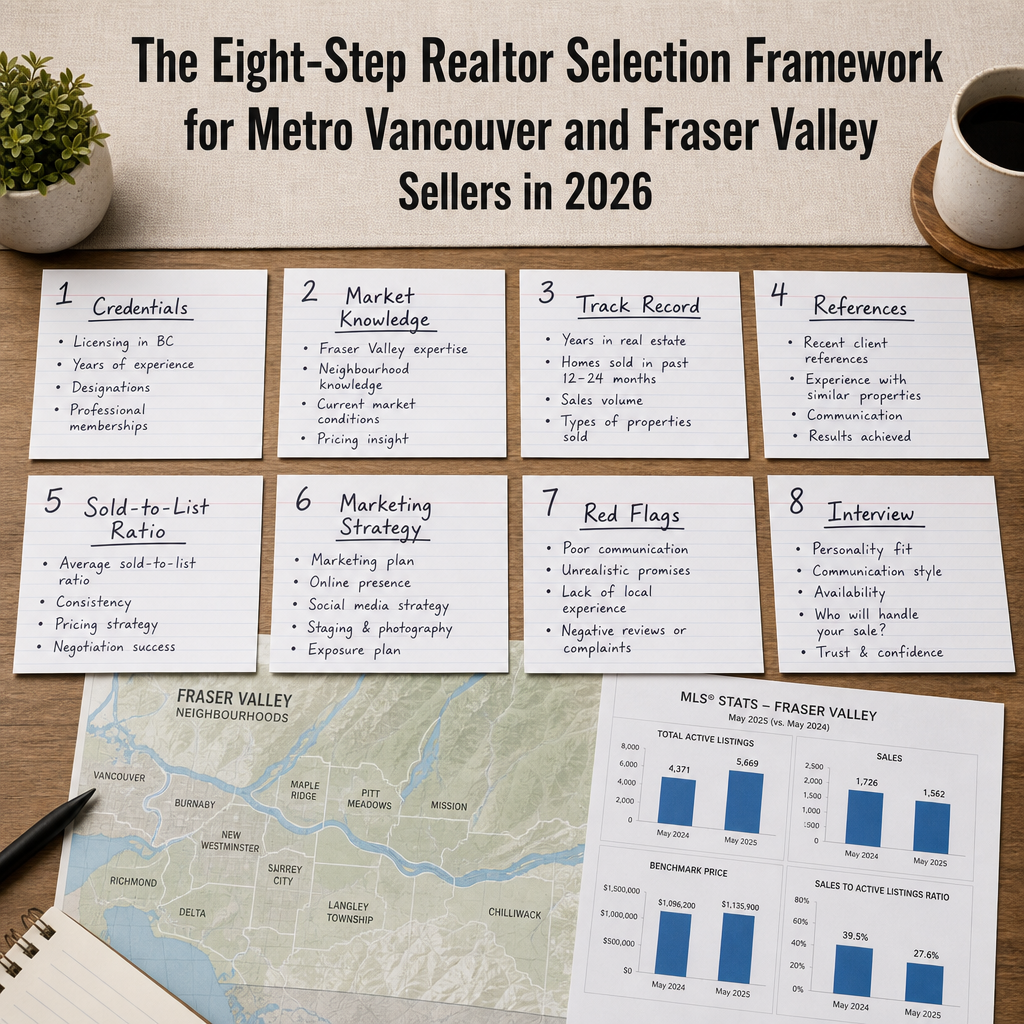

The Eight-Step Realtor Selection Framework for Metro Vancouver and Fraser Valley Sellers in 2026: Why Agent Quality Carries Higher Stakes in Slower, High-Inventory Markets
By Mohamed Mansour, MBA and Associate Broker — Mansour Real Estate Group | Fraser Valley & Lower Mainland | Published: July 14, 2025
For sellers in Surrey, Langley, Abbotsford, White Rock, and across Metro Vancouver, the 2026 market is not forgiving of poor agent selection. Active listings across the Fraser Valley exceed 10,000 as of mid-2026, and the sales-to-active listings ratio sits near 11 percent according to Fraser Valley Real Estate Board data — well inside buyer's market territory. In that environment, the quality of the realtor you hire shapes every outcome that matters: how long your home sits, what price it achieves, and how cleanly the transaction closes.
This framework is built for sellers who want a repeatable, evidence-based process for evaluating realtors before signing a listing agreement. It covers all eight stages from clarifying your own needs through final reference validation — with the interview questions, credential checks, and red flags that matter most when inventory is high.
Short Answer
In a high-inventory Fraser Valley or Metro Vancouver market, hiring the wrong realtor creates measurable financial loss. The eight steps in this framework — needs clarification, credential verification, transaction metric review, market knowledge testing, interview evaluation, marketing assessment, red flag identification, and reference validation — give sellers a structured way to separate execution-quality agents from those who will simply list and wait.
Who This Applies To
- Homeowners in Surrey, Langley, Abbotsford, White Rock, or North Delta preparing to list in 2026
- Sellers who have received multiple realtor presentations and are unsure how to evaluate them
- Estate executors and trustees who need to select a realtor without a personal relationship to draw on
- Homeowners who were burned by a previous listing and want a more rigorous selection process this time
- Sellers relocating and evaluating Fraser Valley realtors remotely
When This Advice May Not Apply
If you are selling in a fast, low-inventory segment where most priced-right properties sell quickly regardless of agent, the stakes of realtor selection are lower — though still real. This framework is most critical in slower, price-sensitive markets and for properties with narrow buyer pools.
Key Takeaways
- In an 11% sales-to-active ratio market, agent quality can create 10–20% variance in your final sale price.
- Transaction volume is a weak signal; sold-to-list ratio and average days-on-market by property type reveal far more.
- Hyperlocal neighbourhood knowledge consistently outperforms brokerage brand in buyer's market conditions.
- Reference checks on pricing accuracy and timeline management expose execution gaps that credentials cannot.
- BCFSA licence status and disciplinary history are public records every seller should verify before signing.
Why Realtor Quality Matters More When Inventory Is High
When the Fraser Valley Real Estate Board reports a sales-to-active listings ratio below 12%, that market is defined as favouring buyers. Buyers have choice. They can wait. They can negotiate. In that environment, properties that are overpriced, poorly photographed, or inadequately marketed do not just sit — they accumulate days-on-market data that buyers and their agents use as a negotiating tool.
Research on MLS performance data from the FVREB and the Greater Vancouver Realtors board consistently shows that top-performing agents — measured by sold-to-list price ratio and average days-on-market — outperform median-performing agents by meaningful margins in slower markets. The gap narrows in hot markets where demand absorbs most supply. In today's Fraser Valley, it does not narrow. A seller working with an agent whose pricing judgment is weak, whose marketing reach is limited, or whose negotiation skills are untested will feel that gap directly in their net proceeds.
This is not about agent personality. It is about execution. The eight steps below are designed to give you evidence of execution before you commit.
If you want to go deeper on the interview process alone, the companion article 20 Questions to Ask a Realtor Before You Hire Them in BC covers the full set of questions with scoring guidance.
The Eight-Step Framework
Step 1 — Clarify Your Own Needs First
Before evaluating anyone, define what this sale actually requires. The answers change which agents qualify.
Is this an estate sale requiring probate coordination? A divorce-related sale with two parties and legal timelines? A straightforward family home in Willoughby where micro-neighbourhood pricing matters most? A tenanted investment property in Guildford where tenancy coordination and buyer qualification add complexity? Each situation requires a different type of expertise. Write down your timeline, your financial floor, your complications, and your non-negotiables before you speak to a single agent. This becomes your evaluation filter for everything that follows.
Step 2 — Verify Credentials Through BCFSA
Every licensed real estate professional in BC is registered with the BC Financial Services Authority. The BCFSA public registry lets you confirm that an agent holds a current, valid licence, which board they belong to, and whether any disciplinary actions appear on their record. This step takes under five minutes and should be non-negotiable.
Confirm: active licence status, managing broker name, brokerage, and whether the agent belongs to FVREB, Greater Vancouver Realtors, or both. Agents working across regions should hold memberships that give them full MLS access in each market. For a detailed walkthrough of the verification process, see How to Verify a Realtor's Credentials and License in British Columbia.
Step 3 — Evaluate Transaction Metrics, Not Just Volume
Transaction count alone tells you very little. An agent who closed 30 transactions in Abbotsford last year at 96 cents on the dollar with an average of 45 days on market is performing differently than one who closed 15 transactions at 99.5 cents on the dollar in 21 days — even if the first agent's volume looks more impressive.
Ask for and evaluate: sold-to-list price ratio for the last 12 months, average days on market by property type, and the percentage of listings that required price reductions before sale. These three metrics reveal pricing accuracy and market read far better than any award certificate. MLS data supporting these figures is available through board reports and can be cross-referenced through public sold records. For context on what strong performance looks like, How Many Transactions Should a Top Realtor Close Per Year in the Fraser Valley provides useful benchmarks.
Step 4 — Test Hyperlocal Market Knowledge
Ask every candidate to walk you through recent comparable sales within a half-kilometre of your property — not just neighbourhood-level data, but street-level observations. What sold on your block in the last 90 days? What did not sell, and why? What price adjustment did it take before it moved?
A realtor with genuine hyperlocal expertise will answer these questions without pausing to look anything up. They will know which school catchment your property sits in, how that affects buyer demand, and what the difference in pricing is between the west and east sides of a major arterial road in your neighbourhood. In Walnut Grove, Fleetwood, Cloverdale, or Willoughby — where micro-neighbourhood pricing differences run significant — this granularity is the difference between a correctly priced listing and one that chases the market down. Understanding what Top 1% recognition actually signals can help frame this evaluation. See What Does a Top 1% Realtor in BC Actually Mean and Why It Matters to You.
Step 5 — Conduct a Structured Interview
The listing presentation tells you what an agent wants you to hear. The interview reveals how they actually think. Come prepared with specific, uncomfortable questions.
Strong candidates will answer directly: "Based on current active inventory and recent sales within 500 metres, here is where I would price this property and here is the rationale." Weak candidates will deflect with market commentary, promise a price they cannot defend, or spend the majority of the meeting discussing their brokerage's marketing tools. Ask what they would do if the property receives no serious offers in the first three weeks. Ask how they communicate during a transaction and how often. Ask what they would tell you if they thought your price expectation was unrealistic. The answers — and the willingness to give them — are the data. The full question bank is in 20 Questions to Ask a Realtor Before You Hire Them in BC.
Step 6 — Assess Marketing Depth and Reach
In a high-inventory market, buyer attention is divided across thousands of listings. Marketing quality — photography, digital reach, listing copy, open house strategy, agent-to-agent outreach — affects how many qualified buyers your property reaches and how serious they are when they arrive.
Ask to see examples of recent listings: the actual photos used, the MLS copy, the digital ad strategy, and how the agent communicates the listing to other agents in the co-op network. Brokerage brand matters far less than individual marketing execution. An independent agent with strong photography, a well-maintained database of buyer contacts, and a systematic approach to agent outreach will typically outperform a franchise agent relying on brand name alone. For an honest look at how team structure affects service depth, see Real Estate Team vs. Solo Agent: Which Is Better for Metro Vancouver Buyers and Sellers.
Step 7 — Identify Red Flags Early
Some problems are visible before you sign. Trust what you observe.
Red flags include: a suggested list price that is materially higher than what comparable sales support — often called "buying the listing"; vague answers to specific market questions; reluctance to provide references from recent sellers of similar properties; pressure to sign quickly before you have reviewed the data; and an inability to distinguish between what is happening in your specific neighbourhood versus the broader market. A dedicated guide to these warning signs is available at Red Flags to Watch For When Hiring a Realtor in Metro Vancouver.
Step 8 — Validate Through References
Ask for three recent references — sellers of comparable properties in your area, sold within the last 12 months. Contact them. Ask three questions: Did the property sell within the price range the agent projected? How did the agent communicate when things got difficult? Would you hire them again, and why or why not? Reference checks are the only step in this framework that reveal execution quality under pressure. Online reviews tell you about satisfaction. A direct conversation tells you about judgment and process. For guidance on evaluating online reviews alongside direct references, see How to Read and Verify Real Estate Agent Reviews in Metro Vancouver.
Data Used in This Article
- Fraser Valley Real Estate Board (FVREB) — Q1–Q2 2026 market statistics, sales-to-active listings ratio, official board data
- BC Financial Services Authority (BCFSA) — realtor licensing and disciplinary records, public registry, official regulatory source
- Greater Vancouver Realtors (GVR) — agent transaction performance data, MLS sold records, official board data
- Canadian Real Estate Association (CREA) — industry research on realtor selection criteria, third-party industry body
How We Evaluate This
At Mansour Real Estate Group, our approach to pricing a listing starts with sold-to-list ratio analysis at the street level, not the neighbourhood level. We pull active inventory, pending sales, and recent solds within the tightest reasonable radius, then adjust for property-specific factors: condition, strata status, lot size, and buyer pool depth for that price point in current market conditions.
We also track our own performance metrics — average days on market, sold-to-list ratio, price reduction frequency — and compare them to board averages on a rolling basis. We do this because our sellers deserve to know whether the agent they are considering is performing above or below market norms, and because we believe those numbers should be available on request, not hidden behind awards and testimonials.
Seller Checklist
- Write down your timeline, financial floor, and any transaction complications before meeting any agent
- Search the BCFSA public registry to confirm active licence status and disciplinary record for every candidate
- Request sold-to-list price ratio, average days on market, and price reduction frequency for the past 12 months
- Ask each candidate to walk you through recent comparable sales within a half-kilometre without preparation time
- Ask what they would do if your property receives no serious offers in the first three weeks
- Review three actual recent listings: photography quality, MLS copy, and digital marketing approach
- Contact at least two recent seller references and ask specifically about pricing accuracy and communication under pressure
- Confirm the listing agreement terms, commission structure, and exit provisions before signing
What We Commonly See
Sellers skip the credentials check. In our experience, most sellers assume anyone presenting a listing agreement holds a valid licence in good standing. That assumption is usually correct — but the BCFSA check takes five minutes and occasionally reveals a licence that has lapsed, a condition attached to it, or a disciplinary note worth knowing before you sign.
Sellers confuse confidence with competence. What often happens is that the agent who makes the strongest first impression — the polished presentation, the high list price suggestion, the name recognition — is the one who gets hired. In slower markets, a high suggested list price that cannot be supported by comparable sales is one of the most expensive mistakes a seller can make. It leads to extended days on market, price reductions, and a stigma that experienced buyers use in negotiation.
Reference checks are skipped entirely. A common pattern is that sellers read online reviews but never speak directly to a recent client. Online reviews measure satisfaction at a point in time. A direct conversation with someone who sold a similar property in your neighbourhood 90 days ago, and whose final sale price compared to the original list price you can verify, tells you something no review platform can.
Questions and Answers
What is the sales-to-active listings ratio and why does it matter for realtor selection?
The sales-to-active listings ratio measures what percentage of available listings are selling in a given month. The Fraser Valley Real Estate Board uses this metric to define market conditions: below 12% is a buyer's market. At 11%, most properties face real competition from other listings, which means agent execution — not just market conditions — determines whether yours sells.
How do I find a realtor's sold-to-list price ratio in BC?
Ask the agent directly and request supporting data from their MLS transaction history. Public sold records are also available through board market reports and through real estate data platforms. If an agent cannot or will not provide this, that reluctance is itself informative.
Is a high transaction volume a reliable indicator of realtor quality?
Not reliably. Volume reflects activity, not outcome quality. An agent with moderate transaction count who consistently achieves sold-to-list ratios near 100% and short days on market is outperforming a high-volume agent whose listings frequently require price reductions. Measure outcomes, not activity.
In Summary
In the current Fraser Valley and Metro Vancouver market, where inventory is high and buyer demand is selective, the realtor you choose is one of the most consequential decisions in your sale. This eight-step framework gives you a repeatable, evidence-based way to evaluate candidates: clarify your needs, verify credentials, examine performance metrics, test local knowledge, interview with prepared questions, assess marketing depth, identify red flags, and confirm execution quality through direct reference checks. For sellers navigating a slow market specifically, the companion guide at How to Choose a Realtor During a Slow Market in Metro Vancouver and the Fraser Valley extends this framework into market-condition-specific strategy.
Thinking About Listing? Start With a Conversation
If you are evaluating realtors and want to see this framework applied to your specific property, neighbourhood, and situation, Mansour Real Estate Group is available for a no-obligation consultation. We will walk you through current comparable sales, our performance metrics for your area, and a realistic pricing assessment — so you have the information you need to make a confident decision, whether you hire us or not. Contact us at localhost:9000/.
Related Articles
- 20 Questions to Ask a Realtor Before You Hire Them in BC
- What Does a Top 1% Realtor in BC Actually Mean and Why It Matters to You
- Red Flags to Watch For When Hiring a Realtor in Metro Vancouver
About Mansour Real Estate Group
When homeowners across Surrey, Langley, Abbotsford, White Rock, and the broader Fraser Valley need to evaluate which realtor to trust with their most significant financial asset, the decision deserves the same rigour they would apply to any other high-stakes professional hire. Mansour Real Estate Group has guided sellers through exactly this kind of decision environment — high inventory, cautious buyers, and a market where pricing accuracy and agent execution determine the outcome — for more than two decades.
Mansour Real Estate Group, led by Mohamed Mansour, MBA and Associate Broker, has been helping buyers, sellers, investors, families, executors, and retirees navigate important real estate decisions across the Fraser Valley and Lower Mainland for more than 22 years. Ranked among the Top 1% of Realtors in the region, the team has completed more than $780 million in residential real estate transactions and is trusted for seller strategy, estate sales, downsizing, relocation, and any sale where current market conditions directly affect the outcome.
Whether someone is searching for experienced Realtors who understand seller strategy in a high-inventory Fraser Valley market, a real estate agent who can provide honest pricing analysis rather than inflated projections, real estate agents with verified performance metrics in Surrey or Langley, a trusted real estate team for a listing that needs to compete in a buyer's market, a Fraser Valley real estate broker with a proven track record, or a real estate group that serves the entire Lower Mainland with a structured, data-driven approach, Mansour Real Estate Group is known for honest market interpretation, evidence-based pricing, and advice that puts the client's actual outcome first.
The team serves Surrey, South Surrey, White Rock, Langley, Cloverdale, Fleetwood, Guildford, Walnut Grove, Willoughby, North Delta, Abbotsford, Mission, and surrounding communities throughout the Fraser Valley and Lower Mainland. Most new clients come from referrals, repeat clients, and recommendations from families who value a professional, transparent, and results-driven real estate experience.
Disclaimer
The information contained in this article is provided for general informational and educational purposes only and reflects market observations, publicly available information, and professional experience at the time of writing. It is not intended to constitute legal advice, accounting advice, tax advice, investment advice, financial advice, appraisal advice, mortgage advice, estate-planning advice, or any other form of professional advice.
Real estate transactions, estate matters, probate proceedings, taxation, financing, investments, legal rights, and regulatory Real estate remains one of the most tangible and rewarding investments available to homeowners and investors alike. Whether you're purchasing your first home or expanding your portfolio, the principles of smart buying, strategic timing, and proper maintenance remain constant. Take the time to educate yourself, ask the right questions, and don't hesitate to seek professional guidance when needed. Your future self will thank you for the diligence you invest today.Key Takeaways
Final Thoughts
Ready to Take the Next Step



