
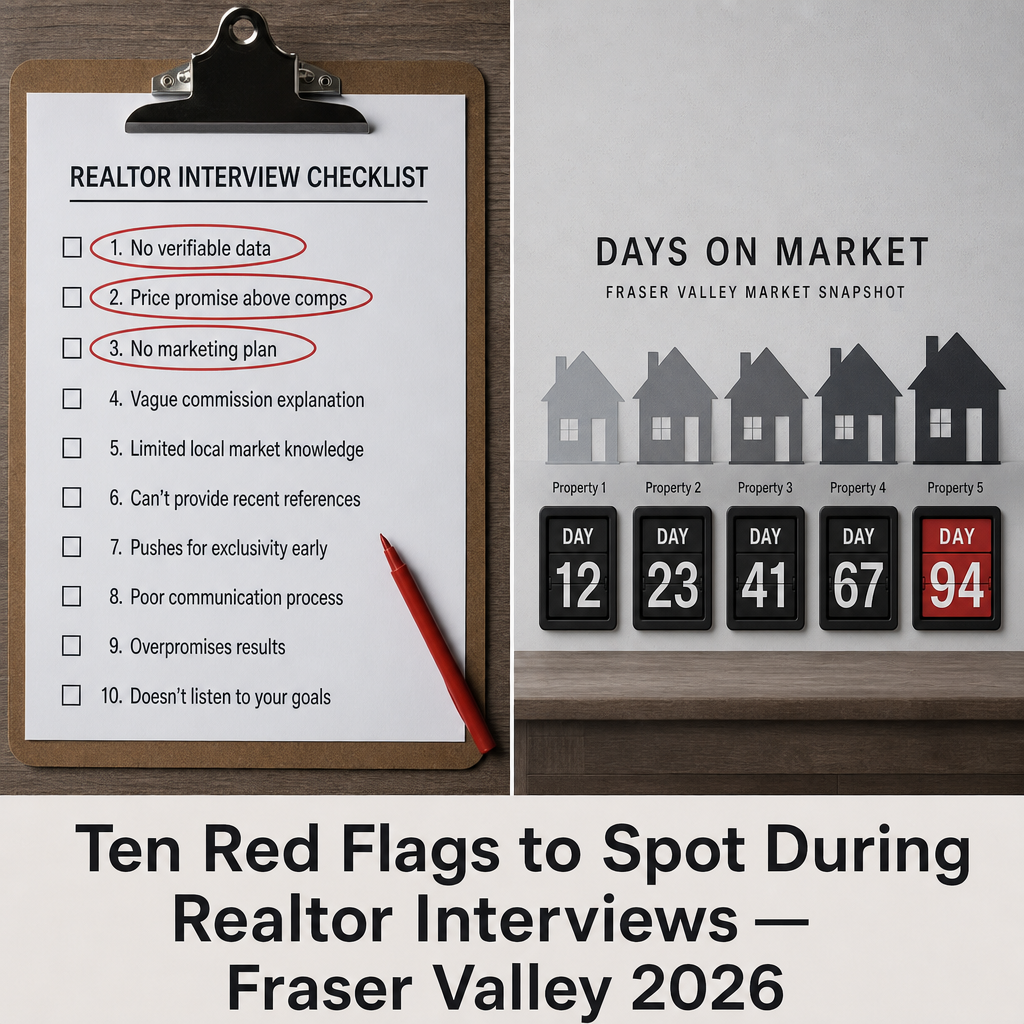

Ten Red Flags to Spot During Realtor Interviews in Metro Vancouver and Fraser Valley 2026: How to Identify Overpricing Promises, Vague Marketing Plans, Part-Time Availability, Unverifiable Sales Data, and Pressure Tactics Before They Cost You 15–25% in Net Proceeds
By Mohamed Mansour, MBA and Associate Broker — Mansour Real Estate Group | Fraser Valley and Lower Mainland, BC | Published: July 15, 2025 | Topic: Seller Strategy — Realtor Vetting
Hiring the wrong realtor in a slow market costs more than most sellers realize before it happens. In Metro Vancouver and the Fraser Valley in 2026, with inventory above 10,000 active listings, a weak agent selection doesn't just delay a sale — it can extend your time on market by 30 to 60 days and erode your net proceeds by amounts that reach well into six figures when carrying costs, price reductions, and lost negotiating leverage are factored together.
The interview is your only practical window to identify these risks before you sign a listing agreement. Most sellers don't know what warning signs to look for. This guide names ten specific red flags, explains what each one signals, and gives you the questions and benchmarks to apply during the conversation.
Short Answer
The ten most costly realtor interview red flags in Fraser Valley and Metro Vancouver markets are: overpricing promises above comparable sales, vague or unspecified marketing plans, part-time availability, inability to produce MLS-verifiable sales data, high-pressure tactics, no specialist knowledge for your property type, outdated CMAs without hyperlocal analysis, absence during critical transaction stages, defensive commission posturing, and no team accountability structure. Any one of these can extend your days on market by 20 to 80 days and reduce your net proceeds significantly.
Key Takeaways
- Overpricing promises 5–10% above comparable sales typically result in 20–40 day DOM extensions and forced price reductions averaging $20K–$80K in the Fraser Valley.
- Insisting on MLS-verifiable sales data, not self-reported statistics, is the only reliable way to distinguish specialists from inflators.
- Part-time agents or those splitting focus across multiple regions show 15–30% longer average DOM, according to FVREB transaction analytics.
- In a market with 10,000+ listings, undefined marketing plans correlate with 40–80 day DOM extensions and $50K–$150K in cumulative carrying cost losses.
- Pressure tactics during an interview — artificial urgency, resistance to questions, dismissiveness — reliably predict how an agent handles buyer pressure during negotiations.
Who This Applies To
- Homeowners in Surrey, Langley, Abbotsford, White Rock, South Surrey, or North Delta preparing to list in 2025 or 2026
- Sellers interviewing multiple agents and unsure how to compare them objectively
- Executors, trustees, or family members selecting an agent for an estate property
- Couples navigating a divorce-related sale who need a neutral, structured process
- Downsizers with significant equity who cannot afford a mispriced or delayed sale
When This Advice May Not Apply
If you are selling in an exceptionally tight micro-market with few competing listings and strong buyer demand, some pricing latitude may exist. That said, the interview vetting process described here remains relevant regardless of market conditions — a capable agent can explain why your market conditions differ. A weak agent cannot.
Data Used in This Article
- FVREB MLS Transaction History and Days-on-Market Analytics by Agent — official board data, Fraser Valley, 2024–2026
- BCFSA Licensed Agent Discipline Records — regulatory authority, BC, 2024–2026
- Real Estate Council of BC (RECBC) Public Discipline Records — code of conduct and compliance, BC, ongoing
- Mansour Real Estate Group internal transaction analysis — agent performance variance observations, Fraser Valley, 2025–2026 (professional interpretation, not published third-party data)
How We Evaluate This
At Mansour Real Estate Group, our approach to agent evaluation starts with verifiable outputs: MLS-confirmed transaction volume, days-on-market averages relative to the neighbourhood benchmark, and sales-to-list price ratios by property type. We look at these figures the same way we expect sellers to look at ours — with questions, not assumptions.
The red flags described in this article are drawn from patterns we have observed across the Fraser Valley over more than two decades — both in how capable agents behave during interviews and in how poorly selected agents tend to perform once a listing is live. A slow market compresses the margin for error. Every observation in this guide reflects that reality.
The Ten Red Flags — What to Watch For and Why It Matters
Red Flag 1: A Listing Price Promise That Exceeds Comparable Sales
An agent who leads the interview by naming a price — particularly one 5 to 10 percent above recent comparable sales in your neighbourhood — without showing you the data behind it is using a well-documented tactic called buying the listing. The inflated number secures your signature. The price reduction comes later, after your listing has sat long enough to signal weakness to buyers.
According to FVREB MLS analytics, overpriced listings in Fraser Valley markets typically require 20 to 40 additional days on market and price reductions averaging $20,000 to $80,000 before they sell. Ask any agent presenting a high price to walk you through the comparable sales, active competing listings, and sales-to-list ratios that support that number. If they cannot, or if they dismiss the question, treat it as a serious warning. For a deeper look at how pricing strategy is built, see How to Choose the Best Realtor in Metro Vancouver and the Fraser Valley.
Red Flag 2: A Vague or Undefined Marketing Plan
In a market with more than 10,000 active listings, the difference between a property that sells within its first two weeks and one that sits for 90 days is almost always marketing exposure and buyer targeting. A realtor who describes their plan in terms like "we'll list on MLS, do some social media, and hold an open house" has not described a plan. They have described a default.
Ask specifically: What photography specification do you require? What paid advertising budget will you commit, and which platforms? How do you target buyers outside the immediate neighbourhood? How do you measure and report listing performance weekly? Inability to answer these questions with specifics — photographer names, platform choices, budget ranges, reporting cadence — indicates that no real plan exists. An undefined marketing approach in 2026's Fraser Valley correlates with 40 to 80 day DOM extensions, according to internal transaction analysis comparing marketed versus minimally marketed listings. For a detailed evaluation framework, see How to Evaluate a Realtor's Marketing Plan Before Signing a Listing Agreement.
Red Flag 3: Part-Time Availability or Split Market Focus
Real estate transactions in BC have multiple time-sensitive stages: booking and managing showings, responding to offers, negotiating subject conditions, coordinating inspections, handling subject removal, and managing the final walk-through. A part-time agent — one who holds another job, treats real estate as supplemental income, or divides their focus across Metro Vancouver, the Fraser Valley, and the Interior — is structurally unable to be consistently available at each of these stages.
FVREB data shows that part-time agents or those splitting market focus across regions average 15 to 30 percent longer days on market. During an interview, ask directly: Is this your primary occupation? How many active listings do you currently manage, and in which markets? Who handles your listings when you are unavailable? If the answer involves another agent who will "step in" but has no direct accountability for your file, that arrangement deserves scrutiny.
Red Flag 4: Sales Data You Cannot Independently Verify
Self-reported statistics — "I've sold over 200 homes" or "my average days on market is 14" — have no verification mechanism unless the agent provides the underlying MLS transaction records. Buyers of professional services deserve the same verification standard they apply to contractors, lawyers, and financial advisors.
Ask any agent you interview to provide: their MLS licence number, their transaction history for the past 24 months by neighbourhood, their average days on market by property type, and their sales-to-list price ratio for comparable properties. A capable, active agent will have this information and will offer it without hesitation. An agent who cannot produce it — or who responds defensively — is asking you to accept claims without evidence. See How Many Transactions Should a Top Realtor Close Per Year in the Fraser Valley? for context on what credible volume actually looks like.
Red Flag 5: Pressure Tactics or Artificial Urgency
An agent who creates urgency before you've even listed — "you need to decide today," "I have another seller in your area and can only take one," or "interest rates could change next month" — is using sales pressure, not professional judgment. How an agent handles the interview tells you precisely how they will handle buyer negotiations on your behalf.
An agent skilled in negotiation is comfortable sitting with your questions, presenting data calmly, and allowing you to reach your own conclusions. Pressure during the interview is one of the most reliable predictors of poor negotiating outcomes on your file. According to BCFSA complaint records, client complaints frequently cite pressure tactics as the initial warning sign that was ignored. You can verify a realtor's conduct history through the BC Financial Services Authority public licence lookup.
Red Flag 6: No Specialist Knowledge for Your Property Type or Situation
A generalist who primarily sells detached homes in one submarket is not the right agent for a strata property in Willoughby, an estate sale in South Surrey, or a court-ordered sale in Abbotsford. Strata transactions require familiarity with Form B, depreciation reports, special levy history, and strata bylaw compliance. Estate sales require coordination with executors, probate timelines, and court-imposed listing conditions. Divorce-related sales require neutral process management and familiarity with how BC family law intersects with property disposition.
Ask directly what experience the agent has with your specific situation. If their answer is general ("I've sold a few condos"), ask for specific examples with verifiable outcomes. Vague answers here carry real risk. For sellers managing estate situations, How to Choose a Realtor for Downsizing in Metro Vancouver and the Fraser Valley covers related considerations.
Red Flag 7: A Templated CMA Without Hyperlocal Analysis
A comparative market analysis (CMA) is only useful if it reflects what buyers in your specific neighbourhood, at your specific price point, are doing right now. A CMA that draws comparables from a different school catchment, a different strata complex category, or a neighbourhood two kilometres away with different transit access misrepresents your actual market position.
A well-constructed CMA for a Fraser Valley property in 2026 should reference active competing listings, pending sales, school catchment boundaries where buyer behaviour diverges (particularly in Willoughby, Fleetwood, and Cloverdale), zoning changes that affect future value, and days-on-market patterns by price bracket. If the CMA you are shown uses only sold data from the past six months with no analysis of current active competition, it is incomplete and likely outdated for current market conditions. Ask how the agent accounts for the ratio of active listings to pending sales in your price bracket today — not last quarter.
Red Flag 8: Structural Unavailability During Critical Transaction Stages
Ask any agent you interview: who handles showings if you are unavailable? Who responds to offer negotiations after business hours? Who manages subject removal coordination when your file reaches that stage? If the answer involves a receptionist, an administrative assistant without agency authority, or vague assurances that someone will "take care of it," the accountability gap is real and consequential.
A real estate team with defined roles is structurally better positioned for this than a solo agent operating without coverage. But even within a team structure, ask who specifically has authority over your file at each stage, and confirm that person will be named in your listing agreement responsibilities.
Red Flag 9: Defensive or Dismissive Responses to Commission Questions
Commission in BC is negotiable. How an agent responds to your questions about commission structure, what it includes, and what you receive in return for that cost reveals a great deal about how they handle every financial conversation in a transaction.
A confident, experienced agent can explain their commission structure clearly, itemize what it funds (photography, staging, advertising, offer coordination, negotiation, paperwork, follow-through), and discuss it without defensiveness. An agent who becomes evasive, dismissive, or pressuring when you raise the question is demonstrating exactly the approach they will take when negotiating your sale. For a full breakdown of how commission works in BC, see How Real Estate Commissions Work in BC and What to Ask Your Realtor Before Signing.
Red Flag 10: No Team Accountability Structure
A realtor operating without a defined team structure — no coordinator, no buyer agent coverage, no administrative support — is a single point of failure for your transaction. When illness, personal circumstances, or workload spikes occur (and they do, in every agent's career), your file has no backup. Ask specifically: What happens to my listing if you are unavailable for 10 days? Who has the authority to negotiate on my behalf in your absence, and are they named on my listing? A credible answer involves a named person with an actual role, not a reassuring generality.
Seller Checklist: What to Ask Before You Sign
- Ask for MLS-verifiable transaction data: licence number, 24-month history, average DOM by property type
- Request a written marketing plan with platform specifications, photography standard, and weekly reporting commitment
- Ask the agent to walk you through the comparable sales and active competing listings behind their suggested list price
- Confirm whether real estate is their primary occupation and whether they are licensed through BCFSA
- Ask who specifically handles your file during showings, offer negotiation, subject removal, and final walk-through
- Request a hyperlocal CMA that accounts for active competing listings and days-on-market by price bracket in your neighbourhood today
- Ask how they handle commission — what it includes, what is itemized, and whether it is open to discussion
What We Commonly See
Overpricing followed by silence. In our experience working with sellers who come to us after a failed listing, the most common pattern is an agent who promised a high number, listed at that price, and then went quiet while the DOM climbed. By the time the conversation about a price reduction started, the listing had already been on market long enough to carry a stigma that affected the eventual sale price.
Marketing plans described verbally but never put in writing. What often happens is that the plan described in the interview — professional video, targeted social advertising, a buyer outreach campaign — never materializes in practice. If a marketing commitment is not in writing as part of the listing agreement or an attached schedule, it is not a commitment. Ask for it in writing before you sign.
Sellers who dismissed the interview red flags because they liked the agent personally. A common mistake is confusing rapport with competence. The agents who are most comfortable making overpricing promises and dismissing hard questions are often also the most personable in the room. The interview exists to evaluate professional performance, not personality. The questions in this guide are designed to separate one from the other.
Questions and Answers
Can I check an agent's sales history independently in BC?
You can verify an agent's licence status and any disciplinary history through the BC Financial Services Authority public licence lookup at bcfsa.ca. For transaction volume and days-on-market data, you need the agent to provide MLS records directly, as this data is not publicly accessible without board access.
Is a higher suggested list price always a red flag?
Not automatically. A higher price is only a red flag when it is not supported by comparable sales data, active competing listings, and a clear explanation of why your property commands a premium. A well-reasoned case for a higher price is valid. A promise without evidence is not.
What is a reasonable marketing budget for a Fraser Valley listing in 2026?
This varies by price point and property type, but a credible marketing plan for a mid-range Fraser Valley property should include professional photography, a defined digital advertising budget, and active social media placement. When an agent cannot specify any of these by dollar amount or platform, the marketing plan is likely a default rather than a strategy.
In Summary
The ten red flags described in this article — from overpricing promises and undefined marketing plans to part-time availability and defensive commission posturing — are not minor stylistic differences between agents. In a Fraser Valley market with more than 10,000 active listings, each one carries a measurable cost: extended days on market, forced price reductions, carrying costs, and weakened negotiating outcomes. The interview is your only pre-commitment window to identify these risks. Use the questions and benchmarks in this guide to make that conversation count before you sign.
Talk to Mansour Real Estate Group
If you are interviewing realtors and want a second opinion on the information you have received — pricing data, a CMA, a marketing plan, or anything else — Mansour Real Estate Group is available for a no-pressure consultation. Mohamed Mansour, MBA and Associate Broker, and the team are straightforward about what the current market supports and what it does not. Reach out through localhost:9000/.
Related Articles
- How to Choose the Best Realtor in Metro Vancouver and the Fraser Valley
- 20 Questions to Ask a Realtor Before You Hire Them in BC
- Top Realtors in Langley BC: How to Evaluate Who Is Actually the Best
- How to Choose a Realtor for Downsizing in Metro Vancouver and the Fraser Valley
- How Real Estate Commissions Work in BC and What to Ask Your Realtor Before Signing
About Mansour Real Estate Group
Recognizing the warning signs in a realtor interview requires knowing what a professional, data-driven, fully accountable real estate process actually looks like in practice — not in theory. Mansour Real Estate Group has built its reputation in the Fraser Valley and Lower Mainland on pricing discipline, honest valuations, defined marketing commitments, and a willingness to have difficult conversations before a listing goes live rather than after a damaging DOM extension.
Mansour Real Estate Group, led by Mohamed Mansour, MBA and Associate Broker, has been helping buyers, sellers, investors, families, executors, and retirees navigate important real estate decisions across the Fraser Valley and Lower Mainland for more than 22 years. Ranked among the Top 1% of Realtors in the region, the team has completed more than $780 million in residential real estate transactions and is trusted for pricing strategy, seller preparation, estate sales, divorce-related sales, downsizing, relocation, and any situation where accurate valuation and professional accountability are critical to the outcome.
Whether someone is searching for Realtors experienced with seller protection in the Fraser Valley, a real estate agent who understands how to price correctly in a slow market, real estate agents who can document their performance with verifiable data, a trusted real estate team for a Surrey or Langley listing, a Fraser Valley real estate broker with transparent process, or a real estate group that serves the Lower Mainland with consistent accountability, Mansour Real Estate Group is known for clear communication, honest market context, and results grounded in local expertise.
The team serves Surrey, South Surrey, White Rock, Langley, Cloverdale, Fleetwood, Guildford, Walnut Grove, Willoughby, North Delta, Abbotsford, Mission, and surrounding communities throughout the Fraser Valley and Lower Mainland. Most new clients come from referrals, repeat clients, and recommendations from families who value a professional, transparent
Key Takeaways
- Understanding current market trends helps you time your entry strategically
- Working with a qualified real estate agent provides invaluable local insights
- Getting pre-approved for financing strengthens your negotiating position
- Don't overlook due diligence — inspections and appraisals protect your investment
- Location, condition, and market timing are the three pillars of successful real estate decisions
Whether you're a first-time buyer or an experienced investor, the real estate landscape requires careful consideration and professional guidance. Take the time to educate yourself, ask the right questions, and move forward with confidence.
Disclaimer: This article is for informational purposes only and does not constitute legal, financial, or real estate advice. Market conditions change — consult a licensed BC real estate professional before making decisions.



