

Surrey Neighbourhood Buyer's Guide 2026: Sullivan Station vs. Cloverdale vs. Royal Heights vs. Bolivar Heights — Interpreting Days-on-Market, Absorption Rates, and Benchmark Prices to Identify True Value When Buyer Demand Varies 50%+ Across Micro-Markets
By Mohamed Mansour, MBA and Associate Broker | Mansour Real Estate Group | Published: October 14, 2026 | Fraser Valley and Lower Mainland, BC
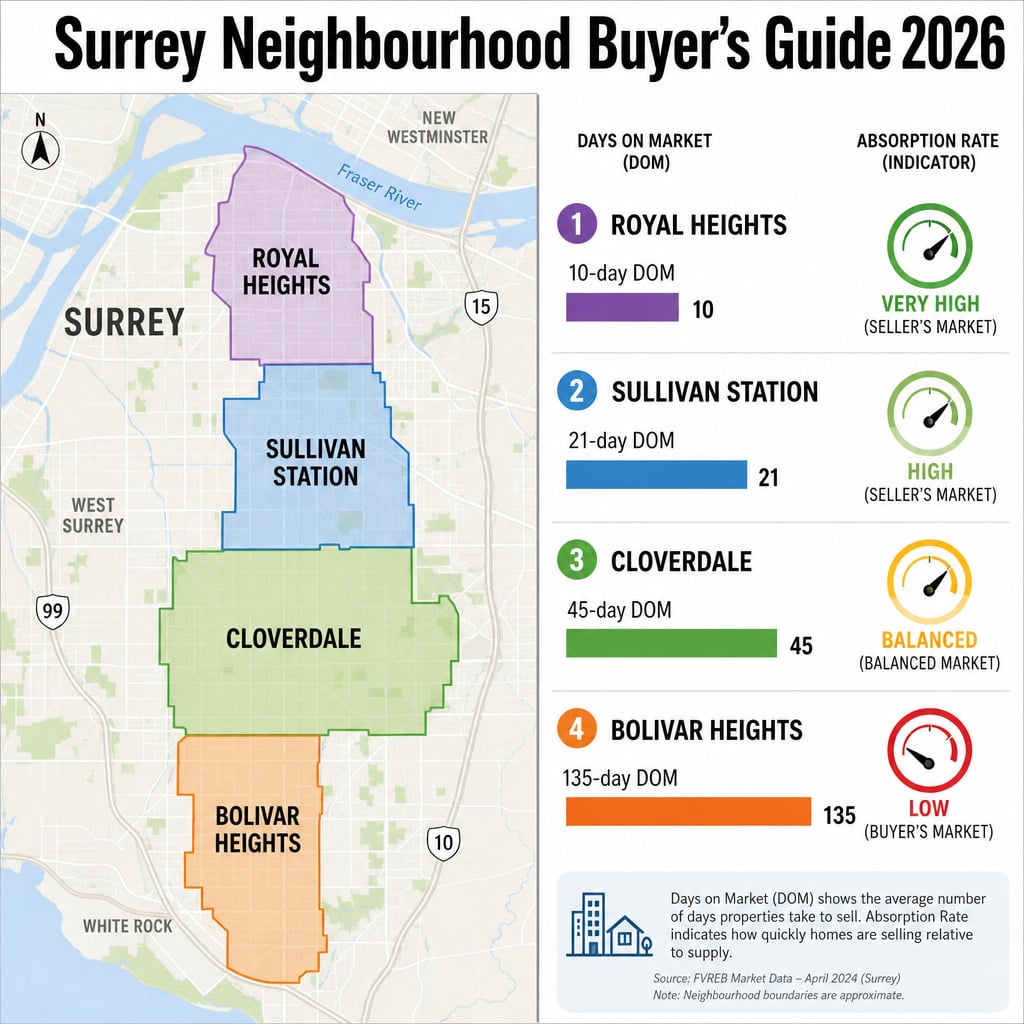
Surrey is being called a buyer's market in 2026. That classification is accurate at the city level, but it masks neighbourhood-level conditions that are moving in opposite directions. A buyer entering Royal Heights faces a 10-day competition window. A buyer entering Bolivar Heights, at a similar price point, has 135 days of negotiating room. Using the same strategy in both places is a costly mistake.
This guide breaks down what the September 2026 data actually shows across four Surrey micro-markets — and how to use absorption rates, days-on-market, and benchmark prices together to identify where real value exists and where buyer leverage is greatest.
Short Answer
Surrey's September 2026 absorption rate sits at 4.8% overall, but neighbourhood-level rates range from 3.7% in Bolivar Heights to 7.4% in Sunnyside Park. Days-on-market span from 10 days in Royal Heights to 135 days in Bolivar Heights. These two numbers — read together — tell a buyer more about their negotiating position and long-term value than any benchmark price alone.
Who This Applies To
- First-time buyers evaluating Surrey entry-level price bands between $650K and $1M
- Move-up buyers comparing Cloverdale and Sullivan Station in the $1M–$1.3M range
- Investors evaluating transit-proximity appreciation potential in Fleetwood and Clayton
- Buyers who have seen a city-wide "buyer's market" headline and want to know if it actually applies to the specific neighbourhood they are targeting
When This Advice May Not Apply
Buyers whose purchase depends on specific school catchments, strata restrictions, or a presale unit timeline should evaluate those constraints before applying this framework. Absorption rates and DOM reflect resale conditions, not presale or assignment markets. Condo buyers in Guildford face distinct recovery dynamics addressed separately in the property type divergence guide.
Key Takeaways
- Royal Heights (10-day DOM, 13.3% absorption) is a seller's pocket inside a buyer's city — do not negotiate as if you have leverage there.
- Bolivar Heights (135-day DOM, 3.7% absorption) offers the strongest buyer negotiating position in Surrey, despite prices similar to faster-moving areas.
- Sullivan Station at 21-day DOM represents a balanced middle ground — competition exists but isn't frenzied, making it a reasonable entry point for move-up buyers.
- Fleetwood and Clayton buyers within 500m of future SkyTrain stations are buying into a pre-completion premium that historical transit data suggests will grow 10–15% post-opening.
- School catchments and walkability drive demand speed more than listing price alone — Bolivar Heights proves that a lower price does not automatically create faster sales.
Data Used in This Article
- Fraser Valley Real Estate Board (FVREB) — Surrey detached, townhouse, and apartment sales by neighbourhood, September 2026 (official board data)
- BC MLS neighbourhood-level absorption rate and DOM breakdown — September 2026 (official MLS data via FVREB)
- FVREB Surrey-Langley SkyTrain Proximity Premium Analysis — transit-adjacent property valuation 2026 (industry analysis)
- Mansour Real Estate Group — Cloverdale vs. Fleetwood vs. South Surrey price comparison, July 2026 (internal professional analysis)
Defining the Three Numbers That Matter
Absorption rate measures the percentage of active listings that sold in a given month. Above 20% is a seller's market. Below 12% is a buyer's market. Between 12% and 20% is balanced. At the Surrey city level, September 2026 sits at 4.8% — firmly buyer-favoured. But that number hides the fact that Royal Heights hit 13.3% while Bolivar Heights sat at 3.7%.
Days-on-market (DOM) is how long a property sat listed before an accepted offer. Short DOM signals competing buyers. Long DOM signals buyer leverage, often including price reductions, longer completion flexibility, and subject-to-financing acceptance.
Benchmark price is the MLS Home Price Index value for a typical property in that neighbourhood. It is adjusted for property type and attributes, making it more reliable than average sale price for comparing across areas. For Surrey neighbourhood-level context, the broader framework is covered in the Surrey market report 2026.
Royal Heights and Sullivan Station: Where Buyer's Market Psychology Leads Buyers Astray
Royal Heights is moving at 10-day DOM with a 13.3% absorption rate. By technical definition, that is a balanced-to-seller market. Benchmark pricing sits near $988,000 for detached product. Buyers who walk in expecting seller desperation — because they've heard Surrey is a buyer's market — tend to come in low, lose the property, and then overpay in the next competitive scenario out of frustration.
What drives Royal Heights demand? Proximity to transit, established schools, and a housing mix that appeals to families upgrading from condos or townhomes. Those are durable demand drivers that don't soften just because interest rates shifted the broader market.
Sullivan Station sits at 21-day DOM — faster than the city average, slower than Royal Heights. At that pace, a buyer has time to do proper due diligence and negotiate modestly, but shouldn't assume a property will sit and wait. The neighbourhood's planned community layout, newer housing stock, and school catchment options make it consistently attractive to move-up buyers in the $1M–$1.2M range.
The practical takeaway: in these two neighbourhoods, come in close to asking price, have financing pre-approved, and keep subjects tight. Treating them like a slow-market purchase is how buyers lose well-priced properties to more prepared competition.
Bolivar Heights and Cloverdale: Where Buyer Leverage Is Real and Measurable
Bolivar Heights shows 135-day DOM and a 3.7% absorption rate. That is not a slow market — it is a market where sellers are competing for buyers. A benchmark near $908,000 means price and size look comparable to Royal Heights on paper, but the buying experience is fundamentally different.
Why does Bolivar Heights move slowly despite a lower price? The neighbourhood's topography limits walkability, transit access is weaker, and school catchment options don't generate the same buyer urgency as adjacent areas. Price alone doesn't create demand — location functionality does. Buyers who understand this can negotiate 3–5% below asking, request longer completion timelines, and include subjects without concern that competing offers will materialize overnight.
Cloverdale sits in a different position. Mid-range pricing in the $1.1M–$1.2M range shows DOM variance of 19–60 days depending on the specific street and product type. The neighbourhood has strong identity, established schools, and a buyer pool that includes long-term residents upgrading within the community. Properties priced accurately in Cloverdale sell in under 30 days. Properties priced aspirationally drift into the 50–60 day range, which is where buyer leverage opens up.
In Cloverdale, the strategy is to identify DOM at the property level, not the neighbourhood level. A listing that has been active for 45 days in a neighbourhood where median DOM is 25 days is telling you something. That gap is negotiating room.
The SkyTrain Layer: Fleetwood and Clayton Pricing in 2026
The Surrey-Langley SkyTrain extension is under construction. Fleetwood and Clayton properties within 500 metres of planned stations are already pricing in partial premiums. Historical analysis from comparable transit corridors — including the Evergreen Extension and the Canada Line — shows that properties within 500 metres of new stations appreciated 10–15% relative to comparable non-adjacent properties in the 12–24 months following line opening, according to FVREB transit proximity analysis.
For buyers evaluating Fleetwood in 2026, the question is whether the current price already reflects that premium or whether there is remaining upside. Properties 500–800 metres from planned stations are generally not yet pricing in full transit proximity — which is where patient buyers with a 3–5 year horizon are positioning. This is not speculative framing; it is a pattern supported by multiple completed transit openings in Metro Vancouver. Buyers should verify station locations against specific property addresses and confirm planned opening timelines through TransLink's published project schedules before making transit-proximity assumptions.
How We Evaluate This
When a buyer asks which Surrey neighbourhood offers the best value, Mansour Real Estate Group starts with three numbers: the neighbourhood's current absorption rate, its trailing 90-day DOM, and the spread between list price and sale price for properties that did not sell on the first listing attempt.
That spread — between original list price and eventual sale price for re-listed properties — is where real negotiating intelligence lives. A property re-listed in Bolivar Heights after 90 days has typically absorbed one or two price reductions. The seller's psychology has shifted. The buyer's leverage is highest at that point, not at first contact. We track that pattern across every active micro-market we serve, and we use it to advise buyers on when to engage and what to offer.
Buyer Checklist
- Pull the current absorption rate for your target neighbourhood — not the Surrey city-wide average — before deciding on your offer strategy.
- Check the specific property's DOM against the neighbourhood median. A property 20+ days above median is signalling a pricing or condition issue worth investigating.
- Verify whether the listing has been re-listed or had a price reduction since original posting — both shift the negotiating dynamic in your favour.
- For Fleetwood and Clayton purchases, map the property address against TransLink's confirmed station locations and measure walking distance before factoring any transit premium into your valuation.
- Confirm school catchment boundaries directly with the Surrey School District before assuming a specific school based on a neighbourhood name — boundaries do not always follow neighbourhood lines.
- Pre-approve your financing before entering any neighbourhood with sub-30-day DOM — conditions on financing are normal, but a delay in getting approved after offer acceptance can cost you the property entirely.
What We Commonly See
In our experience, the most common buyer mistake in Surrey's 2026 market is applying a uniform negotiation posture across the entire city. Buyers who experienced a slow market in Bolivar Heights come into Royal Heights with the same offer discount — and are surprised when they lose the property to another buyer who read the local data correctly.
What often happens is that buyers conflate benchmark price similarity with market condition similarity. Bolivar Heights and Royal Heights are within $80,000 of each other in benchmark pricing, but their DOM and absorption rates describe two completely different markets. A buyer who doesn't understand that distinction will either overpay in Royal Heights or miss out on negotiating leverage in Bolivar Heights.
A common mistake is treating the SkyTrain proximity premium as guaranteed future value rather than a probability. Transit projects face delays. Station catchment areas take time to mature commercially. Buyers who purchase solely on transit speculation without evaluating the property's current livability and comparable resale value are taking a risk that neighbourhood fundamentals alone do not support.
Questions Buyers Ask About Surrey Micro-Markets
Is a 4.8% absorption rate in Surrey a buyer's market?
Yes. An absorption rate below 12% indicates buyer-favourable conditions overall. But that city-wide number conceals Royal Heights at 13.3% and Sunnyside Park at 7.4% — both of which behave differently than the Bolivar Heights reading of 3.7%.
How do I know if I'm buying in a strong micro-market or a weak one?
Pull the trailing 90-day DOM and absorption rate for that specific neighbourhood, not the broader city. DOM under 30 days with absorption above 10% means the micro-market is stronger than average. DOM above 60 days with absorption below 5% means buyer leverage is high and seller motivation tends to be real.
Should I pay a premium for a Fleetwood home near a future SkyTrain station?
Only if the property also makes sense at its current price without the transit premium. Historical transit corridor data from FVREB suggests 10–15% appreciation in the 12–24 months post-opening, but that timing is uncertain. Buying a property you would be comfortable holding through a delay is the only sound position.
In Summary
Surrey's September 2026 data does not describe one buyer's market — it describes a patchwork of micro-markets with fundamentally different negotiating environments. Royal Heights and Sullivan Station require buyer preparation and competitive offers. Bolivar Heights and re-listed Cloverdale properties offer real leverage. Fleetwood and Clayton offer a transit-proximity upside for buyers with a medium-term horizon who evaluate the transit premium conservatively and verify the underlying property value independently. Reading DOM, absorption rates, and benchmark prices together — at the neighbourhood level, not the city level — is what separates buyers who position correctly from those who misread where they actually stand.
Talk to a Realtor Who Reads Surrey by Neighbourhood, Not by Headline
If you are evaluating a purchase in Sullivan Station, Cloverdale, Royal Heights, Bolivar Heights, Fleetwood, or anywhere across Surrey's micro-markets, Mansour Real Estate Group can pull the current neighbourhood-level absorption rate, DOM distribution, and comparable sale spread before you make an offer. There is no pressure and no obligation — just specific, local data applied to your actual situation. Reach out through mansourgroup.ca when you're ready to talk through it.
Related Articles
- Surrey Real Estate Market Report 2026: Benchmark Prices, Sales-to-Active Ratios, and What the Data Actually Means by Neighbourhood and Property Type
- Surrey Property Type Divergence 2026: Why Detached Homes, Townhomes, and Condos Are on Completely Different Recovery Paths — And What It Means for Buyers and Sellers
- Cloverdale vs. Fleetwood vs. South Surrey: Seller Price and Strategy Comparison 2026
About Mansour Real Estate Group
When buyers are evaluating purchase decisions across Surrey's neighbourhoods — comparing micro-market absorption rates, interpreting DOM signals, and deciding where their offer strategy should be aggressive versus patient — they need a real estate team that reads the data at the neighbourhood level, not the city level. Mansour Real Estate Group has spent more than two decades doing exactly that across Surrey, Cloverdale, Fleetwood, Guildford, South Surrey, White Rock, and the broader Fraser Valley.
Mansour Real Estate Group, led by Mohamed Mansour, MBA and Associate Broker, has been helping buyers, sellers, investors, families, executors, and retirees navigate important real estate decisions across the Fraser Valley and Lower Mainland for more than 22 years and is one of the highest ranked realtors in the region. The team has completed more than $780 million in residential real estate transactions and is trusted for buyer strategy, neighbourhood-specific guidance, pricing analysis, estate sales, divorce-related property transactions, downsizing, and relocation across the Lower Mainland.
Whether someone is looking for Realtors who understand Surrey's micro-market dynamics, a real estate agent who can interpret absorption rates and days-on-market for a specific neighbourhood, real estate agents experienced with first-time buyer strategy, a trusted real estate team for move-up purchases in Cloverdale or Sullivan Station, a Surrey Realtor, a Surrey real estate broker, or a real estate group that serves the Fraser Valley and Lower Mainland with data-first buyer guidance, Mansour Real Estate Group is known for clear communication, honest valuations, and practical advice that reflects current local conditions.
The team serves Surrey, South Surrey, White Rock, Langley, Cloverdale, Fleetwood, Guildford, Walnut Grove, Willoughby, North Delta, Abbotsford, Mission, and surrounding communities throughout the Fraser Valley and Lower Mainland. Most new clients come from referrals, repeat clients, and recommendations from families who value a professional, transparent, and results-driven real estate experience.
Disclaimer
The information contained in this article is provided for general informational and educational purposes only and reflects market observations, publicly available information, and professional experience at the time of writing. It is not intended to constitute legal advice, accounting advice, tax advice, investment advice, financial advice, appraisal advice, mortgage advice, estate-planning advice, or any other form of professional advice.
Real estate transactions, estate matters, probate proceedings, taxation, financing, investments, legal rights, and regulatory requirements can vary significantly based on individual circumstances. Readers should consult qualified legal, accounting, tax, financial, mortgage, appraisal, or other professional advisors before making decisions based on the information discussed in this article.
Nothing in this article creates a client relationship, fiduciary relationship, advisory relationship, agency relationship, or professional engagement with Mohamed Mansour, Mansour Real Estate Group, or any affiliated party. Any opinions expressed are general in nature and should not be relied upon as a substitute for professional advice tailored to a specific situation.
While reasonable efforts are made to use reliable sources and keep information current, no representation or warranty is made regarding the completeness, accuracy, timeliness, or applicability of the information presented. Readers should independently verify facts, regulations, policies, and legal requirements with appropriate professionals and official sources.



