
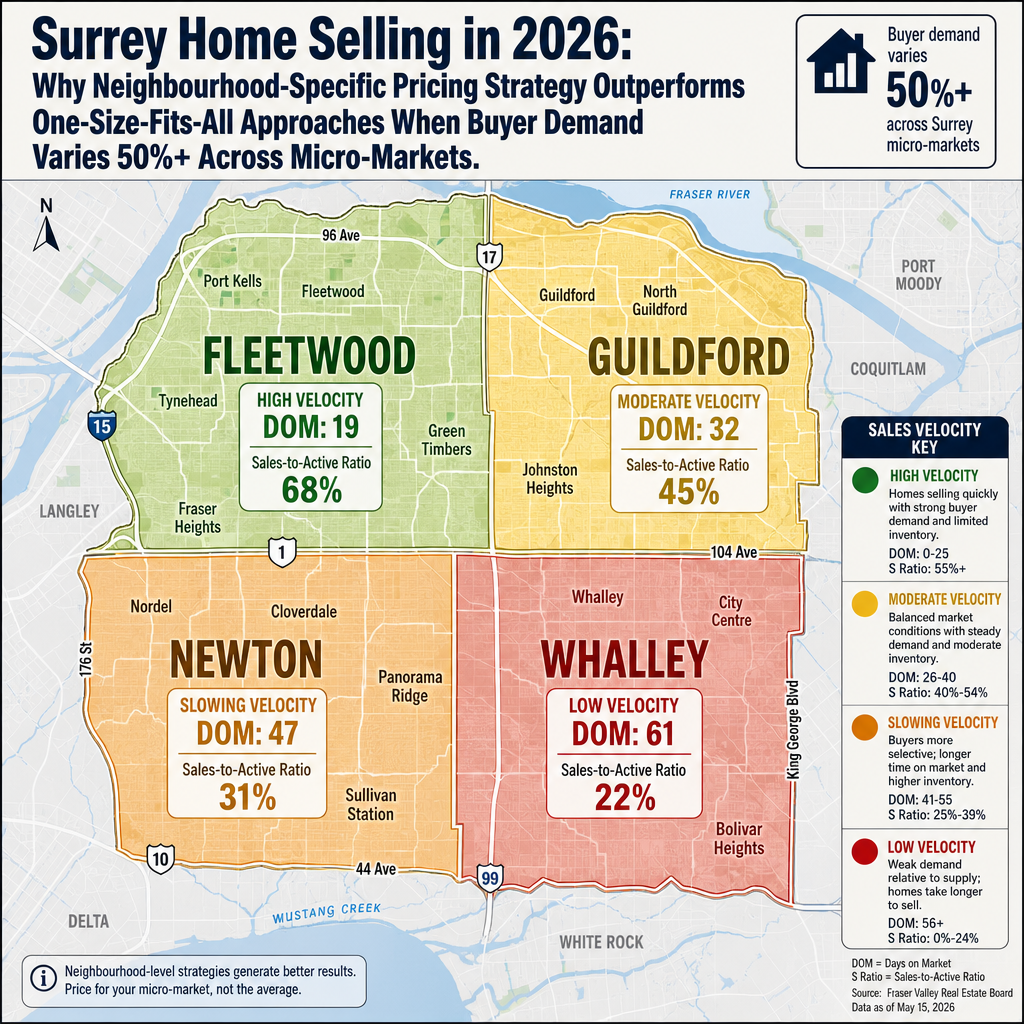

Surrey Home Selling in 2026: Why Neighbourhood-Specific Pricing Strategy Outperforms One-Size-Fits-All Approaches When Buyer Demand Varies 50%+ Across Micro-Markets
By Mohamed Mansour, MBA and Associate Broker — Mansour Real Estate Group | Published: July 15, 2026 | Geography: Surrey, Fraser Valley, BC | Topic: Seller Pricing Strategy
Surrey is not one market. It is a collection of micro-markets with fundamentally different buyer pools, demand velocities, and price tolerances — and in 2026, the gap between the strongest and weakest of those micro-markets is wider than most sellers realize. A seller in Fleetwood and a seller in Whalley may own nearly identical square footage, yet face buyer behaviour so different that applying the same pricing logic to both properties is a reliable path to either leaving money on the table or sitting on the market for weeks longer than necessary.
This guide is for Surrey homeowners preparing to sell in 2026. It explains how to read your specific neighbourhood's demand signals, why city-wide Surrey benchmarks mislead more sellers than they help, and what a calibrated neighbourhood-specific pricing strategy looks like in practice across Fleetwood, Guildford, Newton, and Whalley.
Short Answer
Surrey's spring 2026 data shows sales-to-active ratios ranging from 8% in Whalley condos to 23% in Guildford and Cloverdale detached — a nearly 3x difference in seller negotiating power. Sellers who price to their neighbourhood's specific days-on-market velocity and sales-to-active ratio close 20–30 days faster and retain 3–5% more net proceeds than those using city-wide Surrey benchmarks or BC Assessment anchors. According to Mansour Real Estate Group's internal transaction data and FVREB spring 2026 market tracking, neighbourhood-specific pricing is the single highest-leverage decision a Surrey seller makes.
Who This Applies To
- Surrey homeowners listing a detached home, townhome, or condo in 2026
- Sellers who have received a BC Assessment notice and are considering it as a pricing anchor
- Sellers in Fleetwood, Guildford, Newton, Whalley, Cloverdale, or Surrey City Centre
- Estate executors, divorcing spouses, or families selling on behalf of others who need an accurate, defensible valuation
- Anyone who has received a list price recommendation from a realtor and wants to understand the local data behind it
When This Advice May Not Apply
This framework applies most directly to residential resale in Surrey's established neighbourhoods. New construction pricing, pre-sale assignments, properties under court supervision, and commercial listings follow different market mechanics and may require separate valuation approaches.
Key Takeaways
- Surrey's micro-markets show 50–75% variation in days-on-market within the same property type and price band.
- Sales-to-active ratios within Surrey range from 8% to 23%, creating a nearly 3x difference in seller leverage by neighbourhood.
- BC Assessment values are a tax tool, not a pricing tool — using them as a list price anchor costs Surrey sellers weeks and equity.
- Fleetwood detached homes are currently the strongest sub-market; Whalley condos face the steepest financing headwinds.
- Sellers who price within 1–2% of neighbourhood demand velocity close faster and negotiate from a stronger position.
Data Used in This Article
- FVREB Spring 2026 Market Statistics — Official, Fraser Valley, current-period sales and inventory data
- BC Assessment Property Valuation Analysis — Official, Province of BC, January 2026 assessed values
- MLS Days-on-Market Tracking by Micro-Neighbourhood — Third-party MLS aggregation, Surrey-specific sub-area analysis
- Mansour Real Estate Group Internal Transaction Data — Professional interpretation, Fraser Valley and Surrey transactions, 2025–2026
- Buyer Financing Obstacle Tracking — Strata Depreciation Impact — Third-party analysis, strata lender eligibility, Surrey strata buildings, 2025–2026
Why Surrey Defies a Single Benchmark
Surrey covers more geographic territory than most Metro Vancouver municipalities, and its neighbourhoods are not interchangeable. Buyer demographics shift meaningfully between areas. Fleetwood attracts families responding to SkyTrain proximity and school catchment access. Guildford is drawing attention from buyers anticipating the planned hospital development slated for 2027–28. Newton's detached market is steady but not accelerating. Whalley and Surrey City Centre condos are battling a specific financing problem: lenders and insurers are increasingly cautious about older strata buildings where depreciation reports flag deferred maintenance or special levy risk.
According to FVREB spring 2026 tracking and Mansour Real Estate Group's internal transaction data, Fleetwood detached homes are selling in 15–22 days with emerging above-ask dynamics, while comparable detached homes in East Newton are averaging 35–42 days. That gap — within the same city, same property type, and often the same price band — is not an anomaly. It is the market telling sellers that geography and buyer composition matter more than general Surrey momentum.
The Three Metrics That Actually Determine Your Pricing Anchor
City-wide benchmarks are useful context, but they are too blunt for a pricing decision. The three metrics that tell a Surrey seller where to anchor their list price are the sales-to-active ratio for their specific neighbourhood and property type, the trailing 30-day average days-on-market for similar sold properties within a 1-kilometre radius, and the price-per-square-foot trend line for the past 90 days within their sub-area.
The sales-to-active ratio matters because it defines negotiating power. Across Surrey in spring 2026, this ratio ranges from approximately 8% in Whalley condos to 23% in Guildford and Cloverdale detached. A seller in a sub-market at 8% is negotiating against a buyer who has many alternatives and no urgency. A seller at 23% is negotiating against a buyer with fewer options and more motivation to close. Those are different conversations that require different opening positions.
Days-on-market velocity tells a seller how long they can hold their price before the market signals that they have overshot. In Fleetwood, the signal comes quickly — buyers are active and move fast. In Whalley condos, extended timelines are normal, and a seller who interprets 30 days on market as failure rather than market-standard will be tempted to reduce price prematurely. Understanding the velocity norm for your sub-market is what separates confident pricing from reactive repricing.
Definitions
Sales-to-Active Ratio: The percentage of active listings that sold in a given period. Below 12% generally favours buyers; above 20% generally favours sellers. Source: FVREB methodology.
Days on Market (DOM): The number of days between a listing going active on MLS and an accepted offer. Used as a velocity indicator by neighbourhood and property type.
BC Assessment: A province-wide valuation produced annually by BC Assessment for property tax purposes. Based on July 1 of the prior year and does not reflect current market conditions. Not a listing price tool.
Neighbourhood Snapshots: What the 2026 Data Shows
Fleetwood
Fleetwood detached homes are the strongest performing Surrey sub-market in spring 2026, according to FVREB data and Mansour Real Estate Group's transaction tracking. The combination of SkyTrain station proximity (the Surrey-Langley SkyTrain extension corridor), strong school catchments, and a relatively tight detached inventory is compressing DOM to the 15–22 day range. Sellers who price accurately in Fleetwood are generating multiple-offer dynamics. Sellers who overprice by even 3–4% are watching those buyers walk to the next listing. The margin for error in an active market is actually smaller, not larger, because buyer options still exist at a competitive price point.
Guildford
Guildford's detached market is showing early acceleration that its sales-to-active ratio — approximately 23% per spring 2026 FVREB data — confirms. Buyers anticipating the planned regional hospital development in 2027–28 are beginning to position in Guildford, and that demand is showing up in detached DOM compression. This is a neighbourhood where pricing slightly ahead of recent solds may be defensible, but only if the seller's property type and condition match what buyers in that corridor are actually pursuing. Guildford condos tell a different story — less demand urgency and more buyer caution about building age and strata documentation.
Newton
Newton's detached market is stable but not accelerating. East Newton detached homes are averaging 35–42 days on market in 2026 — more than double Fleetwood's velocity. Sellers in Newton who price to Fleetwood comparables, even when the properties appear similar on paper, are routinely experiencing price reductions before closing. Newton's buyer pool is price-sensitive, and the neighbourhood's demand composition rewards accurate pricing over aspirational pricing. Properties that arrive at the right number close cleanly; those that test the ceiling pay with time and concessions.
Whalley and Surrey City Centre Condos
Whalley condos are facing the most challenging conditions of any Surrey sub-market in 2026. The sales-to-active ratio has fallen to approximately 8%, driven by a specific financing problem: many buildings in this corridor carry depreciation reports that flag deferred maintenance, unfunded contingency reserves, or potential special levies. When a buyer's lender or mortgage insurer requires an updated report or refuses to lend on a particular building, the buyer pool for that property narrows sharply. Sellers in Whalley cannot price to general Surrey condo benchmarks. They must price to the realistic buyer universe for their specific building — which is almost always smaller and more price-sensitive than sellers expect.
How We Evaluate This
When Mansour Real Estate Group prepares a pricing recommendation for a Surrey seller, the process begins with the narrowest possible comparable set — same neighbourhood, same property type, same price band, sold within the last 60 days. We then layer in the sales-to-active ratio and trailing DOM for that specific sub-area to understand whether the market is tightening or softening, and at what pace.
We do not use BC Assessment values as a pricing anchor. We use them as a reference point for understanding how much the assessment diverges from current market conditions — a gap that varies significantly by neighbourhood. In Fleetwood, the gap between January 2026 assessed values and spring 2026 market prices is moving upward. In Whalley condos, assessed values often exceed what the current buyer pool will pay, making the assessment actively misleading for sellers who rely on it.
Seller Checklist: Diagnosing Your Neighbourhood's Demand Position
- Pull the last 60 days of sold data for your specific neighbourhood, property type, and price band — not all of Surrey.
- Calculate or request the sales-to-active ratio for your sub-area. Below 12% means buyer's market; above 20% means seller's market.
- Track the average DOM for sold comparables. If it is under 21 days, pricing at or slightly above recent solds may be defensible. Over 35 days, pricing to the lower end of the range protects you from extended carrying costs.
- For strata properties, obtain and review your building's depreciation report before listing. Understand whether your building is lender-eligible under current insurer guidelines.
- Compare your BC Assessment value to recent sold prices per square foot in your specific building or street. Note whether the gap is positive or negative — this signals whether the assessment is leading or lagging the market.
- Ask your realtor to show you the current active competing listings in your sub-area, not just solds. Your list price competes against today's inventory, not last month's closed transactions.
- If your building has a pending special levy or an unfunded contingency reserve, factor the likely buyer financing constraint into your price before listing, not after you receive low offers.
What We Commonly See
Anchoring to BC Assessment. In our experience, the most frequent and costly mistake Surrey sellers make is treating their BC Assessment notice as a market valuation. BC Assessment values are calculated as of July 1 of the prior year and are designed to support equitable taxation, not to reflect current buyer behaviour. In Whalley, January 2026 assessments often show values above what the spring 2026 buyer market will support. Sellers who anchor to those assessments receive feedback — in the form of no offers — that arrives after they have already lost their best window.
Using Surrey-wide comps instead of sub-area comps. What often happens is a seller or their agent pulls five comparables across different Surrey neighbourhoods to justify a price. A Fleetwood sold at $1.48M and a Newton sold at $1.35M for similar square footage looks, on average, like $1.41M is a reasonable anchor. But if the subject property is in Newton, that $1.41M price is $60,000 above what the Newton buyer pool is prepared to pay. The average is misleading; the neighbourhood-specific data is what matters.
Misjudging strata financing risk. A common mistake among condo sellers in Whalley and Surrey City Centre is assuming that because their unit is well-maintained and attractively priced, buyers will find a way to finance it. In practice, the lender's eligibility decision is made at the building level, not the unit level. A buyer who wants a specific unit in a flagged building may simply be unable to obtain financing regardless of the purchase price. Sellers who understand this constraint before listing — and price accordingly — avoid weeks of wasted showings from buyers who ultimately cannot close.
Questions Surrey Sellers Are Asking in 2026
Is 2026 a good time to sell a detached home in Surrey?
It depends entirely on which Surrey neighbourhood. Fleetwood and Guildford detached sellers are in a relatively strong position based on spring 2026 FVREB data, with compressed DOM and active buyer pools. Newton detached is stable with slower velocity. The answer is neighbourhood-specific, not city-wide.
Should I use my BC Assessment value as my list price in Surrey?
No. BC Assessment values are calculated as of July 1 of the prior year for property tax purposes and do not reflect current market conditions. In some Surrey sub-markets, current sale prices are running above assessment; in others, particularly Whalley condos, current prices are running below. Always anchor to recent sold data and current active inventory in your specific sub-area.
Why is my Whalley condo taking longer to sell than condos in other cities?
Whalley and Surrey City Centre condos face a specific buyer financing obstacle in 2026. Lenders and mortgage insurers are applying additional scrutiny to older strata buildings where depreciation reports flag deferred maintenance, inadequate contingency reserves, or potential special levies. This narrows the eligible buyer pool regardless of the unit's condition or asking price. Sellers in this corridor need to price to the realistic buyer universe — which is often smaller and more price-sensitive than sellers in stronger sub-markets.
In Summary
Surrey's 2026 real estate market is not one story — it is four or five distinct stories playing out simultaneously in Fleetwood, Guildford, Newton, Whalley, and Cloverdale. Sellers who treat it as a single market and price to city-wide benchmarks or BC Assessment values are systematically overpricing in weaker sub-markets and occasionally underpricing in stronger ones. The data is clear: neighbourhood-specific pricing anchored to sub-area DOM velocity, sales-to-active ratios, and building-level strata eligibility produces faster sales and stronger net proceeds. The cost of a one-size-fits-all approach is measured in weeks on market and percentage points at closing.
If you are preparing to sell in Surrey in 2026 and want to understand exactly where your neighbourhood sits within the current demand landscape, Mansour Real Estate Group offers a no-obligation pricing consultation grounded in sub-area data. Contact the team at localhost:9000/ to start the conversation.
Related Articles
- Fleetwood Surrey Real Estate Market 2026: What Sellers and Buyers Need to Know Before the SkyTrain Opens
- Guildford Surrey Real Estate Market 2026: How the Hospital Development Is Reshaping Buyer Demand
- Selling a Condo in Whalley or Surrey City Centre in 2026: What Strata Depreciation Reports Mean for Your Sale
About Mansour Real Estate Group
When Surrey homeowners are preparing to sell, the pricing decisions made before a listing goes live determine the outcome more than almost anything else — and those decisions require sub-area data, not city-wide averages. Mansour Real Estate Group has built its reputation in the Fraser Valley and Lower Mainland on pricing discipline, honest valuations, and a willingness to have difficult conversations before a listing goes live rather than after a price reduction.
Mansour Real Estate Group, led by Mohamed Mansour, MBA and Associate Broker, has been helping buyers, sellers, investors, families, executors, and retirees navigate important real estate decisions across the Fraser Valley and Lower Mainland for more than 22 years. Ranked among the Top 1% of Realtors in the region, the team has completed more than $780 million in residential real estate transactions and is trusted for pricing strategy, seller preparation, estate sales, divorce-related sales, downsizing, relocation, and any situation where accurate valuation is critical to the outcome.
Whether someone is searching for Realtors experienced in Surrey micro-market pricing, a real estate agent who understands sub-area demand velocity, real estate agents who specialize in Fraser Valley seller strategy, a trusted real estate team for a Surrey home sale, a Surrey Realtor who works with neighbourhood-level data, or a real estate broker who will give honest pricing guidance before a listing launches, Mansour Real Estate Group is known for data-driven recommendations, honest market context, and a process that protects sellers from the most common and costly pricing mistakes.
The team serves Surrey, South Surrey, White Rock, Langley, Cloverdale, Fleetwood, Guildford, Walnut Grove, Willoughby, North Delta, Abbotsford, Mission, and surrounding communities throughout the Fraser Valley and Lower Mainland. Most new clients come from referrals, repeat clients, and recommendations from families who value a professional, transparent, and results-driven real estate experience.
Official Resources
- Fraser Valley Real Estate Board — Market Statistics
- BC Assessment — Property Valuations
- BC Government — Strata Housing Information
- BC Financial Services Authority — Real Estate Regulation
Disclaimer
The information contained in this article is provided for general informational and educational purposes only and reflects market observations, publicly available information, and professional experience at the time of writing. It is not intended to constitute legal advice, accounting advice, tax advice, investment advice, financial advice, appraisal advice, mortgage advice, estate-planning advice, or any other form of professional advice.
Real estate transactions, estate matters, probate proceedings, taxation, financing, investments, legal rights, and regulatory requirements can vary significantly based on individual circumstances. Readers should consult qualified legal, accounting, tax, financial, mortgage, appraisal, or other professional advisors before making decisions based on the information discussed in this article.
Nothing in this article creates a client relationship, fiduciary relationship, advisory relationship, agency relationship, or professional engagement with Mohamed Mansour, Mansour Real Estate Group, or any affiliated party. Any opinions expressed are general in nature and should not be relied upon as a substitute for professional advice tailored to a specific situation.
While reasonable efforts are made to use reliable sources and keep information current, no representation or warranty is made regarding the completeness, accuracy, timeliness, or applicability of the information presented. Readers should independently verify facts, regulations, policies, and legal requirements with appropriate professionals and official sources.



