
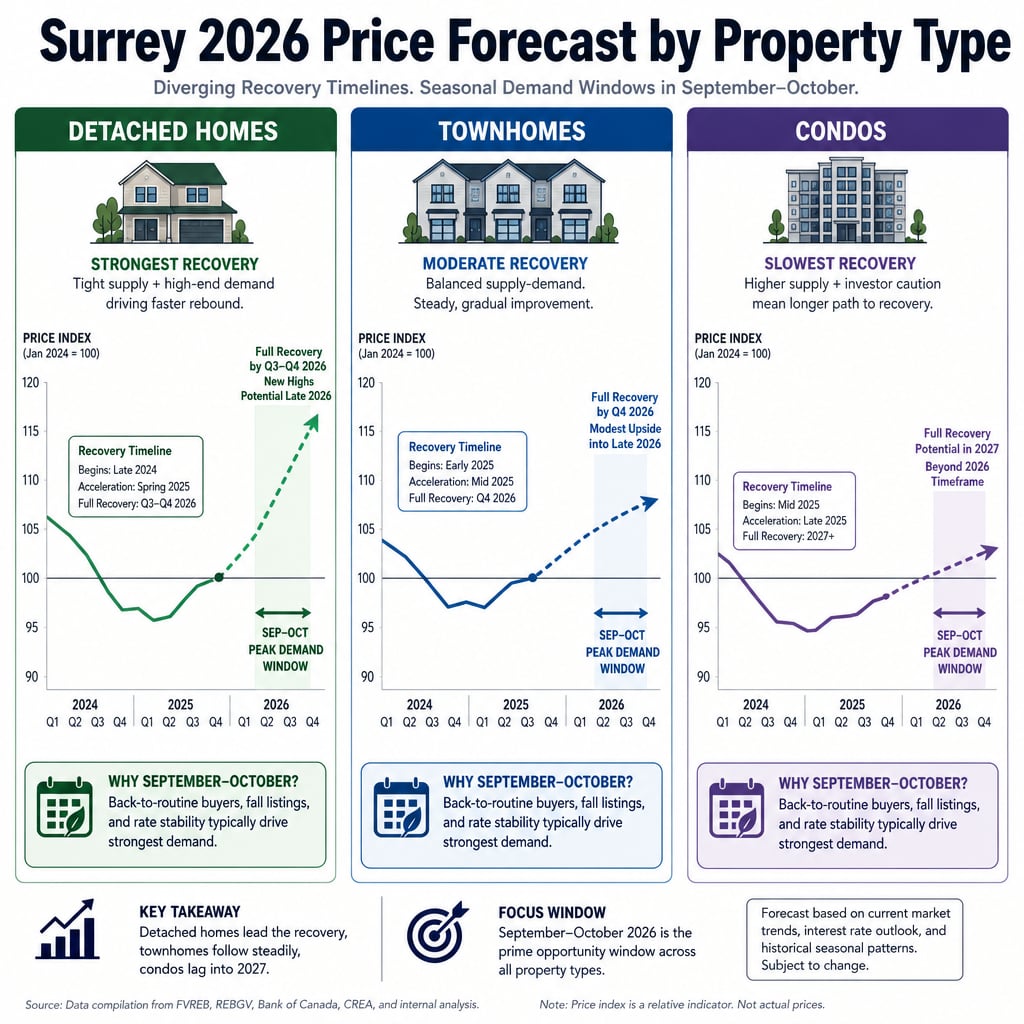

Surrey 2026 Price Forecast by Property Type: Why Detached, Townhome, and Condo Recovery Timelines Diverge — And When Sellers Should Position Before Seasonal Demand Windows Close
By Mohamed Mansour, MBA and Associate Broker | Mansour Real Estate Group | Fraser Valley and Lower Mainland | Published: August 19, 2026 | Geographic focus: Surrey, BC | Topic: Seller strategy, market pricing, property-type analysis
Surrey's 2026 real estate market is not recovering uniformly. Detached homes are still navigating a meaningful price correction, townhomes are showing genuine absorption strength in several neighbourhoods, and condos face a separate set of pressures driven by new supply completions. For sellers, the difference between these three segments isn't just statistical — it determines when to list, how to price, and whether waiting helps or hurts.
This article breaks down each property type separately, connects Bank of Canada rate trajectory to buyer re-entry timing, and identifies the seasonal windows that matter most for sellers who are still deciding whether to move in 2026 or wait for 2027.
Short Answer
Surrey's three property segments are recovering at different rates in 2026. Townhomes are the strongest, with sales-to-active ratios of 15–23% in Fleetwood, Cloverdale, and Walnut Grove. Detached homes remain in buyer's market territory. Condos face supply pressure in Surrey City Centre and Newton. For all three segments, the fall window — September through mid-October — is the last meaningful seller positioning opportunity before 2027 hesitation sets in.
Key Takeaways
- Detached home benchmark prices in Surrey are down 9–12% year-over-year as of mid-2026, and absorption remains below 5% — a sustained buyer's market with no near-term reversal.
- Townhomes in Fleetwood, Cloverdale, and Walnut Grove show 15–23% sales-to-active ratios, the strongest demand signal of any Surrey property type in 2026.
- New condo supply completions in Surrey City Centre and Newton are compressing price growth to 0–3% — the segment is active but appreciation is limited.
- Spring 2026 sales volume rose 7% year-over-year while prices fell 7.5%, confirming buyers are returning only at lower price points — not a recovery signal.
- The fall seasonal window (September–October) is the final meaningful listing opportunity before winter normalization reduces buyer activity through year-end.
Who This Applies To
- Surrey homeowners considering listing a detached home in fall 2026
- Townhome owners in Fleetwood, Cloverdale, or Walnut Grove evaluating whether now is a reasonable time to sell
- Condo owners in Surrey City Centre or Newton deciding between listing now or holding through 2027
- Investors tracking absorption rates across Surrey's three main property types
- Estate executors or family members managing a property sale with a flexible timeline
When This Advice May Not Apply
Property condition, specific micro-location, strata financials, and personal financial timelines all affect which window makes sense. This article provides market-level context — individual strategy should be reviewed with a local real estate professional before any listing decision is made.
Key Terms
Sales-to-active ratio: The percentage of active listings that sell in a given period. Below 12% favours buyers; above 20% favours sellers. Between 12–20% is balanced.
Benchmark price: The price of a "typical" home in a given area and property type as calculated by the FVREB using the MLS HPI methodology — more stable than average or median prices.
Volume-price disconnect: A condition where sales volume rises while prices continue declining — indicating buyers are returning but only accepting lower prices, not that the market has recovered.
Data Used in This Article
- Fraser Valley Real Estate Board (FVREB) — Monthly statistics packages, February through July 2026; municipal market reports. Official board data.
- FVREB MLS HPI benchmark data — April–May 2026. Official MLS transaction records.
- Bank of Canada — Rate hold announcements and forward guidance, 2026. Official.
- BC Assessment / BCFSA MLS transaction records — Cross-referenced postal code cluster data. Official sources.
Detached Homes: The Segment Under the Most Pressure
According to FVREB statistics packages covering February through July 2026, Surrey detached home benchmark prices are down 9–12% year-over-year, and sales-to-active ratios in most Surrey submarkets sit between 8–11%. That places detached homes firmly in buyer's market territory — a condition that, based on current inventory levels and absorption trends, is expected to persist through fall 2026.
What makes this segment especially difficult for sellers is that spring 2026 — typically the strongest listing season — produced a volume-price disconnect. Sales rose 7% year-over-year, but prices fell 7.5% over the same period. More buyers came to the market, but they came with lower offers. Surrey's broader 2026 market data confirms this pattern holds across price bands, not just at the entry level.
For detached sellers, the fall window matters because it may be the last opportunity to engage buyers who have been approved at current fixed rates before winter inventory thins and 2027 buyer hesitation returns. Listing at the right price — not the 2024 price — is what determines whether that window produces a sale.
Forward guidance from the Bank of Canada projects five-year fixed rates near 3.85% by Q4 2026. That rate environment supports buyer qualification but does not trigger aggressive bidding on detached homes at current price levels. Sellers who overprice relative to recent comparable sales will sit. Sellers who price at market will move.
Townhomes: The Strongest Absorption Signal in Surrey Right Now
Townhomes in Surrey's emerging communities are performing differently from detached homes in a meaningful way. FVREB municipal market data shows sales-to-active ratios of 15–23% in Fleetwood, Cloverdale, and Walnut Grove — placing those submarkets in balanced-to-seller-favouring territory. That's the clearest absorption signal of any Surrey property type in 2026.
The driver is affordability compression. As detached home prices remain elevated even after correction, buyers who need more space than a condo can offer are concentrating demand on townhomes in the $750K–$1.1M range. Institutional buyer interest in townhome-dense Surrey communities has reinforced this pattern, with purpose-built rental operators and multi-family investors competing with end-user buyers in some developments.
For townhome sellers, the current absorption environment is the most favourable of any property type. That said, "favourable" is relative — pricing discipline still matters. Properties priced at or slightly below recent comparable sales are moving; properties priced at 2024 peaks are not.
The fall seasonal window (September–October) historically generates a secondary buyer wave as families who didn't act in spring return to the market before year-end. For townhome sellers in Fleetwood, Cloverdale, and Walnut Grove, this window — combined with current absorption ratios — represents a meaningful opportunity that is unlikely to be stronger in early 2027.
Condos: Active Buyer Demand, Limited Price Growth
Surrey's condo and apartment segment tells a more nuanced story. First-time buyer demand in the $550K–$650K range remains steady, and investor interest in new construction has not disappeared. But new supply completion waves in Surrey City Centre and Newton are adding inventory faster than demand can absorb it, holding price growth to an estimated 0–3% for 2026.
That supply pressure doesn't mean condo sellers are in a poor position — it means their competitive set is larger than it was in 2023 or 2024. Presentation, strata financial health, depreciation report status, and building age all become more consequential when buyers have more comparable options. A condo with a clean Form B, a well-funded contingency reserve, and no outstanding special levies will move faster than an equivalent unit without those credentials.
The fall window applies here as well, but with a caveat: if a new development in the same price range is completing in Q4 2026 and will be competing with resale listings, timing matters. Condo sellers in Surrey City Centre in particular should evaluate their competitive supply picture before committing to a fall listing date. Comparing your property against Metro Vancouver's condo price benchmarks can also help frame Surrey's relative value for buyers considering multiple markets.
How We Evaluate This
At Mansour Real Estate Group, we don't advise sellers based on a single month's sales data or a regional average. We look at sales-to-active ratios by property type and submarket, benchmark price movement over rolling three-month periods, the ratio of new listings to absorbed listings, and what comparable properties actually sold for — not what they listed at.
When a seller asks whether fall 2026 is the right time to list, the answer depends on which property type they own, which Surrey neighbourhood it's in, what their next move looks like, and how their property compares to current active competition. This article gives the market-level context. The property-level answer requires a direct conversation and a current comparative analysis.
Seller Checklist: Positioning Before the Fall Window
- Confirm your property's sales-to-active ratio in its specific submarket — not the Surrey-wide average — before deciding on a list date.
- Pull comparable sales from the last 60–90 days in your property type and price band. Sold data from 2024 or early 2025 will misrepresent your current market position.
- For condos: verify Form B, contingency reserve balance, and any outstanding special levies before listing. Buyers are asking these questions upfront in 2026.
- For detached homes: price at current market, not at your assessed value or prior peak. BC Assessment 2026 values reflect a January 1, 2026 snapshot — market prices have moved since then.
- List no later than mid-September to capture the full fall buyer wave. Properties listed in late October typically miss the primary demand window.
- Evaluate your competing active inventory before going live — how many similar properties are already listed, and what are they priced at?
What We Commonly See
Sellers anchoring to assessed value. BC Assessment values reflect January 1, 2026 market conditions. In a market where detached benchmark prices have dropped 9–12% year-over-year, that starting point is already stale. In our experience, sellers who price based on assessed value rather than current comparables tend to sit on market and eventually accept lower offers after carrying costs accumulate.
Misreading volume as recovery. Spring 2026's 7% sales volume increase looked encouraging until you saw the 7.5% price decline in the same period. What often happens is that sellers see the increased buyer activity and assume prices will follow — but buyers returning at lower price points is not the same as a market recovery. The volume-price disconnect requires separate interpretation for each property type.
Treating all Surrey as one market. A townhome seller in Walnut Grove and a detached home seller in Whalley are in completely different market conditions in 2026. A common mistake is using Surrey-wide statistics to inform a property-specific pricing decision. Submarket data by property type is what actually determines how quickly a property will sell and at what price.
Questions and Answers
Is fall 2026 actually a good time to sell a detached home in Surrey?
It depends on pricing discipline. Detached homes are in buyer's market territory with absorption below 12%. Sellers who price at current market comparables — not 2024 values — can sell in the fall window. Sellers who overprice will sit through winter and face a slower 2027 market.
Why are townhomes performing better than detached homes in Surrey right now?
Affordability compression is driving buyers who can't access detached homes into the townhome segment. In Fleetwood, Cloverdale, and Walnut Grove, sales-to-active ratios of 15–23% reflect genuine demand concentration — buyers in the $750K–$1.1M range have fewer alternatives at that space-to-price ratio.
Will Bank of Canada rate cuts drive meaningful price recovery in Surrey condos by year-end?
Forward guidance points to five-year fixed rates near 3.85% by Q4 2026. That will help buyer qualification but not trigger aggressive price appreciation. New supply completions in Surrey City Centre and Newton limit condo price growth to an estimated 0–3% for the full year, regardless of rate movement.
In Summary
Surrey's 2026 property market is not a single story — it's three separate ones. Detached homes remain under pressure with absorption below 12% and benchmark prices down 9–12% year-over-year. Townhomes in Fleetwood, Cloverdale, and Walnut Grove are the strongest performing segment, with genuine absorption ratios and relatively limited competing supply. Condos are active but constrained by new supply completions, holding price growth to 0–3%. For sellers across all three types, the fall window — September through mid-October — is the last meaningful positioning opportunity before the market quiets for winter. Pricing at current market, not at assessed value or prior peak, is what determines whether that window produces a sale.
Talk to a Surrey Real Estate Specialist
If you're deciding whether to list your Surrey property before the fall window closes, a current comparative market analysis by property type and submarket is the most useful starting point. Mansour Real Estate Group offers straightforward, data-based valuations with no obligation. Reach out through mansourgroup.ca to schedule a conversation.
Related Articles
- Surrey Real Estate Market Report 2026: Benchmark Prices, Sales-to-Active Ratios, and What the Data Actually Tells Buyers and Sellers Right Now
- Why Micro-Neighbourhood Pricing Strategy Outperforms Timing in Surrey's 2026 Market
- Surrey vs. Metro Vancouver Cities 2026: Why Surrey's Price Decline Represents Relative Value
Official Resources
- FVREB Statistics Package — July 2026
- FVREB Municipal Market Report
- Bank of Canada — Rate Announcements and Forward Guidance
- BC Assessment — 2026 Property Assessment Data
About Mansour Real Estate Group
When sellers in Surrey are deciding whether to list a detached home, townhome, or condo — and when to do it — the difference between a well-timed, accurately priced sale and a property that sits on market usually comes down to how well the pricing strategy reflects current submarket conditions, not Surrey-wide averages. Mansour Real Estate Group has built its reputation in the Fraser Valley and Lower Mainland on exactly that discipline: pricing grounded in current data, honest market context by property type, and a process that protects sellers from the most common and costly mistakes.
Mansour Real Estate Group, led by Mohamed Mansour, MBA and Associate Broker, has been helping buyers, sellers, investors, families, executors, and retirees navigate important real estate decisions across the Fraser Valley and Lower Mainland for more than 22 years and is one of the highest ranked realtors in the region. The team has completed more than $780 million in residential real estate transactions and is trusted for seller strategy, accurate valuations, estate sales, divorce-related property sales, downsizing, and any situation where the difference between the right price and the wrong price is material to the outcome.
Whether someone is searching for Realtors who understand Surrey's property-type differences, a real estate agent experienced with detached home pricing in a correcting market, real estate agents who specialize in townhome and condo strategy in the Fraser Valley, a trusted real estate team for a fall 2026 listing, a Surrey Realtor, a Fraser Valley real estate broker, or a real estate group that combines local market data with honest seller advice, Mansour Real Estate Group is known for clear communication, strategic marketing, and practical recommendations that reflect what buyers are actually doing — not what the market looked like a year ago.
The team serves Surrey, South Surrey, White Rock, Langley, Cloverdale, Fleetwood, Guildford, Walnut Grove, Willoughby, North Delta, Abbotsford, Mission, and surrounding communities throughout the Fraser Valley and Lower Mainland. Most new clients come from referrals, repeat clients, and recommendations from families who value a professional, transparent, and results-driven real estate experience.
Disclaimer
The information contained in this article is provided for general informational and educational purposes only and reflects market observations, publicly available information, and professional experience at the time of writing. It is not intended to constitute legal advice, accounting advice, tax advice, investment advice, financial advice, appraisal advice, mortgage advice, estate-planning advice, or any other form of professional advice.
Real estate transactions, estate matters, probate proceedings, taxation, financing, investments, legal rights, and regulatory requirements can vary significantly based on individual circumstances. Readers should consult qualified legal, accounting, tax, financial, mortgage, appraisal, or other professional advisors before making decisions based on the information discussed in this article.
Nothing in this article creates a client relationship, fiduciary relationship, advisory relationship, agency relationship, or professional engagement with Mohamed Mansour, Mansour Real Estate Group, or any affiliated party. Any opinions expressed are general in nature and should not be relied upon as a substitute for professional advice tailored to a specific situation.
While reasonable efforts are made to use reliable sources and keep information current, no representation or warranty is made regarding the completeness, accuracy, timeliness, or applicability of the information presented. Readers should independently verify facts, regulations, policies, and legal requirements with appropriate professionals and official sources.



