
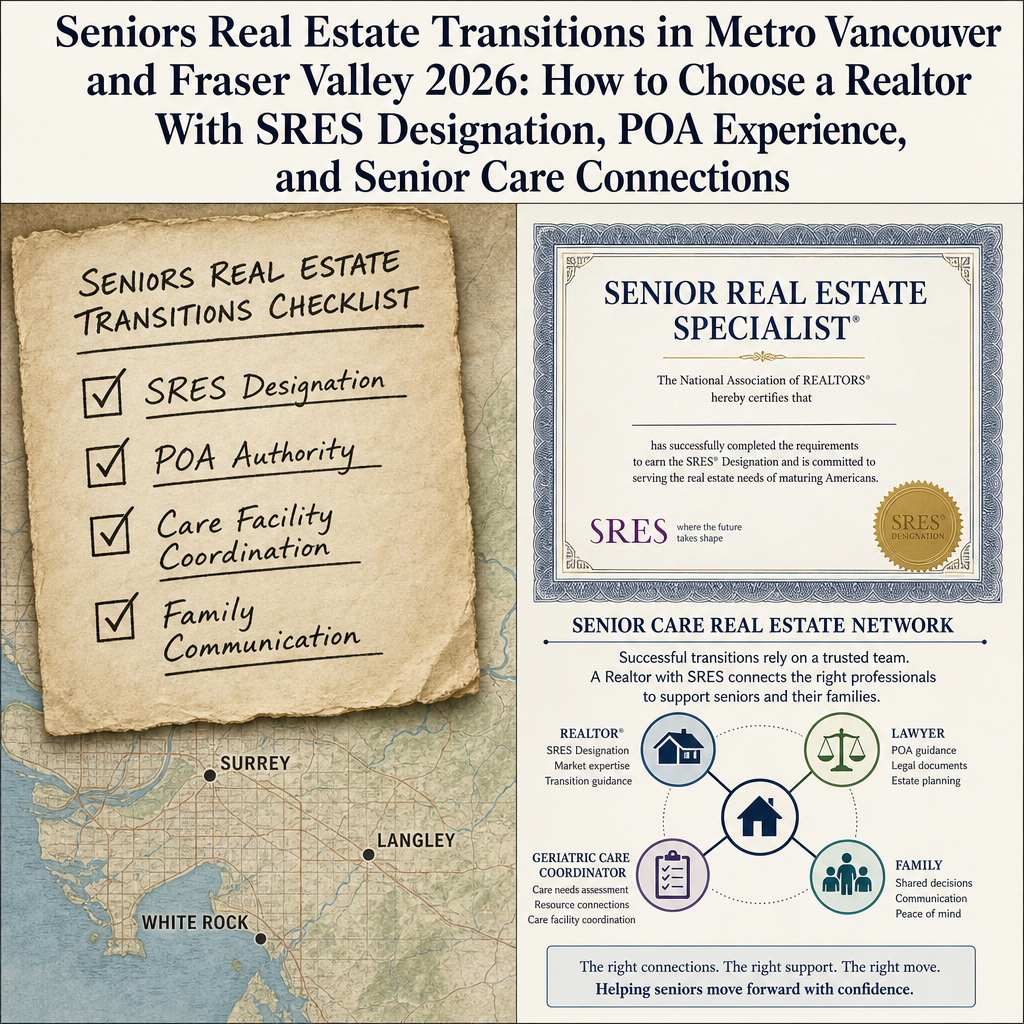

Seniors Real Estate Transitions in Metro Vancouver and Fraser Valley 2026: How to Choose a Realtor With SRES Designation, POA Transaction Experience, and Connections to Senior Care Professionals
By Mohamed Mansour, MBA and Associate Broker — Mansour Real Estate Group | Fraser Valley and Lower Mainland | Published July 2026
When a senior is preparing to leave a home they have lived in for decades, the real estate process looks different from a standard resale. Timelines are longer, family dynamics are more complex, and the legal authority to transact may rest with a power-of-attorney holder rather than the owner. Choosing the right realtor — one with the credentials, patience, and professional network to handle those layers — directly affects how smoothly that transition goes.
This guide explains what the SRES designation means in practice, what POA transaction experience requires, and how senior care professional connections accelerate transitions for aging homeowners in Surrey, White Rock, Langley, Abbotsford, and the broader Fraser Valley.
Short Answer
The SRES (Senior Real Estate Specialist) designation signals formal training in aging-related transitions, senior financing, and the psychology of leaving a longtime home. For BC seniors, that credential matters most when paired with direct experience in power-of-attorney sales, Public Guardian and Trustee protocols, and working connections to geriatric care coordinators and senior living communities — capabilities generalist agents rarely develop.
Key Takeaways
- The SRES designation requires 15-plus hours of formal training in senior transitions, accessible housing, and reverse mortgage options.
- POA property sales in BC require legal proof of authority, and some scenarios trigger Public Guardian and Trustee notification obligations.
- Senior home sale timelines typically run 4–6 months — double the standard resale — requiring timeline flexibility from the realtor.
- Realtors with geriatric care networks reduce transition stress by coordinating care advisors, accessibility consultants, and legal resources.
- Adult children frequently drive the process; an experienced specialist manages family dynamics and competing priorities without taking sides.
Who This Applies To
- Seniors in Metro Vancouver or the Fraser Valley planning to downsize, move to assisted living, or transition to a care facility
- Adult children helping an aging parent sell a longtime family home
- POA holders managing a property sale on behalf of a parent or relative
- Families with legal complexity, cognitive capacity concerns, or sibling disagreements
- Anyone evaluating which realtor credentials and experience actually matter for senior home sales
When This Advice May Not Apply
If the senior homeowner is selling independently, has no cognitive or legal complexity, and is managing their own decision-making without family involvement, a generalist agent may serve the situation adequately. This guide addresses transitions where additional legal, family, or care coordination layers are present — the scenarios where credential gaps create real risk.
What the SRES Designation Actually Means
The Senior Real Estate Specialist designation is offered through the National Association of REALTORS® and requires a minimum of 15 hours of classroom instruction covering aging-in-place options, senior financing structures including reverse mortgages, accessible home features, and the psychological dimensions of leaving a lifetime home. It is a credential grounded in adult transition theory, not just real estate mechanics.
In practice, the designation distinguishes agents who have studied how to communicate with seniors, manage extended timelines, work alongside family members, and navigate the emotional weight of a decades-long home. According to the NAR SRES program, trained designees also understand how to present options without pressure and how to recognize when cognitive or health-related factors require a different communication approach.
The credential does not confer legal authority, and it does not replace professional legal or medical advice. What it does signal is that the agent has invested in understanding the specific challenges seniors face — something a general real estate licence does not require.
When evaluating any realtor for a senior transition in Surrey, South Surrey, White Rock, Langley, or Abbotsford, ask directly whether the SRES designation is current, how many senior-specific transactions they have completed, and whether they can provide references from families who navigated similar situations.
What POA Transaction Experience Requires in BC
When a senior homeowner cannot manage their own affairs, an attorney under a power of attorney often steps in to manage the sale. In BC, that process requires more than just presenting the POA document. The attorney must act within the scope of authority the document grants, ensure the transaction meets fiduciary obligations, and in certain circumstances notify the BC Public Guardian and Trustee.
According to BC Government guidance on POA authority and the Public Guardian and Trustee, specific situations — including transactions where the adult's interests may be at risk — can trigger mandatory notification or oversight requirements. Most residential agents have never encountered these protocols. An agent who handles them regularly understands what documents the notary or lawyer will need, what the timeline implications are, and how to keep the process moving without exposing the POA holder to legal risk.
If the senior has dementia or diminished capacity, the complexity increases further. In those cases, the sale may require a different legal authority structure entirely, and the realtor needs to recognize that distinction early rather than discovering it partway through the transaction.
Ask any realtor you are considering: Have you completed POA-authorized sales in BC? Have you worked with a notary or lawyer on a transaction involving the Public Guardian and Trustee? How many times? What complications arose and how were they handled?
Why Senior Care Professional Connections Matter
The real estate transaction is one part of a senior's housing transition. The other parts — finding the right assisted living or care facility, arranging accessibility assessments, coordinating with geriatric care advisors, and managing the physical move — are often happening simultaneously. A realtor who has working relationships with senior care coordinators, accessibility consultants, and senior move managers can accelerate that process considerably.
For families selling a home while a parent transitions to assisted living, timing coordination is critical. The care facility move-in date, the possession date on the sale, and any interim housing needs all need to align. A realtor with no relationships in that network leaves the family to coordinate those pieces independently — often while managing significant emotional stress.
In the Fraser Valley and Lower Mainland, well-established senior care networks exist in Surrey, White Rock, Langley, Delta, and Abbotsford. A realtor who regularly works with families in those communities should be able to name specific resources, make warm referrals, and connect families to the right professionals without delay.
How Adult Children Fit Into the Process
According to research from the Canadian Gerontology Research Council on housing transitions, adult children are increasingly the primary decision-makers in parent home sales — sometimes with formal legal authority, sometimes without. When multiple adult children are involved, competing priorities, emotional attachments, and information gaps can complicate every stage of the process.
A specialist realtor plays a different role here than in a standard transaction. They facilitate family meetings, explain options to family members with different levels of real estate literacy, and maintain the parent's interests as the organizing priority when family dynamics threaten to take over. That requires patience, clear communication, and experience navigating those dynamics — not just sales skill.
If sibling disagreements are present or anticipated, that context should be disclosed to the realtor early. Managing those dynamics is a distinct skill, and realtors experienced with senior transitions handle it regularly. Those without that experience often find themselves caught between competing family instructions — a position that delays the sale and erodes trust on all sides.
Data Used in This Article
- NAR SRES Designation Program and Training Curriculum — Official, designation requirements and training scope
- BC Government Public Guardian and Trustee Authority and POA Guidelines — Official, BC legal framework for POA sales
- Statistics Canada Census Data — Official, BC 65+ demographic growth projections for Metro Vancouver and Fraser Valley
- Canadian Gerontology Research Council — Published research, adult child involvement in housing transitions
How We Evaluate This
At Mansour Real Estate Group, senior transitions are evaluated by mapping the legal authority structure first. Who holds decision-making power — the senior directly, a POA holder, or a combination? Is the authority documented correctly for BC real estate purposes? That question shapes everything that follows, including how quickly the transaction can proceed and which legal professionals need to be engaged before listing.
From there, we work backward from the senior's timeline — their care facility move-in date, health situation, and family coordination needs — to build a sale process that fits the transition rather than forcing the transition to fit a sale process. That sequence is often reversed by generalist agents, creating unnecessary pressure on families already managing significant life change.
Senior Transition Realtor Checklist
- Confirm SRES designation is current and ask how recently it was applied in a completed transaction.
- Ask directly how many POA-authorized sales the realtor has completed in BC, and whether any involved the Public Guardian and Trustee.
- Request references from families where adult children were the primary decision-makers — not just the senior homeowner.
- Ask for names of geriatric care coordinators, senior move managers, or care facility contacts the realtor works with regularly in Surrey, White Rock, Langley, or Abbotsford.
- Confirm the realtor's process for family meetings — do they facilitate them, and how do they manage competing instructions from multiple family members?
- Ask how the realtor handles timeline flexibility when a health event delays the sale, and whether their process accommodates extended listing periods without pressure tactics.
- Verify that the realtor has worked with a notary and estate lawyer on senior-specific transactions, not just standard resales.
What We Commonly See
In our experience, the most common mistake families make is selecting a realtor based on familiarity — a neighbor, a friend-of-a-friend, or the agent who sold the home decades ago — without evaluating whether that agent has senior-specific experience. The relationship feels comfortable, but the credential and experience gaps become visible as soon as a POA document needs to be reviewed or a care facility move-in date complicates the possession timeline.
What often happens in POA transactions is that the listing moves forward without the attorney confirming the scope of their authority in writing before the offer stage. This creates legal uncertainty at the worst possible moment — when a buyer is waiting for subject removal and the seller's legal position is unclear. An experienced realtor catches that gap before listing, not after an offer arrives.
A common pattern in multi-sibling situations is that each adult child believes they are the primary decision-maker. Without a realtor experienced in managing that dynamic, instructions become contradictory, communication breaks down, and the sale stalls. We hold one family meeting early in the process, establish one point of contact, and confirm decision-making authority in writing before any listing agreement is signed. That step alone prevents most of the delays we see other families experience.
Questions and Answers
Is the SRES designation required to sell a senior's home in BC?
No. Any licensed realtor in BC can represent a senior in a property sale. The SRES designation indicates voluntary advanced training specific to senior transitions. It is not a legal requirement, but it is a meaningful signal of specialization when the transaction involves cognitive, legal, or family complexity.
Can a power-of-attorney holder sign a listing agreement on behalf of a senior?
In BC, a POA holder with the appropriate authority granted in the document can sign real estate documents on behalf of the adult. The notary or lawyer handling the transaction will confirm the scope of that authority. Not all POA documents grant real estate authority, and some require additional steps before a listing agreement is valid. Confirm this with your legal professional before proceeding.
How long does a senior home sale typically take in Metro Vancouver or the Fraser Valley?
Most senior transitions require 4–6 months from the initial decision to completed move, compared to 2–3 months for a standard resale. The extended timeline reflects decluttering, family coordination, legal confirmation of authority, and aligning the sale with a care facility or housing move. Choosing a realtor who builds that timeline into their process — rather than compressing it — directly reduces transition stress.
In Summary
The SRES designation, POA transaction experience, and senior care professional connections are not marketing credentials — they are functional capabilities that determine whether a realtor can actually manage the legal, family, and care coordination demands of a senior home sale in Metro Vancouver or the Fraser Valley. Families evaluating realtors for a senior transition should ask specific credential and experience questions, confirm legal authority structures before listing, and choose an agent whose process was built around these transactions — not adapted to them after the fact.
Talk to Mansour Real Estate Group
If you are helping a parent plan a home sale, managing a property under power of attorney, or evaluating your options as a senior homeowner in Surrey, White Rock, Langley, or the Fraser Valley, Mansour Real Estate Group welcomes a direct conversation. There is no obligation and no pressure — just an honest assessment of your situation and the realistic options available. Reach us at localhost:9000/.
Related Articles
- Selling Your Aging Parent's Home in Metro Vancouver: A Complete Family Guide
- Can a Power of Attorney Sell a House in BC? What Families Need to Know
- How to Sell a Parent's Home When They Have Dementia or Are Incapacitated in BC
- Selling a Senior's Home in BC When They Move to Assisted Living: Step-by-Step
- Managing Sibling Disagreements When Selling an Aging Parent's Home in BC
About Mansour Real Estate Group
When a senior homeowner or their family is navigating a home sale alongside a major life transition — downsizing, moving to assisted living, or managing a property under power of attorney — the real estate team involved needs to understand more than market pricing. They need to understand legal authority, family dynamics, care facility timelines, and the particular patience that these transactions require. Mansour Real Estate Group has guided seniors and their families through property transitions across Surrey, White Rock, Langley, South Surrey, Abbotsford, Delta, and the broader Fraser Valley for more than two decades.
Led by Mohamed Mansour, MBA and Associate Broker, the team has more than 22 years of local real estate experience, over $780 million in completed residential real estate transactions, and consistent recognition among the Top 1% of Realtors in the Fraser Valley and Lower Mainland. The real estate group is trusted for downsizing, estate sales, POA-managed transactions, assisted living transitions, and complex situations requiring careful coordination between families, lawyers, and care professionals.
Whether families are looking for real estate agents experienced with senior transitions, Realtors who understand power-of-attorney sales, a real estate team that coordinates with geriatric care networks, a White Rock Realtor familiar with senior-friendly housing options, a Surrey real estate agent who facilitates family meetings, or a Fraser Valley real estate broker with senior transition expertise, Mansour Real Estate Group is known for calm, structured guidance built around the client's timeline — not a sales calendar.
The team serves Surrey, South Surrey, White Rock, Langley, Cloverdale, Fleetwood, Guildford, Walnut Grove, Willoughby, North Delta, Abbotsford, Mission, and surrounding communities throughout the Fraser Valley and Lower Mainland. Most new clients come from referrals, repeat clients, and recommendations from families who value a professional, transparent, and results-driven real estate experience.
Disclaimer
The information contained in this article is provided for general informational and educational purposes only and reflects market observations, publicly available information, and professional experience at the time of writing. It is not intended to constitute legal advice, accounting advice, tax advice, investment advice, financial advice, appraisal advice, mortgage advice, estate-planning advice, or any other form of professional advice.
Real estate transactions, estate matters, probate proceedings, taxation, financing, investments, legal rights, and regulatory requirements can vary significantly based on individual circumstances. Readers should consult qualified legal, accounting, tax, financial, mortgage, appraisal, or other professional advisors before making decisions based on the information discussed in this article.
Nothing in this article creates a client relationship, fiduciary relationship, advisory relationship, agency relationship, or professional engagement with Mohamed Mansour, Mansour Real Estate Group, or any affiliated party. Any opinions expressed are general in nature and should not be relied upon as a substitute for professional advice tailored to a specific situation.
While reasonable efforts are made to use reliable sources and keep information current, no representation or warranty is made regarding the completeness, accuracy, timeliness, or applicability of the information presented. Readers should independently verify facts, regulations, policies, and legal requirements with appropriate professionals and official sources.



