
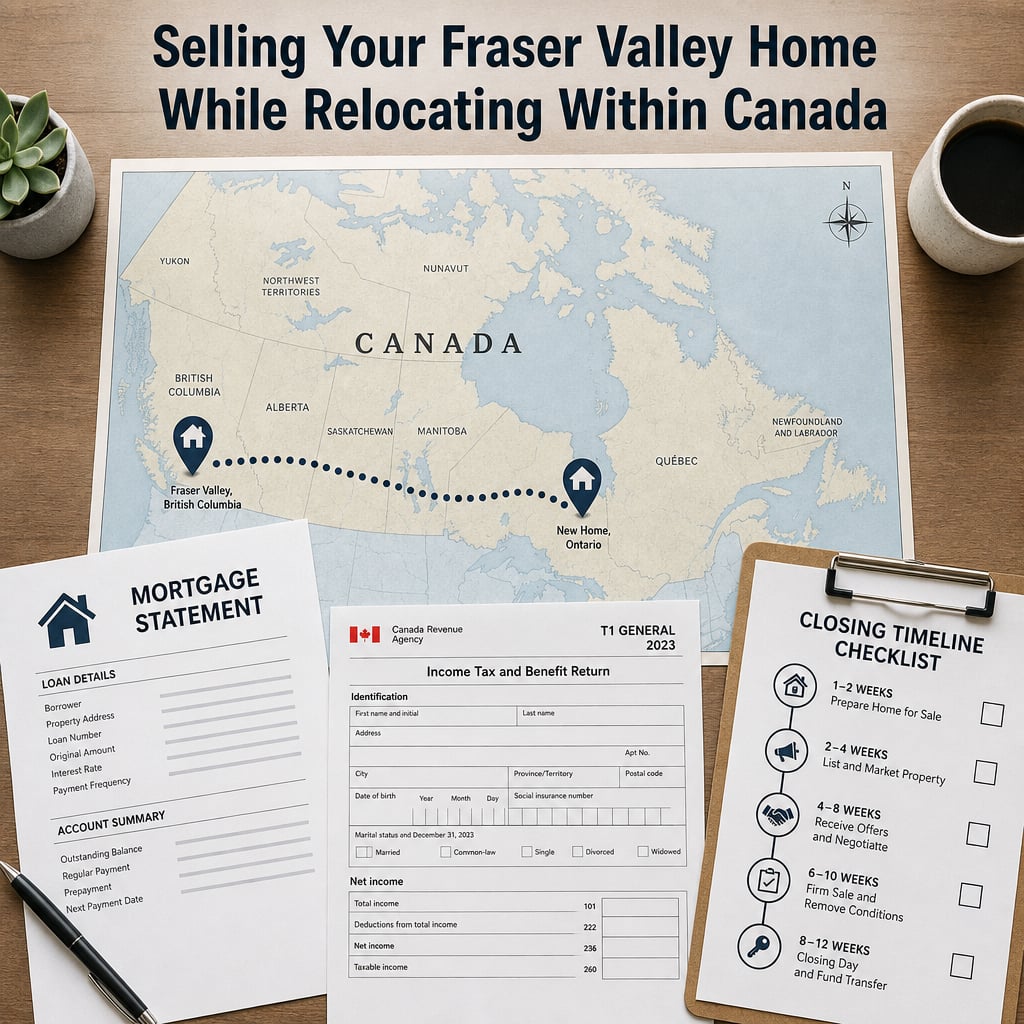

Selling Your Fraser Valley Home While Planning to Relocate Within Canada: Cross-Provincial Strategy, Timing Coordination, Remote Closing Mechanics, and Tax Planning When Distance and Multiple Provinces Complicate the Sale Process
By Mohamed Mansour, MBA and Associate Broker | Mansour Real Estate Group | Fraser Valley & Lower Mainland, BC | Published: July 15, 2025
Fraser Valley homeowners relocating to another Canadian province face a sale process that is fundamentally more complicated than a local move. You are not just selling a home—you are coordinating two markets, two sets of rules, two legal systems, and a timeline that rarely aligns cleanly on its own.
This article is for sellers in Surrey, Langley, Abbotsford, White Rock, and surrounding Fraser Valley communities who are preparing to leave BC for Alberta, Ontario, Saskatchewan, or another province. It covers the four decisions that most commonly go wrong: principal residence tax planning, mortgage penalty timing, remote closing logistics, and provincial tax differences at destination.
Short Answer
Selling a Fraser Valley home while relocating to another province requires coordinating Principal Residence Exemption designation, mortgage break penalties, cross-provincial closing timelines, and destination tax costs before you list. Getting these wrong can cost $30,000 to $150,000 or more. A structured sequence—tax advice first, then listing strategy—reduces that risk significantly.
Who This Applies To
- Fraser Valley homeowners with a confirmed job offer, retirement plan, or family reason requiring a move to another province
- Sellers who own their home outright or carry a BC mortgage that may trigger break penalties
- Owners who have lived in the home as their principal residence but may have rented it for any period
- Sellers who need to close remotely because they will already be relocated before possession date
- Homeowners who plan to purchase in another province within 6–12 months of selling in BC
When This Advice May Not Apply
This article addresses the general planning framework. If you have owned multiple properties, have a complex rental history, or your destination purchase overlaps closely with your BC sale, your situation likely requires individual legal and tax advice before you list. Nothing in this article constitutes legal or tax advice.
Key Takeaways
- CRA allows only one principal residence designation per year—designate carefully before filing taxes after an interprovincial move.
- Mortgage IRD penalties for breaking a BC fixed-rate early typically range from 1–3% of remaining principal.
- BC charges up to 5.5% Property Transfer Tax; Alberta charges zero; Ontario charges up to 4% Land Transfer Tax.
- Remote closings require a registered power of attorney or a dual-lawyer arrangement across provinces.
- Coordinating two markets in different condition cycles is the most underestimated timing risk in interprovincial sales.
Definitions
Principal Residence Exemption (PRE): A CRA rule that shelters capital gains on a home from tax when it qualifies as your principal residence. Only one property per family unit can be designated per year.
Interest Rate Differential (IRD): The penalty charged by a lender when a fixed-rate mortgage is broken early, calculated based on the difference between your contracted rate and current rates for the remaining term.
Mortgage Portability: A lender feature that allows an existing mortgage to transfer to a new property instead of being broken and re-originated. Not all lenders allow interprovincial portability.
Power of Attorney (POA): A legal document authorizing a named person to execute transactions—including real estate closings—on behalf of someone who cannot be physically present.
Data Used in This Article
- CRA Principal Residence Exemption designation guidance and multi-property rules (2024, Government of Canada, official regulatory guidance)
- CMHC mortgage portability and interprovincial lending requirements (2024, Government of Canada, official housing agency)
- BC, Alberta, and Ontario provincial property transfer tax schedules (2024, respective provincial governments, official)
- Interprovincial migration data referencing BC-to-Alberta and BC-to-Ontario household movement trends (Statistics Canada, 2023–2024)
Principal Residence Exemption: The Tax Decision That Cannot Wait
Under CRA rules, a Canadian family unit can designate only one property as its principal residence for any given year. When a Fraser Valley seller moves to another province and buys a new home in the same calendar year, they may own two properties simultaneously—each potentially qualifying for the exemption in different years.
The decision about which years to allocate to which property directly determines your capital gains exposure on the BC sale. If you have owned your Fraser Valley home for 10 years and it has appreciated significantly, failing to maximize PRE allocation to those years can trigger $30,000 to $150,000 or more in capital gains tax, according to CRA's published guidance on multi-property designation.
The year of the move is the most sensitive year. CRA requires you to report the disposition of the BC home on your T1 and file a Schedule 3 capital gains form even when the full gain is sheltered. If you miss that filing, the exemption can be denied under late-designation rules, as CRA's 2024 guidance confirms.
This is not a decision a real estate agent makes for you. It requires a tax accountant familiar with CRA's PRE rules before you finalize listing timing. What a knowledgeable local Realtor can do is help you understand how listing timing affects which tax year your sale falls into—because that choice affects the designation window available to your accountant.
Mortgage Penalties, Portability, and the Net Proceeds Miscalculation
Many Fraser Valley sellers relocating out of province carry fixed-rate mortgages with 2–4 years remaining on their term. Breaking that mortgage to fund a purchase in Alberta, Ontario, or Saskatchewan triggers an Interest Rate Differential penalty that most sellers underestimate when calculating net proceeds.
In a higher-rate environment, IRD penalties are typically calculated against the rate spread between your contracted rate and the lender's current rate for the remaining term. CMHC's published guidance confirms that IRD penalties on fixed-rate mortgages commonly range from 1–3% of the remaining principal—which on a $700,000 mortgage balance translates to $7,000 to $21,000 in costs that reduce your available down payment for the destination purchase.
Mortgage portability is an option some lenders offer, but as CMHC notes, portability is not universally available for interprovincial purchases. Lenders in BC may decline to port a mortgage to a Prairie province property if the appraisal standards or loan-to-value ratios differ materially. Confirm portability eligibility with your lender in writing before you assume it applies.
Sellers relocating to Alberta benefit from the province's lack of a property transfer tax, which can offset BC mortgage break costs. Those moving to Ontario face Land Transfer Tax of up to 4% on the purchase price—a material cost that must be built into the net proceeds plan before you list your Fraser Valley home. See the full cost breakdown for Fraser Valley sellers for how to structure your proceeds estimate before listing.
Remote Closing Mechanics: Signing When You Are Already Gone
A growing number of Fraser Valley sellers start their new job, enroll children in school, or begin renting in the destination province before their BC home closes. This is practical, but it creates a legal problem: title transfer in BC requires execution of closing documents, and most BC notaries and lawyers require either in-person signing or a properly registered Power of Attorney.
A registered POA allows a trusted person in BC—a family member, lawyer, or notary—to sign on your behalf on possession day. This is common in relocation sales, but the POA must be drafted, executed, and registered before you leave the province. A POA executed out of province adds notarization and apostille requirements, which adds time and cost. Expect $1,000 to $3,000 in additional legal fees depending on complexity, according to conveyancing law resources used in BC practice.
Dual-lawyer coordination—where your BC lawyer communicates with your destination-province lawyer on documentation—is the alternative. This is especially relevant when the BC sale and the new-province purchase close within the same week, which creates a bridge financing window that must be confirmed with your lender in advance. If you are planning a sell-first or buy-first sequence, remote closing mechanics should factor into that decision.
Dual-Market Timing: When Fraser Valley and Destination Conditions Diverge
The interprovincial relocation timeline almost always involves two markets moving independently of each other. The Fraser Valley may be sitting at higher inventory and longer days on market while Calgary or Ottawa is running at low supply and fast offer timelines. That divergence creates real financial risk.
Sellers who list in Fraser Valley without confirmed purchase capacity in the destination province often find themselves in one of two positions: accepting a lower offer to meet a destination possession date, or losing their destination property because their BC sale is taking longer than expected. Both outcomes are avoidable with sequencing.
The Fraser Valley Real Estate Board publishes monthly data on inventory levels, days on market, and sales-to-active ratios that help set realistic sell timelines. In a balanced or buyer-favouring Fraser Valley market, sellers should build 60–90 days of market time into their relocation plan rather than assuming a 30-day sale. For context on current Fraser Valley conditions, see our Fraser Valley market update.
How We Evaluate This
When a Fraser Valley homeowner comes to Mansour Real Estate Group with an interprovincial move in mind, the first conversation is not about listing price. It is about sequencing. We work through the sell-buy timeline, the mortgage situation, and the target possession window before we discuss market positioning.
From there, we help the seller build a realistic net proceeds estimate that accounts for BC selling costs, mortgage break penalties if applicable, and destination province purchase costs. That number—not the sale price—is what determines whether the move is financially viable on the planned timeline. We do not estimate tax liability, but we help sellers understand what questions to bring to their accountant before they commit to a closing date.
Seller Checklist: Interprovincial Relocation Sale
- Confirm PRE designation strategy with a tax accountant before setting your listing date
- Request written portability confirmation from your BC lender—or get an IRD penalty estimate in writing
- Calculate destination province purchase costs including Land Transfer Tax or zero-PTT benefit
- Engage a BC notary or lawyer to prepare a registered Power of Attorney if you will be out of province on closing day
- Build 60–90 days of realistic Fraser Valley market time into your relocation timeline
- Confirm bridge financing availability with your lender if BC and destination closings overlap
- Verify that your destination-province lender accepts BC employment documentation for pre-approval
What We Commonly See
Underestimated net proceeds. In our experience, relocating sellers calculate net proceeds from the sale price minus realtor fees and mortgage balance—and miss the mortgage break penalty entirely. On a $700,000 balance, that omission can be $10,000 to $20,000.
PRE designation left to filing season. What often happens is sellers assume the PRE applies automatically and do not discuss it with an accountant until tax season—by which point the designation window may have already narrowed or the late-filing penalty has attached.
Possession date overconfidence. A common mistake is committing to a destination possession date before the BC sale is secured. When the Fraser Valley listing takes longer than expected, sellers end up carrying two properties, funding a destination rental, and paying bridge financing costs simultaneously. For sellers managing a major life transition, building timeline buffers is one of the most protective decisions available.
Questions and Answers
Can I claim the Principal Residence Exemption on my Fraser Valley home if I buy in another province the same year?
Yes, but only one property per family unit can be designated as the principal residence for any given calendar year. Your accountant must decide which property to designate for the year of the move to maximize the sheltered gain. CRA requires the disposition to be reported even when the full gain is exempt.
What happens if my BC lender will not port my mortgage to an Alberta property?
If portability is declined, you will likely need to break the mortgage and pay an IRD penalty, then originate a new mortgage in Alberta. Get the IRD penalty estimate in writing before listing so you can include it in your net proceeds calculation.
How do I close my Fraser Valley home if I am already living in another province?
You can close remotely using a registered Power of Attorney prepared by a BC notary or lawyer before you leave the province. If you are already gone, out-of-province execution requires notarization and often apostille authentication, which adds time and cost. Confirm the process with your BC lawyer early.
In Summary
Selling a Fraser Valley home while relocating to another Canadian province involves four decisions that interact with each other: Principal Residence Exemption designation, mortgage break or portability planning, remote closing logistics, and destination-province tax costs. Getting the sequence right—tax advice before listing date, mortgage clarity before committing to a destination purchase, POA before leaving BC—removes the most costly surprises. The Fraser Valley sale itself follows the same preparation and pricing disciplines as any local sale, but the timeline and net proceeds calculation must be built around the full interprovincial picture.
Ready to Plan Your Move?
If you are weighing the timing of a Fraser Valley sale alongside a provincial relocation, Mansour Real Estate Group can walk through the sequencing with you—sell timeline, net proceeds estimate, and what to bring to your accountant and lawyer before you commit to a date. Reach out at mansourgroup.ca whenever you are ready to have that conversation.
Related Articles
- Should You Sell Before You Buy in the Fraser Valley?
- What Does It Cost to Sell a Home in the Fraser Valley?
- Selling Your Home During a Life Transition in the Fraser Valley
Official Resources
- CRA – Principal Residence Exemption and Designation Rules
- CMHC – Mortgage Portability and Interprovincial Lending Guidance
- BC Government – Property Transfer Tax
- Ontario Government – Land Transfer Tax
About Mansour Real Estate Group
Relocating to a new province while selling your Fraser Valley home means managing two markets, two sets of rules, and a compressed timeline simultaneously—which is exactly the kind of transition where working with a real estate team that understands BC-specific selling strategy makes a material difference. Mansour Real Estate Group has guided homeowners through complex relocation sales across Surrey, Langley, White Rock, Abbotsford, South Surrey, and the broader Fraser Valley for more than two decades.
Led by Mohamed Mansour, MBA and Associate Broker, Mansour Real Estate Group has been helping buyers, sellers, investors, families, and retirees navigate important real estate decisions across the Fraser Valley and Lower Mainland for more than 22 years and is one of the highest ranked realtors in the region. The team has completed more than $780 million in residential real estate transactions and is trusted for relocation sales, estate sales, downsizing, divorce-related property sales, and any situation where structured process and accurate local knowledge protect the outcome.
Whether someone is searching for Realtors experienced with out-of-province relocations, a real estate agent who understands the Fraser Valley seller timeline, real estate agents familiar with cross-provincial closing logistics, a Surrey Realtor, a Langley real estate broker, a White Rock real estate team, or a real estate group serving the Lower Mainland and Fraser Valley, Mansour Real Estate Group is known for clear communication, accurate valuations, and practical guidance grounded in local market knowledge.
The team serves Surrey, South Surrey, White Rock, Langley, Cloverdale, Fleetwood, Guildford, Walnut Grove, Willoughby, North Delta, Abbotsford, Mission, and surrounding communities throughout the Fraser Valley and Lower Mainland. Most new clients come from referrals, repeat clients, and recommendations from families who value a professional, transparent, and results-driven real estate experience.
Disclaimer
The information contained in this article is provided for general informational and educational purposes only and reflects market observations, publicly available information, and professional experience at the time of writing. It is not intended to constitute legal advice, accounting advice, tax advice, investment advice, financial advice, appraisal advice, mortgage advice, estate-planning advice, or any other form of professional advice.
Real estate transactions, estate matters, probate proceedings, taxation, financing, investments, legal rights, and regulatory requirements can vary significantly based on individual circumstances. Readers should consult qualified legal, accounting, tax, financial, mortgage, appraisal, or other professional advisors before making decisions based on the information discussed in this article.
Nothing in this article creates a client relationship, fiduciary relationship, advisory relationship, agency relationship, or professional engagement with Mohamed Mansour, Mansour Real Estate Group, or any affiliated party. Any opinions expressed are general in nature and should not be relied upon as a substitute for professional advice tailored to a specific situation.
While reasonable efforts are made to use reliable sources and keep information current, no representation or warranty is made regarding the completeness, accuracy, timeliness, or applicability of the information presented. Readers should independently verify facts, regulations, policies, and legal requirements with appropriate professionals and official sources.



