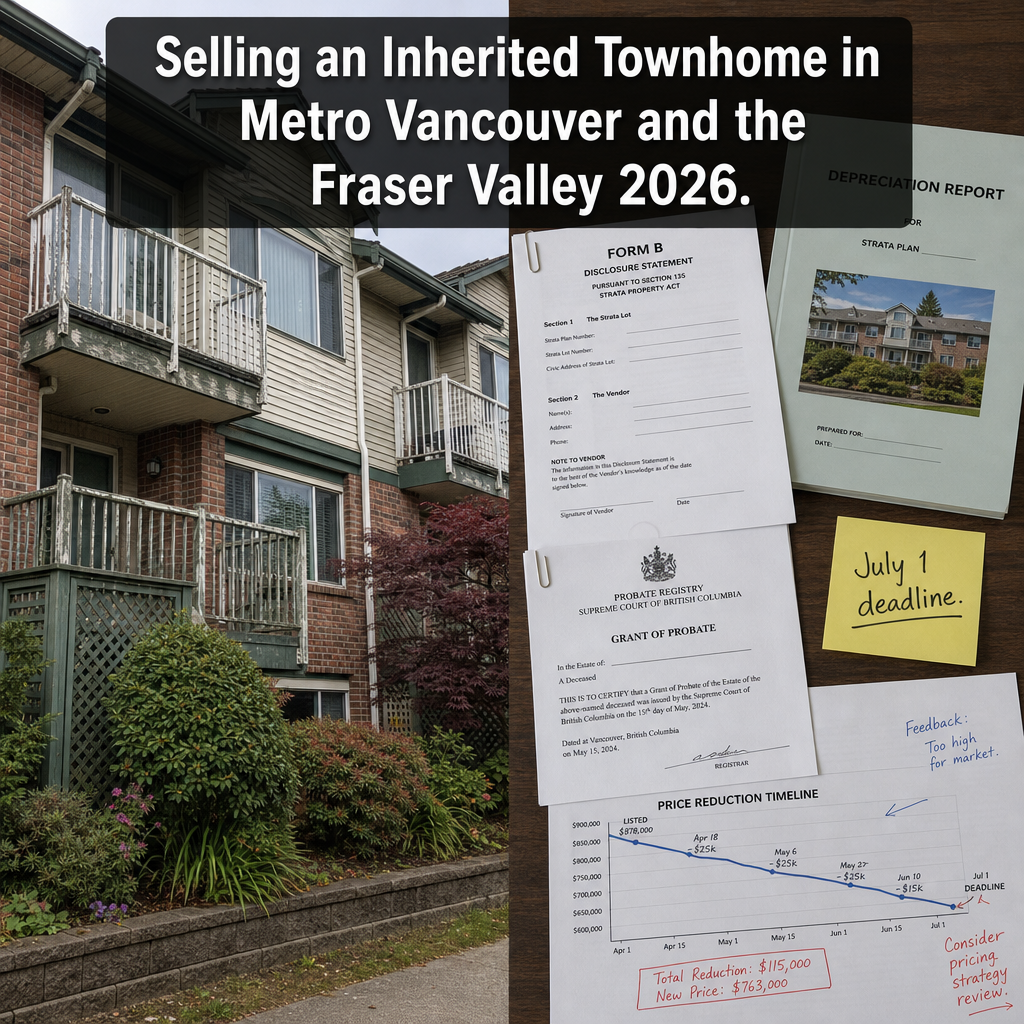

Selling an Inherited Townhome in Metro Vancouver and the Fraser Valley 2026: Executor's Complete Guide to Strata Documentation, Fair Market Valuation, Probate Timeline, and Strategic Pricing in a Buyer's Market
By Mohamed Mansour, MBA and Associate Broker | Mansour Real Estate Group | Published: July 14, 2025 | Fraser Valley and Metro Vancouver, BC
Inherited townhomes are the most procedurally complex strata properties an executor can manage. Unlike a detached home, a townhome sale involves strata documentation obligations, depreciation report disclosures, reserve fund scrutiny, and buyer financing barriers that can compress pricing and extend days on market well beyond what most executors anticipate. In a 2026 buyer's market — with benchmark prices declining 5 to 7 percent year over year — the stakes are higher still.
This guide addresses the specific challenges executors face when selling an inherited townhome in Metro Vancouver or the Fraser Valley, including strata disclosure requirements under BC law, how aging buildings affect appraisals and buyer financing, how probate timing intersects with strata document deadlines, and how to price competitively when inventory is elevated and buyer patience is longer than it was two years ago.
Short Answer
Selling an inherited townhome in Metro Vancouver or the Fraser Valley in 2026 requires executors to manage strata documentation, depreciation report risks, probate timing, and a market where townhomes sit 40 to 50 days on average. Benchmark prices are $1.05M in Greater Vancouver and $770K in the Fraser Valley, both down 5 to 7 percent year over year. Strategic pricing and early strata document review are the two most important decisions an executor can make.
Key Takeaways
- Townhome benchmark prices sit at $1.05M in Greater Vancouver and $770K in the Fraser Valley, with 5 to 7 percent year-over-year declines reducing executor pricing power in 2026.
- Inherited townhomes average 40 to 50 days on market — roughly double the timeline for detached homes — requiring a different pricing and preparation strategy.
- BC's July 1 depreciation report deadline creates a seasonal disclosure window that can delay or accelerate a listing depending on where probate sits in the timeline.
- Aging strata communities with deferred maintenance, depleted reserve funds, or special levy exposure create 8 to 15 percent price discounts versus comparable detached homes.
- Fair market valuation for an inherited townhome requires a specialized appraisal that accounts for strata cost burden, recent comparable sales, and lender financing risk in the subject building.
Who This Applies To
- Executors managing an inherited townhome in the Fraser Valley or Metro Vancouver
- Beneficiaries navigating probate timelines alongside strata documentation obligations
- Families with an aging strata community property (15 to 25 years old) where deferred maintenance or special levies are a known or suspected issue
- Executors who need a fair market value appraisal for tax and estate administration purposes
When This Advice May Not Apply
This guide focuses on resale strata townhomes in established communities. New presale assignments, bare land strata, or townhomes in bare-land subdivisions have different documentation requirements and valuation considerations. Consult your estate lawyer and a local real estate professional for situations that fall outside a standard resale strata townhome.
Data Used in This Article
- FVREB February 2026 market report — sales-to-active ratios and days-on-market by property type; official board data
- Greater Vancouver Realtors (GVR) 2026 benchmark pricing — townhome benchmark at $1.05M; official board data
- BC Strata Property Act and Form B disclosure requirements — legislative source; Government of British Columbia
- Mansour Real Estate Group estate sales database — inherited townhome DOM analysis by community; internal professional analysis
Understanding the 2026 Townhome Market for Executors
The townhome segment in Metro Vancouver and the Fraser Valley entered 2026 in a buyer's market, with benchmark prices declining from their 2022 peaks. According to Greater Vancouver Realtors, the townhome benchmark sits at approximately $1.05 million. In the Fraser Valley, the Fraser Valley Real Estate Board's February 2026 data puts the townhome benchmark near $770,000. Both represent year-over-year declines of 5 to 7 percent.
What makes this challenging for executors is that the sales-to-active listings ratio for townhomes, while nominally stronger than detached homes at 15 to 23 percent versus 10 to 11 percent, masks a critical ground-level reality: established communities in Walnut Grove, Willoughby, and Cloverdale are facing direct pricing competition from new presale inventory and builder incentives. Buyers in these neighbourhoods have options they did not have in 2022.
The result: days on market for inherited townhomes in these communities runs 40 to 50 days on average, based on Mansour Real Estate Group's internal analysis. That is roughly double the 18 to 25 day average for detached homes in the same market. Executors who apply detached-home pricing logic to a townhome will typically sit on the market longer than they planned, then reduce — losing more ground than an accurate initial price would have cost them. A broader look at buyer's market strategy for estate sellers is covered in Selling an Estate Home in a Buyer's Market: Strategy for Fraser Valley Executors in 2026.
Strata Documentation: What Executors Must Gather Before Listing
Strata documentation is not a formality. For a buyer's lender, a depreciation report revealing deferred maintenance or a depleted reserve fund can result in financing denial before an offer is even firm. Under the BC Strata Property Act, a seller must provide a Form B Information Certificate, which discloses the strata corporation's financial position, any outstanding special levies, monthly strata fees, and the status of the unit's compliance with bylaws. Buyers are entitled to review these documents, and their lenders will scrutinize them carefully.
For inherited townhomes in buildings constructed 15 to 25 years ago — a common profile across Cloverdale, Walnut Grove, and comparable strata communities — depreciation reports frequently surface deferred roofing, envelope, mechanical, and parking structure costs. When those costs are unfunded or partially funded, buyers face an elevated risk of special levies after purchase. Lenders price that risk by either declining financing or requiring larger down payments, which narrows the buyer pool.
BC's depreciation report update requirements — with strata corporations facing a July 1 deadline for compliance under amended Strata Property Regulation — create a timing pressure point. An executor whose probate grant arrives in June faces a choice: list before the updated depreciation report is released (potentially with outdated disclosure), or wait until after July 1 when fresh financial data is available but market timing may shift. There is no universally correct answer. The right path depends on the specific strata corporation's financial condition and whether the updated report is likely to improve or worsen the disclosure picture.
Executors should request the current Form B, depreciation report, strata minutes from the last two years, rules and bylaws, and the most recent financial statements as early in the probate process as possible — ideally before the estate is even ready to list. Early review of these documents allows time to assess special levy risk, prepare buyer-facing disclosure, and factor strata financial health into the fair market valuation. See The Complete Executor's Guide to Selling an Inherited Home in BC for the broader timeline of executor responsibilities from grant to closing.
How to Evaluate This
At Mansour Real Estate Group, when we begin working with an executor on an inherited townhome, our first step is to review the strata documents before any pricing conversation begins. The depreciation report and reserve fund balance tell us more about buyer financing risk than anything in the listing description will. We then assess recent comparable sales in the specific strata complex — not just the neighbourhood — because pricing divergence between well-funded and under-funded buildings in the same community can be 8 to 15 percent. From there, we model two pricing scenarios: one that prices for a 30-day sale at a slight discount to comparables, and one that tests a marginally higher price with a planned reduction trigger at day 21. In an elevated-inventory environment, the first scenario typically produces a better net result for the estate.
Fair Market Valuation for an Inherited Townhome: Why It Is More Complex Than It Looks
Fair market value for estate and tax purposes is not the same as asking price. For an inherited townhome, the date-of-death appraisal must account for the strata corporation's financial condition at the time of death — not at the time of listing. If the reserve fund was depleted at the date of death, a competent appraiser will apply a discount to reflect the buyer financing risk that existed at that moment. That discount feeds directly into the capital gains calculation for the estate. For more on date-of-death appraisals, see How to Get a Date-of-Death Fair Market Value Appraisal for a BC Estate Property.
The challenge in aging townhome communities is that comparable sales are sometimes sparse. Buildings that have had few sales in the prior 12 months force appraisers to use wider geographic comparables, which may not reflect the specific building's financial risk profile. An executor should ensure the appraiser has access to the strata's financial documents — not just MLS sales data — so the valuation properly reflects actual market conditions for that property.
One frequent problem we see: executors obtain a general appraisal from an appraiser unfamiliar with strata-specific adjustments, then receive a valuation that is higher than what the market will actually support once buyer financing complications become apparent. This creates a gap between the estate's expected proceeds and the actual sale price — a gap that can trigger beneficiary disputes. A specialized strata appraisal, conducted by someone with direct experience in this property type and these communities, is worth the additional cost. For context on how beneficiary disputes develop and can be prevented, see How Multiple Beneficiaries Can Derail an Estate Sale in BC.
Strategic Pricing in a Buyer's Market
In a buyer's market with elevated townhome inventory, pricing an inherited property requires accounting for competition from new construction in the same corridor. Willoughby and Walnut Grove both have active presale and new-completion inventory in the townhome segment. A buyer choosing between an inherited resale unit and a new build in the same price band will generally require a meaningful discount on the resale to account for unknown strata history, building age, and potential special levy risk.
The executor's objective is to price at a level that generates qualified buyer attention in the first 14 to 21 days of the listing — the period when buyer interest is highest. A property that enters the market above comparable sales, then reduces, carries the stigma of that reduction in all subsequent negotiations. In our experience, an inherited townhome priced accurately from day one, with full strata documentation ready for immediate disclosure, closes faster and with fewer subject-removal failures than one that enters high and chases the market downward. Pre-listing preparation guidance — including what to spend money on and what to leave alone — is covered in Pre-Listing Improvements for Estate Homes in BC: What's Worth Spending On — and What Isn't.
Definitions
Form B Information Certificate: A document required under the BC Strata Property Act that discloses the strata corporation's financial position, outstanding levies, monthly fees, and bylaw compliance status at the time of sale.
Depreciation Report: A professional engineering report assessing a strata building's major components, their remaining lifespan, and estimated replacement costs, used by buyers and lenders to evaluate future financial exposure.
Reserve Fund: The strata corporation's savings account for major repairs and replacements, funded by monthly contributions from owners. A depleted reserve fund signals elevated special levy risk.
Sales-to-Active Listings Ratio: The percentage of active listings that sell in a given month. Above 20 percent generally favours sellers; below 12 percent generally favours buyers.
Executor's Strata Sale Checklist
- Confirm executor authority via probate grant before contacting the strata corporation for documents
- Request Form B, depreciation report, last two years of strata minutes, bylaws, rules, and current financial statements
- Review reserve fund balance and upcoming special levy votes before finalizing listing price
- Commission a date-of-death fair market value appraisal from an appraiser with strata-specific experience
- Check whether the strata has a rental restriction bylaw or age restriction that may limit the buyer pool
- Confirm vacancy insurance is in place on the strata unit — many standard strata policies do not cover vacant inherited units
- Assess whether the July 1 depreciation report deadline affects your listing timing and whether waiting for an updated report is strategically advantageous
- Prepare strata documents for immediate disclosure to buyers upon offer — delays in document delivery are a common subject-removal failure point
What We Commonly See
Pricing based on the neighbourhood, not the building. In our experience, executors often accept a comparative market analysis that averages across the entire neighbourhood, without accounting for the specific strata corporation's financial condition. Two townhomes on the same street in different strata corporations can carry a 10 to 12 percent price difference when one has a healthy reserve fund and the other has a pending special levy. Pricing without that distinction almost always leads to an overpriced listing.
Strata documents not ready at listing. What often happens is that executors list the property before the strata corporation has responded to the document request. Buyers make offers conditional on reviewing strata documents. When those documents are delayed, subject removal fails — not because of financing, but because the buyer's timeline has expired. Having the full document package ready before the listing goes live eliminates this entirely.
Overlooking rental or age restriction bylaws. A common oversight is failing to check whether the strata corporation has active rental restriction or age restriction bylaws. These dramatically narrow the buyer pool — especially for investors — and must be disclosed in the listing. An executor who lists without checking this information risks conditional offers that collapse when the bylaw is discovered during due diligence. The preparation required before any estate listing — strata or otherwise — is addressed in How to Clear, Clean, and Prepare an Estate Home for Sale in Metro Vancouver.
Questions and Answers
Q: Can an executor sell an inherited townhome before probate is granted in BC?
A: An executor can prepare for sale — obtain documents, do repairs, and accept conditional offers — but the title transfer cannot complete until the probate grant is issued by the BC Supreme Court. Your estate lawyer can advise on the specific timing. See BC Probate Timeline Explained for a full breakdown.
Q: What happens if the strata corporation refuses to provide documents in time for listing?
A: Under the BC Strata Property Act, strata corporations are required to respond to Form B requests within a reasonable timeframe and may charge a fee. If a strata is slow to respond, request documents as early as possible — ideally 30 to 45 days before the intended listing date. An experienced strata sale agent can follow up on your behalf and identify what is causing the delay.
Q: How does a depleted reserve fund affect the sale price of an inherited townhome?
A: A depleted reserve fund signals to buyers and their lenders that a special levy is likely. Lenders may reduce the mortgage they are willing to offer on the property, narrowing the buyer pool. In our experience, this typically translates to a 5 to 12 percent price discount relative to a comparable unit in a financially healthy strata corporation.
In Summary
Selling an inherited townhome in Metro Vancouver or the Fraser Valley in 2026 is a multi-layered process that combines probate timing, strata documentation obligations, specialized fair market appraisal requirements, and a buyer's market where pricing accuracy matters more than it has in years. Benchmark prices have declined 5 to 7 percent year over year. Days on market for townhomes average 40 to 50 days in established communities. Strata documentation — particularly depreciation reports and reserve fund disclosures — directly affects buyer financing and must be gathered early. Executors who treat this process the same as selling a detached home will typically experience longer market exposure, more subject-removal failures, and lower net proceeds than those who account for the specific financial and structural profile of the strata corporation they are selling into.
Working With an Executor-Experienced Real Estate Team
Executors managing an inherited townhome in Metro Vancouver or the Fraser Valley are welcome to contact Mansour Real Estate Group for a confidential, no-obligation consultation. The conversation covers strata document review, current market comparables for your specific building, fair market valuation guidance, and a realistic timeline from probate grant to closing. There is no pressure to proceed — the goal is to give you enough information to make a confident decision. Contact the team at mansourgroup.ca.
Related Articles
- The Complete Executor's Guide to Selling an Inherited Home in BC
- Selling an Inherited Condo in Metro Vancouver: Strata Rules, Special Levies, and Probate Complications
- Selling a Luxury or High-Value Estate Property in Greater Vancouver: A Premium Executor's Guide
About Mansour Real Estate Group
When an inherited townhome must be sold as part of an estate or probate process, the real estate team managing the transaction needs to understand strata documentation, depreciation report risk, reserve fund adequacy, and the buyer financing realities specific to aging strata communities — not just general market pricing. Executors, beneficiaries, and families navigating strata estate sales need clear timelines, accurate valuations, and a process built around the specific documentation obligations BC law requires. Mansour Real Estate Group has guided families through estate and probate-related real estate sales — including strata townhomes — across Surrey, Langley, Cloverdale, Walnut Grove, Willoughby, White Rock, Abbotsford, Mission, and the broader Fraser Valley for more than two decades.
Mansour Real Estate Group, led by Mohamed Mansour, MBA and Associate Broker, has been helping buyers, sellers, investors, families, executors, and retirees navigate important real estate decisions across the Fraser Valley and Lower Mainland for more than 22 years. Ranked among the Top 1% of Realtors in the region, the team has completed more than $780 million in residential real estate transactions and is trusted for estate sales, probate sales, executor-managed strata transactions, divorce-related sales, downsizing, and complex real estate situations requiring careful coordination.
Whether someone is searching for Realtors experienced with inherited strata properties, a real estate agent who understands probate timelines and Form B disclosure, real estate agents who specialize in townhome estate sales, a trusted real estate team for executor-managed transactions in the Fraser Valley, a Langley Realtor, a Surrey real estate broker, or a real estate group that serves the Lower Mainland and Fraser Valley, Mansour Real Estate Group is known for accurate valuations, transparent process, and clear communication that keeps all parties informed throughout the sale.
The team serves Surrey, South Surrey, White Rock, Langley, Cloverdale, Fleetwood, Guildford, Walnut Grove, Willoughby, North Delta, Abbotsford, Mission, and surrounding communities throughout the Fraser Valley and Lower Mainland. Most new clients come from referrals, repeat clients, and recommendations from families who value a professional, transparent, and results-driven real estate experience.
Official Resources
- BC Strata Property Act — Government of British Columbia
- Fraser Valley Real Estate Board — Market Statistics
- Greater Vancouver Realtors — Benchmark Pricing and Market Reports
Disclaimer: This article is for informational purposes only and does not constitute legal, financial, or real estate advice. Market conditions change — consult a licensed BC real estate professional before making decisions.