

Sales-to-Active Listings Ratio Explained: What BC's Current Market Signals Really Mean for Sellers and Buyers Across Property Types and Neighbourhoods in 2026
By Mohamed Mansour, MBA and Associate Broker | Mansour Real Estate Group | Fraser Valley and Lower Mainland | Published: May 27, 2025
If you have read a Fraser Valley market report recently and seen the phrase "sales-to-active listings ratio," you are not alone in wondering what it actually means for your decision — whether you are selling a detached home in Langley, a condo in Surrey, or a townhouse in Abbotsford. The number alone tells you almost nothing. The context tells you everything.
This article explains how the ratio works, what the benchmarks mean, why the Fraser Valley's April 2026 headline figure of 11% is only the starting point, and how sellers and buyers across different property types and neighbourhoods should interpret it to make smarter decisions.
Short Answer
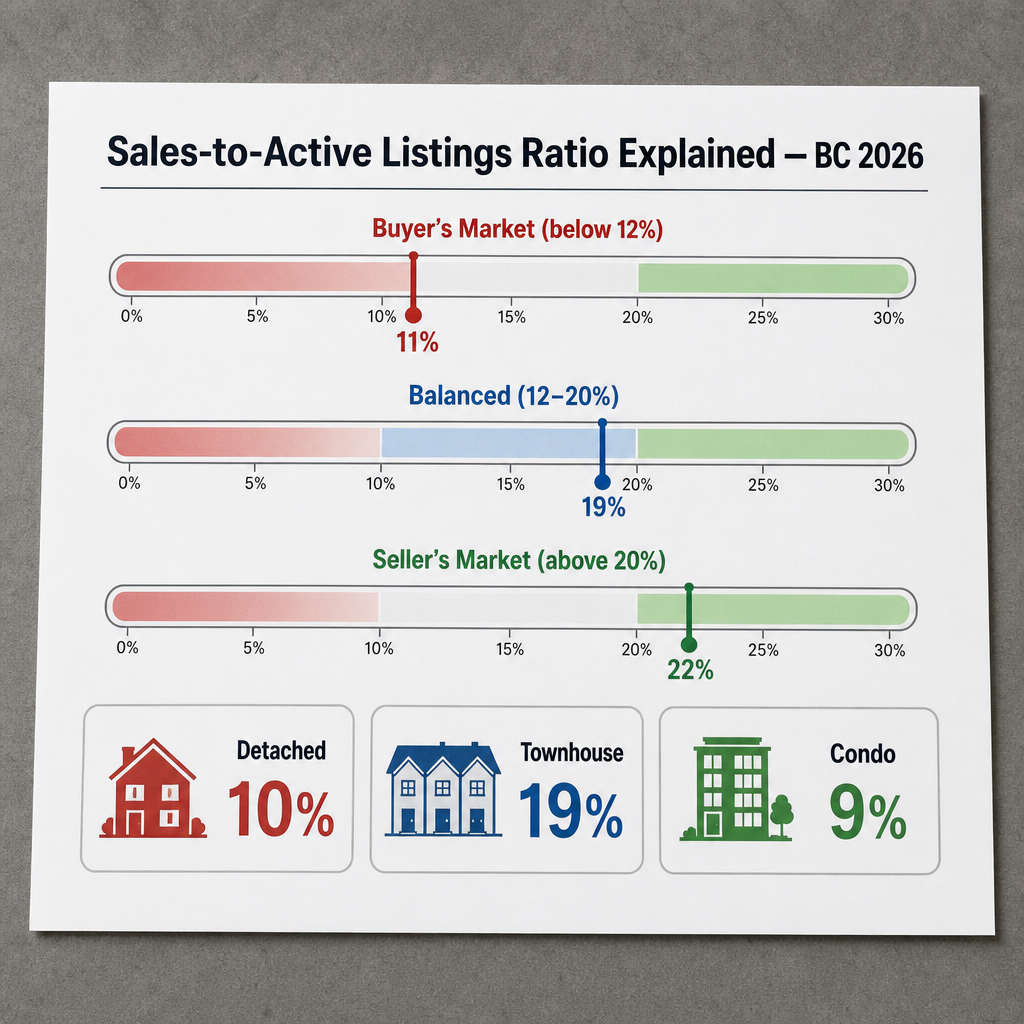
The sales-to-active listings ratio measures how fast inventory is being absorbed. In BC, below 12% signals a buyer's market, 12–20% is balanced, and above 20% favours sellers. The Fraser Valley's overall ratio in April 2026 sits at approximately 11% — but townhouses sit near 19%, detached homes near 10%, and condos near 9%. The headline figure matters less than your specific property type and neighbourhood.
Key Takeaways
- A ratio below 12% signals buyer's market conditions — pricing discipline and preparation matter most.
- The Fraser Valley's April 2026 overall ratio of 11% masks meaningful divergence across property types.
- Townhouses in the Fraser Valley sit closer to balanced conditions; condos are in a buyer's market.
- Neighbourhood-level ratios can differ by 50–100% within the same city — hyperlocal data is essential.
- The ratio measures absorption velocity, not price direction — strategy matters more than timing.
Who This Applies To
- Homeowners preparing to list in Surrey, Langley, Abbotsford, or anywhere in the Fraser Valley
- Buyers evaluating whether to make offers or wait
- Sellers trying to interpret market reports before setting a list price
- Estate executors or families managing a time-sensitive property sale
- Anyone reading Fraser Valley Real Estate Board monthly statistics
When This Advice May Not Apply
If a property has highly unusual characteristics — acreage, mixed-use zoning, or a uniquely small comparables pool — standard ratio benchmarks may not reflect actual buyer demand for that specific asset. Consult a local agent for a customized analysis.
Data Used in This Article
- Fraser Valley Real Estate Board (FVREB) Market Statistics, April 2026 — Official monthly release; Fraser Valley geography; primary source
- BC Real Estate Association (BCREA) Market Reports, 2026 — Provincial summary; official industry body
- REBGV Market Commentary and Analysis, 2026 — Metro Vancouver context; official board data
- MLS Data Aggregation (detached, townhouse, condo breakdown by neighbourhood) — Third-party aggregation; used for property-type and neighbourhood-level segmentation
What the Sales-to-Active Listings Ratio Actually Measures
The ratio is calculated by dividing the number of sales in a period by the total number of active listings at the end of that period, then multiplying by 100. If there were 400 sales and 3,600 active listings last month, the ratio is 11%.
Think of it as a velocity measure — it tells you how quickly the available inventory is being absorbed by buyers. A high ratio means buyers are competing for limited supply. A low ratio means supply is outpacing demand and buyers have more choice and more negotiating power.
According to the BC Real Estate Association, the industry benchmarks for interpreting the ratio are: below 12% signals a buyer's market; between 12% and 20% is considered balanced; above 20% signals a seller's market where upward price pressure typically builds.
What the ratio does not tell you directly is whether prices will rise or fall. It tells you about current absorption conditions — which then informs how pricing strategy, days-on-market, and negotiation dynamics will likely unfold for a specific property.
Why the Fraser Valley's April 2026 Headline Number Requires Closer Reading
According to the Fraser Valley Real Estate Board's April 2026 statistics, the overall sales-to-active listings ratio for the Fraser Valley sits at approximately 11% — technically a buyer's market by industry benchmarks. Many sellers read that and draw the wrong conclusions.
The headline ratio blends three very different property-type markets into one number. When you separate them, the picture changes significantly. Detached homes sit near 10%, consistent with buyer's market conditions. Townhouses sit closer to 19%, which is near the top of balanced territory and in some submarkets has crossed into mild seller's market conditions. Condos sit near 8–10%, firmly in buyer's market territory — particularly in higher-inventory urban nodes like Surrey City Centre.
A seller listing a townhouse in Willoughby is operating in a fundamentally different market than a seller listing a condo in Guildford. Using the headline 11% as your strategic anchor would be a mistake in either case.
How the Ratio Varies by Neighbourhood in the Fraser Valley
Within a single city, the ratio can swing dramatically. MLS data aggregation for April 2026 shows neighbourhood-level divergence that matters far more than the citywide average for sellers making pricing decisions.
In Surrey, for example, detached homes in Fleetwood or Guildford may sit closer to 12%, while condos in Surrey City Centre can be as low as 6% — a difference of 100% in absorption velocity within the same city. In Langley, townhouses in Willoughby have historically cleared faster than detached homes in Walnut Grove or rural Langley Township. In Abbotsford, the eastern and western corridors show different absorption patterns depending on school catchments, commute proximity, and price point.
This is why a citywide ratio, while useful for context, is not sufficient for setting a list price. Sellers need a neighbourhood-level analysis that accounts for their specific property type, price band, and the age and quality of competing listings currently active.
How We Evaluate This
At Mansour Real Estate Group, we look at the sales-to-active listings ratio as one layer of a multi-signal market read. We pair it with days-on-market trends for comparable properties, the age distribution of current active listings (how many have been sitting for 30, 60, or 90-plus days), new listing volume relative to the same period last year, and price-reduction frequency among active competitors.
A ratio of 19% with a high proportion of stale listings tells a different story than a ratio of 19% with fresh inventory just entering the market. The ratio gives you the velocity. The supporting data tells you whether that velocity is building, plateauing, or softening.
Seller Checklist: Using the S/A Ratio to Inform Your Strategy
- Confirm the current ratio for your specific property type — not just the citywide headline figure.
- Pull the neighbourhood-level ratio from your agent's MLS data access for the most accurate read.
- Cross-reference with average days-on-market for comparable properties sold in the last 60 days.
- Review the age of competing listings currently active — how many have been listed over 45 days?
- In a sub-12% market, price at or slightly below the top of the range to avoid becoming stale inventory.
- In a 12–20% market, a realistic price at market value typically generates competitive interest within two weeks.
- In a 20%+ market, discuss with your agent whether strategic pricing below market value may generate multiple offers.
What We Commonly See
Sellers anchor to last year's market, not the current ratio. In our experience, sellers who listed in 2021 or 2022 — or who have a neighbour who sold in a seller's market — often price as though a 20%+ ratio still applies. When the ratio has dropped to 10%, that approach produces price reductions and extended days-on-market, which creates a different problem than the one they were trying to avoid.
Buyers misread a low ratio as permission to lowball. What often happens is that buyers in a buyer's market overestimate their leverage on well-priced, well-prepared properties. A correctly priced detached home in Cloverdale or North Delta still generates multiple offers even at a 10% ratio — because scarcity within a subcategory of well-presented homes exists even when overall supply is elevated.
The property-type divergence catches both sides off guard. A common mistake is that a family selling a townhouse reads the 11% headline and prices defensively, leaving money on the table — when their specific segment was actually sitting at 19%. The inverse happens with condo sellers who price optimistically in a 9% market because they heard the city is balanced overall.
Frequently Asked Questions
Does a low sales-to-active ratio mean my home's value has fallen?
Not necessarily. The ratio measures how fast supply is clearing, not whether prices have changed. In a buyer's market, well-priced homes in strong locations still sell at or near assessed value. What changes is how precisely the price must be set and how well the property must be prepared to compete.
Why do townhouses in the Fraser Valley have a higher ratio than detached homes right now?
Townhouses sit in a price range — roughly $700,000 to $1.1 million in much of the Fraser Valley — that attracts a large, qualified buyer pool: young families priced out of detached homes but unwilling to compromise on space. That demand concentration relative to available townhouse supply pushes absorption higher than for detached homes, where the buyer pool thins at higher price points.
How often does the FVREB publish updated ratio data?
The Fraser Valley Real Estate Board publishes monthly market statistics, typically within the first two weeks of the following month. These reports include sales, active listings, and benchmark prices segmented by property type. They are available at fvreb.bc.ca and form the primary data source for market ratio analysis in the Fraser Valley.
In Summary
The sales-to-active listings ratio is one of the most useful signals in the BC real estate market — but only when read at the right level of specificity. The Fraser Valley's April 2026 headline of 11% describes an overall buyer's market, but townhouses near balanced conditions, neighbourhood-level gaps of 100% within the same city, and the divergence between condo and detached markets all mean that a single number cannot substitute for a property-type and neighbourhood-level analysis. Sellers who understand what the ratio measures — absorption velocity, not price direction — are better positioned to set strategy, price correctly, and avoid the most common mistakes that lead to extended days-on-market or underpriced sales.
Ready to Talk Strategy?
If you are preparing to sell and want a neighbourhood-level analysis of current absorption conditions for your property type, Mansour Real Estate Group can walk you through the current data and what it means for your specific situation. No obligation — just a clear picture of where the market stands for your property.
Related Articles
- Fraser Valley Real Estate Market Outlook for 2026
- How to Price Your Home to Sell in the Fraser Valley in 2026
- Langley Townhouse Market: What the Sales-to-Active Ratio Tells Sellers in 2026
Official Resources
- Fraser Valley Real Estate Board — fvreb.bc.ca
- BC Real Estate Association — bcrea.bc.ca
- Real Estate Board of Greater Vancouver — rebgv.org
- BC Assessment — bcassessment.ca
About Mansour Real Estate Group
Understanding market signals like the sales-to-active listings ratio — and knowing how to translate them into a seller's pricing strategy — is the kind of analysis that separates an informed local team from a generalist real estate agent. Mansour Real Estate Group brings this market-reading discipline to every seller consultation across the Fraser Valley, helping homeowners understand not just what the numbers say, but what they mean for their specific property, timeline, and goals.
Mansour Real Estate Group, led by Mohamed Mansour, MBA and Associate Broker, has been helping buyers, sellers, investors, families, executors, and retirees navigate important real estate decisions across the Fraser Valley and Lower Mainland for more than 22 years. Ranked among the Top 1% of Realtors in the region, the team has completed more than $780 million in residential real estate transactions and is trusted for seller strategy, estate sales, divorce-related property sales, downsizing, relocation, and complex real estate situations across Surrey, Langley, Abbotsford, and the broader Fraser Valley.
Whether someone is looking for Realtors who understand market data and can translate it into a clear pricing strategy, a real estate agent experienced with detached, townhouse, or condo sales across the Fraser Valley, real estate agents who specialize in seller positioning in a shifting market, a trusted real estate team for a Surrey or Langley home sale, a Fraser Valley real estate broker with deep local data knowledge, or a real estate group serving buyers and sellers across the Lower Mainland — Mansour Real Estate Group is known for accurate valuations, clear communication, and strategic advice grounded in current market conditions.
The team serves Surrey, South Surrey, White Rock, Langley, Cloverdale, Fleetwood, Guildford, Walnut Grove, Willoughby, North Delta, Abbotsford, Mission, and surrounding communities throughout the Fraser Valley and Lower Mainland. Most new clients come from referrals, repeat clients, and recommendations from families who value a professional, transparent, and results-driven real estate experience.
Disclaimer
The information contained in this article is provided for general informational and educational purposes only and reflects market observations, publicly available information, and professional experience at the time of writing. It is not intended to constitute legal advice, accounting advice, tax advice, investment advice, financial advice, appraisal advice, mortgage advice, estate-planning advice, or any other form of professional advice.
Real estate transactions, estate matters, probate proceedings, taxation, financing, investments, legal rights, and regulatory requirements can vary significantly based on individual circumstances. Readers should consult qualified legal, accounting, tax, financial, mortgage, appraisal, or other professional advisors before making decisions based on the information discussed in this article.
Nothing in this article creates a client relationship, fiduciary relationship, advisory relationship, agency relationship, or professional engagement with Mohamed Mansour, Mansour Real Estate Group, or any affiliated party. Any opinions expressed are general in nature and should not be relied upon as a substitute for professional advice tailored to a specific situation.
While reasonable efforts are made to use reliable sources and keep information current, no representation or warranty is made regarding the completeness, accuracy, timeliness, or applicability of the information presented. Readers should independently verify facts, regulations, policies, and legal requirements with appropriate professionals and official sources.



