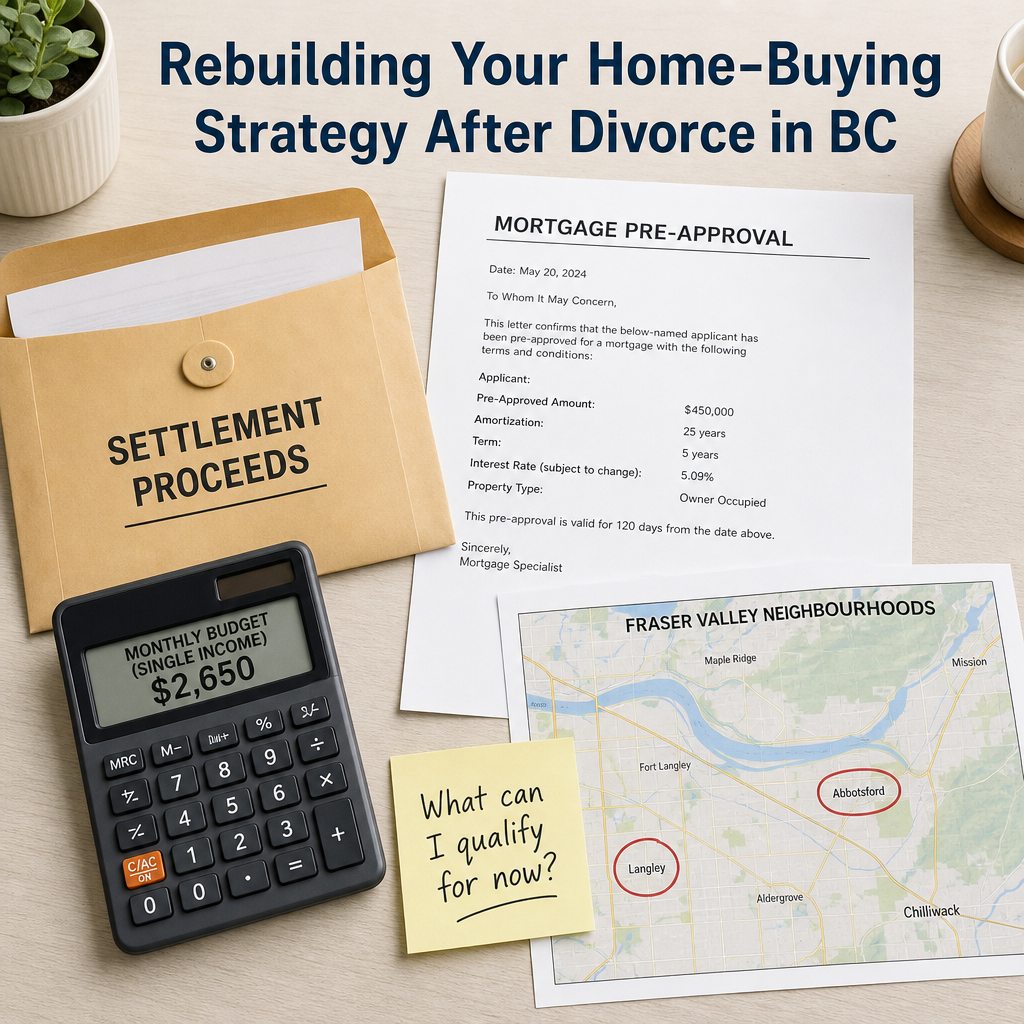

Rebuilding Your Home-Buying Strategy and Mortgage Qualification After Divorce Settlement Is Finalized in BC: From Settlement Proceeds to Keys in Hand
By Mohamed Mansour, MBA and Associate Broker — Mansour Real Estate Group | Fraser Valley and Lower Mainland, BC | Published: July 22, 2025 | Topic: Life-Event Sales — Post-Divorce Buyer Strategy
The day your matrimonial home sale closes and the proceeds land in your account is not an ending. It is the first day of a new real estate process — one that most people are completely unprepared for, because every advisor involved in the divorce focused on the sale, not on what comes next. This article is for separated homeowners in BC who are past the settlement, past the sale, and now trying to figure out how to buy again on a single income in a Fraser Valley market that has shifted substantially since they last purchased.
The decisions you make in the six to twelve months after your settlement closes will shape your housing situation for the next decade. Timing your purchase, understanding what you can actually qualify for, protecting your tax position on the proceeds you received, and choosing the right property type in the right neighbourhood — none of this is straightforward after divorce, and most of the generic advice circulating online ignores the BC-specific rules and the Fraser Valley market realities that will determine your outcome.
Short Answer
After a divorce settlement closes in BC, most single-income buyers qualify for 25 to 35 percent less purchasing power than they expect. Support obligations, stress test rules, and credit history gaps compound that reduction. In the Fraser Valley's current buyer's market, acting with a clear financial picture — rather than waiting indefinitely — often produces better outcomes than delaying for conditions that may not materialize.
Key Takeaways
- Single-income qualification typically reduces maximum purchase power by 25 to 35 percent compared to a joint application.
- A $1,500 monthly support obligation can reduce your approved mortgage by $200,000 to $300,000 under CMHC stress test rules.
- The principal residence exemption on the matrimonial home sale requires a CRA election — it is not automatic and missed timing creates taxable gains.
- Fraser Valley benchmark prices in 2026 are down year-over-year, creating genuine entry opportunities for qualified single-income buyers.
- Waiting 6 to 12 months for rate cuts or further price drops often means missing the window when financial readiness and market conditions align.
Who This Applies To
- Homeowners in BC whose matrimonial home has sold and settlement proceeds have been distributed
- Divorced or separated individuals now qualifying for a new mortgage on a single income
- People managing spousal or child support payments that affect their debt servicing ratios
- Buyers weighing property type, neighbourhood, and timing trade-offs in the Fraser Valley
- Homeowners who have not yet filed a principal residence exemption election with the CRA
When This Advice May Not Apply
This article provides general guidance, not legal, tax, mortgage, or financial advice. If your settlement is still in progress, if there are disputes over property division, or if your tax situation involves business assets, rental income, or multiple properties, consult a BC family lawyer, a CRA-registered accountant, and a licensed mortgage professional before making any decisions based on this content.
Definitions
Stress test: A federal qualification requirement that tests your ability to afford mortgage payments at the higher of your contract rate plus 2 percent, or the minimum qualifying rate set by OSFI. This applies to all federally regulated lenders in Canada as of 2025.
Total debt service ratio (TDS): The percentage of gross monthly income used for all debt payments including the proposed mortgage, property taxes, heat, and any support or other obligations. Most lenders cap TDS at 44 percent.
Principal residence exemption: A CRA provision that exempts capital gains from tax when a property qualifies as your principal residence. The exemption must be elected on your tax return — it does not apply automatically.
Deemed disposition: A tax concept where a property is treated as sold at fair market value for tax purposes, even if it has not been sold — relevant when a matrimonial home changes ownership through a separation agreement.
Data Used in This Article
- FVREB: Fraser Valley Real Estate Board monthly market reports, 2025–2026 — official, benchmark pricing and sales-to-active ratios
- CMHC: Mortgage qualification guidelines for insured and conventional mortgages — official regulatory guidance
- CRA: Income Tax Act provisions on principal residence exemption election (T2091) and deemed dispositions — official federal tax authority
- Bank of Canada: Monetary Policy Reports and overnight rate announcements — official
- BC Family Law Act: Part 5, property division and support obligations — official provincial legislation
What Single-Income Qualification Actually Means for Your Budget
When you and your former spouse purchased together, both incomes were used to calculate your maximum mortgage. After divorce, only your income qualifies — and the stress test still applies at the higher of your contract rate plus 2 percent or the minimum qualifying rate. That combination compresses your approval range significantly.
For most Fraser Valley buyers, the practical result is a 25 to 35 percent reduction in maximum purchase price. If you and your former spouse could have qualified for a $900,000 purchase together, you may now qualify for $585,000 to $675,000 on your own — before support obligations are factored in.
Support payments make this more complex. Under CMHC guidelines and most lender policies, spousal and child support payments you are paying are treated as a recurring debt obligation and reduce your TDS room. A $1,500 monthly support payment can reduce your approved mortgage by $200,000 to $300,000 depending on your income level and the lender's specific stress test calculation. If you are receiving support, documented and consistent support income can be used to increase qualifying income — but lenders typically require at least 12 months of payment history and a court order or formal agreement to use it. Consult a licensed mortgage professional to model your specific numbers before assuming what you can afford.
The settlement proceeds you received represent your down payment pool. A larger down payment reduces the mortgage required and can shift you from an insured mortgage (under 20 percent down) to a conventional mortgage, which removes the CMHC insurance premium and can slightly increase your flexibility with some lenders. Understanding exactly how your settlement proceeds, your income, and your support obligations interact requires a pre-approval conversation with a mortgage professional — not a calculator on a real estate website.
The Principal Residence Exemption and Your Tax Position
Many divorced homeowners assume their share of the matrimonial home sale was completely tax-free because the property was their principal residence. In most cases that is correct — but the exemption is not automatic, and the mechanics matter.
To claim the principal residence exemption, you must file CRA Form T2091 with your income tax return for the year the property sold. If you were the registered owner and the property was your principal residence for each year of ownership, the full gain is sheltered. If the home was owned for years during which it was not designated as your principal residence — for example, if you had a rental suite and claimed CCA, or if the home was rented during separation — partial gains may be taxable. Your accountant needs to confirm this before you assume your proceeds are fully tax-free.
There is also the deemed disposition issue. Under the BC Family Law Act and the Income Tax Act, when one spouse transfers their interest in the matrimonial home to the other as part of a settlement — rather than selling to a third party — a deemed disposition can occur at fair market value. The tax treatment of that transfer depends on how the settlement agreement was structured. This is an area where a CRA-registered accountant who works with family law matters is essential. The difference between correctly structured and incorrectly structured transfers can create a $15,000 to $50,000 variance in tax liability, according to general professional guidance in this area. This is not an exaggeration and it is not a rare outcome — it is a common gap that emerges when people assume their lawyer and their accountant are communicating when they may not be.
Timing Your Next Purchase in the Fraser Valley's 2026 Buyer's Market
The Fraser Valley entered 2026 with elevated inventory and softened benchmark prices across most property categories. According to FVREB market data, active listings remain elevated compared to the five-year average, giving buyers more selection, longer negotiation windows, and reduced competition pressure on well-priced properties in Surrey, Langley, Abbotsford, and surrounding communities.
For divorced buyers entering this market, the conditions are genuinely favourable — if your financial position is clear and your pre-approval is in hand. The challenge is that many people delay the purchase to "rebuild first," a reasonable instinct that can easily extend 12 to 18 months without a defined trigger for re-entry. In that window, rate cuts may push more buyers back into the market, inventory may tighten, and the price advantage that exists right now may compress.
The question worth asking is not "when will conditions be perfect?" It is "does my current financial picture support a purchase that I can sustain at my actual income level, with my actual obligations, in a property that fits the life I am rebuilding?" If the answer is yes — and a licensed mortgage professional has confirmed your pre-approval — then waiting for conditions to improve further is a strategy that carries its own risks. If the answer is not yet, then the six to twelve months of preparation has a defined purpose: improving your credit profile, documenting support income, reducing other debt obligations, and working with a local real estate team to identify the right property type and neighbourhood before you are ready to act. Related reading on how the Fraser Valley seller's market has shifted: Why the Bank of Canada Held Its Key Interest Rate and What It Means for Home Buyers, Sellers and Owners.
Choosing the Right Property Type After Divorce
Budget recalibration after divorce often means a different property type than you owned before. In the Fraser Valley, that trade-off usually plays out in one of three ways.
Detached to townhouse: Many divorced buyers who owned detached homes in Surrey or Langley move into townhouses in Willoughby, Walnut Grove, or Cloverdale — communities where townhouse inventory has expanded and benchmark prices are more accessible on a single income. Townhouses also reduce maintenance burden during a period of life when simplification has real value.
Detached to condo: In White Rock, South Surrey, and parts of Guildford and Fleetwood, condos offer the ability to stay in a familiar community at a lower price point. Strata fees must be factored into TDS calculations — a $400 to $600 monthly strata fee will reduce your qualifying mortgage further. For condo-specific considerations, see our guide on what strata sellers need to know in the Fraser Valley.
Staying in the same category: Some buyers — particularly those with significant down payments from a high-equity matrimonial home — can remain in the detached market in communities like North Delta, Abbotsford, or Mission where price points are lower than Surrey's west side. This strategy works when the down payment is large enough to keep the mortgage within single-income qualifying range.
How We Evaluate This
At Mansour Real Estate Group, when we work with divorced buyers in the post-settlement phase, the first conversation is not about property. It is about the financial picture: what the pre-approval confirms, what the support obligations mean for qualifying, what the down payment actually represents after taxes and transaction costs, and what the realistic budget range looks like across different property types and communities. Only once that picture is clear do we begin identifying properties — because showing someone a home they cannot sustainably afford does not serve them. The Fraser Valley buyer's market creates genuine opportunity for qualified single-income buyers, and our role is to help clients understand exactly where they sit in that market before they fall in love with a price point that does not work.
Post-Divorce Buyer Checklist
- Confirm your principal residence exemption election (T2091) has been filed with CRA for the year of sale
- Have your accountant review any deemed disposition implications from the settlement structure
- Obtain a written mortgage pre-approval — not a quick online estimate — from a licensed mortgage professional who models your support obligations accurately
- Request your credit report from both Equifax and TransUnion and resolve any joint account issues or missed payments from the separation period
- Calculate your realistic down payment after accounting for any tax owing, transaction costs, and a cash reserve for moving and initial home costs
- Define your neighbourhood priorities by commute, school catchment, or community fit before you begin viewing properties
- Understand the full cost of ownership — strata fees, property tax, insurance, and maintenance — before comparing detached and strata properties
- Work with a local Fraser Valley real estate team to model comparable sales in your budget range across multiple property types and communities
What We Commonly See
In our experience working with divorced buyers in the Fraser Valley, the most common problem is not the market — it is the gap between what someone believes they can afford and what a lender will actually approve. Most people leave the settlement process with a number in their head that came from an informal conversation, a rough calculation, or an optimistic broker estimate that did not fully model support obligations against the stress test. The actual pre-approval is often $100,000 to $300,000 lower than expected. That is not a failure — it is information. But it is much harder to absorb when someone has already started viewing properties in the wrong price range.
A common mistake is deploying settlement proceeds immediately into a purchase without confirming the tax position. If CRA determines that part of the proceeds is taxable — because the exemption election was missed, because a deemed disposition was mishandled, or because there was rental use during the ownership period — you may receive an assessment after the purchase closes with fewer liquid assets to respond to it. Tax clarity before purchase is not a bureaucratic step. It is financial protection.
What often happens is that buyers who wait too long for "the right moment" end up purchasing in a more competitive market than the one they delayed entering. The Fraser Valley's current buyer's market is a real window. For buyers who are financially clear and pre-approved, hesitation is a strategy with costs — not a neutral choice.
Questions and Answers
Does spousal support I pay count against my mortgage qualification in BC?
Yes. Spousal and child support payments you are legally obligated to pay are treated as recurring debt obligations by federally regulated lenders. They reduce your total debt service ratio, which directly limits the mortgage you can qualify for. A licensed mortgage professional can calculate the exact impact on your approval amount using your actual support order and income documentation.
Can I use spousal support I receive as qualifying income for a new mortgage?
Generally yes, but with conditions. Most lenders require at least 12 months of consistent support payment history and a formal court order or separation agreement confirming the obligation. Some lenders apply a haircut — counting only 70 to 80 percent of support income toward qualification. Confirm with your mortgage professional which lenders will accept your specific documentation.
Is my share of the matrimonial home sale automatically tax-free in Canada?
Not automatically. You must elect the principal residence exemption on CRA Form T2091 filed with your income tax return for the year of sale. If the property qualifies for all years of ownership, the gain is fully sheltered — but the election must be filed. Missed filings, rental use, or settlement structures involving deemed dispositions can create partial taxable gains. Consult a qualified accountant before assuming your proceeds are tax-free.
How long should I wait after divorce before buying again in the Fraser Valley?
There is no standard waiting period. The right time is when your pre-approval is confirmed, your tax position is clear, and you have identified a property type and budget range that you can sustain at your actual single income. For some buyers that is six months post-settlement. For others it is 18 months. The Fraser Valley's current buyer's market adds urgency to getting financially clear — not to buying before you are ready.
What property types are most accessible for single-income buyers in the Fraser Valley right now?
In the current market, townhouses in Willoughby, Walnut Grove, Cloverdale, and parts of Abbotsford represent the best balance of space, community quality, and price accessibility for single-income buyers with moderate down payments. Condos in Guildford, Fleetwood, and South Surrey are available at lower price points but carry strata fees that affect qualification. Detached homes remain accessible in North Delta, Mission, and Abbotsford for buyers with larger down payments from higher-equity matrimonial homes.
In Summary
The post-settlement phase of a divorce is one of the most consequential real estate moments a homeowner can face — and one of the least supported by good, specific, locally grounded guidance. Single-income qualification compresses your budget more than most people expect. Support obligations compound that compression further. Tax clarity on your settlement proceeds protects the down payment you worked through a difficult process to secure. And the Fraser Valley's current buyer's market rewards buyers who are financially clear and pre-approved — not buyers who are still deciding whether conditions are favourable enough. Get the financial picture right first. Then find the property that fits the life you are building.
Thinking About Your Next Home After Divorce?
If you have recently finalized a settlement and are starting to think about your next purchase in the Fraser Valley, Mansour Real Estate Group is available for a private, no-pressure conversation about what the current market looks like for buyers in your situation. There is no obligation and no sales pitch — just a clear picture of what is available, what your budget range can realistically access, and what the process looks like from here. Reach us at mansourgroup.ca.
Related Articles
- Selling Your Home in Langley BC: A Complete Guide for Homeowners in 2026
- Selling a Townhouse in the Fraser Valley: What Owners Need to Know Before Listing
- Why the Bank of Canada Held Its Key Interest Rate and What It Means for Home Buyers, Sellers and Owners
About Mansour Real Estate Group
After a divorce settlement closes and proceeds are distributed, the path to the next home purchase involves financial decisions that most Realtors are not equipped to address — from single-income mortgage qualification and support obligation modelling to principal residence exemption timing and property type strategy in a changed market. Mansour Real Estate Group has worked alongside divorced buyers and families navigating post-settlement real estate decisions across the Fraser Valley and Lower Mainland for more than two decades, providing the local market context and buyer strategy that this transition demands.
Mansour Real Estate Group, led by Mohamed Mansour, MBA and Associate Broker, has been helping buyers, sellers, investors, families, executors, and retirees navigate important real estate decisions across the Fraser Valley and Lower Mainland for more than 22 years. Ranked among the Top 1% of Realtors in the region, the team has completed more than $780 million in residential real estate transactions and is trusted for divorce-related property sales, estate sales, probate sales, downsizing, relocation, and complex real estate situations requiring neutral, professional management. Led by Mohamed Mansour, MBA and Associate Broker, the team brings a structured, data-first process to situations where clarity and accuracy protect the client's financial position.
Whether someone is searching for real estate agents experienced with post-divorce buyer strategy, a Realtor who understands how support obligations affect mortgage qualification, a real estate team that can model property type trade-offs across Surrey, Langley, and Abbotsford, a trusted real estate broker for single-income buyers in the Fraser Valley, or Realtors who can connect a buyer with qualified mortgage and tax professionals — Mansour Real Estate Group is known for clear communication, accurate valuations, and a process that puts the client's long-term financial stability first.
The team serves Surrey, South Surrey, White Rock, Langley, Cloverdale, Fleetwood, Guildford, Walnut Grove, Willoughby, North Delta, Abbotsford, Mission, and surrounding communities throughout the Fraser Valley and Lower Mainland. Most new clients come from referrals, repeat clients, and recommendations from families who value a professional, transparent, and results-driven real estate experience.
Official Resources
- CRA — Principal Residence Exemption and Form T2091
- CMHC — Home Buying and Mortgage Qualification Resources
- Bank of Canada — Key Interest Rate and Monetary Policy
- BC Family Law Act — Property Division and Support Provisions
- Understanding local market trends helps inform better real estate decisions in BC
- Professional guidance from licensed agents and lawyers is essential before committing to any purchase
- Timing, location, and property condition are critical factors in real estate success
- Stay informed about changing regulations and market conditions in your area
Key Takeaways
Next Steps
Ready to take action in the BC real estate market? Connect with a licensed real estate professional in your area who can provide personalized guidance based on your specific situation and goals.
Disclaimer: This article is for informational purposes only and does not constitute legal, financial, or real estate advice. Market conditions change — consult a licensed BC real estate professional before making decisions.