
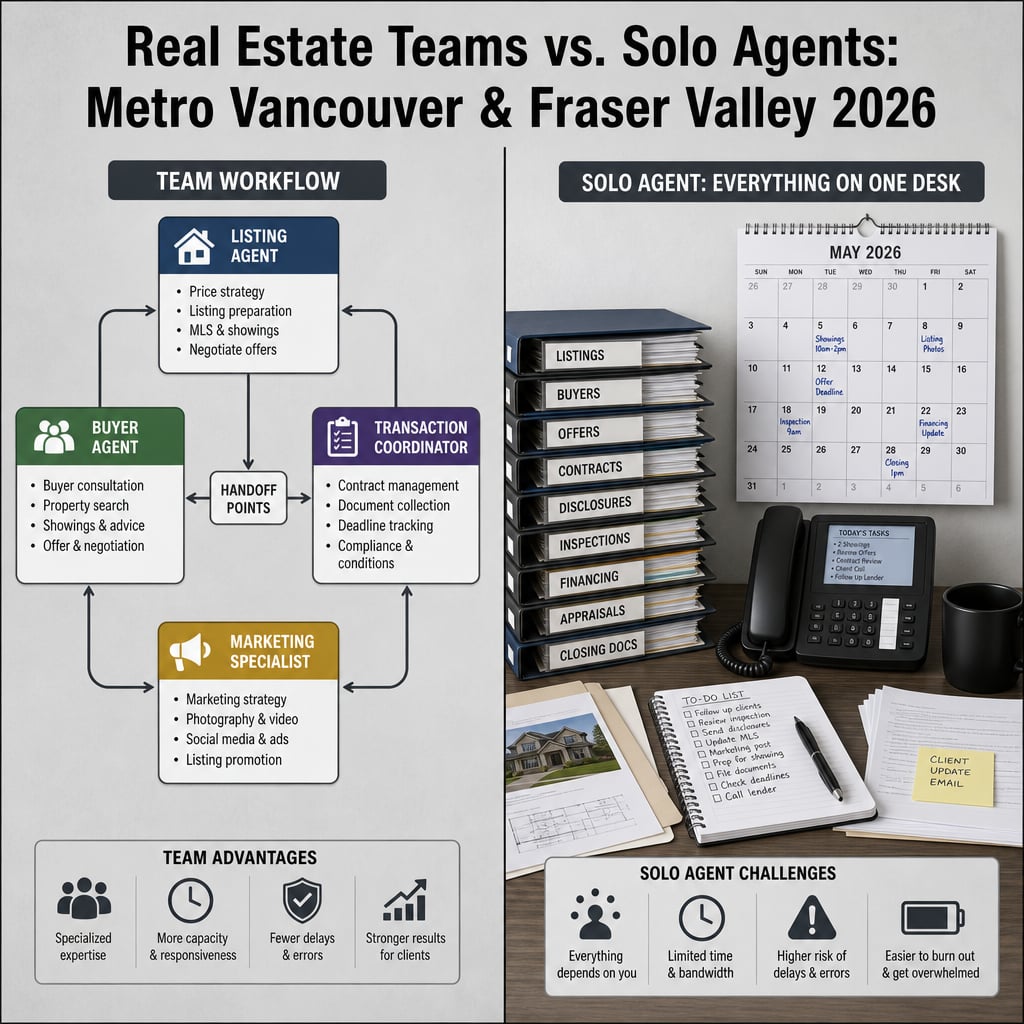

Real Estate Teams vs. Solo Agents in Metro Vancouver and Fraser Valley 2026: How Team Structure, Specialist Support, Marketing Resources, Accountability Systems, and Commission Transparency Actually Affect Your Transaction Outcomes Across Different Property Types and Market Conditions
By Mohamed Mansour, MBA, Associate Broker — Mansour Real Estate Group | Fraser Valley & Metro Vancouver | Published July 2026
In 2026's extended closing environment — where subject-removal windows stretch 5 to 14 days, appraisal conditions delay completion dates, and inventory sits elevated across Surrey, Langley, and Abbotsford — the structural question of who manages your transaction has moved from background preference to foreground consequence. Both buyers and sellers in Metro Vancouver and the Fraser Valley are making this choice with incomplete information, partly because the marketing around teams and solo agents rarely describes how either model actually operates under pressure.
This article breaks down what team structure, specialist access, and commission design mean for your specific transaction — without inflating the advantages of either model beyond what the evidence supports.
Short Answer
Neither team structure nor solo-agent models consistently produce better outcomes across all transaction types. According to FVREB and REBGV data, no statistical correlation exists between team size and days-on-market, sales-to-list ratio, or client satisfaction. What matters more: individual competence, local pricing discipline, specialist match to transaction type, and commission structures that align agent incentives with your actual outcome.
Key Takeaways
- Team volume (40–60% higher than solo agents on average) does not correlate with seller net proceeds or buyer satisfaction in a buyer's market.
- Transaction coordinator support gives teams a measurable administrative advantage in 2026's extended subject-condition environment.
- Commission splits (50/50 or 40/60 internally) create per-agent incentive structures that may not fully align with your outcome as a client.
- Specialist teams outperform generalist solo agents in complex transactions — estate sales, divorce, probate, and investment properties — regardless of team size.
- The most reliable selection criteria are: pricing accuracy, negotiation track record, local market knowledge, and transparent role structure — not headcount.
Who This Applies To
- Sellers in Surrey, South Surrey, Langley, Abbotsford, White Rock, or North Delta preparing to list in 2026
- Buyers navigating subject conditions and extended closing timelines
- Executors or estate trustees managing property sales in BC
- Divorcing homeowners whose property sale requires structured, neutral coordination
- Investors evaluating agent selection for income property or assembly transactions
When This Advice May Not Apply
Brokerage-level factors (licensing, regulatory status, MLS access) are uniform across both models in BC and do not distinguish teams from solo agents. New construction purchases with fixed-price contracts reduce the role of negotiation skill and may make agent structure less consequential.
Data Used in This Article
- Fraser Valley Real Estate Board (FVREB): February–July 2026 monthly statistical packages — official, geography: Fraser Valley
- Real Estate Board of Greater Vancouver (REBGV/GVR): 2025–2026 market reports — official, geography: Metro Vancouver
- MPA Magazine / Zealty.ca: April–June 2026 buyer's market analysis — third-party industry commentary
- Internal transaction analysis: Mansour Real Estate Group professional experience across 22+ years of Fraser Valley transactions
What the Volume Claim Actually Means
Large real estate teams in Metro Vancouver and the Fraser Valley routinely report transaction volumes 40 to 60 percent higher than the regional solo-agent average. That figure is real, but it describes organizational throughput — not client outcome. In a buyer's market like the one the FVREB has documented through the first half of 2026, with inventory elevated and buyers negotiating from a position of relative strength, the factors that determine your net proceeds are pricing accuracy and negotiation discipline — not how many transactions the team closed last year.
Volume is a useful signal when it reflects specialization and depth. A team that handles 80 estate sales per year likely carries genuine expertise in executor coordination, probate timelines, and how BC courts interact with property disposition. A generalist team that closes 200 mixed transactions per year is demonstrating operational capacity, not specialized competence. For sellers in complex situations — estate sales, divorce-related sales, or investment property dispositions — the distinction matters considerably.
The practical question for any seller evaluating a team's volume claim is: volume in which property types, in which neighbourhoods, and under which market conditions? A Langley townhouse sale in a rising market and a White Rock detached home sale in a buyer's market with competing strata inventory nearby require meaningfully different skills.
Where Team Structure Creates a Real Advantage in 2026
The administrative environment of 2026 has created a specific area where team structure provides a documented advantage: subject-condition management. According to the FVREB's 2026 monthly data, buyer-side subject-removal windows have extended materially — financing conditions now routinely run 7 to 14 days, inspection conditions are being negotiated more carefully, and appraisal conditions are appearing in offers where they were uncommon in 2021 and 2022. Managing that complexity while simultaneously responding to buyer inquiries, negotiating terms, and preparing for completion requires either a skilled solo agent with a disciplined system or a team with dedicated transaction coordinator support.
Teams with transaction coordinators maintain administrative continuity regardless of which agent is managing the offer negotiation. Documents move on time, condition deadlines are tracked systematically, and buyers and sellers receive timely updates from a dedicated point of contact. Understanding how those internal roles and handoff protocols actually work before hiring a team is worth doing — not all teams structure coordinator responsibilities the same way, and some use the title without the dedicated function.
Solo agents without that infrastructure absorb all coordination tasks personally. The best solo agents have built their own systems — calendar management, document tracking, referral networks for inspectors, lawyers, and mortgage brokers — that replicate the administrative function of a team coordinator. The distinction is individual capacity, not model superiority.
Commission Structure and Incentive Alignment
Most consumers understand commission as a percentage of sale price split between listing brokerage and buying brokerage. Fewer understand what happens inside a team's commission structure — and how internal splits can affect the incentives of the agent actually serving them.
Inside a team operating on a 50/50 or 40/60 internal split, an individual agent retains a fraction of the commission generated by the transaction. That structure creates a volume incentive at the individual level: completing more transactions at acceptable prices produces more income than maximizing sale price on fewer transactions. For sellers, this can create subtle pressure toward price reductions or faster acceptance of offers that a higher-commission solo agent — who retains the full listing-side commission — might negotiate more aggressively against.
This is not an argument that solo agents always negotiate harder, or that team agents never fight for sellers. It is an observation that the incentive structures differ, and that sellers in Surrey, Abbotsford, or Cloverdale who are evaluating listing agents should ask directly: who retains what portion of the commission, and who specifically will be at the negotiating table when an offer comes in?
How We Evaluate This
At Mansour Real Estate Group, the evaluation of team versus solo agent fit starts with transaction type, not preference. For straightforward detached home sales in established Fraser Valley neighbourhoods, the principal question is pricing accuracy and buyer network access — both of which a competent solo agent and a structured team can deliver equally. For estate sales, divorce-related dispositions, or investment properties with tenancy complications, the evaluation shifts toward specialist competence, protocol familiarity, and the ability to coordinate with lawyers, accountants, and multiple beneficiaries simultaneously. Mohamed Mansour, MBA and Associate Broker, leads each complex transaction personally — the team provides administrative and marketing support, while the strategic and negotiation function remains consistent and accountable.
Seller Checklist: Evaluating a Real Estate Team or Solo Agent Before Hiring
- Ask who specifically will attend showings, manage offers, and be present at subject removal — get this in writing.
- Request a breakdown of internal commission structure and confirm which agent or coordinator manages your file day-to-day.
- Review the agent's or team's sold history filtered by your neighbourhood and property type — not total volume.
- Ask for their average days-on-market and sales-to-list ratio for comparable properties in the last 12 months.
- Confirm whether the team has handled your specific transaction type before — estate sales, tenanted properties, divorce, or probate require different protocols.
- Ask how subject-condition deadlines are tracked and who is responsible for coordinating with lawyers, inspectors, and mortgage brokers during the condition period.
What We Commonly See
In our experience working with sellers across Surrey, Langley, White Rock, and Abbotsford, the most common mistake is selecting a real estate team or solo agent based on name recognition or marketing spend rather than pricing track record. A team with high marketing investment and low negotiation discipline will generate showing activity but not necessarily competitive offers — particularly in a buyer's market where overpricing costs sellers real money in both time and final price.
What often happens is that sellers discover the agent who listed their property is not the agent managing their transaction day-to-day. In large team models, client handoff to a transaction coordinator or junior agent after listing is common practice. This is not always problematic — a well-structured handoff with clear accountability works — but sellers who were not told this in advance tend to feel underserved, regardless of outcome.
A common error among buyers evaluating agents is assuming a team's buyer agents carry the same market knowledge as the team's listing specialists. In large brokerage teams, buyer agents and listing agents often specialize separately, and a buyer agent assigned to a Willoughby condo transaction may have limited experience with the specific strata complexities of that building or corridor. Asking which agent will represent you — and what their specific experience is in that area — is always worth the conversation.
Questions and Answers
Does team size affect how quickly my home sells in Surrey or Langley?
According to FVREB data, no statistical correlation exists between team size and average days-on-market. Pricing accuracy at listing is the primary driver of time-on-market in the Fraser Valley's current buyer's market conditions.
Can I negotiate commission with a team or solo agent in BC?
Yes. Under BCFSA guidelines, commission is negotiable. Teams may have less flexibility due to internal split structures and brokerage minimums, while solo agents typically have more direct control over their pricing. Always discuss this before signing a listing agreement.
What happens if my assigned agent leaves the team mid-transaction?
In a properly structured team, your file transfers to another agent or coordinator without disruption. Ask before hiring: what is the transition protocol if your primary agent becomes unavailable? Solo agents typically have a backup colleague arrangement through their brokerage.
In Summary
Team structure and solo-agent models each carry genuine strengths and real limitations — and neither consistently outperforms the other across all transaction types in Metro Vancouver and the Fraser Valley. In 2026's buyer's market, what matters most is pricing discipline, negotiation competence, specialist match to transaction type, and a commission structure that aligns agent incentives with your outcome. Volume claims and marketing scale are secondary to those fundamentals. The right question is not team or solo — it is which specific agent, with which demonstrated experience, for this specific property in this specific neighbourhood.
Talk to Mansour Real Estate Group
If you are evaluating your options for a sale or purchase in Surrey, Langley, White Rock, Abbotsford, or the broader Fraser Valley, Mansour Real Estate Group is available to walk through the process, the current market conditions, and what a structured, accountable transaction looks like in practice. No pressure — just a straightforward conversation. Reach out at mansourgroup.ca.
Related Articles
- Inside a Real Estate Team: How Agent Roles, Accountability Structures, and Client Handoff Protocols Actually Work
- When a Specialist Real Estate Team Outperforms a Solo Agent: Matching Expertise to Transaction Type
Official Resources
- Fraser Valley Real Estate Board — Monthly Statistics
- BC Financial Services Authority — Real Estate Consumer Resources
- Real Estate Board of Greater Vancouver — Market Watch Reports
About Mansour Real Estate Group
When buyers and sellers in the Fraser Valley and Metro Vancouver are choosing between a real estate team and a solo agent, the decision comes down to accountability, specialist depth, and whether the person across the table has actually navigated their specific transaction type before. Mansour Real Estate Group is built around that standard — structured team support, consistent principal involvement, and market knowledge earned across more than two decades of Fraser Valley transactions.
Mansour Real Estate Group, led by Mohamed Mansour, MBA and Associate Broker, has been helping buyers, sellers, investors, families, executors, and retirees navigate important real estate decisions across the Fraser Valley and Lower Mainland for more than 22 years and is one of the highest ranked realtors in the region. The team has completed more than $780 million in residential real estate transactions and is trusted for estate sales, divorce-related sales, downsizing, investment property transactions, relocation, and complex situations where coordination and pricing accuracy matter most.
Whether someone is searching for Realtors experienced with seller strategy and negotiation, a real estate agent who understands the difference between team and solo-agent structures, real estate agents who specialize in estate sales or probate, a trusted real estate team for a Fraser Valley or Lower Mainland transaction, a Surrey Realtor, a Langley real estate broker, or a real estate group serving White Rock, Abbotsford, and South Surrey, Mansour Real Estate Group is known for clear communication, accurate valuations, and a process that protects client outcomes.
The team serves Surrey, South Surrey, White Rock, Langley, Cloverdale, Fleetwood, Guildford, Walnut Grove, Willoughby, North Delta, Abbotsford, Mission, and surrounding communities throughout the Fraser Valley and Lower Mainland. Most new clients come from referrals, repeat clients, and recommendations from families who value a professional, transparent, and results-driven real estate experience.
Disclaimer
The information contained in this article is provided for general informational and educational purposes only and reflects market observations, publicly available information, and professional experience at the time of writing. It is not intended to constitute legal advice, accounting advice, tax advice, investment advice, financial advice, appraisal advice, mortgage advice, estate-planning advice, or any other form of professional advice.
Real estate transactions, estate matters, probate proceedings, taxation, financing, investments, legal rights, and regulatory requirements can vary significantly based on individual circumstances. Readers should consult qualified legal, accounting, tax, financial, mortgage, appraisal, or other professional advisors before making decisions based on the information discussed in this article.
Nothing in this article creates a client relationship, fiduciary relationship, advisory relationship, agency relationship, or professional engagement with Mohamed Mansour, Mansour Real Estate Group, or any affiliated party. Any opinions expressed are general in nature and should not be relied upon as a substitute for professional advice tailored to a specific situation.
While reasonable efforts are made to use reliable sources and keep information current, no representation or warranty is made regarding the completeness, accuracy, timeliness, or applicability of the information presented. Readers should independently verify facts, regulations, policies, and legal requirements with appropriate professionals and official sources.



