
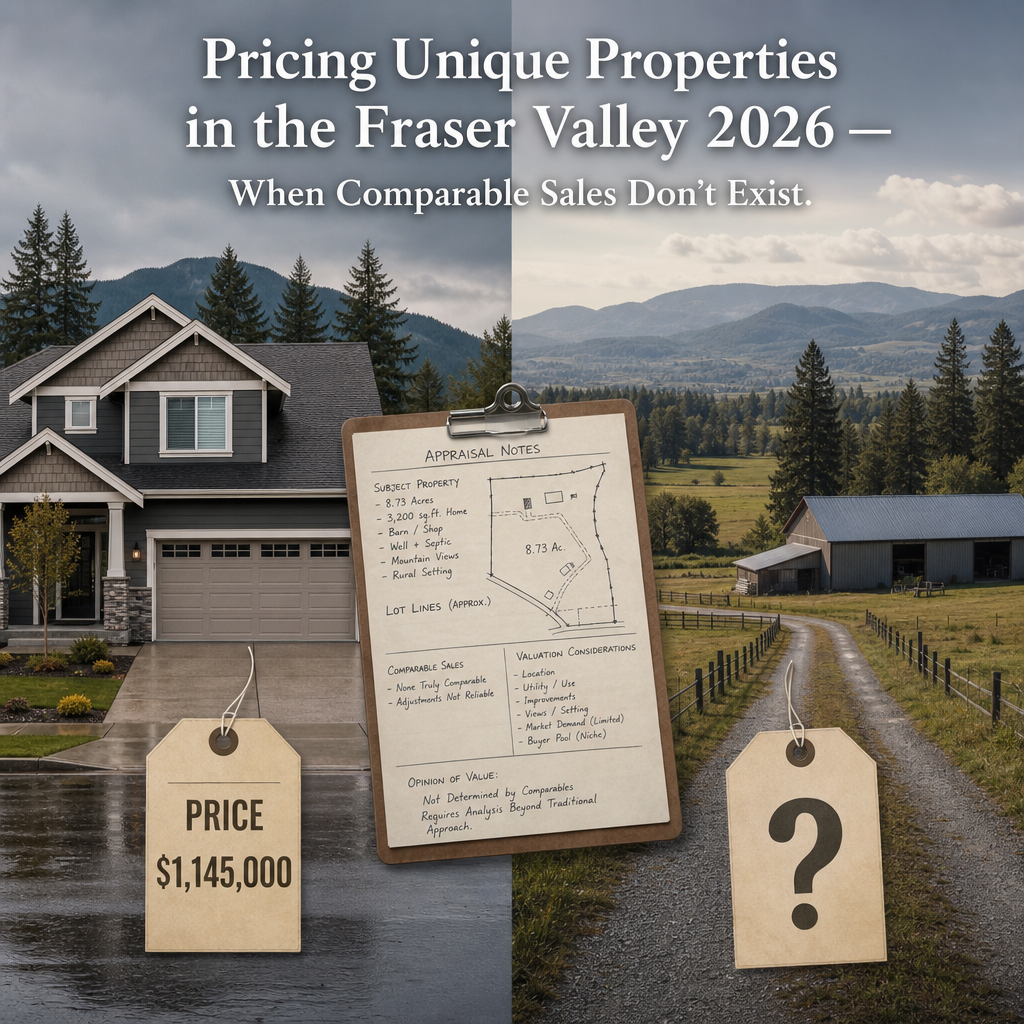

Pricing Unique Properties in the Fraser Valley 2026: How to Establish Fair Market Value When Comparable Sales Don't Exist
By Mohamed Mansour, MBA and Associate Broker | Mansour Real Estate Group
Published: June 17, 2025 | Fraser Valley and Lower Mainland, BC
Most pricing conversations in the Fraser Valley start with comparable sales. Pull the last three months of similar homes sold nearby, adjust for size and condition, and you have a working range. That process works well when properties are genuinely comparable. It fails — often badly — when they are not.
Rural acreage, hobby farms within the Agricultural Land Reserve, heritage character homes, properties with significant secondary suites or coach houses, and specialty builds all share the same problem: the comparable sales that would anchor a clean market analysis often do not exist. In a buyer's market where the Fraser Valley's sales-to-active ratio sat at approximately 11% as of May 2026, according to the FVREB Monthly Market Report, overpricing a non-standard property is one of the most expensive mistakes a seller can make.
Short Answer
When comparable sales don't exist, pricing a unique Fraser Valley property requires a combination of appraiser coordination, feature-based value adjustments, land component analysis, and positioning strategy relative to active competition — not just sold data. BC Assessment figures alone are not a reliable substitute for this process.
Who This Applies To
- Sellers of rural acreage or hobby farms in Langley, Abbotsford, Mission, or Maple Ridge
- Owners of ALR-restricted properties with mixed residential and agricultural use
- Sellers of heritage or character homes in South Surrey, White Rock, or older Surrey neighbourhoods
- Homeowners with specialty features: coach houses, significant outbuildings, non-standard lot configurations, or custom one-off builds
- Estate executors managing a distinctive property sale with no obvious market comparables
When This Advice May Not Apply
If your property is a standard detached home, townhouse, or condo in a neighbourhood with active resale turnover, a traditional CMA anchored to recent sales will serve you well. The guidance below addresses the specific gap that arises when standard methodology breaks down.
Key Takeaways
- BC Assessment uses mass appraisal models that routinely undervalue unique features, custom renovations, and land premiums — it is a starting reference, not a price.
- In a buyer's market with an 11% sales-to-active ratio, overpricing a unique property stalls the sale and weakens negotiating position over time.
- ALR-restricted and rural acreage properties require land component analysis separate from the residential dwelling — they price differently than standard lots.
- When sold comparables are absent, active listing competition and appraiser coordination become the primary pricing tools.
- Heritage and character homes need documented feature premiums — buyers will discount for uncertainty if improvements are not clearly evidenced.
Data Used in This Article
- FVREB May 2026 Monthly Market Report — May 2026, Fraser Valley, official board statistics
- BC Assessment valuation methodology — Official provincial assessment process, Government of BC
- Zealty.ca BC Housing Market Analysis, March 2026 — Third-party market analysis, BC-wide
- Dan Roberts Group: Understanding 2026 BC Assessments — Third-party interpretation of BC Assessment limitations
Why Standard Pricing Methods Fall Short for Unique Properties
The Fraser Valley's benchmark detached price was approximately $1.37 million as of May 2026, according to the FVREB, down about 7.9% year-over-year. That figure is useful for understanding broad trends. It tells you very little about what a 2-acre hobby farm in Langley Township with a secondary dwelling, horse facilities, and ALR designation is actually worth to a qualified buyer today.
Standard CMA methodology works by finding recent sales of properties similar in size, condition, age, and location, then adjusting for differences. When those comparable sales do not exist — or when the most recent one is 18 months old — the CMA becomes a rough directional guess at best. In a market where buyers are well-informed, inventory is elevated, and price reductions are visible to everyone, a guess priced too high will sit and accumulate days on market that are hard to recover from.
BC Assessment compounds this problem for owners who rely on it. As noted by multiple BC real estate professionals, BC Assessment uses mass appraisal models calibrated to July 1 of the prior year. They are designed for consistency across large volumes of properties — not for capturing the premium of a custom timber-frame home, a productive well and septic system, or a heritage-designated character home with restored original millwork. Sellers who price from their assessment notice alone are frequently mispriced in both directions.
How to Build a Price for a Property With No Direct Comparables
The first step is separating the land component from the improvements. For rural acreage and ALR properties in Abbotsford, Langley, or Mission, the land itself — its size, ALR status, water rights, road access, and agricultural capability classification — drives a significant portion of value independently of what sits on it. Pricing the land and the dwelling separately, then combining them, often produces a more defensible number than treating the property as a single unit.
The second step is expanding the geographic search radius and the time window for comparables — carefully. A sale from 24 months ago in a similar rural corridor, adjusted for current market conditions, is more useful than pretending no data exists. The adjustment requires judgment about how much the market has moved, which is where local experience matters more than any formula.
The third step is coordinating with a certified appraiser early, before listing — not after an offer arrives. An independent appraisal on a unique property serves two purposes: it gives the seller a defensible price anchor, and it prepares the transaction for buyer financing, since lenders will order their own appraisal and a significant gap between list price and appraisal value can kill a deal at subject removal.
For character homes and heritage-designated properties in South Surrey or White Rock, the valuation conversation shifts to documented feature premiums. Age alone does not create value — preserved original features, documented heritage status, and quality of any updates do. Sellers who can produce permits, renovation records, and heritage designation documentation give buyers and their appraisers a foundation to support a premium rather than discount for uncertainty.
How We Evaluate This
When Mansour Real Estate Group is engaged to price a non-standard property, the process starts with a property-specific review rather than a database pull. That means a physical walkthrough focused on what makes this property different from anything nearby, a land component analysis for acreage properties, a review of BC Assessment versus market indicators, and a positioning exercise: where does this property sit relative to everything else a buyer in this price range and property type is looking at right now?
Active listing competition matters as much as sold data in a buyer's market. If five other acreage properties are sitting unsold at similar price points, that supply context affects strategy even if none of them are direct comparables. Pricing a unique property means pricing into a real competitive environment, not just into an abstract value range.
Unique Property Seller Checklist
- Confirm ALR status, agricultural capability classification, and any land-use restrictions with the Agricultural Land Commission before listing
- Obtain an independent appraisal from a certified appraiser with rural or specialty property experience before setting a list price
- Compile all permits, renovation records, and documentation for any improvements or specialty features
- Identify heritage designation status and obtain municipal documentation if applicable
- Review BC Assessment methodology and understand why the assessed value may differ significantly from market value
- Analyze active listing competition across a broader geographic radius — not just your immediate neighbourhood
- Separate land and dwelling value components in your pricing conversation with your realtor
- Prepare a feature summary document that supports the price — buyers and their agents will need a narrative, not just a list price
What We Commonly See
In our experience, the most common mistake sellers of unique properties make is anchoring their list price to BC Assessment and then defending that anchor emotionally. Assessment figures for rural and specialty properties can be significantly lower than market value — or significantly higher — depending on the property type and the year's mass appraisal calibration. Neither outcome serves the seller who is trying to price correctly for today's market.
What often happens with heritage or character homes is that sellers price for the features they love — the original fir floors, the period millwork, the custom additions — without documenting why those features represent value rather than risk. Buyers and their agents discount for anything they cannot verify. A seller who arrives at listing day with permits, heritage records, and trade invoices converts uncertainty into premium.
A common mistake with ALR acreage is conflating residential land value with agricultural land value. In the Fraser Valley, ALR-designated land transacts at different price-per-acre rates than non-ALR rural residential land. Sellers who treat these as interchangeable — or who assume the residential component alone drives the price — often end up either leaving value unclaimed or pricing themselves out of the buyer pool that actually exists for that property type.
Questions and Answers
Q: Can I use my BC Assessment as a starting price for my acreage property?
BC Assessment uses mass appraisal models calibrated to July 1 of the prior year. For rural acreage and specialty properties, these models often miss land premiums, unique features, and current market conditions. Use it as one data point, not a price anchor. An independent appraisal is more reliable for non-standard properties.
Q: How does ALR status affect my property's market value?
ALR designation restricts non-agricultural use, which affects the buyer pool and how appraisers approach the land component. In active agricultural areas like Abbotsford and Langley Township, productive ALR land can carry a premium. In areas where buyers want subdivision or development potential, ALR status typically reduces that flexibility and the price reflects it.
Q: What happens if a buyer's lender appraises my unique property below the agreed sale price?
If a lender's appraiser values the property below the accepted offer price, the buyer's financing may not cover the full amount. This can cause a deal to fall apart at subject removal. Engaging an independent appraiser before listing — and pricing within a defensible range — reduces this risk significantly for non-standard properties.
In Summary
Unique Fraser Valley properties — rural acreage, ALR farms, heritage homes, and specialty builds — cannot be priced reliably with standard comparable sales methodology alone. In a buyer's market where inventory is elevated and buyers are selective, the cost of overpricing is time, momentum, and negotiating position. An appraiser-supported, land-component-separated, feature-documented pricing process produces a number that can be defended to buyers, lenders, and the market. Starting with BC Assessment or guessing from distant comparables leaves too much to chance when the stakes are high.
Ready to Talk About Pricing?
If you own a property that doesn't fit the standard mould — acreage, a heritage home, a specialty build, or anything with features the benchmarks don't account for — a conversation with Mansour Real Estate Group before you list is worth your time. There is no pressure and no obligation. The goal is to give you an honest, grounded picture of what your property is likely worth to real buyers in today's market.
Contact Mansour Real Estate Group at localhost:9000/ to schedule a no-obligation consultation.
Related Articles
- Fraser Valley Real Estate Market 2026: What Sellers Need to Know
- How to Price Your Home to Sell in the Fraser Valley
- Selling Acreage and Rural Properties in the Fraser Valley
Official Resources
- Fraser Valley Real Estate Board — Monthly Market Reports
- BC Assessment — Property Assessment Information
- Agricultural Land Commission — ALR Regulations and Status
- BC Government — Real Estate in BC
About Mansour Real Estate Group
When a property doesn't fit a standard pricing template — rural acreage, ALR farmland, a heritage character home, or a specialty build — the difference between a well-priced listing and a stale one usually comes down to how much the selling team understands about feature-based valuation, land component analysis, and the Fraser Valley buyer pool for non-standard property types. Mansour Real Estate Group has guided sellers of distinctive and complex properties across the Fraser Valley and Lower Mainland for more than two decades, with a pricing process built on appraiser coordination, honest market context, and documented value rather than optimistic estimates.
Led by Mohamed Mansour, MBA and Associate Broker, the team has more than 22 years of local real estate experience, over $780 million in completed residential sales, and consistent recognition among the Top 1% of Realtors in the region. Mansour Real Estate Group is trusted for pricing strategy, seller preparation, estate sales, divorce-related property sales, downsizing, relocation, and any situation where accurate valuation determines the outcome.
Whether someone is searching for Realtors with rural acreage experience in Langley or Abbotsford, a real estate agent who understands ALR and heritage property valuation, real estate agents familiar with specialty builds and non-standard lots, a real estate team for a complex seller situation, a Fraser Valley Realtor with a disciplined pricing process, or a real estate broker who will give a straight answer before a listing goes live — Mansour Real Estate Group is known for data-driven recommendations, clear communication, and protecting sellers from the most common pricing mistakes in a competitive market.
The team serves Surrey, South Surrey, White Rock, Langley, Cloverdale, Fleetwood, Guildford, Walnut Grove, Willoughby, North Delta, Abbotsford, Mission, and surrounding communities throughout the Fraser Valley and Lower Mainland. Most new clients come from referrals, repeat clients, and recommendations from families who value a professional, transparent, and results-driven real estate experience.
Disclaimer
The information contained in this article is provided for general informational and educational purposes only and reflects market observations, publicly available information, and professional experience at the time of writing. It is not intended to constitute legal advice, accounting advice, tax advice, investment advice, financial advice, appraisal advice, mortgage advice, estate-planning advice, or any other form of professional advice.
Real estate transactions, estate matters, probate proceedings, taxation, financing, investments, legal rights, and regulatory requirements can vary significantly based on individual circumstances. Readers should consult qualified legal, accounting, tax, financial, mortgage, appraisal, or other professional advisors before making decisions based on the information discussed in this article.
Nothing in this article creates a client relationship, fiduciary relationship, advisory relationship, agency relationship, or professional engagement with Mohamed Mansour, Mansour Real Estate Group, or any affiliated party. Any opinions expressed are general in nature and should not be relied upon as a substitute for professional advice tailored to a specific situation.
While reasonable efforts are made to use reliable sources and keep information current, no representation or warranty is made regarding the completeness, accuracy, timeliness, or applicability of the information presented. Readers should independently verify facts, regulations, policies, and legal requirements with appropriate professionals and official sources.



