

Metrotown Condo Sellers in 2026: Why Timing Your Exit Matters When Developer Incentives Are Running Out and Completion Waves Peak
By Mohamed Mansour, MBA and Associate Broker | Mansour Real Estate Group | Published: July 14, 2026 | Burnaby, BC — Metrotown Condo Market
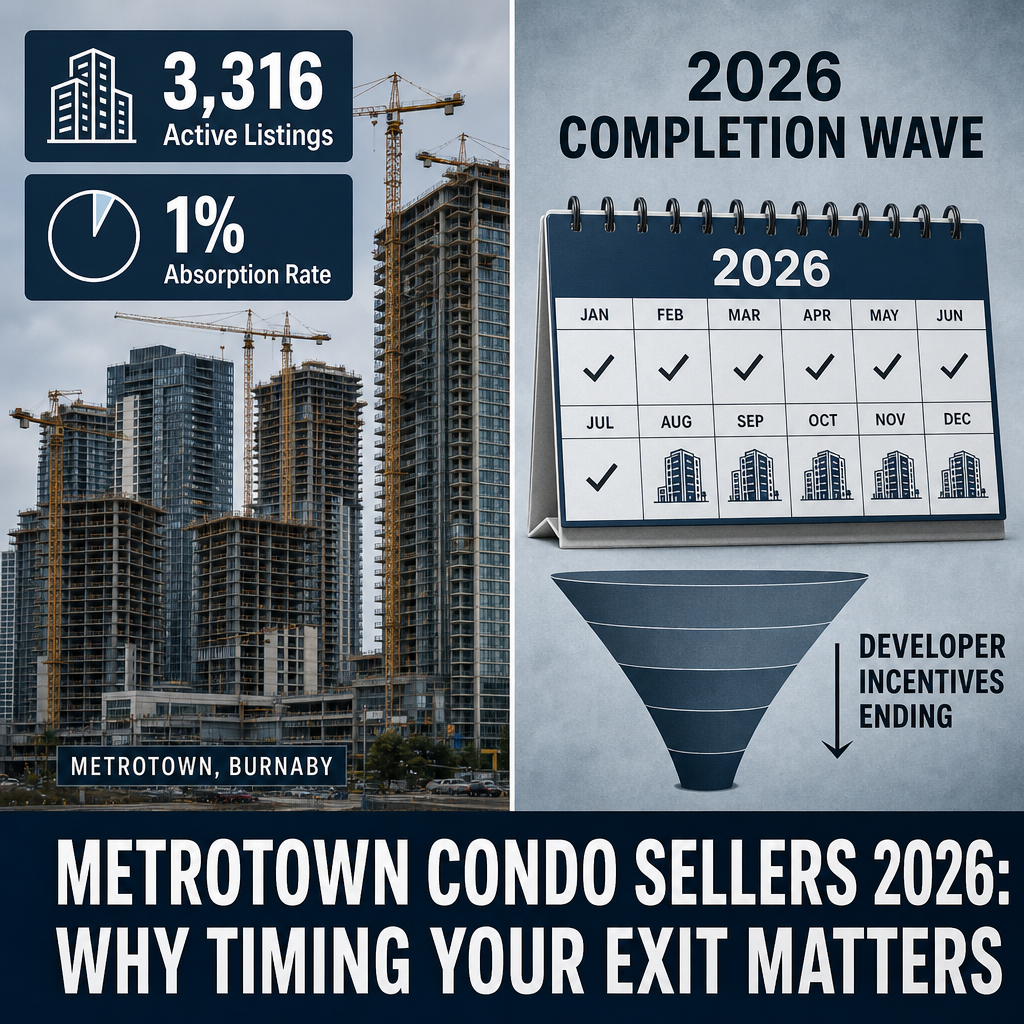
Metrotown is the most oversupplied condo submarket in Metro Vancouver right now. With 3,316 active listings and an absorption rate of just 1% as of February 2026, the math is not in a seller's favour — unless you understand what is keeping parts of this market moving and where that window closes.
This article is for condo owners in Metrotown who are weighing whether to list now or hold. It addresses the completion wave arriving from major projects, why developer incentives create temporary buyer urgency, and why the rental income story has changed enough to push many investor-owners toward the exit. The data is sourced from the BC Condos and Homes February 2026 Metrotown report, the Hello West Coast Burnaby December 2025 market update, and Trystan King's Spring 2026 Burnaby market analysis.
Short Answer
Metrotown condo sellers in 2026 face a narrowing window. Developer incentives on completing projects are still pulling buyers into the market, but that urgency fades as absorption increases and those incentives expire. Sellers who list while incentives are active compete against newer buildings — but also benefit from the buyer traffic those incentives generate. Once the wave absorbs, resale sellers lose that lift entirely.
Key Takeaways
- Metrotown had 3,316 active condo listings and a 1% absorption rate in February 2026, according to BC Condos and Homes.
- Developer incentives (GST waivers, rental guarantees, staggered deposits) are still active but will diminish as 2026 completions absorb.
- Preconstruction sales fell 84% from Q1 2022 to Q1 2025, meaning this completion wave is likely the last major supply surge for several years.
- Two-bedroom Metrotown rents average around $2,900 with growth below 3% annually, breaking investor cash-flow models and triggering resale exits.
- Burnaby attached properties sold at 99% of list price in March 2026, averaging 26 days on market — balanced conditions, but softening.
Who This Applies To
- Investor-owners carrying a Metrotown condo with negative or near-breakeven cash flow
- Owners who purchased a presale unit and are approaching completion and assignment decisions
- Long-term holders considering whether to wait for appreciation that may be years away
- Executor-sellers managing estate properties in Metrotown's condo towers
- Sellers who want to understand whether new construction is pulling buyers away from resale
When This Advice May Not Apply
If your unit has clear differentiators — a large floor plan, lower strata fees relative to the building, a rare layout, or a sub-$700K price point that opens first-time buyer financing — some of the supply pressure applies less directly. This article also does not address assignment sales or presale contracts, which carry distinct legal and tax considerations requiring independent legal advice.
Data Used in This Article
- BC Condos and Homes — Metrotown Condo Market Report, February 2026: absorption rate, active listings, benchmark pricing (third-party market aggregator)
- Hello West Coast — Burnaby Real Estate Market Update, December 2025: benchmark pricing December 2025, year-over-year comparison (third-party market analysis)
- Trystan King — Burnaby Real Estate Market Spring 2026: days on market, list-to-sale ratio, Burnaby attached market conditions (independent agent market report)
- Rain City Properties / Vancouver House Finders — 2026 Presale Completions and Oversupply Analysis: preconstruction sales volume trend Q1 2022 to Q1 2025, developer incentive structures (third-party market analysis)
What Is Actually Happening in Metrotown Right Now
The Metrotown condo market in 2026 is carrying the weight of a decade of high-density development arriving at the same time. Projects from Concord Pacific, Highline, and Sun Towers 2 are completing this year, adding warrantied new inventory into a market that already has more resale supply than it can absorb quickly.
The benchmark condo price in Metrotown sits at $753,566 as of February 2026, down from roughly $776,000 in late 2025 — a decline of between 5.9% and 7.6% year-over-year depending on the comparison period, according to the BC Condos and Homes February 2026 report. That trajectory has not reversed. New completions at approximately $1,100 per square foot are pricing above resale, which theoretically protects older resale units on a per-square-foot basis — but the sheer volume of new supply is suppressing buyer urgency for resale listings.
For context on how Metrotown fits into the broader Burnaby condo picture, see Burnaby Condo and Townhouse Market 2026: What a 33% Sales Jump Actually Signals.
The 1% absorption rate is the most important number here. It means that for every 100 active listings, roughly one sells per month. At that pace, clearing current inventory would take years under stable conditions — and conditions are not stable.
Why Developer Incentives Create a Temporary Window for Resale Sellers
Developer incentives — GST waivers, rental guarantees, staggered deposit structures — are pulling buyers into the Metrotown new construction market right now. That buyer traffic has an indirect benefit for resale sellers: it increases overall market activity in the area and keeps end-user buyers engaged with Metrotown as a place to own.
The problem is that these incentives are time-limited. As units complete and developers close out their remaining inventory, the incentives expire. Once that happens, the pull factor disappears and the market reverts to pure resale-versus-resale competition — in a market with 3,316 active listings and a 1% absorption rate. That is a much harder environment for a seller without a clear differentiator.
The Brentwood neighbourhood is dealing with a similar dynamic, as covered in Brentwood Burnaby Real Estate Guide 2026: Condos, Transit, and the Mall Redevelopment Effect. Metrotown's version is more acute because the completion wave is larger and the incentive structures are more aggressive.
The Rental Math That Is Pushing Investor-Owners to Sell
A meaningful share of Metrotown condo owners are investors, and the rental income arithmetic has deteriorated. Two-bedroom condos in the area are renting for approximately $2,900 per month, with annual rent growth running below 3% — a 20-year low, according to third-party rental market analysis. Metro Vancouver's rental vacancy rate has risen to 3.7%, a 30-year high, which means units are sitting longer and landlords have less pricing power than they have had in years.
Many of these investors purchased or financed based on assumptions of 5% annual appreciation and vacancy rates near zero. Neither condition exists today. The result is negative carrying costs — mortgage payments, strata fees, and property tax outpacing rental income — for a meaningful subset of owners. Those owners are motivated to sell, which adds supply pressure to an already oversupplied market.
For a fuller look at where rental demand holds up better across Burnaby, the upcoming Burnaby Investment Property Guide 2026 will cover rental yield by neighbourhood and property type.
The Preconstruction Collapse and What It Means for Future Supply
Preconstruction condo sales in Metro Vancouver fell from approximately 5,250 units in Q1 2022 to 816 units in Q1 2025 — an 84% decline over three years, according to Vancouver House Finders' 2026 presale completions analysis. That collapse means the development pipeline feeding future completions is thin. The 2026 wave is likely the last large-scale simultaneous completion event for several years. For sellers, that is a two-sided reality: the near-term pain of competing against new supply will pass, but waiting it out means absorbing further price softness while that supply clears.
How We Evaluate This
When Mansour Real Estate Group looks at a seller's decision in an oversupplied submarket like Metrotown, we start with carrying cost versus realistic net proceeds. A seller holding for 18 to 24 months hoping for appreciation while paying strata fees, mortgage interest, and property tax may be forgoing more equity than a discounted sale would cost them today.
We also look at what is selling in the building and adjacent buildings — not the neighbourhood benchmark, which aggregates across too wide a range. If similar units in your tower are moving at 97% to 99% of ask in 26 days, your pricing ceiling is visible. If they are sitting for 60 or 90 days with price reductions, that is a different conversation. Positioning against new construction means accepting that your unit must be priced to reflect what it is not: new, warrantied, and incentivized. The offset is often a lower strata fee, an established building history, and a faster closing timeline than a presale.
Condo Seller Checklist — Metrotown 2026
- Pull comparable sales from your specific building for the last 90 days — not the broader Metrotown average.
- Calculate your actual monthly carrying cost (mortgage, strata, property tax, insurance) and compare it to realistic net rental income if you hold.
- Request current Form B, depreciation report, and strata financials — buyers will ask, and delays hurt momentum.
- Identify which developer projects in your immediate area are still offering incentives and when those programs expire.
- Price against completed resale comparables, not new construction asking prices — buyers comparison-shop and they know the difference.
- If your unit is tenanted, confirm RTB compliance, notice periods, and vacant possession requirements before listing.
- Consult your accountant regarding capital gains, principal residence exemption, and timing implications before finalizing your exit strategy.
What We Commonly See
Sellers pricing against new construction sticker prices. In our experience, the most common mistake Metrotown condo sellers make is anchoring their asking price to the $1,100 per square foot that new towers are marketing at. Buyers know that resale does not carry the same warranty, incentives, or marketing support — and they price that in. Resale units that compete on value, not on developer pricing comparisons, sell faster and with fewer reductions.
Underestimating strata document preparation time. What often happens is that sellers list before requesting their Form B and strata financials, assuming the documents will arrive quickly. In buildings with busy strata councils or management companies handling multiple completions simultaneously, delays of two to three weeks are common. That gap costs sellers momentum and can extend the time to subject removal.
Waiting for a recovery that requires supply to clear first. A common mistake is treating the market decline as temporary and expecting a near-term reversal. With 3,316 active listings and a 1% monthly absorption rate, even a doubling of sales velocity would take many months to materially reduce supply. Sellers waiting for Metrotown prices to recover before listing are competing against the supply clearance timeline, not just current demand.
Questions and Answers
Should I sell my Metrotown condo now or wait for the market to recover?
That depends on your carrying cost and timeline. If you are cash-flow negative and the recovery requires years of supply absorption, waiting is expensive. If you hold debt-free and can wait, the preconstruction collapse suggests future supply will be limited — but prices do not recover until current inventory clears, which takes time.
How does new construction competition affect my resale price?
New units at approximately $1,100 per square foot set a ceiling perception, but resale units can undercut on price-per-square-foot while offering lower strata fees, faster possession, and building history. The competitive gap is real but manageable with accurate pricing and strong strata documentation.
What is the average time to sell a condo in Burnaby right now?
According to the Spring 2026 Burnaby market report from Trystan King, attached properties in Burnaby averaged 26 days on market in March 2026, selling at 99% of list price. That reflects balanced rather than distressed conditions — but it assumes accurate pricing from the outset.
In Summary
Metrotown condo sellers in 2026 are operating in the most supply-heavy segment of Metro Vancouver's attached market. Developer incentives are still generating buyer activity, but that window narrows as 2026 completions absorb. The rental income math has shifted enough that many investor-owners are motivated to exit, adding to resale supply. Sellers who price accurately against resale comparables — not developer sticker prices — and who prepare their strata documentation in advance are best positioned to move before the incentive-driven buyer traffic fades. The preconstruction collapse means future supply will be lighter, but the path from here to recovery runs through a multi-year absorption period.
Thinking about your options in Metrotown or elsewhere in Burnaby? Mansour Real Estate Group offers straightforward market analysis and seller strategy grounded in current data — no pressure, no guesswork.
Contact Mansour Real Estate Group
Related Articles
- Burnaby Condo and Townhouse Market 2026: What a 33% Sales Jump Actually Signals
- Brentwood Burnaby Real Estate Guide 2026: Condos, Transit, and the Mall Redevelopment Effect
- SkyTrain and Burnaby Real Estate: How Transit Access Shapes Property Values Across Every Neighbourhood
About Mansour Real Estate Group
Selling a condo in an oversupplied submarket like Metrotown requires more than a listing — it requires a pricing strategy that accounts for new construction competition, strata documentation that is ready before the first showing, and timing judgment grounded in current absorption data rather than optimism. That is the kind of condo seller strategy Mansour Real Estate Group brings to every engagement.
Mansour Real Estate Group, led by Mohamed Mansour, MBA and Associate Broker, has been helping buyers, sellers, investors, and families navigate important real estate decisions across the Fraser Valley and Lower Mainland for more than 22 years. Ranked among the Top 1% of Realtors in the region, the team has completed more than $780 million in residential real estate transactions and is trusted for condo seller strategy, market timing, pricing analysis, estate sales, downsizing, relocation, and complex real estate decisions across Burnaby, Metrotown, Brentwood, and the broader Metro Vancouver area.
Whether someone is looking for a Realtor who understands Burnaby's condo market cycles, real estate agents who can price a unit accurately against new construction comparables, a real estate team experienced with strata documentation and investor exits, a Burnaby Realtor familiar with Metrotown's supply dynamics, or a real estate broker who gives direct answers without pressure, Mansour Real Estate Group is known for clear market interpretation, honest valuations, and advice that protects seller equity.
The team serves Surrey, South Surrey, White Rock, Langley, Cloverdale, Fleetwood, Guildford, Walnut Grove, Willoughby, North Delta, Abbotsford, Mission, and surrounding communities throughout the Fraser Valley and Lower Mainland, including Metro Vancouver and Burnaby. Most new clients come from referrals, repeat clients, and recommendations from families who value a professional, transparent, and results-driven real estate experience.
Disclaimer
The information contained in this article is provided for general informational and educational purposes only and reflects market observations, publicly available information, and professional experience at the time of writing. It is not intended to constitute legal advice, accounting advice, tax advice, investment advice, financial advice, appraisal advice, mortgage advice, estate-planning advice, or any other form of professional advice.
Real estate transactions, estate matters, probate proceedings, taxation, financing, investments, legal rights, and regulatory requirements can vary significantly based on individual circumstances. Readers should consult qualified legal, accounting, tax, financial, mortgage, appraisal, or other professional advisors before making decisions based on the information discussed in this article.
Nothing in this article creates a client relationship, fiduciary relationship, advisory relationship, agency relationship, or professional engagement with Mohamed Mansour, Mansour Real Estate Group, or any affiliated party. Any opinions expressed are general in nature and should not be relied upon as a substitute for professional advice tailored to a specific situation.
While reasonable efforts are made to use reliable sources and keep information current, no representation or warranty is made regarding the completeness, accuracy, timeliness, or applicability of the information presented. Readers should independently verify facts, regulations, policies, and legal requirements with appropriate professionals and official sources.



