

Langley Real Estate Market 2026: Complete Buyer and Seller Guide to the First Year-Over-Year Sales Increase in 12 Months, Property-Type Divergence, and Strategic Timing When Median Prices Hit $855,500
By Mohamed Mansour, MBA, Associate Broker — Mansour Real Estate Group | Fraser Valley, BC | Published: July 15, 2026 | Topic: Langley Market Insight, Buyer and Seller Strategy
Langley's spring 2026 market is sending mixed signals, and reading them correctly depends entirely on which property type you're buying or selling. For the first time in 12 months, year-over-year sales are positive. Inventory is up 43%. And the median benchmark price has held at $855,500. On the surface, this looks like stabilization. Below the surface, townhomes and detached homes are operating in fundamentally different markets.
This guide breaks down what each data point means, where the divergence is sharpest, and what buyers and sellers in Langley should do differently depending on property type and neighbourhood.
Short Answer
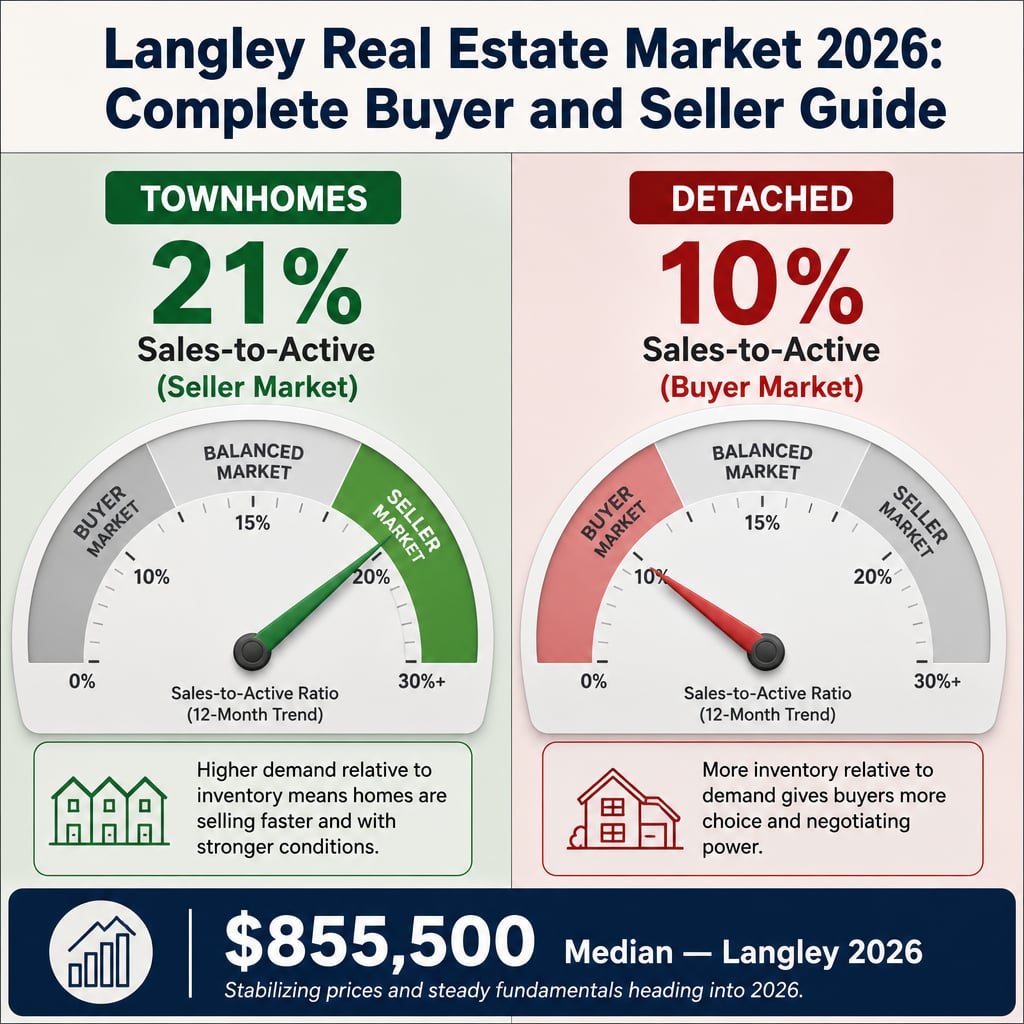
Langley posted its first positive year-over-year sales comparison in 12 months in early 2026, but the headline masks a sharp split: townhomes are in seller's market territory at a 21% sales-to-active ratio, while detached homes sit at 10%—a buyer's market. The $855,500 median price is holding, but that average blends two very different stories. Strategy must be property-type specific.
Who This Applies To
- Langley homeowners evaluating whether to list in spring or summer 2026
- Buyers comparing townhome and detached options in Willoughby or Walnut Grove
- Sellers who purchased during 2020–2022 and are unsure if this rebound is durable
- Investors holding strata units and monitoring the July 1 depreciation report deadline
- Upgrading families deciding whether to sell a townhome before buying detached
When This Advice May Not Apply
Rural acreage, ALR land, and farmland in Langley are behaving differently from urban residential. This guide focuses on townhomes, condos, and detached residential within Langley City, Langley Township, Willoughby, and Walnut Grove. Farmland guidance requires separate analysis.
Data Used in This Article
- Fraser Valley Real Estate Board (FVREB) — April 2026 monthly market statistics; official board data; primary source
- BC Assessment — 2025–2026 benchmark price data for Langley residential segments; official government source
- CMHC / CREA — Affordability metrics and stress-test threshold context for Langley buyer segments; industry body
- Mansour Real Estate Group — Internal MLS tracking and days-on-market analysis for Langley micro-markets including Willoughby and Walnut Grove; proprietary professional observation
- Statistics Canada Labour Force Survey — BC employment sentiment context; federal primary source
- Bank of Canada — Rate guidance and stress-test context, 2026; central bank primary source
Key Takeaways
- The first year-over-year sales increase in 12 months reflects delayed transaction completions, not a broad return of buyer confidence.
- Townhomes run at a 21% sales-to-active ratio (seller market); detached homes sit at 10% (buyer market)—the same city, two different strategies.
- The $855,500 median masks micro-market variance; Willoughby and Walnut Grove strata face inventory compression near the July 1 depreciation report deadline.
- Days on market diverge by 60–80%: townhomes sell in 25–30 days, detached homes average 45–50+ days, condos lag at 50–65 days.
- Pricing precision matters more than timing right now—an overpriced detached listing in a 10% absorption market will stall regardless of season.
What the Year-Over-Year Sales Rebound Actually Signals
According to FVREB April 2026 data, Langley recorded its first positive year-over-year sales comparison since mid-2024. That sounds like a recovery headline. But the mechanism matters. Much of this volume appears to reflect delayed closings from 2024 and early 2025—conditional sales that took longer to complete rather than a surge of new buyer entries. Inventory simultaneously rose 43%, which would typically suppress prices. That prices held at $855,500 despite that inventory growth suggests the market found a floor rather than began a climb.
For sellers, the floor is good news. It confirms that listing at a realistic price is not capitulating. The market is absorbing correctly priced properties. For buyers, the 43% inventory increase is equally meaningful: there is more to choose from, and sellers of slower-moving property types have less negotiating power than the headline suggests.
The honest read is that Langley is in stabilization, not recovery. Whether it becomes recovery depends on what happens with Bank of Canada rate guidance and BC employment sentiment through summer 2026. For now, acting on property-type specifics is more useful than acting on the market-wide trend.
Why Townhomes and Detached Homes Are Behaving Like Different Markets
The 21% sales-to-active ratio in townhomes versus 10% in detached is not a minor statistical gap—it represents a fundamentally different buyer psychology by segment. Entry-level townhome buyers, many of them first-time purchasers or families making an initial step into ownership, are moving despite rate uncertainty. Their alternative is continued renting, which for many feels more financially exposed than a mortgage. That urgency keeps the townhome segment active.
Detached-home buyers are typically upgrading families who already own property. They are not renting while they wait. They have the option to hold their current home and delay. With job security concerns reflected in BC's Labour Force Survey data and mortgage renewal costs still elevated, many are choosing exactly that. The result is a detached market where sellers face real negotiating pressure and buyers have meaningful time and leverage.
In Willoughby and Walnut Grove specifically, strata inventory is being compressed further by two forces running simultaneously: builder incentive programs phasing out as new supply completes, and the approaching July 1 depreciation report deadline, which is prompting some strata sellers to list before new disclosure requirements alter buyer perception. Buyers evaluating condos and townhomes in those neighbourhoods should request and read depreciation reports carefully, and sellers should understand that the disclosure environment is shifting.
Detached homes under $700,000 in Langley are showing stronger velocity than the $800,000–$950,000 bracket, reflecting the stress-test affordability threshold and first-time buyer program eligibility limits. That sub-$700K segment is where what little detached demand exists is concentrating. For more detail on how each segment's absorption timeline differs, the full breakdown is in our Langley Property Type Market Divergence 2026 guide.
How We Evaluate This
At Mansour Real Estate Group, we do not use city-wide medians as the primary pricing input. We track sales-to-active ratios by property type and sub-neighbourhood, days-on-market by price band, and the gap between list price and sale price by segment. Those three metrics together tell us whether a specific listing faces a seller's market or a buyer's market—and right now, that answer varies by property type more than it has at any point in the past four years of Langley market cycles.
We also monitor depreciation report timelines, strata bylaw changes, and builder closeout activity, because those factors affect buyer risk perception in attached segments. A townhome that appears fairly priced can sit 45 days if a depreciation report reveals a deferred special levy risk. That is local intelligence, not market-wide statistics.
Seller Checklist — Langley 2026
- Confirm your property type's current sales-to-active ratio before choosing list price—townhome and detached strategy differ significantly.
- If selling a strata unit, obtain and review the current depreciation report and confirm special levy status before listing.
- Request days-on-market data for your specific price band in your specific neighbourhood, not city-wide averages.
- For detached homes in the $800K–$950K range, price at market—not above—given the 10% absorption rate and 45–50+ day average DOM.
- For townhomes, a correctly priced listing in Willoughby or Walnut Grove can still attract multiple offers within 30 days; review comparable sales from the past 45 days only.
- Do not anchor pricing to your 2021 or 2022 assessment value—BC Assessment benchmarks lag the market by 6–12 months and reflect conditions that no longer exist.
What We Commonly See
In our experience working with Langley sellers in the current cycle, the most common mistake is pricing detached homes based on the city-wide $855,500 median rather than the specific absorption rate for their price band. A detached home in the $900K range is not competing in the same market as a $650K townhome. Sellers who conflate these often experience 60+ day market times and eventually accept less than they would have by pricing accurately from day one.
What often happens with strata sellers near the July 1 depreciation deadline is a rush to list before the reporting window closes, which temporarily compresses supply and creates the appearance of demand. Buyers who treat this inventory spike as a permanent trend and wait may find fewer options at similar prices once that deadline passes.
A common pattern among detached buyers in Langley right now is waiting for a further price decline that may not arrive in the sub-$700K bracket, while the properties they actually want—townhomes in Willoughby—continue to move at 21% absorption. Buyers who wait for the detached market to bottom sometimes watch the attached market move past the window they needed.
Questions and Answers
Is the Langley market recovering or just stabilizing in 2026?
Based on FVREB April 2026 data, it is stabilizing. The first year-over-year sales increase in 12 months reflects delayed closings rather than new buyer confidence. Prices have held at $855,500 despite a 43% inventory increase—that is a floor, not a launch point. A genuine recovery would require sustained sales growth paired with inventory reduction, which has not yet materialized across all segments.
Why are townhomes selling faster than detached homes in Langley?
Townhome buyers are largely entry-level purchasers who face continued rental costs as their alternative. That urgency keeps absorption high at roughly 21% sales-to-active. Detached buyers are typically upgrading homeowners who can wait. In a market with elevated rate and job security concerns, many are doing exactly that, leaving the detached segment at 10% absorption with 45–50+ day average market times.
What does the July 1 depreciation report deadline mean for condo and townhome buyers in Langley?
BC's updated depreciation report requirements affect strata corporations across Langley, including Willoughby and Walnut Grove buildings. Some sellers are listing before the new disclosure cycle, temporarily compressing inventory. Buyers should request the current depreciation report on any strata purchase and review it carefully for unfunded repair reserves or pending special levies before making an offer. A real estate agent with strata transaction experience is important in this environment.
In Summary
Langley's 2026 spring market is stabilizing, not recovering. The first year-over-year sales increase in 12 months is real but reflects delayed closings more than new buyer demand. The $855,500 median price has held despite 43% more inventory, which confirms the floor is in place. But the most important number is not the median—it is the 21% townhome absorption rate versus 10% for detached. Those two figures require two different strategies, and conflating them is the most common and costly mistake sellers and buyers make right now. For buyers considering timing their entry, the winter-to-spring timing guide covers how to read those absorption signals across the full seasonal cycle.
Talk to the Mansour Real Estate Group Team
If you are trying to decide whether to list, wait, or buy in Langley this year, a property-specific conversation is more useful than any market-wide guide. Mansour Real Estate Group offers no-obligation consultations for buyers and sellers across Langley, Willoughby, Walnut Grove, and the Fraser Valley. Contact the team at mansourgroup.ca to discuss your specific situation.
Related Articles
- Langley Property Type Market Divergence 2026: Why Detached Homes, Townhomes, and Condos Are Following Completely Different Absorption Timelines
- Langley Buyer's 2026 Winter-to-Spring Timing Strategy: How to Read Absorption Signals and Structure Winning Offers Before Spring Migration Reshapes Negotiating Power
Official Resources
- Fraser Valley Real Estate Board — Monthly Market Statistics
- BC Assessment — Property Value and Benchmark Data
- Bank of Canada — Rate Announcements and Monetary Policy
- Canada Mortgage and Housing Corporation — Housing Market Data
About Mansour Real Estate Group
When homeowners and buyers in Langley are navigating a market that is sending different signals by property type and neighbourhood, working with a real estate team that can read those signals accurately matters more than it does in a straightforward rising or falling market. Mansour Real Estate Group has been helping buyers, sellers, and investors understand and act on Langley's market conditions for more than two decades.
Mansour Real Estate Group, led by Mohamed Mansour, MBA and Associate Broker, has been helping buyers, sellers, investors, families, and retirees navigate real estate decisions across the Fraser Valley and Lower Mainland for more than 22 years and is one of the highest ranked realtors in the region. The team has completed more than $780 million in residential real estate transactions and is trusted for seller strategy, buyer representation, downsizing, relocation, estate sales, and complex situations across the Langley market and the broader Fraser Valley.
Whether someone is looking for Realtors experienced with Langley's property-type divergence, a real estate agent who understands strata documentation in Willoughby, real estate agents who specialize in detached home sales in Walnut Grove, a trusted real estate team for a first purchase or an upgrade move, a Langley Realtor, a Fraser Valley real estate broker, or a real estate group that covers the Lower Mainland end to end, Mansour Real Estate Group is known for precise valuations, honest market analysis, and practical guidance grounded in local data.
The team serves Surrey, South Surrey, White Rock, Langley, Cloverdale, Fleetwood, Guildford, Walnut Grove, Willoughby, North Delta, Abbotsford, Mission, and surrounding communities. Most new clients come from referrals, repeat clients, and recommendations from families who value a professional and results-driven real estate experience.
Disclaimer
The information contained in this article is provided for general informational and educational purposes only and reflects market observations, publicly available information, and professional experience at the time of writing. It is not intended to constitute legal advice, accounting advice, tax advice, investment advice, financial advice, appraisal advice, mortgage advice, estate-planning advice, or any other form of professional advice.
Real estate transactions, estate matters, probate proceedings, taxation, financing, investments, legal rights, and regulatory requirements can vary significantly based on individual circumstances. Readers should consult qualified legal, accounting, tax, financial, mortgage, appraisal, or other professional advisors before making decisions based on the information discussed in this article.
Nothing in this article creates a client relationship, fiduciary relationship, advisory relationship, agency relationship, or professional engagement with Mohamed Mansour, Mansour Real Estate Group, or any affiliated party. Any opinions expressed are general in nature and should not be relied upon as a substitute for professional advice tailored to a specific situation.
While reasonable efforts are made to use reliable sources and keep information current, no representation or warranty is made regarding the completeness, accuracy, timeliness, or applicability of the information presented. Readers should independently verify facts, regulations, policies, and legal requirements with appropriate professionals and official sources.



