
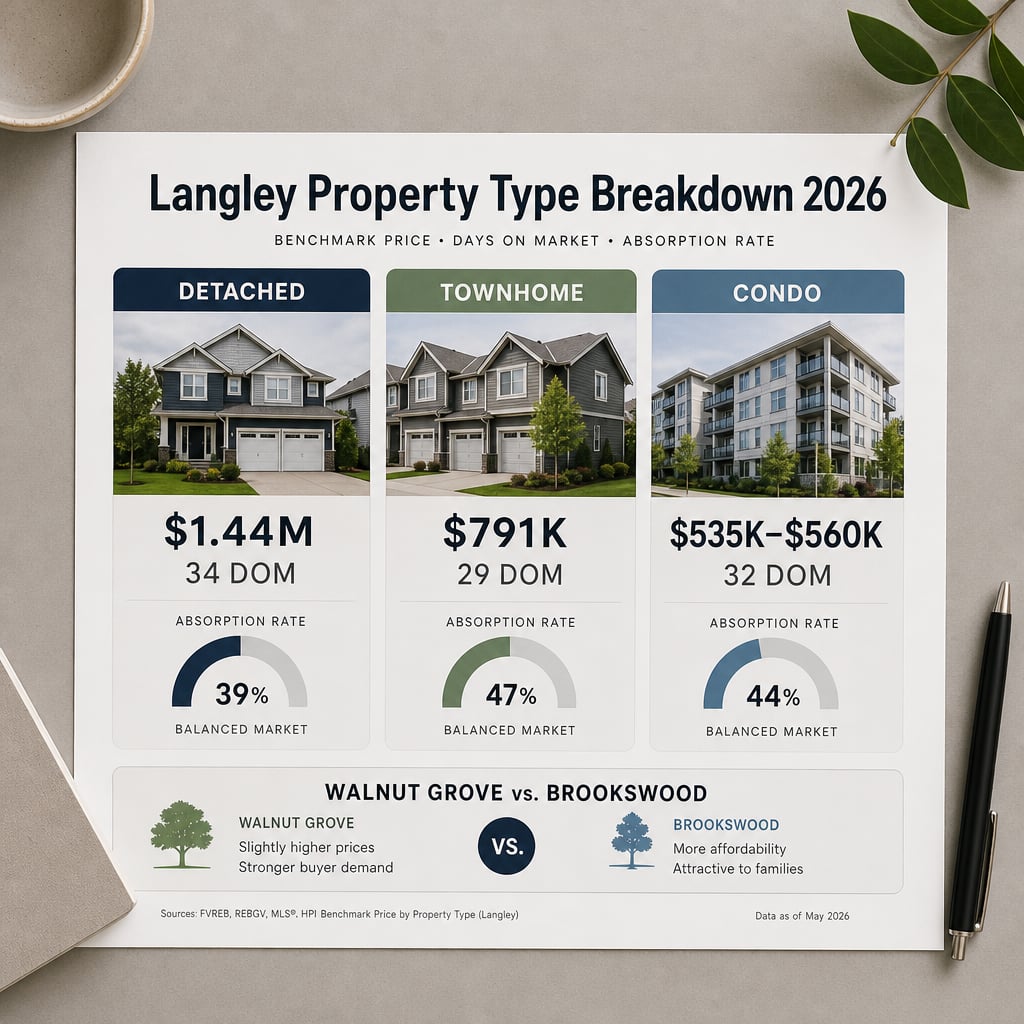

Langley Property Type Breakdown 2026: Detached Homes vs. Townhomes vs. Condos — Market Performance, Carrying Costs, Days-on-Market Divergence, and Which Buyer Profile Is Best Served by Each Segment
By Mohamed Mansour, MBA and Associate Broker | Mansour Real Estate Group | Fraser Valley | Published: August 26, 2026 | Geographic Focus: Langley, Walnut Grove, Willoughby, Brookswood
Langley's August 2026 market is not one market. It is three distinct segments operating under different buyer dynamics, different velocity, and different cost structures. Townhomes are selling faster than any other property type despite mid-range pricing. Detached homes are accumulating inventory. Condos are holding steady at a price point accessible to entry-level buyers and downsizers. Understanding which segment fits your position — as a buyer or a seller — requires a property-type-specific read of the current data.
This article draws on August 2026 Langley market data to compare all three property types simultaneously: absorption rates, days on market, carrying costs, neighbourhood extremes, and the buyer profiles that each segment actually serves.
Short Answer
In Langley's August 2026 market, townhomes are the highest-velocity segment at 29 days on market and 10.7% absorption, detached homes are the slowest at 34 days and 4.6% absorption, and condos sit at 32 days with consistent entry-level demand. Each segment has a distinct carrying cost profile that directly affects buyer qualification and long-term affordability.
Key Takeaways
- Langley townhomes achieved the fastest sales velocity in August 2026 at 29 days on market and a 10.7% absorption rate.
- Detached homes face a 4.6% absorption rate across 655 active listings — a strong buyer's market signal that rewards accurate pricing.
- Condos at $535K–$560K serve entry-level and downsizer buyers with predictable monthly costs dominated by strata fees.
- Walnut Grove townhomes absorbed at 18.4% while Brookswood detached sat at 0.9% — neighbourhood matters as much as property type.
- True monthly carrying costs vary by roughly $500 across segments, directly shaping which buyers can qualify at each price point.
Who This Applies To
- Move-up buyers deciding between a townhome and a detached home in Langley
- First-time buyers comparing condo and townhome entry points
- Downsizers evaluating whether a condo or townhome better fits their cost and lifestyle needs
- Sellers trying to understand how their property type is positioned in the current market
- Investors comparing absorption rates and carrying cost profiles across Langley segments
When This Advice May Not Apply
Neighbourhood-level data can vary significantly from the broader Langley averages shown here. Walnut Grove and Willoughby townhomes, for example, perform differently than Aldergrove. If your property or target area is highly specific, a neighbourhood-level analysis — not just a property-type average — is the correct starting point.
Data Used in This Article
- Fraser Valley Real Estate Board (FVREB) — August 2026 Municipal Market Report | Official board data | fvreb.bc.ca | Langley municipal breakdown
- BC Condos and Homes Market Stats — Langley | Third-party aggregation of FVREB data | bccondosandhomes.com | Cross-referenced against FVREB report
- Neighbourhood-level absorption data | Professional interpretation of FVREB Langley sub-area data | August 2026
- Carrying cost estimates | Internal professional analysis based on current BC Assessment values, insurance ranges, BC strata fee norms, and maintenance reserve standards
Definitions
Absorption rate: The percentage of active listings that sold in a given month. A rate above 20% generally indicates a seller's market. Below 12% indicates a buyer's market.
Days on market (DOM): The number of days from listing to accepted offer. Lower DOM indicates higher buyer demand relative to supply.
Strata fee: A monthly contribution paid by strata unit owners to cover shared building maintenance, insurance, and contingency reserve fund contributions. Required in all BC strata properties, including condos and most townhomes.
How We Evaluate This
When a client asks which property type makes more sense in Langley right now, we start with three numbers: absorption rate, days on market, and active-to-sold ratio. Those three data points reveal whether the market is moving toward buyers or sellers in that specific segment — before we ever discuss price.
From there, we layer in carrying costs, because affordability at the purchase price and affordability at the monthly level are different questions. A buyer who qualifies for a $791,000 townhome may not qualify for a $1.44M detached home even with the same down payment percentage, because the monthly obligation — property tax, maintenance reserve, insurance — changes the debt-service calculation. Our approach treats property type as a structural variable, not just a preference.
Townhomes: The Highest-Velocity Segment in Langley Right Now
According to the FVREB's August 2026 municipal market report, Langley's townhome segment had 309 active listings, 33 sales, and a 29-day average days on market. That produces an absorption rate of approximately 10.7% — more than double the detached segment's rate at the same point in the cycle.
The buyer profile driving this velocity is fairly consistent: households that have outgrown a condo, cannot yet afford a detached home at $1.44M, and need space for children, a home office, or a garage. At $791,000 average, a Langley townhome competes with Murrayville detached homes on livability while offering a lower entry point and, in many cases, lower strata fees than comparable condos.
The Walnut Grove sub-market shows this effect most clearly. Walnut Grove townhomes absorbed at 18.4% in August 2026 — a market where well-priced properties were moving within weeks. That is a notably different environment than the broader Langley townhome average, and it matters for sellers deciding where to position and buyers deciding when to move.
For sellers, this segment currently offers the best odds of a timely sale at a reasonable price. For buyers, the same velocity means that well-priced Willoughby or Walnut Grove townhomes will not sit. Subject periods and financing conditions need to be ready before the offer goes in.
Detached Homes: High Inventory, Extended Timelines, and a Pricing Strategy Signal
The detached segment tells a different story. The FVREB August 2026 data shows 655 active listings against only 30 sales — a 4.6% absorption rate and a 34-day average days on market. With more than 21 months of supply at current sales velocity, this is a strong buyer's market in the detached segment.
That does not mean detached homes are not selling. It means pricing is the primary variable. At $1.44M average, the buyer pool is narrower — mortgage qualification at that price requires either significant equity from a previous sale, a high household income, or both. When inventory is elevated and the buyer pool is thin, a listing priced 5% above comparable sales is not just slow. It may not sell at all without a price correction.
The Brookswood neighbourhood illustrates the extreme. Brookswood detached absorption was approximately 0.9% in August 2026 — effectively a stalled market. Properties there face specific challenges: older builds, fewer buyer financing options for properties that need work, and competition from newer townhome product elsewhere in Langley at a fraction of the price.
For buyers in this segment, the data supports careful negotiation. Understanding how to use absorption rates in a Langley negotiation is particularly relevant when the seller's market signal is absent and days-on-market data supports a lower offer.
Condos: Consistent Absorption and a Carrying Cost Profile That Changes the Affordability Math
Langley's condo segment had 422 active listings, 31 sales, and a 32-day average days on market in August 2026 — an absorption rate of approximately 7.3%. At $535,000 to $560,000 average, this segment is accessible to first-time buyers and downsizers in a way that townhomes and detached homes are not.
The carrying cost profile is where condos require careful analysis. Strata fees in Langley condos typically run $200 to $350 per month. That is a predictable, non-negotiable monthly cost that compounds significantly over time. Over 10 years, $200–$350 per month adds $24,000 to $42,000 in carrying cost that does not contribute to equity and does not appear in the purchase price. Buyers focused only on the listing price can underestimate true ownership cost by a meaningful margin.
That said, condos offer the lowest property tax and maintenance exposure of the three segments, and strata management removes many ad hoc repair responsibilities from the owner. For a buyer whose priority is monthly cost predictability and minimal maintenance involvement, a well-managed Langley condo at $535K–$560K with a healthy contingency reserve fund can be a financially sound decision — provided the strata documents are reviewed carefully before subject removal.
Carrying Cost Comparison Across All Three Segments
| Property Type | Avg. Price | Est. Monthly Carrying Cost | Primary Cost Drivers |
|---|---|---|---|
| Detached | $1,440,000 | $1,200–$1,600/mo | Property tax, insurance, maintenance reserve |
| Townhome | $791,000 | $900–$1,200/mo | Lower property tax, strata fee, shared insurance |
| Condo | $535K–$560K | $700–$1,050/mo | Strata fee dominant, lowest property tax |
Carrying cost estimates include property tax, insurance, strata fees where applicable, and a maintenance reserve allowance. Mortgage principal and interest not included. Estimates based on professional analysis of BC Assessment values, current strata fee norms, and insurance ranges for Langley. Individual properties will vary.
Buyer Checklist: Evaluating Property Types in Langley
- Confirm your maximum mortgage qualification at current rates before comparing property types — the gap between townhome and detached qualification is significant at current prices.
- For any strata property (condo or townhome), request the Form B information certificate, the last two years of strata meeting minutes, the current operating budget, and the depreciation report before removing subjects.
- Calculate true monthly carrying cost including property tax, strata fees, insurance, and a maintenance reserve — not just mortgage payment — for each property type you are comparing.
- Check the absorption rate for the specific neighbourhood and property type you are targeting — Walnut Grove townhomes and Brookswood detached homes require different offer strategies in August 2026.
- For detached homes over 34 DOM, review the price history. A listing that has been reduced once typically signals negotiating room that a fresher listing does not.
- For condos, verify the contingency reserve fund balance and whether any special levies have been assessed or are under consideration — these are not visible in the listing price.
What We Commonly See
Buyers underestimating the carrying cost gap. In our experience, buyers comparing a $791,000 townhome to a $1.44M detached home focus almost entirely on the purchase price difference. The monthly carrying cost gap — often $300 to $400 per month in property tax and maintenance alone — rarely enters the conversation until after an offer is made. That gap affects mortgage qualification, monthly cash flow, and hold-period returns in ways that a purchase-price-only comparison misses.
Sellers in the detached segment pricing to the previous market. What often happens is that detached home sellers in areas like Brookswood price their property based on sales from 12 to 18 months ago, when conditions were more balanced. With 655 active listings and 30 sales per month, the current detached market in Langley does not support legacy pricing. Properties that sit past 45 days typically face more pressure than a proactive 3–5% price adjustment would have required at listing.
Condo buyers skipping the strata document review. A common mistake is treating a low strata fee as a permanent cost rather than a current one. Strata fees can increase if the depreciation report identifies deferred maintenance, if the reserve fund is underfunded, or if a special levy is passed by owners. Reviewing the depreciation report — not just the current fee — is the correct first step for any condo buyer in Langley.
Questions and Answers
Why are Langley townhomes selling faster than detached homes when detached homes are worth nearly twice as much?
Price drives buyer pool size. At $791,000, townhomes are accessible to a significantly larger group of qualified buyers than detached homes at $1.44M. More buyers competing for fewer units creates faster absorption. The velocity difference — 29 days vs. 34 days — reflects that buyer pool gap, not the relative desirability of the property type.
What does a 4.6% absorption rate mean for detached home sellers in Langley?
It means roughly 1 in 22 active listings sold in August 2026. At that pace, if no new listings entered the market, it would take more than 21 months to clear existing inventory. For sellers, this means accurate pricing at or slightly below recent comparable sales is the most important variable — not marketing, not presentation, not staging.
Are Langley condo strata fees typical compared to the rest of the Fraser Valley?
Langley condo strata fees in the $200–$350 per month range are broadly consistent with Fraser Valley norms for mid-size buildings of typical age. Older buildings or those with pools, parkades, or deferred maintenance in the depreciation report tend toward the higher end. Newer concrete builds often run higher still. The fee alone does not determine value — the reserve fund health determines risk.
In Summary
Langley's August 2026 market shows three property segments operating at meaningfully different velocities. Townhomes are the strongest seller's position right now at 29 days on market and 10.7% absorption. Detached homes require accurate pricing discipline in a market with 655 active listings and only 30 monthly sales. Condos serve a distinct and consistent buyer segment at $535K–$560K, but strata fee compounding over a 10-year hold is a real cost that purchase-price comparisons do not capture. Neighbourhood-level data — particularly the Walnut Grove versus Brookswood divergence — confirms that property-type averages are a starting point, not a final answer. Strategy should be built at the intersection of property type, neighbourhood, and current absorption data.
Talk to a Langley Real Estate Team That Reads the Numbers
If you are deciding between property types in Langley — or positioning a listing in a segment where absorption rates vary widely — a conversation grounded in current local data is more useful than general market commentary. Mansour Real Estate Group works with buyers and sellers across Langley, Walnut Grove, Willoughby, and the broader Fraser Valley. Reach out when you are ready for a property-specific analysis.
Related Articles
- Murrayville Langley Real Estate 2026: Neighbourhood Profile, Average Prices, and Why Buyers Are Prioritizing This Established Community Over Newer Developments
- Langley Buyer Negotiation Strategy 2026: How to Use Absorption Rates, Days-on-Market Data, and Inventory Levels to Make Competitive Offers Without Overpaying in a Buyer's Market
- Langley Property Type Breakdown 2026: Full Segment Comparison
About Mansour Real Estate Group
Choosing between a detached home, townhome, and condo in Langley is not simply a lifestyle decision — it is a financial and market-positioning decision that requires a real estate team with current, segment-specific data and experience across all three property types. Mansour Real Estate Group has helped buyers, sellers, and investors navigate every segment of the Langley market, from first-time condo buyers reviewing strata documents to move-up buyers transitioning from Willoughby townhomes to Langley detached homes.
Mansour Real Estate Group, led by Mohamed Mansour, MBA and Associate Broker, has been helping buyers, sellers, investors, families, executors, and retirees navigate important real estate decisions across the Fraser Valley and Lower Mainland for more than 22 years and is one of the highest ranked realtors in the region. The team has completed more than $780 million in residential real estate transactions and is trusted for condo and strata transactions, move-up purchases, downsizing, relocation, and complex real estate decisions across the Lower Mainland.
Whether someone is looking for Realtors who understand the Langley townhome market, a real estate agent familiar with condo strata documents and depreciation reports, real estate agents who can compare property-type absorption rates, a trusted real estate team for a Langley detached home purchase, a Walnut Grove Realtor, a Willoughby real estate broker, or a real estate group that covers the Fraser Valley and Lower Mainland, Mansour Real Estate Group is known for data-grounded analysis, accurate valuations, and practical advice at every price point.
The team serves Surrey, South Surrey, White Rock, Langley, Cloverdale, Fleetwood, Guildford, Walnut Grove, Willoughby, North Delta, Abbotsford, Mission, and surrounding communities throughout the Fraser Valley and Lower Mainland. Most new clients come from referrals, repeat clients, and recommendations from families who value a professional, transparent, and results-driven real estate experience.
Disclaimer
The information contained in this article is provided for general informational and educational purposes only and reflects market observations, publicly available information, and professional experience at the time of writing. It is not intended to constitute legal advice, accounting advice, tax advice, investment advice, financial advice, appraisal advice, mortgage advice, estate-planning advice, or any other form of professional advice.
Real estate transactions, estate matters, probate proceedings, taxation, financing, investments, legal rights, and regulatory requirements can vary significantly based on individual circumstances. Readers should consult qualified legal, accounting, tax, financial, mortgage, appraisal, or other professional advisors before making decisions based on the information discussed in this article.
Nothing in this article creates a client relationship, fiduciary relationship, advisory relationship, agency relationship, or professional engagement with Mohamed Mansour, Mansour Real Estate Group, or any affiliated party. Any opinions expressed are general in nature and should not be relied The real estate market continues to evolve with changing economic conditions and buyer preferences. Whether you're a first-time homebuyer, experienced investor, or seller looking to maximize your property's value, staying informed and taking a strategic approach will serve you well. By applying the insights and strategies discussed throughout this article, you'll be better positioned to make confident decisions that align with your goals. Remember that real estate is ultimately about finding the right property for your unique situation—take your time, do your homework, and don't hesitate to seek expert guidance when needed.Key Takeaways
Final Thoughts



