
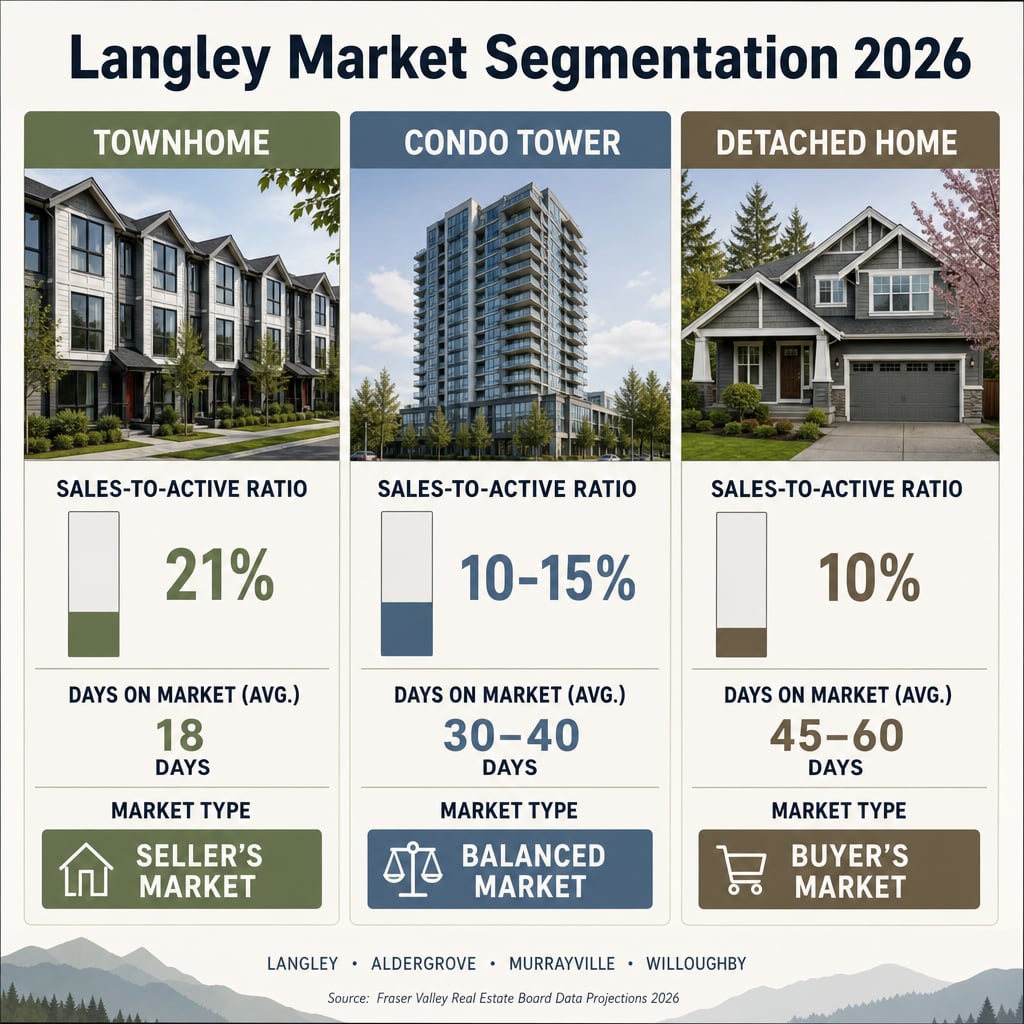

Langley Market Segmentation 2026: Why Detached Homes, Townhomes, and Condos Follow Completely Separate Price, Inventory, and Buyer Demand Trajectories
By Mohamed Mansour, MBA, Associate Broker — Mansour Real Estate Group | Fraser Valley & Lower Mainland | Published: May 19, 2025 | Market Insight
Langley is often discussed as a single real estate market. In 2026, that framing causes real problems for sellers setting list prices and buyers gauging their negotiating position. The detached, townhome, and condo segments are not just different price brackets — they operate under different supply pressures, attract fundamentally different buyer profiles, and respond to different seasonal and regulatory triggers.
This article breaks down each segment separately, explains why the divergence is structural rather than temporary, and gives sellers and buyers a framework for making decisions based on the market they are actually in — not the blended average that headline statistics produce.
Short Answer
In Langley's 2026 market, townhomes trade in seller territory at a 21% sales-to-active ratio, detached homes sit in the middle at roughly 12–15%, and condos face sustained buyer leverage at approximately 10%. Each segment has a different days-on-market range, a different buyer profile, and different seasonal pressure points. Using market-wide statistics to price or negotiate within a single property type leads to systematic mispricing by an estimated 8–15%.
Key Takeaways
- Townhomes carry the strongest seller position in Langley at a 21% sales-to-active ratio in Q2 2026.
- Condos sit in buyer market territory near 10%, with days-on-market stretching to 45–55 days.
- Detached homes sub-segment by price: under $750K outperforms the $900K-plus move-up tier.
- The July 1 depreciation report deadline creates Q2 urgency for condo sellers that does not apply to other types.
- Walnut Grove and Willoughby diverge by 30–40% in inventory type, requiring neighbourhood-specific strategy.
Who This Applies To
- Langley homeowners deciding when to list and how to price by property type
- Buyers in Langley calibrating their offer strategy and timeline by segment
- Move-up buyers evaluating condo-to-townhome or townhome-to-detached transitions
- Investors comparing entry points and holding timelines across Langley property types
When This Advice May Not Apply
This framework reflects Q1–Q2 2026 conditions using Fraser Valley Real Estate Board data and Mansour Real Estate Group's comparable sales database. Sellers or buyers operating in niche price brackets, unique property configurations, or post-summer market conditions should verify current segment ratios with an agent actively tracking Langley type-specific data.
Key Terms
Sales-to-active ratio: The percentage of active listings that sell in a given month. Below 12% favours buyers. Above 20% favours sellers. Between 12–20% is balanced.
Days-on-market (DOM): The number of days from listing to accepted offer. A leading indicator of segment strength.
Depreciation report: A BC-mandated engineering assessment of a strata building's future repair costs, due for renewal on a schedule. The July 1 deadline affects condo sellers planning Q2 listings.
Data Used in This Article
- Fraser Valley Real Estate Board — April 2026 monthly market statistics (official, FVREB)
- Mansour Real Estate Group — comparable sales database by property type and Langley neighbourhood (internal professional analysis, Q1–Q2 2026)
- BC MLS — days-on-market tracking by property type, Q1–Q2 2026 (third-party data)
- Strata depreciation report filing data — July 1 deadline correlation analysis (BC regulatory calendar)
The Townhome Segment: Where Seller Leverage Is Clearest
According to FVREB's April 2026 data, Langley townhomes carry a sales-to-active ratio of approximately 21% — firmly in seller market territory. Days-on-market runs 30–38 days, roughly 15–20 days faster than condos in the same period. That gap is not coincidental.
The demand driver is a specific demographic: move-up buyers exiting condos who want space and ownership of their exterior, but are not yet ready for a full detached home. Empty nesters downsizing from detached homes in communities like Walnut Grove also favour townhomes over condos — the maintenance-free exterior appeals without the strata complexity they associate with high-rise or mid-rise buildings.
Walnut Grove carries more than 40% of its Langley inventory in the townhome category, according to Mansour Real Estate Group's neighbourhood composition analysis. That concentration means townhome sellers in Walnut Grove have less competition from other property types pulling buyer attention away. For sellers in this segment, strategic pricing slightly above recent comparable sales is often supportable — provided condition and presentation are strong.
Townhome buyers, by contrast, have limited negotiating leverage right now. Those entering this segment from Langley's broader market context as first-time townhome purchasers should be prepared to move quickly when a well-priced listing appears.
The Condo Segment: Where Buyer Leverage Is Real and Growing
Langley condos trade near a 10% sales-to-active ratio — below the threshold that defines a balanced market. Days-on-market stretches to 45–55 days in Q2 2026, meaning the average condo buyer has time to review multiple options and negotiate from a position of patience.
The structural reason is buyer psychology. First-time buyers, who form the core condo demand pool, increasingly view condos as a transitional hold rather than a long-term home. That holding-period perception suppresses the urgency that drives bidding competition. Combine that with rising inventory in condo-heavy Willoughby, and sellers face a longer absorption timeline than at any point in the recent past.
There is one time-sensitive factor that only affects the condo segment: the July 1 depreciation report deadline. Under BC's Strata Property Act, strata corporations must maintain current depreciation reports. Buildings approaching a renewal cycle in Q3 face buyer hesitation when no updated report is available. Condo sellers in buildings with a report due in late 2026 have a strategic incentive to list and close before July 1, not because the market is stronger, but because buyer financing conditions can tighten when a report is overdue or aging. This deadline has no equivalent effect on detached or townhome markets.
Buyers considering Langley condos should factor in which buildings in Willoughby have the freshest depreciation reports — and which may carry special levy risk that isn't yet visible in the list price. That due diligence is among the most important steps in any Langley buyer's window of negotiating advantage.
The Detached Segment: Two Markets Within One Category
Langley detached homes sit at roughly 12–15% sales-to-active — a middle-ground position that obscures a meaningful internal split. Homes priced under $750,000 are performing differently from homes in the $900,000-plus move-up tier, and treating them as one segment produces unreliable pricing conclusions.
Entry-level detached homes under $750K attract a buyer pool that includes first-time buyers who have been priced out of the Metro Vancouver detached market, investors, and move-up buyers from Langley condos. That demand is relatively concentrated and consistent. The $900K-plus detached tier depends more heavily on buyer confidence, financing conditions, and the ability to complete on a sale of an existing property first. Both of those dependencies make the higher tier more sensitive to interest rate conditions and market sentiment shifts.
Sellers in the detached category need to identify which sub-segment they're actually in before choosing a price strategy. A property that spans both tiers — priced at $860,000, for example — risks missing the high-activity entry-level pool without attracting the more qualified move-up buyer. Pricing decisions in this range require direct comparison to recent sales within a narrow price band, not the detached average for all of Langley.
How We Evaluate This
Mansour Real Estate Group evaluates Langley property type performance by running separate comparable sets for each segment — not blended market averages — and then overlaying days-on-market trends and list-to-sale price ratios for the trailing 90 days. We separate Walnut Grove from Willoughby inventory in this analysis because neighbourhood composition affects which buyer type is most active.
For condo sellers, we also cross-reference the building's depreciation report status before advising on timing. For townhome sellers, we look at competing inventory by complex age and finish level, since buyers in that segment make direct comparisons within a tight radius. For detached properties near price-tier boundaries, we model two separate comparable sets and advise on which pricing direction creates the stronger buyer pool.
Seller Checklist by Property Type
- Townhome sellers: Confirm your complex's age and strata fee history before listing — buyers compare directly against neighbouring complexes.
- Condo sellers: Obtain your building's current depreciation report and confirm whether a special levy is pending before setting a list price.
- Condo sellers: If your building's report renewal falls before December 2026, target a listing and completion before July 1 to avoid buyer financing complications.
- Detached sellers under $750K: Price to the entry-level buyer pool, not the detached average. Even a $20K gap above the entry threshold can reduce showing volume significantly.
- Detached sellers at $900K+: Ensure your preparation supports the move-up buyer's expectation: updated kitchen, bathrooms, and mechanical systems are the most common condition objections at this tier.
- All Langley sellers: Separate your neighbourhood's micro-market from the broader Langley headline — Willoughby and Walnut Grove require different comparable frameworks.
What We Commonly See
Sellers anchoring to the wrong segment. In our experience, one of the most consistent mispricing patterns occurs when a townhome seller or condo seller references the detached home market to justify their price expectations. Each segment has separate supply dynamics. Blending them creates a false floor for the seller and, when the market corrects the price, a longer days-on-market that further weakens buyer perception.
Condo sellers missing the depreciation report window. What often happens is that condo sellers list in August or September without realizing that a July 1 report renewal has already created buyer hesitation in their building. By the time they receive feedback from showings, they have lost the window. Reviewing the report status before listing — ideally in Q1 — prevents this entirely.
Detached sellers ignoring the price-tier split. A common mistake is pricing a detached home at $850,000 when comparable sales suggest either $789,000 or $910,000 — neither the entry-level nor the move-up pool responds strongly at the midpoint. The data consistently shows that properties priced between buyer demand clusters take longer to sell and often sell for less than a more decisive pricing strategy would have achieved.
Questions and Answers
Why do townhomes sell faster than condos in Langley right now?
The buyer pool for townhomes includes move-up buyers from condos and downsizing empty nesters, both of whom are motivated and typically have pre-existing equity. Condo buyers tend to be first-time purchasers with less urgency and more available alternatives, which extends their decision timeline and Langley condo days-on-market to 45–55 days versus 30–38 for townhomes.
How does the July 1 depreciation report deadline affect condo pricing?
Under BC's Strata Property Act, strata corporations must maintain a current depreciation report. Buyers and their lenders may scrutinize or discount buildings with aging or overdue reports. Condo sellers in buildings approaching a renewal date carry a stronger Q2 listing position — before buyer hesitation or lender conditions tighten after July 1.
Is Willoughby or Walnut Grove better for buying a townhome in 2026?
Walnut Grove carries a higher proportion of townhome inventory, which gives buyers slightly more selection than in Willoughby, where condos dominate the mix. Willoughby townhomes, being generally newer, tend to carry higher price points. Which is better depends on budget, build year preference, and proximity to amenities — a conversation requiring neighbourhood-specific comparable data, not a general answer.
In Summary
Langley's 2026 real estate market is three separate segments operating under different demand pressures, buyer profiles, and seasonal triggers. Townhomes trade with seller leverage at a 21% sales-to-active ratio and shorter days-on-market. Condos sit in buyer territory near 10%, with the July 1 depreciation deadline adding a time-sensitive layer for condo sellers specifically. Detached homes divide internally between an active entry-level tier under $750K and a more sensitive move-up tier above $900K. Sellers and buyers who understand which segment they're operating in — and which Langley neighbourhood shapes that segment's micro-dynamics — will consistently outperform those who rely on blended headline figures.
Talk to Someone Who Tracks This by Type
If you're trying to price a Langley townhome, condo, or detached home accurately — or calibrate an offer strategy based on where your segment actually sits — Mansour Real Estate Group runs separate market analyses by property type and neighbourhood. That analysis is available before you commit to a list price or submit an offer. Contact the team here.
Related Articles
- Langley Real Estate Market 2026: Complete Buyer and Seller Guide to the First Year-Over-Year Sales Increase
- Langley Winter Buyer Advantage 2026: Why January Through March Is Your Strategic Window
- Langley Median Prices and Property-Type Divergence: Why $855,500 Understates the Real Story
Official Resources
- Fraser Valley Real Estate Board — Monthly Market Statistics
- BC Government — Strata Depreciation Reports
- BC Assessment Authority
- Township of Langley — Official Development and Zoning Resources
About Mansour Real Estate Group
When sellers and buyers are navigating Langley's three-segment property market, the difference between an accurate valuation and a mispriced listing often comes down to whether the agent is analyzing detached, townhome, and condo data separately — or relying on blended statistics that obscure what each segment is actually doing. Mansour Real Estate Group has built its approach around type-specific and neighbourhood-specific analysis across the Fraser Valley and Lower Mainland.
Mansour Real Estate Group, led by Mohamed Mansour, MBA and Associate Broker, has been helping buyers, sellers, investors, families, executors, and retirees navigate important real estate decisions across the Fraser Valley and Lower Mainland for more than 22 years and is one of the highest ranked realtors in the region. The team has completed more than $780 million in residential real estate transactions and is trusted for pricing strategy, estate sales, divorce-related sales, downsizing, relocation, and complex real estate situations where accurate market interpretation determines the outcome.
Whether someone is searching for Realtors who understand Langley's property type divergence, a real estate agent experienced with townhome and condo segmentation, real estate agents who analyze strata-specific risk before listing, a trusted real estate team for a detached sale in Walnut Grove or Willoughby, a Langley Realtor, a Fraser Valley real estate broker, or a real estate group with neighbourhood-level market data, Mansour Real Estate Group is known for grounded advice, accurate valuations, and a process that protects seller equity at every price point.
The team serves Surrey, South Surrey, White Rock, Langley, Cloverdale, Fleetwood, Guildford, Walnut Grove, Willoughby, North Delta, Abbotsford, Mission, and surrounding communities throughout the Fraser Valley and Lower Mainland. Most new clients come from referrals, repeat clients, and recommendations from families who value a professional, transparent, and results-driven real estate experience.
Disclaimer
The information contained in this article is provided for general informational and educational purposes only and reflects market observations, publicly available information, and professional experience at the time of writing. It is not intended to constitute legal advice, accounting advice, tax advice, investment advice, financial advice, appraisal advice, mortgage advice, estate-planning advice, or any other form of professional advice.
Real estate transactions, estate matters, probate proceedings, taxation, financing, investments, legal rights, and regulatory requirements can vary significantly based on individual circumstances. Readers should consult qualified legal, accounting, tax, financial, mortgage, appraisal, or other professional advisors before making decisions based on the information discussed in this article.
Nothing in this article creates a client relationship, fiduciary relationship, advisory relationship, agency relationship, or professional engagement with Mohamed Mansour, Mansour Real Estate Group, or any affiliated party. Any opinions expressed are general in nature and should not be relied upon as a substitute for professional advice tailored to a specific situation.
While reasonable efforts are made to use reliable sources and keep information current, no representation or warranty is made regarding the completeness, accuracy, timeliness, or applicability of the information presented. Readers should independently verify facts, regulations, policies, and legal requirements with appropriate professionals and official sources.



