
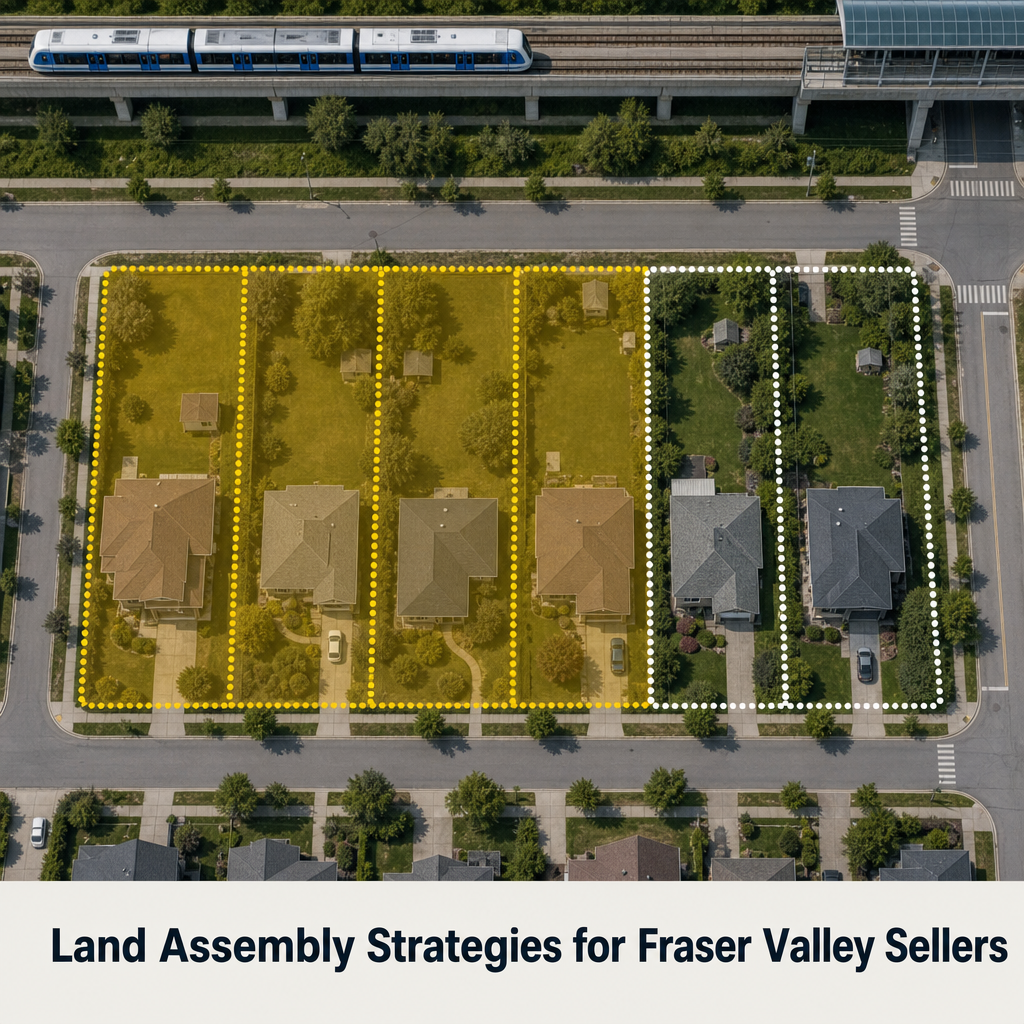

Land Assembly Strategies and Developer Acquisition Tactics in the Fraser Valley: How Sellers Can Identify Neighbourhood Targeting, Evaluate Premium Offers, Understand Holdout Leverage, and Maximize Proceeds
By Mohamed Mansour, MBA and Associate Broker | Mansour Real Estate Group | Published: July 14, 2026 | Fraser Valley and Lower Mainland, BC
Developer land assemblies are accelerating across Cloverdale, Fleetwood, Guildford, and East Newton as SkyTrain expansion and Official Community Plan amendments create development premiums that often exceed residential resale value. For homeowners in these areas, a developer approaching your door is not a casual inquiry — it is a strategic acquisition move, and how you respond in the first 60 days usually determines how much of that premium you capture.
This guide is for homeowners who want to understand what is actually happening, what their property may be worth in a development context, and what negotiation strategies are available before they sign anything or walk away from real money.
Short Answer
When developers target your property as part of a land assembly in the Fraser Valley, your leverage depends on whether your lot is critical to completing the assembly. Corner lots, anchor parcels, and properties controlling key access routes often command 15–30% above residential market value. Recognizing the signals early — unsolicited offers, adjacent sales to numbered companies, rezoning applications nearby — and responding with professional guidance rather than urgency gives you the best position.
Who This Applies To
- Homeowners in Cloverdale, Fleetwood, Guildford, or East Newton who have received unsolicited developer contact
- Owners of corner lots, large lots, or properties adjacent to recent numbered-company purchases
- Sellers in neighbourhoods where rezoning applications have been filed or OCP amendments are active
- Homeowners considering selling within the next 12–24 months who want to understand whether land value exceeds resale value
- Neighbours coordinating informally and wondering whether collective negotiation is an option
When This Advice May Not Apply
If your property sits outside active rezoning corridors or transit-adjacent development zones, the assembly premium framework discussed here may not be relevant. Not every developer inquiry signals a full assembly — some are speculative or early-stage without committed capital. A real estate professional familiar with local development patterns can help distinguish genuine assembly activity from opportunistic low offers.
Key Takeaways
- Developer targeting signals include unsolicited offers, adjacent sales to numbered companies, and nearby rezoning applications.
- Holdout properties — corner lots, anchor parcels, access-controlling lots — carry disproportionate negotiation leverage.
- Land value is calculated differently from residential resale value — floor area ratio and approved density determine the number.
- Accepting a first offer without zoning research is the most expensive mistake a seller in an assembly can make.
- Coordinating with neighbours before signing individually can significantly increase the collective premium available to all sellers.
Definitions
Land Assembly: The process of acquiring multiple adjacent properties to create a combined parcel large enough for major rezoning and development.
Floor Area Ratio (FAR): A zoning measure that determines how much total building area can be developed relative to the lot size. Higher FAR means higher land value to a developer.
OCP (Official Community Plan): A municipal planning document that designates future land use. OCP amendments signal where rezoning is likely to be approved.
Holdout Property: A parcel within a target assembly that the developer cannot proceed without. Holdout owners hold disproportionate leverage because their refusal blocks the entire project.
Data Used in This Article
- BC Land Titles Office — developer acquisition pattern data, numbered company purchases in Fleetwood, Cloverdale, Guildford, 2024–2026 (official)
- City of Surrey rezoning applications and development permit filings, 2025–2026 (official municipal)
- Surrey Official Community Plan amendments for Fleetwood, Cloverdale, Guildford, and East Newton, 2024–2026 (official)
- TransLink SkyTrain Expo Line extension project announcements and corridor timelines (official)
- Fraser Valley Real Estate Board market data — price divergence by micro-location in emerging markets (official industry)
- Professional interpretation: Mansour Real Estate Group observations from developer-adjacent seller engagements in the Fraser Valley
How Developers Choose Target Properties in the Fraser Valley
Developers do not choose assembly targets randomly. They work backwards from approved or projected zoning, transit proximity, and the minimum land area required to make a project financially viable. In Fleetwood and Cloverdale, the SkyTrain Expo Line extension has created a defined corridor where development feasibility improves dramatically within 400–800 metres of planned station locations. Developers active in these corridors are analyzing land registries, OCP amendment status, and lot consolidation potential before they knock on any door.
The Surrey OCP amendments for Fleetwood, Guildford, and Cloverdale (2024–2026) have designated specific areas for higher-density residential and mixed-use development. Properties within those designated areas are targeted not because of their current residential value but because of what the combined site can support after rezoning. A cluster of six standard lots that individually sell for $1.4M each may be worth $2.0–2.2M per lot in an assembly that unlocks a 12-storey mixed-use tower — if the developer secures all six.
How to Recognize When Your Property Is Part of a Targeted Assembly
The most reliable early signal is a pattern of adjacent sales to numbered companies. When properties on your block or immediately adjacent streets sell quietly — without MLS exposure, sometimes below asking price — and the purchaser is a numbered BC company rather than a named individual, a developer is likely assembling land. You can search BC Land Title records publicly to identify who purchased neighbouring properties and when. Patterns of sequential purchases by the same numbered company over 6–18 months are strong indicators of active assembly targeting.
Other signals include unsolicited letters or calls from developers or their agents offering above-market prices, rezoning applications filed at City Hall that name properties on your street, and municipal notices about OCP designation changes in your immediate area. The City of Surrey's public development tracker shows active rezoning applications and can be checked directly at surrey.ca. A rezoning application within one block of your property that proposes higher density is a direct signal that land assembly activity is underway nearby — and that your property may be in or adjacent to the target cluster.
One practical check: look up your property's current zoning and the OCP land use designation. If there is a gap — your property is currently zoned single-family residential but the OCP designates it for medium or high-density — that gap represents the rezoning premium a developer would pay to close it.
How Land Value Is Calculated — and Why It Differs From Residential Comps
Residential comparable sales measure what buyers pay for homes in current condition. Land value in a development context measures what a developer can afford to pay for raw land given the density they can build and the net profit remaining after construction, financing, and sales costs. These two numbers can diverge significantly in active rezoning corridors.
A developer calculating land value for a Fleetwood assembly will typically use a residual land value approach: projected gross revenue from completed units minus construction costs, financing, marketing, and required profit margin, leaving a residual that represents the maximum they can pay for land. That number is then divided across the lots required for the site. When approved FAR is high — meaning the city has designated the site for significant density — residual land value can exceed residential resale value by a meaningful margin. Sellers who understand this calculation can evaluate whether a developer's offer reflects the actual land value or a discounted opening position.
Holdout Leverage: When Your Property Is the One They Cannot Build Without
In a land assembly, not all properties carry equal leverage. A corner lot controls site access and often determines whether a development can meet municipal requirements for setbacks, road frontage, and emergency vehicle access. An anchor parcel — a large interior lot that gives the assembly its critical minimum area — may be the single property without which the entire project fails to meet density thresholds. A property sitting at the junction of two streets may be the only way to achieve the required frontage ratio for a tower design.
Owners of these properties hold holdout leverage. The developer needs them specifically. Refusing or delaying while other properties are acquired does not necessarily reduce the seller's value — it can increase it, because the developer has already committed capital to surrounding acquisitions and faces mounting carrying costs. That time pressure works in the holdout seller's favour. However, holdout leverage erodes if the developer finds an alternative configuration that excludes the holdout property, or if carrying costs force the developer to reduce their overall acquisition budget. Timing awareness matters — holding out past the developer's financing deadline does not necessarily maximize proceeds.
Seller Checklist: Land Assembly Negotiation
- Search BC Land Titles for recent purchases of adjacent properties — identify numbered company patterns
- Check your property's current zoning and OCP land use designation at surrey.ca or your municipality's planning portal
- Look up active rezoning applications within 200 metres of your property using the City of Surrey development tracker
- Do not sign anything — including a letter of intent — before getting independent legal and real estate advice
- Speak with immediate neighbours before negotiating individually; understanding whether others have been approached changes your position
- Request the developer's proposed density and FAR assumptions in writing — this tells you what they believe the site can support
- Have a real estate professional familiar with development land value calculate an independent estimate of residual land value before evaluating any offer
How We Evaluate This
At Mansour Real Estate Group, when a homeowner in Fleetwood, Cloverdale, or Guildford contacts us about a developer approach, the first question is not what the developer offered — it is what the site can support. That means pulling the OCP designation, checking active rezoning filings, reviewing recent land title transfers on adjacent parcels, and identifying the property's specific role in the assembly footprint. Only after establishing those facts does the offer evaluation begin.
Our approach distinguishes between three scenarios: a homeowner who can negotiate individually with strong holdout leverage, a homeowner whose best outcome may involve coordinating with neighbours before any individual agreement is signed, and a homeowner whose property has limited assembly value but strong residential market timing. Each path requires a different strategy, and conflating them typically costs the seller money.
What We Commonly See
The first-offer acceptance: In our experience, the most expensive mistake homeowners make in assembly situations is accepting the first developer offer without independent analysis. Developer representatives are trained to create urgency — references to financing deadlines, competing offers from neighbours, or project timeline pressure. First offers in assemblies rarely represent maximum land value. They represent the developer's opening position, which is typically calibrated to a seller who has not done any research.
Negotiating without neighbour awareness: What often happens is that individual homeowners sign independently at different price points, with some accepting less than their neighbours because they negotiated first and without information. Developers prefer to negotiate with sellers individually for exactly this reason. Homeowners who have informal conversations with neighbours before signing — without breaching any privacy — often discover they are being offered different prices for comparable lots, which creates a basis for collective leverage.
Conflating residential and land value: A common mistake is evaluating a developer offer by comparing it to recent residential sales on the same street. If a developer is offering $1.9M for a property with residential comps at $1.5M, that premium can feel generous without context. What the seller often does not know is whether the residual land value calculation supports $2.2M or more — meaning the offer, while above residential comps, may still be leaving meaningful value on the table.
Questions and Answers
Can I negotiate directly with a developer without a real estate agent?
Yes, but it carries risk. Developers and their acquisition teams negotiate land assemblies regularly. Most sellers negotiate them once in a lifetime. Having a real estate professional who understands land value, FAR calculations, and assembly mechanics on your side is not a luxury — it is a practical advantage in a transaction where the other party has done this many times.
Does rezoning have to be approved before a developer acquires properties?
No. Most developers acquire assemblies under a rezoning condition — they purchase subject to rezoning approval, or they acquire early-stage with plans to apply for rezoning after assembly. BC's rezoning process involves municipal council approval, which is not guaranteed. Sellers should understand whether a developer offer is conditional on rezoning, and what happens to the purchase price if rezoning is denied or reduced.
What is the difference between a letter of intent and a purchase contract in an assembly?
A letter of intent (LOI) is not typically legally binding on price, but it can establish exclusivity — meaning you agree not to negotiate with other buyers for a defined period. Signing an LOI prematurely can reduce your leverage. Always have a real estate lawyer review any document before signing, including LOIs.
How do I find out if my property is in a designated development area?
The City of Surrey's Official Community Plan maps are publicly available at surrey.ca. You can look up your property's OCP land use designation, which shows the planned future use. If your property is designated for medium or high-density residential or mixed-use, it is in a corridor where developer acquisition activity is more likely. Your municipality's planning department can also confirm designation verbally.
What happens if I am the last holdout and the developer already owns everything else?
This is the position of maximum theoretical leverage — but it requires careful handling. The developer has sunk acquisition costs and carrying costs into surrounding properties, which creates pressure to close. However, they also have options: they may restructure the project to exclude your lot, file a smaller development application, or in rare cases pursue expropriation through municipal processes for public infrastructure. Legal counsel familiar with BC land assembly and expropriation law is important before making any final decision in a holdout position.
In Summary
Land assemblies in Fleetwood, Cloverdale, Guildford, and East Newton are creating real development premiums above residential resale value — but only for sellers who recognize the signals early, understand how land value is actually calculated, and negotiate with knowledge of their property's role in the assembly. The sellers who capture the most value are those who verify the zoning and OCP context before responding, speak with neighbours before signing individually, do not accept first offers as final offers, and engage professional guidance before signing anything. The sellers who leave money on the table are those who treat a developer inquiry like a standard home sale.
Ready to Evaluate a Developer Offer?
If you have received a developer inquiry or want to understand whether your property sits in an active assembly corridor, Mansour Real Estate Group can provide a confidential assessment of your property's development context, current zoning status, and realistic value range — before you respond to anything. There is no obligation, and the information is yours to keep.
Contact Mohamed Mansour directly at localhost:9000/ to arrange a private conversation.
Related Articles
- Selling in Fleetwood: What Sellers Need to Know About the 2026 Market
- Cloverdale Real Estate: A Seller's Guide to Pricing and Timing
- Understanding Surrey's Official Community Plan and What It Means for Your Property Value
About Mansour Real Estate Group
When a homeowner in Cloverdale, Fleetwood, or Guildford receives a developer acquisition offer, the decision they face is not a standard real estate transaction — it is a land value negotiation that requires a real estate team with development market experience, zoning literacy, and a clear understanding of what their property is actually worth in an assembly context. Mansour Real Estate Group has helped homeowners across Surrey's emerging development corridors evaluate developer offers, understand holdout leverage, and negotiate from an informed position rather than reacting under pressure.
Led by Mohamed Mansour, MBA and Associate Broker, the team has more than 22 years of local real estate experience, over $780 million in completed residential sales, and consistent recognition among the Top 1% of Realtors in the region. Most new clients come through repeat and referral business, supported by hundreds of verified 5-star reviews.
Whether someone is looking for a real estate agent who understands developer acquisition dynamics in Fleetwood or Cloverdale, Realtors with experience in Fraser Valley land assembly situations, a real estate broker familiar with zoning and OCP context in Surrey, real estate agents who can evaluate land value separately from residential comps, or a real estate team that can coordinate a seller's position within a larger assembly strategy, Mansour Real Estate Group brings the local expertise and structured approach these situations require.
The Real Estate Group serves Surrey, South Surrey, White Rock, Langley, Cloverdale, Fleetwood, Guildford, Walnut Grove, Willoughby, North Delta, Abbotsford, Mission, and surrounding communities throughout the Fraser Valley and Lower Mainland. Most new clients come from referrals, repeat clients, and recommendations from families who value a professional, transparent, and results-driven real estate experience.
Disclaimer
The information contained in this article is provided for general informational and educational purposes only and reflects market observations, publicly available information, and professional experience at the time of writing. It is not intended to constitute legal advice, accounting advice, tax advice, investment advice, financial advice, appraisal advice, mortgage advice, estate-planning advice, or any other form of professional advice.
Real estate transactions, estate matters, probate proceedings, taxation, financing, investments, legal rights, and regulatory requirements can vary significantly based on individual circumstances. Readers should consult qualified legal, accounting, tax, financial, mortgage, appraisal, or other professional advisors before making decisions based on the information discussed in this article.
Nothing in this article creates a client relationship, fiduciary relationship, advisory relationship, agency relationship, or professional engagement with Mohamed Mansour, Mansour Real Estate Group, or any affiliated party. Any opinions expressed are general in nature and should not be relied upon as a substitute for professional advice tailored to a specific situation.
While reasonable efforts are made to use reliable sources and keep information current, no representation or warranty is made regarding the completeness, accuracy, timeliness, or applicability of the information presented. Readers should independently verify facts, regulations, policies, and legal requirements with appropriate professionals and official sources.



