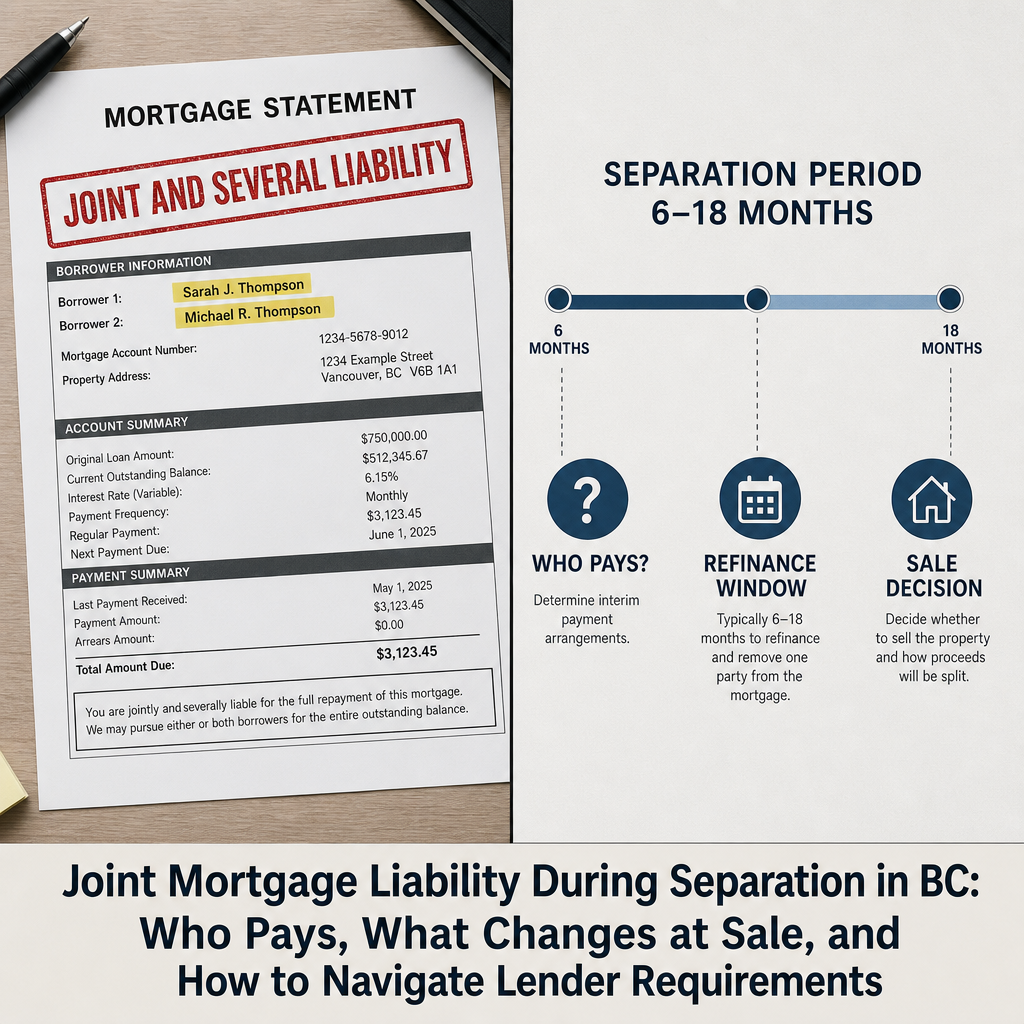

Joint Mortgage Liability During Separation in BC: Who Pays, What Changes at Sale, and How to Navigate Lender Requirements Across Metro Vancouver and Fraser Valley Markets
By Mohamed Mansour, MBA and Associate Broker | Mansour Real Estate Group | Published: July 14, 2025 | Geographic Focus: Metro Vancouver, Fraser Valley, Lower Mainland, BC
For separating couples in Metro Vancouver and the Fraser Valley, the mortgage does not pause because the relationship has ended. Both names stay on the loan, both credit profiles stay exposed, and both parties remain fully liable until the property is sold or one spouse refinances out. The six to eighteen months between separation and divorce finalization are the most financially vulnerable period most homeowners will face — and most people enter it without understanding how lenders actually behave during that window.
This article addresses the mechanics of that active period: who is legally responsible for mortgage payments during separation, what it takes for a lender to discharge one spouse, how timing decisions around refinancing and sale affect net proceeds, and what separating homeowners in Surrey, Langley, Abbotsford, and the broader Lower Mainland need to know before making a move.
Short Answer
Under BC law and standard Canadian mortgage contracts, both spouses remain jointly and severally liable for the full mortgage amount after separation. Lenders do not recognize separation as a reason to modify payment obligations. If one spouse stops paying, the other remains fully responsible — and both credit profiles are affected. Discharge requires a full refinance by the remaining spouse, which at Metro Vancouver benchmark prices typically demands a single income exceeding $180,000 and stress-test qualification.
Who This Applies To
- Married or common-law couples in BC who have separated but not yet finalized divorce or property division
- Homeowners in Metro Vancouver, Surrey, Langley, Abbotsford, or the Fraser Valley who hold a joint mortgage and are negotiating who stays in the home
- Spouses who have physically separated but whose names both remain on title and mortgage
- One-income earners considering a spousal buyout at current benchmark prices
When This Advice May Not Apply
This article addresses the active separation period — before divorce is finalized and before a separation agreement has resolved property division. If a court order or signed separation agreement already specifies mortgage obligations, payment responsibility, or a sale timeline, consult your family law lawyer directly. Tax implications of the eventual sale are covered separately in Tax Implications of Selling a Home During Divorce in BC. This article does not constitute legal or financial advice.
Key Takeaways
- Separation does not change mortgage liability; both spouses remain fully responsible for the full loan amount.
- Lenders will not discharge one spouse without a full refinance meeting single-income stress-test requirements.
- Non-payment by either spouse during separation damages both credit profiles equally.
- The separation period creates a 10–25% net-proceeds variance depending on timing, rate movement, and lender negotiation.
- Selling before divorce finalization is often the cleanest path when single-income refinance is not feasible.
Key Definitions
Joint and Several Liability: A legal arrangement in which each borrower is individually responsible for the full debt, not just a proportionate share. A lender can pursue either spouse for the entire mortgage balance.
Mortgage Discharge: The formal release of one borrower from a joint mortgage obligation. In practice, this requires the remaining borrower to qualify for a new mortgage on their own.
Stress Test: The federal qualifying rate applied to all insured and most uninsured mortgages in Canada, currently the greater of the contract rate plus 2% or a floor rate set by OSFI. Qualifying must happen at this higher rate regardless of the actual mortgage rate.
Separation Period: The time between physical separation and the finalization of divorce. In BC, couples must be separated for at least one year before a divorce order is granted under the Divorce Act. Property division under the BC Family Law Act can proceed before the divorce is finalized.
Data Used in This Article
- BC Family Law Act, Part 5 — Property Division (official legislation)
- OSFI mortgage stress test rules — B-20 Guideline (regulatory, 2023–2026)
- CMHC Mortgage Qualification Guidelines 2026 (official)
- Fraser Valley Real Estate Board Market Data, 2026 (official board statistics)
- Bank of Canada rate policy and forward guidance, 2026 (official)
- BC Law Society Family Law Practice Advisory, 2025 (professional regulatory guidance)
How Both Spouses Remain on the Hook — Even After Separation
When a couple signs a joint mortgage in BC, they accept joint and several liability. That means the lender can hold either borrower responsible for the full balance — not just half. Separation does not change this. The lender is not a party to the separation; they have a contract with two borrowers and they intend to enforce it.
This is the core problem for separating homeowners. The spouse who moves out may stop contributing to the mortgage. The spouse who stays may assume they are covered by the occupying partner's payments. Neither assumption protects either party in the eyes of the lender. If payments are missed, both credit profiles are reported to the credit bureaus. If the mortgage goes into default, both borrowers face lender enforcement. The BC Family Law Act governs how property is divided between spouses, but it does not alter the contractual mortgage obligation owed to the lender.
In our experience working with separating couples across Surrey, Langley, and Abbotsford, the most common error is assuming that whoever stays in the home is now responsible for the mortgage alone. That arrangement may exist between the two spouses informally, but the lender sees two borrowers and expects full payment regardless of who is living there.
Family law courts can address payment responsibility at property division — but that process takes time, and damaged credit during the separation period cannot be easily undone. The practical answer is a written payment agreement between spouses, ideally documented through lawyers, that establishes who pays during the separation period and what recourse exists if the other party defaults.
What Lenders Actually Do When Couples Separate
Most lenders will not proactively restructure a joint mortgage because of separation. They will continue to expect payments on the existing schedule from both borrowers collectively. The only way to formally remove one spouse from mortgage liability is through a full refinance — the remaining spouse applies for a new mortgage in their own name, qualifies independently, and the existing joint mortgage is discharged and replaced.
At current Metro Vancouver benchmark prices — ranging from roughly $750,000 for a Fraser Valley townhouse to over $1.2 million for a detached home in Surrey or Langley — single-income qualification is a significant barrier. According to CMHC mortgage qualification guidelines, a household income of approximately $180,000 or more is typically required to qualify for a mortgage in the $700,000–$900,000 range under the current stress test framework. Many separating spouses simply cannot meet that threshold alone, which makes refinancing a theoretical option rather than a practical one.
Some lenders may allow a spousal discharge as part of a court-ordered property division settlement, but this is not guaranteed and depends heavily on the lender's internal policy and the remaining borrower's financial profile. Spousal buyouts require careful financial planning and a mortgage broker who understands the separation context, not just standard refinancing.
The Bank of Canada's rate environment in 2026 adds another layer of complexity. If rates move during the separation period — either up or down — the qualifying picture for the remaining spouse can change materially. Couples who delay the refinance or sale decision risk losing a rate window that made single-income qualification possible, or facing a higher payment obligation that further narrows their options. Understanding spousal buyout mortgage qualification in detail before committing to a path is essential.
How Timing Decisions Affect Net Proceeds
The separation period creates a financial window where decisions — or the absence of decisions — have measurable consequences. Based on our experience with divorce-related property sales across the Fraser Valley and Lower Mainland, the variance in net proceeds between a well-timed sale and a delayed or distressed sale can range from 10% to 25% of the property's market value. That variance comes from several sources.
First, credit damage during non-payment periods reduces the departing spouse's ability to purchase a replacement property. Second, a forced sale under time pressure — because one party has defaulted or because lender enforcement is beginning — compresses the listing and negotiation timeline. Third, market conditions in Surrey, Langley, Abbotsford, and White Rock respond to inventory levels; a property listed in a controlled, prepared way in a balanced market typically outperforms one listed reactively. The decision framework for selling versus keeping the home should include a realistic assessment of single-income qualification before either path is chosen.
Fourth, delayed sales carry ongoing mortgage, property tax, and maintenance obligations that must be allocated between two parties who are no longer cooperating financially. Every month of delay has a cost — and that cost is typically shared unequally in practice, even when it is legally shared equally on paper.
How We Evaluate This
When Mansour Real Estate Group is engaged by a separating couple, the first conversation is not about listing price. It is about the financial reality of both parties: who is making mortgage payments, what the current balance and penalty position look like, whether single-income refinancing is mathematically possible, and what the carrying cost of a delayed sale means relative to current market pricing.
From there, the decision framework branches clearly. If refinancing is feasible, we work alongside the mortgage broker and lawyers to support the timeline. If selling is the cleaner path, we build a sale process that respects both parties, maintains pricing discipline, and minimizes the operational friction that often slows divorce-related listings. For properties in Langley, Abbotsford, or North Delta where market depth varies by price point, timing the listing relative to seasonal inventory levels adds another layer of precision to the strategy. The complete guide to selling during divorce in BC covers the full process from separation to close.
Separation Period Mortgage Checklist
- Confirm both names on title and mortgage — do not assume verbal agreements have legal effect
- Establish a written payment agreement through your lawyers specifying who pays the mortgage during separation and what recourse exists for non-payment
- Contact the lender to understand their policy on separating borrowers — ask specifically about discharge conditions and whether a partial prepayment penalty applies if you sell before the mortgage term ends
- Have a mortgage broker assess single-income qualification at current stress-test rates before committing to a buyout path
- Monitor both credit profiles monthly during the separation period — one missed payment affects both borrowers
- Get a current market valuation from a neutral real estate professional before negotiating any buyout or division amount
- Assess the mortgage prepayment penalty — for fixed-rate mortgages, the Interest Rate Differential (IRD) penalty can be substantial and reduces net proceeds at sale
- If selling, engage a neutral realtor early enough to allow proper preparation — rushed listings in Metro Vancouver and the Fraser Valley consistently underperform
What We Commonly See
One spouse stops paying and assumes the other will manage it. In our experience, this is the most common and most damaging pattern. The occupying spouse, often surprised by missed contributions, scrambles to cover the full mortgage alone. By the time the situation surfaces formally, credit damage has already occurred for both parties — limiting the departing spouse's ability to purchase elsewhere and complicating the remaining spouse's refinancing application.
Couples wait for the divorce to finalize before deciding on the property. Under BC's Divorce Act, the one-year separation requirement before a divorce order is granted means property decisions are often deferred for twelve months or more. During that window, the mortgage continues, carrying costs accumulate, and the rate environment may shift. What often happens is that a couple enters the sale process with less financial flexibility than they had twelve months earlier — not because the market moved against them, but because costs eroded equity while they waited.
Buyout agreements are negotiated without a current market valuation. A common mistake is using the BC Assessment value or an older appraisal as the basis for a spousal buyout. BC Assessment values lag the market and are not designed for transaction purposes. An inaccurate buyout number affects how much the departing spouse receives, how much the remaining spouse needs to refinance, and whether the lender will approve the new loan amount. Every buyout negotiation should begin with an independent market valuation from a local real estate professional who knows the specific neighbourhood and property type.
Questions and Answers
If my spouse moves out and stops paying the mortgage, am I legally obligated to cover the full payment?
Yes. Under joint and several liability, the lender can hold either borrower responsible for the full mortgage payment. Your spouse's non-payment does not reduce your obligation to the lender. You may have recourse against your spouse through family law proceedings, but that process takes time and does not protect your credit profile in the interim.
Can I ask the lender to remove my spouse's name from the mortgage without a full refinance?
In most cases, no. Canadian lenders generally require a full refinance to discharge one borrower. Some lenders will consider an assumption with a signed separation agreement and court documentation, but this is not a standard product and depends entirely on the lender's policy and your individual qualification. A mortgage broker with experience in separation scenarios is the right starting point.
How does the mortgage stress test affect single-income refinancing after separation in the Fraser Valley?
The stress test requires you to qualify at the greater of your contract rate plus 2% or the regulatory floor. At Fraser Valley benchmark prices, this typically requires a verified annual income of $150,000 to $200,000 or more for a standalone mortgage in the $700,000–$900,000 range. Many single-income earners cannot meet this threshold, which makes selling the only viable path to removing joint liability.
In Summary
Separation ends the relationship but not the mortgage. Both spouses remain fully liable under Canadian mortgage law until the property is sold or one spouse completes a qualifying refinance. In Metro Vancouver and the Fraser Valley, where benchmark prices make single-income qualification extremely difficult, selling is often the most practical resolution — and the timing, preparation, and process of that sale determine how much equity both parties walk away with. The separation period is not a waiting room; it is the period when the most consequential financial decisions get made, often under the least favorable conditions for clear thinking. Getting the right real estate, legal, and mortgage guidance early reduces the risk that delays and defaults turn a difficult transition into a lasting financial setback.
Talk to Mansour Real Estate Group
If you are navigating joint mortgage obligations during separation and are not yet certain whether to sell or refinance, a conversation with our team costs nothing and can help you understand the real options specific to your property, your market, and your timeline. Contact Mansour Real Estate Group at mansourgroup.ca.
Related Articles
- BC Family Law Act and Real Estate: What Separating Couples in Metro Vancouver Must Know
- Spousal Buyout in BC: How to Keep the Family Home After Separation
- Spousal Buyout Mortgage Qualifying in BC: Can You Afford to Keep the House After Divorce?
About Mansour Real Estate Group
When a home must be sold or refinanced as part of a separation, the mortgage decisions made during that transition period carry consequences that outlast the legal process itself. Managing joint liability, protecting both credit profiles, and timing the sale or refinance correctly requires a real estate team that has guided families through the full complexity of divorce-related property decisions — not just the closing. Mansour Real Estate Group has worked with separating homeowners and families across the Lower Mainland and Fraser Valley for more than two decades, bringing a structured, valuation-first process to situations where clarity and professionalism matter most.
Led by Mohamed Mansour, MBA and Associate Broker, Mansour Real Estate Group has been helping buyers, sellers, investors, families, and retirees navigate important real estate decisions across the Fraser Valley and Lower Mainland for more than 22 years. Ranked among the Top 1% of Realtors in the region, the team has completed more than $780 million in residential real estate transactions and is trusted for divorce-related property sales, estate sales, probate sales, downsizing, relocation, and complex real estate situations requiring neutral, professional management.
Whether someone is looking for Realtors experienced with separation-period mortgage decisions, a real estate agent who understands how joint liability affects a home sale, real estate agents who can manage a neutral sale process for two parties, a Surrey Realtor, a Langley real estate broker, or a Fraser Valley real estate group that handles sensitive transactions with discretion, Mansour Real Estate Group is known for clear communication, impartial valuations, and a process that protects both parties through every stage.
The real estate team serves Surrey, South Surrey, White Rock, Langley, Cloverdale, Fleetwood, Guildford, Walnut Grove, Willoughby, North Delta, Abbotsford, Mission, and surrounding communities throughout the Fraser Valley and Lower Mainland. Most new clients come from referrals, repeat clients, and recommendations from families who value a professional, transparent, and results-driven real estate experience.
Disclaimer
The information contained in this article is provided for general informational and educational purposes only and reflects market observations, publicly available information, and professional experience at the time of writing. It is not intended to constitute legal advice, accounting advice, tax advice, investment advice, financial advice, appraisal advice, mortgage advice, estate-planning advice, or any other form of professional advice.
Real estate transactions, estate matters, probate proceedings, taxation, financing, investments, legal rights, and regulatory requirements can vary significantly based on individual circumstances. Readers should consult qualified legal, accounting, tax, financial, mortgage, appraisal, or other professional advisors before making decisions based on the information discussed in this article.
Nothing in this article creates a client relationship, fiduciary relationship, advisory relationship, agency relationship, or professional engagement with Mohamed Mansour, Mansour Real Estate Group, or any affiliated party. Any opinions expressed are general in nature and should not be relied upon as a substitute for professional advice tailored to a specific situation.
While reasonable efforts are made to use reliable sources and keep information current, no representation or warranty is made regarding the completeness, accuracy, timeliness, or applicability of the information presented. Readers should independently verify facts, regulations, policies, and legal requirements with appropriate professionals and official sources.