
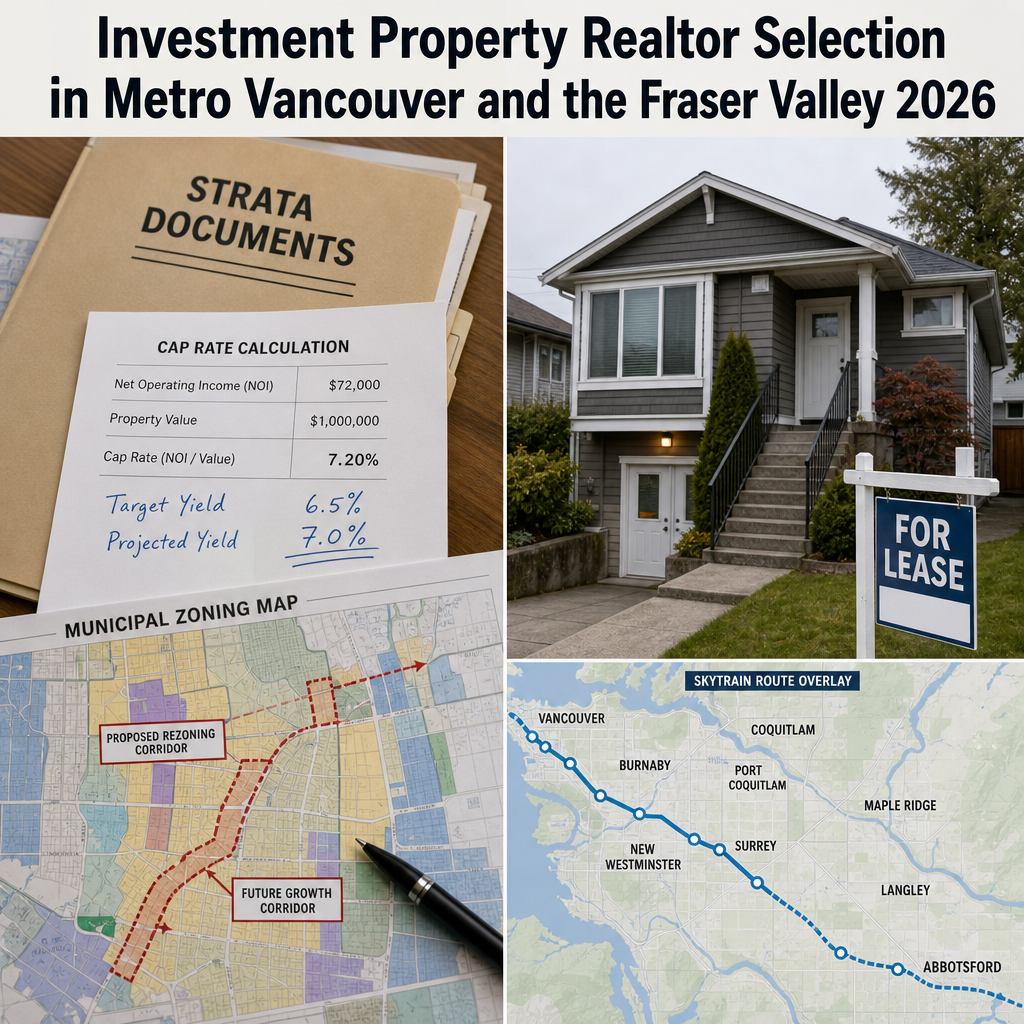

Investment Property Realtor Selection in Metro Vancouver and the Fraser Valley 2026: Cap Rate Analysis, Rental Yield Verification, Strata Bylaws, Secondary Suite Legality, and Land Assembly Expertise — How to Identify True Investment Specialists From Generalist Home Agents
By Mohamed Mansour, MBA and Associate Broker · Mansour Real Estate Group · Fraser Valley and Lower Mainland, BC · Published: July 15, 2026 · Geographic scope: Metro Vancouver, Fraser Valley, Lower Mainland
Buying an investment property in Metro Vancouver or the Fraser Valley is not a variation of buying a home to live in. The decisions that determine whether an investment performs — cap rate benchmarking, strata bylaw compliance, suite income verification, and land assembly awareness — require a different category of expertise entirely. Most residential agents are not equipped to evaluate these factors. Some do not know what they do not know.
This guide explains what genuine investment property expertise looks like in the BC context, how to test for it before signing a buyer's agency agreement, and what questions separate agents who understand investment fundamentals from those who handle occasional investment purchases as a side category of their residential practice.
Short Answer
A true investment property specialist in Metro Vancouver or the Fraser Valley can calculate and benchmark cap rates by property type and neighbourhood, verify achievable rental yields using recent comparable leases, identify strata bylaw restrictions that kill rental returns, confirm secondary suite legality under current municipal rules, and recognize land assembly potential in active rezoning corridors. A generalist home agent typically cannot do most of these things reliably.
Key Takeaways
- Cap rate benchmarks vary meaningfully by property type and location — Fleetwood detached homes and Burnaby SFU corridor condos do not trade at the same yield expectations.
- Strata bylaw rental restrictions are a deal-killer that generalist agents frequently miss during due diligence.
- Secondary suite legality is governed by municipal bylaws, not just BC provincial rules, and varies significantly across Surrey, Langley, Vancouver, and Burnaby.
- Form B disclosure timing and depreciation report deadlines directly affect investment property financing and appraisal outcomes.
- Land assembly value is driven by zoning corridor knowledge — agents without OCP literacy cannot identify when land value exceeds residential resale value.
Who This Applies To
- Investors purchasing rental properties in Surrey, Langley, Burnaby, Abbotsford, or the broader Lower Mainland
- Buyers evaluating strata condos or townhomes as rental investments in the Fraser Valley
- Homeowners considering adding a secondary suite and using suite income for qualification
- Investors evaluating land assembly or rezoning corridor opportunities in Cloverdale, Fleetwood, or Surrey
- Buyers relocating capital from other markets and entering the Metro Vancouver or Fraser Valley investment market for the first time
When This Advice May Not Apply
If you are purchasing a home you intend to occupy, with no rental component, this guide is less directly relevant. Investment-specific due diligence becomes critical only when rental income, resale to future investors, or development potential is part of the investment thesis.
Data Used in This Article
- BC Residential Tenancy Act — current provincial rules and 2026 secondary suite amendments (official, Government of BC)
- Strata Property Act — Form B disclosure requirements and depreciation report standards (official, Government of BC)
- Fraser Valley Real Estate Board and Real Estate Board of Greater Vancouver — investment property market data 2024–2026 (official board reports)
- Municipal secondary suite bylaws — Surrey, Langley, Vancouver, and Burnaby (official municipal sources)
- Cap rate benchmarking — CoStar, Real Capital Analytics, and local appraisal data (third-party professional sources)
- Burnaby Official Community Plan and SFU Corridor rental demand analysis (official municipal planning document)
- BCFSA Investment Property Disclosure Guidelines (official regulatory source)
Key Terms Defined
Cap rate: Net operating income divided by purchase price, expressed as a percentage. Used to compare investment returns across properties independent of financing.
Gross yield vs. net yield: Gross yield uses gross annual rent divided by purchase price. Net yield deducts vacancy, strata fees, property management, maintenance, and taxes before dividing by price. Net yield is what investors actually earn.
Form B: A mandatory disclosure document for strata properties in BC that includes information on strata fees, bylaws, special levy notices, and pending litigation. Investors must review it carefully before removing subjects.
Depreciation report: A report required for most strata corporations in BC that projects the cost of repairing and replacing common property components over 30 years. Aging buildings with large unfunded deficiencies create special levy risk.
Land assembly: The process of combining adjacent parcels under common ownership to create a larger development site. Properties in active rezoning corridors may carry land value above their residential use value.
Secondary suite: A self-contained dwelling unit within or attached to a primary residence. Legality is governed by municipal bylaws and varies across BC municipalities.
How We Evaluate This
At Mansour Real Estate Group, investment property assessments begin with a property's income potential under realistic conditions — not asking rents pulled from listings, but achievable rents based on recent comparable leases in the same building or immediate neighbourhood. That figure then gets stress-tested against actual operating expenses, including strata fees, property management costs, vacancy allowance, and insurance, before we apply a cap rate comparison to current market benchmarks.
For strata investment properties, we review Form B documentation and the depreciation report before advising on purchase. Properties with large unfunded deficiencies or rental restriction bylaws are flagged immediately. For ground-oriented properties, we evaluate secondary suite legality against current municipal bylaws, not assumptions, and assess whether the property sits within an active OCP rezoning corridor that would affect long-term land value.
Cap Rate Analysis: What It Is and Why Location Makes Every Number Different
Cap rate benchmarking is one of the first tests of whether an agent actually understands investment property. A generalist agent may quote a cap rate from the listing, but a specialist knows that listed cap rates are frequently calculated on aspirational rents rather than achievable ones, and that the appropriate benchmark varies materially by location and property type.
Based on appraisal and transaction data from CoStar and Real Capital Analytics, rental condos in the Burnaby SFU corridor have been trading at cap rates in the range of 3.5 to 4.2 percent, reflecting strong and consistent rental demand from the university catchment. Detached homes in Fleetwood with suite income have been benchmarking closer to 4.8 to 5.5 percent pre-SkyTrain completion, reflecting higher acquisition costs being partially offset by transit-driven demand growth.
An agent who cannot distinguish between these benchmarks — or who applies a single cap rate assumption across property types and submarkets — is not equipped to help an investor evaluate whether a price is reasonable relative to income. Before engaging an agent for an investment purchase, ask them what the current cap rate range is for the specific property type and neighbourhood you are considering. Ask them to explain how they calculated it. The answer reveals the level of actual expertise available to you. For a broader list of questions to ask before signing, see 20 Questions to Ask a Realtor Before You Hire Them in BC.
Strata Bylaw Restrictions: The Due Diligence Step Generalist Agents Miss
Some strata corporations in BC restrict or prohibit rentals entirely. Others permit rentals but impose conditions that are operationally difficult for investors — minimum lease terms of six months or longer, requirements that tenants be approved by the strata council, or restrictions limiting rentals only to properties managed by a licensed property manager. Under the Strata Property Act, strata corporations have the authority to pass rental restriction bylaws, and those bylaws are enforceable.
An agent who does not read the strata bylaws in Form B before advising on a rental investment purchase is exposing the client to a serious risk: buying a property that cannot legally be rented, or that can only be rented under conditions that eliminate the investment thesis. This is not a rare edge case. In older strata buildings — particularly White Rock waterfront buildings and some mid-1990s Surrey and Langley complexes — rental restriction bylaws exist and are active.
The July 1 depreciation report deadline under the Strata Property Act creates an additional timing consideration. When depreciation reports are filed and large unfunded deficiencies are disclosed, lenders may decline financing or appraisers may assign values below the purchase price. Investors purchasing in aging strata buildings need an agent who reviews depreciation reports for unfunded balances and special levy risk before subject removal — not after.
Confirming that an agent understands Form B content and strata bylaw rental restrictions is as important as confirming their transaction volume. See How to Verify a Realtor's Credentials and License in British Columbia for how to check an agent's standing with BCFSA before engagement.
Secondary Suite Legality Across Surrey, Langley, Vancouver, and Burnaby
Secondary suite legality in BC is not governed by a single provincial standard. Municipal bylaws determine what is permitted, what requires a permit, what can be used for suite income qualification with lenders, and what constitutes an unauthorized suite that carries compliance risk. The rules differ meaningfully across Metro Vancouver and the Fraser Valley.
In Vancouver, secondary suites have been permitted with conditions for many years, and the city has moved to expand permissions under its housing density goals. Surrey has historically been less restrictive, with a broader range of properties eligible for legal suite designation, making it a relatively investor-friendly environment for detached homes with income suites. Langley Township rules vary by zone and lot size, with rural acreage carrying different permissions than higher-density Township areas. Burnaby's SFU corridor creates a specific demand scenario where secondary suite income is a material part of investor return calculations, but the legal status of individual suites in that corridor requires verification, not assumption.
Lender appetite for suite income in mortgage qualification also varies. Some lenders will use 100 percent of suite rental income; others apply a discount. Whether a suite qualifies for income consideration depends on legality status, which depends on municipal approval — not just the physical presence of a suite. An agent who tells a buyer that "the suite counts as income" without confirming municipal permit status and lender policy is providing advice that may not hold at underwriting.
For investors evaluating investment properties in the Fraser Valley and Metro Vancouver, secondary suite verification should be part of the initial property assessment, not a subject removal question.
Land Assembly Expertise: Reading Rezoning Corridors Before the Market Does
In active development corridors, land value can exceed the residential resale value of a property by a material amount. Identifying those opportunities requires an agent who reads Official Community Plans, tracks developer acquisition patterns, understands rezoning application timelines, and knows which corridors are actively targeted for density — and which ones are only aspirationally zoned.
In 2026, active rezoning corridors in the Fraser Valley include areas near Surrey Memorial Hospital, Fleetwood pre-SkyTrain completion zones, and parts of Cloverdale where the OCP signals higher future density. An agent who identifies that a property sits in one of these corridors — and that adjacent owners are receiving developer inquiries — can position a buyer or seller differently than an agent treating the same property as a standard residential transaction. This type of local zoning literacy is not something that can be acquired quickly. It is built through years of following planning documents, attending public hearings, and tracking developer behaviour across the region. If a specialist is needed for a different life-event situation, the approach to identifying genuine expertise is similar to evaluating a realtor for an estate sale in BC — the domain knowledge requirements are specific and verifiable.
Investor Checklist: Evaluating an Agent Before Engaging for an Investment Purchase
- Ask the agent to benchmark the current cap rate for the specific property type and neighbourhood you are targeting — and explain their calculation method.
- Confirm they review strata bylaws in Form B for rental restriction language before advising on any strata investment property.
- Ask how they verify secondary suite legality in the specific municipality where you are purchasing.
- Ask whether they review depreciation reports for unfunded deficiencies before subject removal, and what they look for.
- Ask how they distinguish achievable rent from asking rent when calculating net yield on a rental property.
- Ask whether any properties in your target area sit within an active OCP rezoning corridor, and how they would identify that.
- Confirm their transaction history includes investment property purchases specifically — not just high residential volume that may include occasional investment purchases.
What We Commonly See
In our experience working with investors in Surrey, Langley, Abbotsford, and Burnaby, the most common mistake is accepting listed cap rates without adjusting for realistic vacancy and operating costs. A listed cap rate calculated on full occupancy and gross rent, without deducting strata fees, property management, or maintenance, can overstate actual returns by 1.5 to 2 percentage points — enough to make an underperforming investment look attractive on paper.
What often happens with strata investment purchases is that the bylaw review is treated as a formality rather than a deal-critical step. Agents who do not read rental restriction bylaws in Form B before advising a client to proceed have, in some cases, guided investors into purchases they cannot legally rent. Discovering a rental restriction bylaw after subject removal is expensive and sometimes irreversible.
A common error with secondary suite income is assuming municipal permit status from the physical presence of a suite. In our experience, a significant number of suites in detached homes across Surrey and Langley are unpermitted, which affects lender income qualification, insurance coverage, and compliance risk if a bylaw complaint is filed. Verifying suite status with the municipality before making an offer is a non-negotiable step in our investment property process.
Questions and Answers
Q: How do I know if a strata building in Surrey or Langley allows rentals?
Request Form B from the strata corporation and review the bylaw section for rental restriction language. Rental restrictions must be adopted by a three-quarters vote of strata owners and are enforceable under the Strata Property Act. Your agent should identify any rental limitations before you submit an offer, not during subject period.
Q: Can a lender use secondary suite income to qualify me for a larger mortgage in BC?
Some lenders will include suite rental income in qualification calculations, but only when the suite is legal and permitted under the applicable municipal bylaw. The percentage of rental income a lender will count varies by institution and product. Confirm suite legality with the municipality and check lender policy before relying on suite income in your financing assumptions.
Q: What is the difference between gross yield and net yield for a Fraser Valley rental property?
Gross yield divides annual gross rent by purchase price. Net yield deducts vacancy allowance, property management fees, strata fees, insurance, and maintenance before dividing by price. Net yield reflects what an investor actually receives. Gross yield is a marketing number. Base investment decisions on net yield using realistic, verified rent figures from recent comparable leases — not asking rents.
In Summary
Investment property expertise in Metro Vancouver and the Fraser Valley is a specific discipline, not a variation of residential home sales. The agents best positioned to serve investors can benchmark cap rates accurately, verify achievable rents from comparable leases, read strata bylaws for rental restrictions, confirm secondary suite legality by municipality, and identify land assembly potential in active rezoning corridors. Asking targeted, verifiable questions before engaging an agent is the most reliable way to separate specialists from generalists. If you want to understand how to choose an agent who fits your specific investment situation, How to Choose a Realtor Who Specializes in Your Specific Situation in BC covers that evaluation framework in detail.
Talk to Mansour Real Estate Group
If you are evaluating an investment property in Surrey, Langley, Abbotsford, Fleetwood, Cloverdale, or the broader Fraser Valley and want a second opinion on cap rate analysis, strata bylaw review, or secondary suite legality, Mansour Real Estate Group is available for a no-pressure initial conversation. Reach us through localhost:9000/.
Related Articles
- 20 Questions to Ask a Realtor Before You Hire Them in BC
- How to Verify a Realtor's Credentials and License in British Columbia
- How to Choose a Realtor for an Estate Sale in BC: What Families Need to Know
- How to Choose a Luxury Real Estate Agent in Vancouver and West Vancouver
- How to Choose a Realtor Who Specializes in Your Specific Situation in BC
About Mansour Real Estate Group
Investors evaluating rental properties, strata condos, secondary suite homes, and land assembly opportunities in the Fraser Valley and Lower Mainland need a real estate team that understands investment-specific due diligence — cap rate benchmarking, Form B review, depreciation report analysis, and municipal suite legality verification. These are not residential sales skills. They require a different depth of local knowledge and analytical process. Mansour Real Estate Group has guided investors, buyers, and sellers through complex real estate decisions across the Fraser Valley and Lower Mainland for more than 22 years.
Led by Mohamed Mansour, MBA and Associate Broker, the team has completed more than $780 million in residential real estate transactions and is ranked among the Top 1% of Realtors in the region. The group is trusted for investment property advisory, estate sales, divorce-related property sales, downsizing, strata transactions, and complex real estate situations where the stakes require experience, not guesswork.
Whether someone is looking for Realtors experienced with investment property analysis in Surrey or Langley, a real estate agent who understands strata bylaws and rental restrictions, real estate agents who can verify secondary suite legality across different BC municipalities, a trusted real estate team for cap rate analysis and yield verification, a Fraser Valley Realtor who reads OCP rezoning corridors, a real estate broker with land assembly awareness, or a real estate group that covers the full Fraser Valley and Lower Mainland investment market, Mansour Real Estate Group is known for analytical rigour, accurate valuations, and practical advice grounded in local market data.
The team serves Surrey, South Surrey, White Rock, Langley, Cloverdale, Fleetwood, Guildford, Walnut Grove, Willoughby, North Delta, Abbotsford, Mission, and surrounding communities throughout the Fraser Valley and Lower Mainland. Most new clients come from referrals, repeat business, and recommendations from investors and families who value a transparent, results-driven real estate experience.
Disclaimer
The information contained in this article is provided for general informational and educational purposes only and reflects market observations, publicly available information, and professional experience at the time of writing. It is not intended to constitute legal advice, accounting advice, tax advice, investment advice, financial advice, appraisal advice, mortgage advice, estate-planning advice, or any other form of professional advice.
Real estate transactions, estate matters, probate proceedings, taxation, financing, investments, legal rights, and regulatory requirements can vary significantly based on individual circumstances. Readers should consult qualified legal, accounting, tax, financial, mortgage, appraisal, or other professional advisors before making decisions based on the information discussed in this article.
Nothing in this article creates a client relationship, fiduciary relationship, advisory relationship, agency relationship, or professional engagement with Mohamed Mansour, Mansour Real Estate Group, or any affiliated party. Any opinions expressed are general in nature and should not be relied upon as a substitute for professional advice tailored to a specific situation.
Key Takeaways
- Research your local market thoroughly before making any investment decisions
- Work with experienced real estate professionals who understand your goals
- Don't rush the process—taking time to find the right property pays dividends
- Consider both current conditions and future growth potential in your area
- Stay informed about changing market trends and economic indicators
Final Thoughts
The real estate market continues to evolve, presenting both challenges and opportunities for buyers and sellers alike. Whether you're entering the market for the first time or expanding your portfolio, understanding the fundamentals of real estate investment remains essential to long-term success.
By staying informed, asking the right questions, and working with trusted professionals, you'll be better equipped to navigate market fluctuations and make decisions that align with your financial goals. Remember that real estate is ultimately a long-term investment—patience and due diligence are your greatest assets.
Have Questions About Real Estate?



