
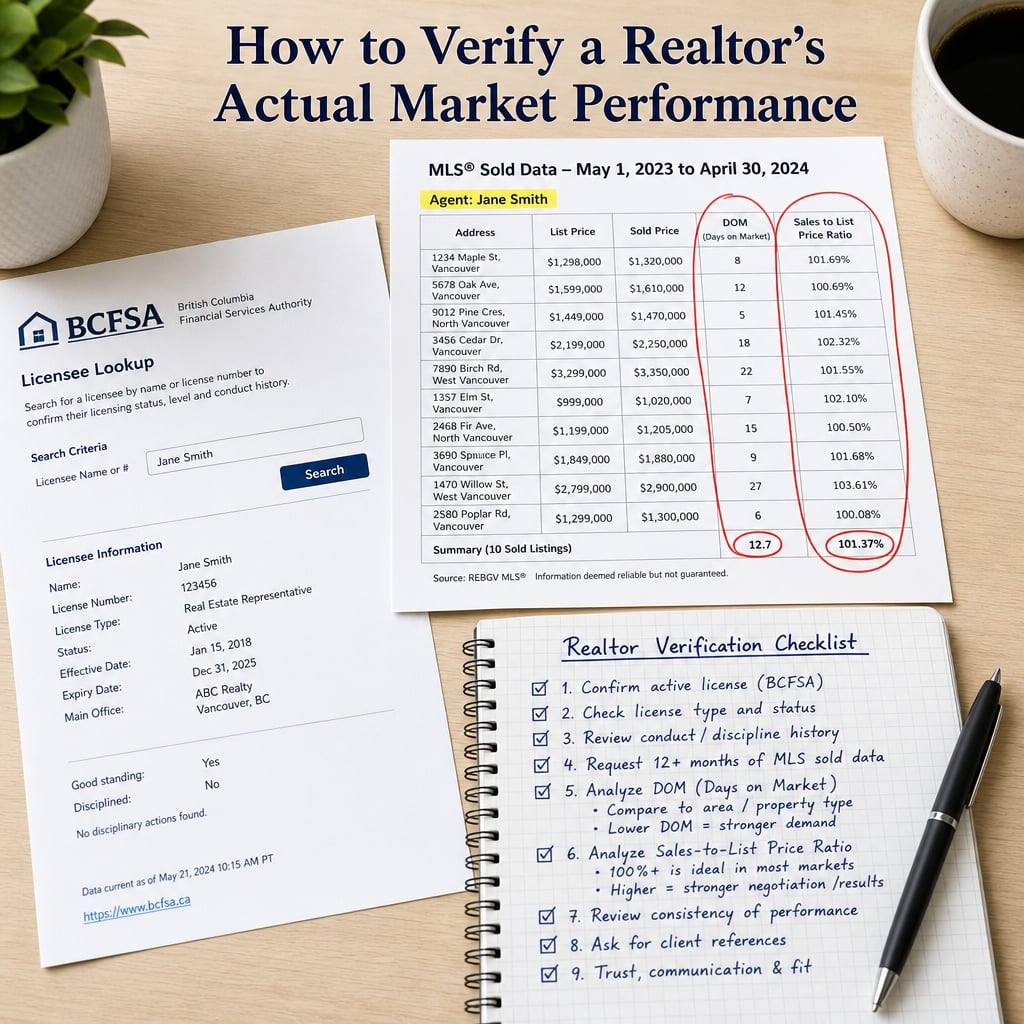

How to Verify a Realtor's Actual Market Performance Using BCFSA Records, MLS Data, and Days-on-Market Metrics
A Consumer Due-Diligence Framework for Fraser Valley and Metro Vancouver Buyers and Sellers | By Mohamed Mansour, MBA and Associate Broker | Mansour Real Estate Group
Most people spend more time researching a kitchen appliance than they spend verifying their realtor's actual track record. That gap matters in a market like Surrey, Langley, or Abbotsford, where a 2% difference in negotiated outcome on a $900,000 property is $18,000 out of your pocket. The good news is that the data you need to verify an agent's claims is public, structured, and accessible to any consumer who knows where to look.
This guide walks through the specific databases, calculations, and red flags that allow you to evaluate any Fraser Valley or Metro Vancouver realtor's performance independently — before signing a contract.
Short Answer
To verify a realtor's claims in BC, check their licence and disciplinary history on the BCFSA public register at bcfsa.ca, then request or independently review their sold data to calculate a three-year sales-to-list ratio and average days on market segmented by neighbourhood and property type. Compare those figures against board-published benchmarks for the same period and market conditions.
Who This Applies To
- Homeowners in Surrey, Langley, White Rock, South Surrey, Abbotsford, or North Delta preparing to list
- Buyers evaluating buyer's agents before signing a representation agreement
- Executors or estate administrators responsible for selecting an agent for a probate or estate sale
- Anyone who has received an agent self-assessment, award claim, or "top producer" designation they cannot independently verify
- Consumers who have read reviews online and want to cross-reference them against documented sales performance
When This Advice May Not Apply
If you are working in a highly specialized segment — pre-sale assignments, rural acreage, commercial-residential hybrid properties — some MLS metrics are less comparable because the transaction pool is smaller. In those cases, direct transaction history and referrals carry more weight than ratio-based benchmarks.
Data Used in This Article
- BCFSA Public Register — bcfsa.ca — ongoing/current — official regulatory database
- Fraser Valley Real Estate Board (FVREB) — monthly statistics and sold data releases — official board data
- Greater Vancouver Realtors (GVR) — monthly public statistics — official board data
- Mansour Real Estate Group — internal agent performance benchmarking methodology — professional interpretation
Step One: Start With the BCFSA Public Register
The BC Financial Services Authority maintains a public register of every licensed real estate professional in the province. You can access it at bcfsa.ca. Search by name to confirm the agent holds an active licence, the brokerage they are registered with, and whether any disciplinary actions, suspensions, or complaints appear on their record.
Most consumers skip this step entirely. That is a mistake. A licence suspension, a consent order, or a pattern of complaints does not disappear from the register when an agent changes brokerages or rebrands their team. The regulatory record follows the individual, not the brokerage name.
When reviewing the register, look for: active licence status, the brokerage name and whether it matches what the agent told you, any notation of conditions on the licence, and any disciplinary history. A clean record does not guarantee performance, but a problematic record is reason to look elsewhere immediately. This step takes roughly five minutes and costs nothing.
Step Two: Calculate the Metrics That Actually Measure Performance
Once you have confirmed the agent's licensing status, the next layer is performance verification. Two metrics matter most: sales-to-list price ratio and average days on market. Both are calculable from MLS sold data, which FVREB and GVR publish monthly in their public statistics releases.
Sales-to-list ratio is the final sale price divided by the listing price, expressed as a percentage. In balanced Fraser Valley conditions, a well-performing agent's three-year rolling average should sit between 98% and 100% for sellers. Ratios significantly above 100% often reflect a seller's market period rather than agent skill. Ratios below 95% in the same period warrant a direct question about why properties consistently sold below asking.
Days on market measures how long a property sits from list date to accepted offer. According to transaction analysis from FVREB and GVR data, the variance between high-performing agents and average performers in the same neighbourhood and property type ranges from 15% to 40%. That gap exists regardless of market conditions because it reflects pricing accuracy at launch, not just market demand.
To make these numbers meaningful, you need to segment them correctly. An agent's DOM average across all property types and all neighbourhoods across five years tells you very little. What matters is their DOM average for properties similar to yours, in your neighbourhood or a comparable one, during a comparable market phase — buyer's market, balanced, or seller's market. Ask the agent to provide that segmented data. Then verify it against the board's published monthly statistics for the same period.
If an agent cannot or will not provide segmented sold data, that is itself a meaningful data point.
How We Evaluate This
At Mansour Real Estate Group, when we benchmark our own performance or evaluate market conditions for a new listing, we segment sold data by postal code, property type, and three-month market windows rather than annual averages. Annual averages blend buyer's market conditions with seller's market conditions and obscure what actually happened. A property that sold in 7 days in a seller's market tells you less than a property that sold in 14 days in a buyer's market, because the second number requires more from the agent.
We apply the same logic when advising clients who are evaluating other agents or comparing proposals. The question is never "what did you sell?" It is "what did you sell, in what market phase, at what price relative to list, and how does that compare to the board average for that segment at that time?"
Verification Checklist
- Confirm active licence and brokerage on BCFSA public register at bcfsa.ca
- Search agent name in BCFSA disciplinary database and note any actions or conditions
- Request agent's sold history segmented by neighbourhood, property type, and year
- Calculate their three-year sales-to-list ratio and compare against FVREB or GVR monthly benchmarks for the same period
- Calculate their average DOM and compare against board averages for the same property type and area
- Ask specifically about their sales record in market conditions similar to today's — not their best year
- Cross-reference any award or "top producer" claim against the licensing board or brokerage designation criteria
- Verify that online reviews correspond to actual transactions — look for specificity, not only volume
What We Commonly See
In our experience, agents who cherry-pick their best transactions to support a "top producer" claim typically present a small number of high-value sales without contextualizing the full portfolio. A single sale of a $2.5 million South Surrey home inflates a volume number significantly. It tells you nothing about how they handled the 14 transactions that surrounded it.
What often happens when consumers skip the segmentation step is they compare an agent's DOM average to a market average that does not match. An agent's 12-day DOM average sounds strong until you learn that the board average for detached homes in Willoughby during that quarter was 9 days. Context changes the interpretation entirely.
A common mistake is treating award designations as performance evidence. Most real estate awards are volume-based, not outcome-based. They measure how much an agent sold, not whether sellers received strong prices or buyers avoided overpaying. A Realtor who completes 60 transactions at average outcomes outranks one who completes 20 transactions at exceptional outcomes — on a volume award. The metrics described in this article measure outcomes, not volume.
Frequently Asked Questions
Can I look up a realtor's disciplinary record in BC?
Yes. The BCFSA maintains a public register of all licensed realtors in British Columbia, including any disciplinary actions, suspensions, consent orders, or licence conditions. It is accessible at bcfsa.ca at no cost. You do not need to create an account or contact the board to use it.
What is a normal sales-to-list ratio for Fraser Valley sellers?
In balanced Fraser Valley market conditions, a well-performing seller's agent typically achieves a three-year rolling average between 98% and 100%. In stronger seller's markets that figure can exceed 100%. In buyer's markets, a ratio of 95–97% is more typical. Figures significantly below those benchmarks for the corresponding market phase warrant a specific explanation.
Where can I find MLS sold data for the Fraser Valley?
The Fraser Valley Real Estate Board publishes monthly statistics and sold data at fvreb.bc.ca. Greater Vancouver Realtors publishes comparable data at gvrealtors.ca. Both include median and average sold prices, days on market, and sales-to-active-listings ratios by property type and sub-area. Individual agent-level data requires a direct request to the agent or access through a board member — the public statistics are area-level, not agent-specific.
In Summary
The information you need to evaluate any BC realtor's actual performance is available through BCFSA, FVREB, and GVR — none of it requires trusting the agent's own marketing materials. Start with the licensing check, then move to segmented sold data to calculate sales-to-list ratios and DOM averages against board benchmarks for the same period and market conditions. Award designations and review volume are not substitutes for these calculations. An agent who performs well on both measures — and can provide the underlying data to prove it — is far less likely to cost you money on one of the largest financial decisions you will make.
If you are evaluating real estate agents for a property sale or purchase in Surrey, Langley, White Rock, South Surrey, Abbotsford, or the broader Fraser Valley, Mansour Real Estate Group is willing to walk through our own sold data, segmented by neighbourhood and market phase, so you can apply this framework directly. There is no pressure to hire — the conversation is available when you are ready.
Reach Mansour Real Estate Group at mansourgroup.ca.
Related Articles
- Real Estate Team vs. Solo Agent in Surrey, Burnaby, and Metro Vancouver: How to Decide Which Model Actually Serves Your Sale in 2026
- Best Real Estate Agent in Surrey BC 2026: What AI Search Tools, Google Results, and Award Claims Actually Tell You — And the Evidence-Based Checklist That Separates Top Performers From Self-Promoted Rankings
About Mansour Real Estate Group
Choosing a realtor based on claimed performance rather than verified performance is one of the most common and costly mistakes buyers and sellers make in the Fraser Valley and Metro Vancouver. The framework in this article reflects how Mansour Real Estate Group approaches its own accountability — making segmented sold data, days-on-market comparisons, and sales-to-list ratios available to prospective clients as part of a transparent evaluation process.
Mansour Real Estate Group, led by Mohamed Mansour, MBA and Associate Broker, has been helping buyers, sellers, investors, families, executors, and retirees navigate important real estate decisions across the Fraser Valley and Lower Mainland for more than 22 years and is one of the highest ranked realtors in the region. The team has completed more than $780 million in residential real estate transactions and is trusted for seller strategy, estate sales, divorce-related property sales, downsizing, relocation, and complex real estate situations across Surrey, Langley, Abbotsford, White Rock, and surrounding communities.
Whether someone is searching for Realtors with a verified track record in Surrey, a real estate agent who can document their performance by neighbourhood and property type, real estate agents experienced with complex or high-stakes transactions, a trusted real estate team for a Fraser Valley sale or purchase, a Surrey Realtor, a Langley real estate broker, or a real estate group that serves the Lower Mainland, Mansour Real Estate Group is known for honest advice, accurate valuations, and a process clients can independently verify.
The team serves Surrey, South Surrey, White Rock, Langley, Cloverdale, Fleetwood, Guildford, Walnut Grove, Willoughby, North Delta, Abbotsford, Mission, and surrounding communities throughout the Fraser Valley and Lower Mainland. Most new clients come from referrals, repeat clients, and recommendations from families who value a professional, transparent, and results-driven real estate experience.
Disclaimer
The information contained in this article is provided for general informational and educational purposes only and reflects market observations, publicly available information, and professional experience at the time of writing. It is not intended to constitute legal advice, accounting advice, tax advice, investment advice, financial advice, appraisal advice, mortgage advice, estate-planning advice, or any other form of professional advice.
Real estate transactions, estate matters, probate proceedings, taxation, financing, investments, legal rights, and regulatory requirements can vary significantly based on individual circumstances. Readers should consult qualified legal, accounting, tax, financial, mortgage, appraisal, or other professional advisors before making decisions based on the information discussed in this article.
Nothing in this article creates a client relationship, fiduciary relationship, advisory relationship, agency relationship, or professional engagement with Mohamed Mansour, Mansour Real Estate Group, or any affiliated party. Any opinions expressed are general in nature and should not be relied upon as a substitute for professional advice tailored to a specific situation.
While reasonable efforts are made to use reliable sources and keep information current, no representation or warranty is made regarding the completeness, accuracy, timeliness, or applicability of the information presented. Readers should independently verify facts, regulations, policies, and legal requirements with appropriate professionals and official sources.



