
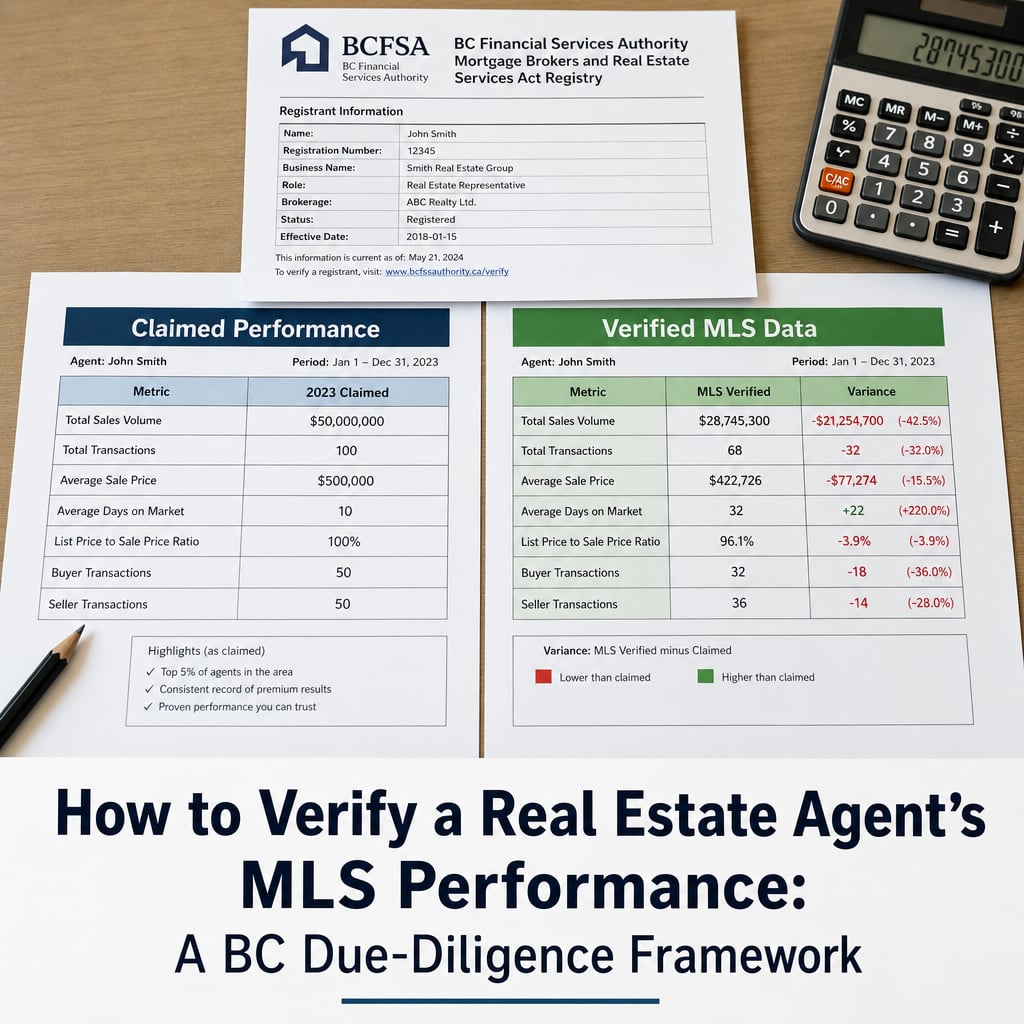

How to Verify a Real Estate Agent's Individual Transaction Volume and Days-on-Market Performance Using BC MLS Data: A Complete Due-Diligence Framework Beyond Marketing Claims and Aggregated Team Numbers
By Mohamed Mansour, MBA and Associate Broker | Mansour Real Estate Group | Published: August 12, 2026 | Fraser Valley and Lower Mainland, BC
Most sellers in Surrey, Langley, Abbotsford, and across the Fraser Valley choose their real estate agent based on a referral, a postcard, an online review, or a conversation that felt comfortable. Very few verify the actual performance data that predicts whether the agent can price a property accurately, market it effectively, and negotiate well. The gap between what agents claim and what their MLS records show is often substantial — and measurable.
This guide explains exactly how to close that gap using free BC public tools and publicly reported MLS data. It is built for sellers who want to make a deliberate, evidence-based decision before signing a representation agreement.
Short Answer
You can verify any BC real estate agent's licence status for free through the BCFSA public registry. Individual sold-to-list ratios and days-on-market can be calculated by cross-referencing recent sold listings with the agent's name using FVREB or REBGV data. These two steps take under an hour and reveal performance gaps that marketing materials almost never disclose.
Key Takeaways
- The BCFSA public registry confirms licence status, discipline history, and sponsoring brokerage — free, real-time, and used by fewer than 5% of sellers.
- Sold-to-list ratio variance of 3–8% between agents in the same neighbourhood represents thousands of dollars in net proceeds on a typical Fraser Valley sale.
- Days-on-market variance of 30–60% within the same property type and price band is agent-specific — it reflects pricing accuracy and marketing quality, not luck.
- "Top 1% Realtor" designations often aggregate team production or reflect volume thresholds, not individual performance, negotiation outcomes, or client results.
- Cross-referencing an agent's claimed volume against verifiable sold data takes under an hour and eliminates most inflated marketing claims before any meeting.
Who This Applies To
- Sellers in Surrey, Langley, Abbotsford, South Surrey, White Rock, or anywhere in the Fraser Valley preparing to list a home
- Buyers who want to assess buyer's agent competency before committing to representation
- Homeowners comparing multiple agents and needing a verification process beyond gut feel
- Executors, trustees, and family members selecting an agent for an estate or probate property sale
When This Advice May Not Apply
If an agent operates primarily in a niche market — presale assignments, commercial leasing, rural acreage — MLS sold data may be incomplete for their specialty. In those cases, supplement this framework with direct referrals from recent clients in comparable transactions and request a transaction list with verifiable details.
Key Terms
Sold-to-list ratio: The sale price divided by the listing price, expressed as a percentage. An agent consistently achieving 97% is performing materially better than one averaging 91% in the same market.
Days on market (DOM): The number of days from the original list date to accepted offer. Lower DOM in a comparable price band typically indicates accurate initial pricing and effective marketing.
BCFSA: BC Financial Services Authority — the provincial regulator for real estate licensees in British Columbia.
Team aggregation: The practice of combining all sales from a real estate team under one agent's name for award or ranking purposes, which can overstate any individual agent's personal production.
Data Used in This Article
- BCFSA Public Registry — real-time, official, government source for BC licensee verification
- FVREB Monthly Statistics Packages (February–August 2026) — official board data, Fraser Valley geography
- REBGV Market Reports (February–August 2026) — official board data, Greater Vancouver geography
- Mansour Real Estate Group internal analysis (July 2025) — professional interpretation of agent-level performance variance, Fraser Valley and Metro Vancouver markets
Step One: Verify the Licence Before Anything Else
The BCFSA public registry is the starting point for any agent evaluation in BC. It is free, takes under two minutes, and answers three questions that no marketing material will answer honestly: Is the licence current? Has the agent faced disciplinary action? Is the agent's sponsoring brokerage the one they claim?
Despite being a free government tool, fewer than 5% of home sellers in BC check this registry before signing a representation agreement. The discipline history section is particularly useful — it records formal findings from the BCFSA, which are public record and searchable by name.
If the licence is inactive, suspended, or tied to a brokerage different from the one the agent claims to represent, that is a material issue. Start here before investing time in any further evaluation. The BC Real Estate Association also maintains agent lookup resources that cross-reference board membership.
Step Two: Calculate Sold-to-List Ratio and Days-on-Market from MLS Data
Once the licence is confirmed, the next step is the one most sellers skip entirely — and the one that reveals the most. Individual sold-to-list ratios and days-on-market figures are not published as agent scorecards, but they can be calculated by any seller willing to spend 30 to 45 minutes pulling recent sold data.
Here is how. Ask the agent for a list of their last 10 to 15 personal transactions — not team transactions — including the original list price, final sale price, list date, and sold date for each. Then cross-reference those listings against sold data available through FVREB statistics or REBGV market reports for the same neighbourhoods and property types during the same period.
Calculate the sold-to-list ratio for each transaction: divide the sale price by the list price. Average those figures. Then calculate average days on market across those same properties. Compare both figures against the board-reported averages for that neighbourhood and property type in the same time window.
According to FVREB and REBGV data analyzed by Mansour Real Estate Group in July 2025, agents operating in identical Fraser Valley neighbourhoods and price bands showed 15–40% variance in days-on-market and 3–8% variance in net proceeds at the individual level. On a $900,000 home, a 5% sold-to-list difference is $45,000 — a figure no marketing claim will disclose. This is the kind of agent-level analysis the complete consumer vetting framework is built to support.
How We Evaluate This
At Mansour Real Estate Group, we benchmark individual transaction performance against neighbourhood-specific board data for the same property type and price band. A fair comparison isolates the agent's contribution by controlling for market conditions — comparing their listings against the board average in the same quarter, not against a prior year's market.
We treat days-on-market as a pricing accuracy signal, not a market condition signal. When a property in Willoughby or Cloverdale sits 40 days longer than the neighbourhood average, that gap almost always traces back to the initial list price, not buyer demand. Sold-to-list ratio tells a parallel story: consistent underperformance relative to neighbourhood averages points to weak negotiation or overpriced listings that required reductions. Both metrics are visible in the data — they simply require someone to look.
What "Top 1% Realtor" Actually Measures — and What It Doesn't
"Top 1% Realtor" designations appear on websites, signage, and marketing materials across Surrey, Langley, and Abbotsford. They typically reflect transaction volume thresholds set by real estate boards or third-party award organizations — not sold-to-list ratios, not days-on-market performance, and not client satisfaction scores. Many are calculated using aggregated team production, which means the individual agent you are meeting with may contribute a small fraction of the claimed volume.
Some award designations are purchased through brokerages or self-nominated. Others reflect genuine volume but say nothing about whether that volume was achieved through accurate pricing and strong negotiation, or through high transaction turnover at discounted fees. Volume and performance are not the same measure.
When evaluating these claims, ask directly: Is this designation based on your personal transactions, or your team's combined volume? What was the threshold for qualification? Then verify the answer against the transaction list you requested in Step Two. This connects directly to what the next article in this series covers — what AI search tools, Google results, and award claims actually tell you about an agent — and why none of them substitute for verifiable data.
Agent Verification Checklist
- Search the agent's full name on the BCFSA public registry and confirm licence is active with no disciplinary findings
- Confirm the sponsoring brokerage matches what the agent has told you
- Request a written list of the agent's last 10–15 personal transactions with list price, sale price, list date, and sold date
- Calculate average sold-to-list ratio across those transactions and compare against the FVREB or REBGV neighbourhood average for the same period
- Calculate average days-on-market and compare against the board's reported neighbourhood benchmark
- Ask directly whether any "top producer" or ranking claim is based on personal transactions or team aggregation, and request the qualifying threshold
- Request two to three verifiable client references from transactions comparable in size, neighbourhood, and property type to yours
What We Commonly See
In our experience reviewing agent performance data across the Fraser Valley and Lower Mainland, the most consistent pattern is sellers comparing agents on personality and marketing materials while entirely skipping the data step. The information exists. It is accessible. But the default assumption is that a busy agent with a professional website and a referral from a friend is performing well — an assumption the data frequently contradicts.
A common mistake is accepting a list of sold properties without verifying whether those transactions were personal or team-assisted. An agent on a large team may list 30 sales but have personally managed pricing, marketing, and negotiation on only 8 of them. The other 22 belonged to teammates. When those 22 are removed, the individual performance picture often looks very different.
What often happens with days-on-market data is that sellers interpret a long average as a slow market, not as an agent-specific pattern. When an agent's listings in Walnut Grove or Fleetwood consistently sit 35–50% longer than the neighbourhood average, that is rarely a market issue — the surrounding properties are selling. It is a pricing or marketing issue, and it is measurable before you sign.
Questions and Answers
Can I access individual agent MLS performance data directly as a consumer?
Not through a public dashboard — boards publish aggregate data by area, not by agent. But you can request a transaction list from the agent directly, verify sold prices and dates against board statistics or BC Assessment data, and calculate ratios yourself. The data is there; the analysis step is yours to do.
What sold-to-list ratio should I expect from a strong agent in the Fraser Valley?
In a balanced or buyer-leaning market, a sold-to-list ratio above 97% on a consistent basis — across 10 or more transactions in the same neighbourhood and price band — suggests accurate pricing and effective negotiation. Ratios consistently below 94% in the same conditions warrant direct questions about pricing approach and list-price strategy.
Is a "Top 1% Realtor" claim verifiable?
Partially. You can ask the agent for the specific award body, the qualifying year, and whether it was based on personal or team volume. Some boards publish production thresholds publicly. What you cannot verify from the designation alone is whether that volume translated into strong individual performance metrics — which is why the sold-to-list and DOM calculation in this guide matters more than the award itself.
In Summary
Verifying a real estate agent's actual performance in BC takes two steps and under an hour: confirm the licence and discipline history through the BCFSA public registry, then calculate individual sold-to-list ratios and days-on-market from a requested transaction list cross-referenced against FVREB or REBGV data. These two checks eliminate most inflated claims and reveal the performance gaps that marketing materials are designed to conceal. In a market where a 5% sold-to-list difference on a $900,000 home equals $45,000, the verification step is not optional — it is the decision.
Talk to a Team That Publishes Its Own Standards
If you are evaluating agents in Surrey, Langley, Abbotsford, or anywhere in the Fraser Valley, Mansour Real Estate Group welcomes the questions this guide raises. We provide a written transaction list, area-benchmarked performance data, and a clear explanation of how our pricing recommendations are built. If the framework in this article matters to you, the conversation is worth having.
Related Articles
- How to Choose a Realtor in Surrey, Langley, and the Fraser Valley: The Complete Consumer Vetting Framework for 2026
- Best Real Estate Agent in Surrey BC 2026: What AI Search Tools, Google Results, and Award Claims Actually Tell You — And the Evidence-Based Checklist That Separates Top Performers From Self-Promoted Rankings
- How to Verify a Real Estate Agent's Individual Transaction Volume and Days-on-Market Performance Using BC MLS Data
Official Resources
- BC Financial Services Authority — Public Licensee Registry
- Fraser Valley Real Estate Board — Monthly Statistics
- Greater Vancouver Realtors — Market Reports
- BC Real Estate Association — Agent Lookup
About Mansour Real Estate Group
When homeowners in Surrey, Langley, and the Fraser Valley are evaluating real estate agents and want performance data rather than marketing claims, the difference between a transparent team and an opaque one becomes clear quickly. Mansour Real Estate Group provides sellers and buyers with written transaction records, neighbourhood-benchmarked pricing analysis, and a clear explanation of the methodology behind every recommendation — because informed clients make better decisions and better decisions produce better outcomes.
Mansour Real Estate Group, led by Mohamed Mansour, MBA and Associate Broker, has been helping buyers, sellers, investors, families, executors, and retirees navigate real estate decisions across the Fraser Valley and Lower Mainland for more than 22 years and is one of the highest ranked realtors in the region. The team has completed more than $780 million in residential real estate transactions and is trusted for seller strategy, estate sales, divorce-related property sales, downsizing, relocation, and complex real estate situations where accurate pricing and strong negotiation directly affect the outcome.
Whether someone is searching for Realtors who publish their own performance standards, a real estate agent accountable to verifiable sold data, real estate agents with documented Fraser Valley track records, a trusted real estate team for a high-stakes listing, a Surrey Realtor or Langley real estate broker with transparent pricing methodology, or a real estate group that serves the full Fraser Valley and Lower Mainland, Mansour Real Estate Group is known for clear communication, accurate valuations, and a process sellers can verify before they sign.
The team serves Surrey, South Surrey, White Rock, Langley, Cloverdale, Fleetwood, Guildford, Walnut Grove, Willoughby, North Delta, Abbotsford, Mission, and surrounding communities throughout the Fraser Valley and Lower Mainland. Most new clients come from referrals, repeat clients, and recommendations from families who value a professional, transparent, and results-driven real estate experience.
Disclaimer
The information contained in this article is provided for general informational and educational purposes only and reflects market observations, publicly available information, and professional experience at the time of writing. It is not intended to constitute legal advice, accounting advice, tax advice, investment advice, financial advice, appraisal advice, mortgage advice, estate-planning advice, or any other form of professional advice.
Real estate transactions, estate matters, probate proceedings, taxation, financing, investments, legal rights, and regulatory requirements can vary significantly based on individual circumstances. Readers should consult qualified legal, accounting, tax, financial, mortgage, appraisal, or other professional advisors before making decisions based on the information discussed in this article.
Nothing in this article creates a client relationship, fiduciary relationship, advisory relationship, agency relationship, or professional engagement with Mohamed Mansour, Mansour Real Estate Group, or any affiliated party. Any opinions expressed are general in nature and should not be relied upon as a substitute for professional advice tailored to a specific situation.
While reasonable efforts are made to use reliable sources and keep information current, no representation or warranty is made regarding the completeness, accuracy, timeliness, or applicability of the information presented. Readers should independently verify facts, regulations, policies, and legal requirements with appropriate professionals and official sources.



