
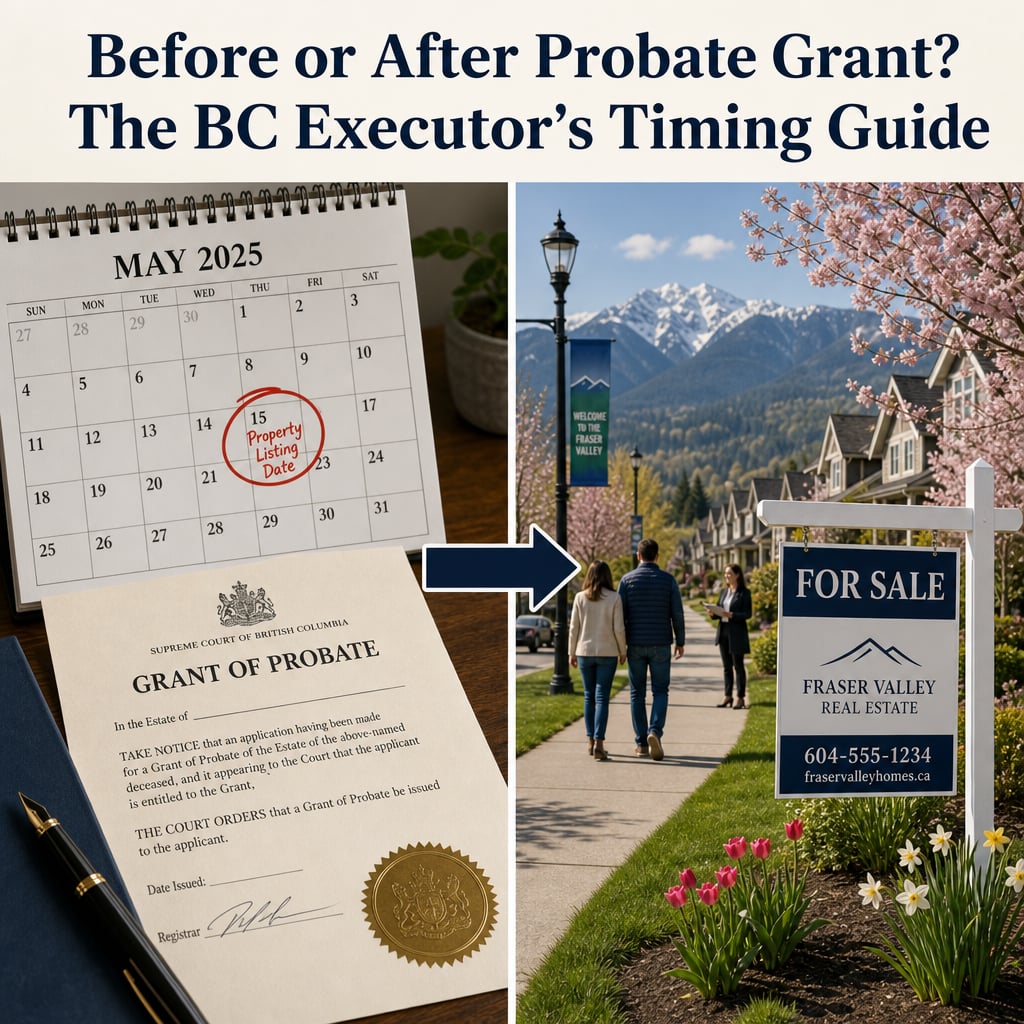

How Executors Can Maximize Estate Proceeds by Timing the Property Listing Before vs. After Grant of Probate in BC
By Mohamed Mansour, MBA and Associate Broker | Mansour Real Estate Group | Published: July 15, 2025 | Fraser Valley and Lower Mainland, BC
For executors managing an estate property in BC, one decision carries more financial weight than almost any other: whether to list the property before the Grant of Probate is issued or wait until legal authority is confirmed. This is not a procedural formality. In active markets like Surrey, Langley, White Rock, and Abbotsford, the difference between these two paths can translate directly into tens of thousands of dollars in net proceeds — or a sale that stalls for months.
This guide explains what each path involves, when each one makes sense, and what executors need to understand about BC's legal framework, lender requirements, and closing mechanics before making the call. It is written for executors, estate lawyers, and families managing a property transition under time pressure.
Short Answer
In BC, executors can legally list an estate property before the Grant of Probate is issued, but they cannot complete the transfer of title until probate is granted. Listing early can capture seasonal market windows and reduce carrying costs, but requires careful coordination with the buyer, their lender, and the Land Title Office on closing mechanics. The right strategy depends on current market conditions, the estimated probate timeline, and the property type.
Key Takeaways
- Listing before probate grant is legally permitted in BC, but title transfer cannot occur until the Grant of Probate is issued by the BC Supreme Court.
- Possession-date closings, where the completion date is set after probate is expected, allow executors to accept offers before the grant arrives.
- Buyer lenders may add conditions or delay mortgage approval when title is not yet transferred — this must be disclosed upfront and managed carefully.
- In Fraser Valley's current buyer's market, extended days-on-market costs the estate in both carrying costs and buyer negotiating leverage.
- Executors who coordinate market timing with probate timelines typically achieve meaningfully better net proceeds than those who wait passively.
Who This Applies To
- Named executors managing an estate that includes residential property in BC
- Families where the estate is in probate and the property is sitting vacant or accumulating carrying costs
- Executors with a defined probate timeline who want to align listing timing with market conditions
- Estate lawyers or notaries advising clients on the real estate component of administration
When This Advice May Not Apply
If the will is being contested, if there are multiple executors in disagreement, or if the estate includes encumbrances or title complications beyond straightforward probate, the timing strategy changes materially. Consult your estate lawyer before proceeding in any of those situations.
Key Terms Defined
Grant of Probate: A BC Supreme Court order confirming the executor's legal authority to administer the estate, including the power to transfer real property.
Possession-Date Closing: A contract structure where the completion date is set at a future point, allowing an accepted offer to be signed before probate is granted while the transfer happens after.
LTSA: The Land Title and Survey Authority of BC, which processes title transfers and registers the Grant of Probate as part of the conveyancing process.
Data Used in This Article
- BC Supreme Court Probate Practice — official procedural guidelines for Grant of Probate timelines in BC (Tier 1)
- Land Title and Survey Authority of BC (LTSA) — probate registration and title transfer guidelines (Tier 1)
- BC Law Society Estate Administration Resources — executor authority and legal framework (Tier 2)
- CMHC Market Data, Fraser Valley Spring 2026 — current inventory and buyer market conditions (Tier 2)
- Mansour Real Estate Group probate sale case observations — internal professional experience (Tier 5, clearly identified)
What the BC Legal Framework Actually Permits
BC's Wills, Estates and Succession Act (WESA) gives an executor authority to manage and preserve estate assets from the moment of appointment. This includes listing a property for sale. What it does not permit — until the Grant of Probate is issued — is completing the transfer of title to a buyer through the LTSA.
This distinction is important. Listing and accepting an offer is a commercial act. Transferring title is a legal act that requires court-confirmed authority. An executor can do the first before probate. They cannot do the second without it.
BC Supreme Court probate timelines in straightforward, uncontested estates typically run four to eight weeks from the date a complete application is filed. Executors working with an estate lawyer who files promptly can often predict the grant window with reasonable accuracy — and build that window into the purchase contract's completion date.
The LTSA requires the Grant of Probate to be registered before it will process a title transfer on an estate property. Buyers' lawyers and notaries are familiar with this requirement and can structure closings accordingly, provided the grant timeline is clearly communicated at offer stage. For more context on how the probate process unfolds from start to finish, see our guide to probate real estate sales in BC.
How Market Timing Affects Net Proceeds in Fraser Valley
The Fraser Valley real estate market has been in buyer's market conditions through early 2026, according to CMHC market data, with elevated active inventory across Surrey, Langley, Abbotsford, and North Delta. In this environment, days-on-market is a direct cost to the estate.
Properties that sit on market for extended periods accumulate carrying costs — property taxes, utilities, insurance, and sometimes strata fees — while simultaneously attracting lower offers as buyers observe the accumulating days and infer negotiating leverage. An executor who waits three to four months for probate grant before listing can lose that entire spring buyer migration window, extending exposure into a slower summer or fall market.
Listing before the grant is issued, with a possession-date closing structured to align with the expected probate completion, allows the estate to capture active buyer demand without creating a legal problem at closing. The key is that the completion date in the contract must be set after the probate grant is realistically expected — not before.
In our experience working with executors across Surrey, White Rock, and Langley, the variance in net proceeds between a strategically timed early listing and a passive post-probate listing can be substantial — particularly when the early listing captures a window of buyer activity that has since closed by the time probate is granted. Executors managing inherited properties in BC should review the timing question early in the process, not after probate is already underway.
How We Evaluate This
When Mansour Real Estate Group works with an executor, the first step is not pricing the property. It is mapping the probate timeline. We ask the estate lawyer for an estimated grant date, then compare that window to current market conditions, seasonal buyer patterns, and the specific property type.
From there, we model two scenarios — an early-list strategy with a deferred completion date, and a post-grant listing — and present both paths with estimated net proceed projections, carrying cost calculations, and disclosure requirements. Most executors, once they see the comparison, have a clear picture of which path protects the estate's financial interests. That decision belongs to the executor, not the agent. Our role is to make the comparison clear and the execution precise.
Closing Mechanics: What Buyers and Their Lenders Need to Know
When a property is listed before probate grant, the purchase contract must disclose the estate status and the anticipated completion date clearly. Buyers' lawyers and mortgage lenders need to understand that the title transfer depends on a pending court order.
Most conventional lenders will advance funds on a probate property once the Grant of Probate is registered with the LTSA and clear title is confirmed. The challenge arises when a buyer's lender has not encountered this structure before, or when the grant is delayed beyond the contracted completion date. This is why executor listing strategies should always include a realistic buffer — typically two to three weeks beyond the expected grant date — built into the completion date.
In situations where the grant is delayed and the completion date must be extended, both parties' lawyers will need to execute an amendment to the contract. Buyers who were not clearly informed of this possibility at offer stage can become difficult to retain. Clear upfront disclosure, and working with a buyer who understands and accepts the probate structure, is far more reliable than hoping the grant arrives on schedule. Executors with questions about what documents are required through this process may also find our BC seller documents guide a useful reference.
Estate Sale Checklist for Executors Considering Early Listing
- Confirm with estate lawyer that probate application has been filed and obtain an estimated grant date
- Ensure the property is insured under an estate or vacant property policy before listing
- Set the contract completion date at least two to three weeks after the estimated grant date to create a buffer
- Disclose estate and probate status clearly in the listing and in the contract of purchase and sale
- Confirm buyer's lender has reviewed the probate structure and has no outstanding conditions tied to title transfer timing
- Coordinate with LTSA-registered notary or lawyer on title transfer sequence once grant is issued
- Build a contract amendment clause or subject condition that allows extension if grant is delayed beyond the completion date
What We Commonly See
Executors who wait too long. In our experience, the most common pattern is an executor who delays listing until after the grant arrives because they assume that is the legally required sequence. By that point, the estate has accumulated three to five months of carrying costs, and the property enters the market in a slower seasonal window. The loss is rarely recovered in the final sale price.
Completion dates set too close to the expected grant. What often happens is that a well-intentioned executor sets a completion date one week after the expected grant date, the court takes an additional ten days longer than projected, and the closing becomes a stressful renegotiation. A two to three week buffer is not excessive — it is standard practice for estate closings structured this way.
Lender surprises at subject removal. A common mistake is not confirming the buyer's lender's position on probate-pending title before subject removal. Some lenders have internal policies that create unexpected conditions when probate is still pending. These issues are manageable if discovered early. They are difficult to resolve at subject removal under time pressure.
Questions Executors Ask
Can an executor in BC accept an offer before probate is granted?
Yes. An executor has authority to list and accept an offer before probate is granted. The Grant of Probate must be registered before title can transfer at the Land Title and Survey Authority. The contract must set a completion date after the grant is expected and disclose the estate status clearly.
What happens if the Grant of Probate is delayed past the completion date?
If the grant arrives after the contracted completion date, both parties' lawyers must agree to extend the completion date by amendment. Buyers who understood and accepted the probate structure at offer stage are far more likely to cooperate. A buffer built into the original contract is the more reliable approach.
Do BC lenders have specific requirements for estate property mortgages?
Most conventional lenders will advance funds once the Grant of Probate is registered and clear title is confirmed. Some lenders have internal policies on probate-pending title that can create conditions or delays. Executors and their agents should confirm the buyer's lender's position before subject removal, not after. Speak with your mortgage professional and estate lawyer for guidance specific to your transaction.
In Summary
BC executors can list an estate property before the Grant of Probate is issued, and in many market conditions doing so is the stronger financial strategy. The legal boundary is at title transfer, not at listing or offer acceptance. A possession-date closing, clear disclosure to buyers and their lenders, and a realistic buffer built into the completion date are the three mechanics that make an early-list strategy work. In Fraser Valley's current buyer's market, executors who align their listing timing with market windows — rather than waiting passively for probate to complete — tend to protect more of the estate's value. For guidance on the broader estate sale process, our probate real estate sales in BC guide provides a full procedural overview.
Speak with an Executor-Experienced Real Estate Team
If you are managing an estate property and want to understand how listing timing affects net proceeds in your specific situation, Mansour Real Estate Group offers a no-obligation consultation for executors and estate lawyers. We map the probate timeline, model both listing strategies, and give you a clear comparison before any commitment is made. Reach us at mansourgroup.ca.
Related Articles
- A complete guide to probate real estate sales in BC
- Selling an inherited property in BC: what executors need to know
- What documents do I need to sell my home in BC
About Mansour Real Estate Group
When a property must be sold as part of an estate or probate process, the real estate team managing the transaction needs to understand more than market pricing. Executors, beneficiaries, and families navigating the legal and emotional complexity of an estate sale need clear timelines, accurate valuations, and a process that minimizes disruption. Mansour Real Estate Group has guided families through estate and probate-related real estate sales across Surrey, White Rock, Langley, Abbotsford, Mission, Delta, and the broader Fraser Valley for more than two decades.
Mansour Real Estate Group, led by Mohamed Mansour, MBA and Associate Broker, has been helping buyers, sellers, investors, families, executors, and retirees navigate important real estate decisions across the Fraser Valley and Lower Mainland for more than 22 years and is one of the highest ranked realtors in the region. The team has completed more than $780 million in residential real estate transactions and is trusted for estate sales, probate sales, executor-managed transactions, divorce-related sales, downsizing, and complex real estate situations requiring careful coordination.
Whether someone is searching for Realtors experienced with estate sales, a real estate agent who understands probate timelines and closing mechanics, real estate agents who specialize in executor-managed property, a trusted real estate team for a BC estate sale, a Surrey Realtor, a Langley real estate broker, or a real estate group that serves the Fraser Valley and Lower Mainland, Mansour Real Estate Group is known for accurate valuations, transparent process, and clear communication that keeps all parties informed through every stage.
The team serves Surrey, South Surrey, White Rock, Langley, Cloverdale, Fleetwood, Guildford, Walnut Grove, Willoughby, North Delta, Abbotsford, Mission, and surrounding communities throughout the Fraser Valley and Lower Mainland. Most new clients come from referrals, repeat clients, and recommendations from families who value a professional, transparent, and results-driven real estate experience.
Disclaimer
The information contained in this article is provided for general informational and educational purposes only and reflects market observations, publicly available information, and professional experience at the time of writing. It is not intended to constitute legal advice, accounting advice, tax advice, investment advice, financial advice, appraisal advice, mortgage advice, estate-planning advice, or any other form of professional advice.
Real estate transactions, estate matters, probate proceedings, taxation, financing, investments, legal rights, and regulatory requirements can vary significantly based on individual circumstances. Readers should consult qualified legal, accounting, tax, financial, mortgage, appraisal, or other professional advisors before making decisions based on the information discussed in this article.
Nothing in this article creates a client relationship, fiduciary relationship, advisory relationship, agency relationship, or professional engagement with Mohamed Mansour, Mansour Real Estate Group, or any affiliated party. Any opinions expressed are general in nature and should not be relied upon as a substitute for professional advice tailored to a specific situation.
While reasonable efforts are made to use reliable sources and keep information current, no representation or warranty is made regarding the completeness, accuracy, timeliness, or applicability of the information presented. Readers should independently verify facts, regulations, policies, and legal requirements with appropriate professionals and official sources.



