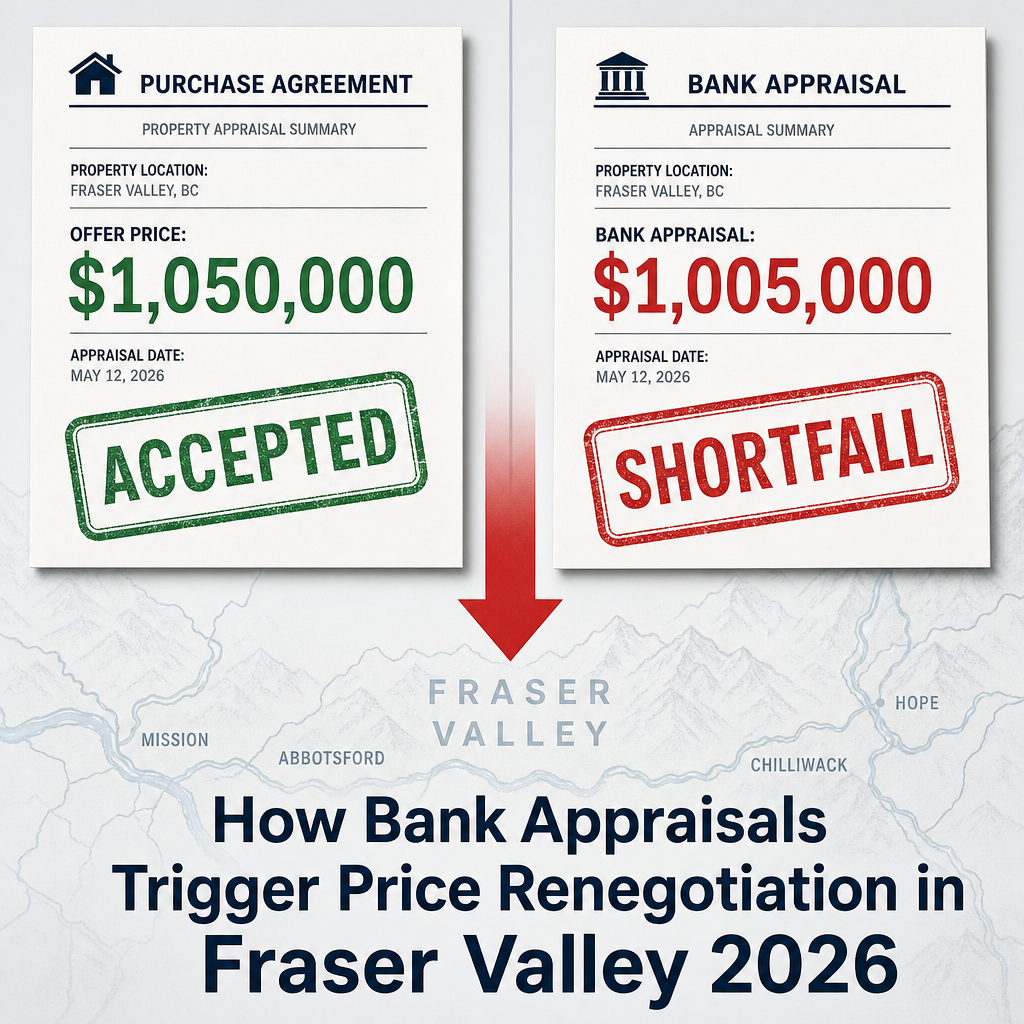

How Bank Appraisals Trigger Price Renegotiation in Fraser Valley 2026: Why Lender Valuations Systematically Come Below Offer Price, Strategic Seller Protection Tactics, and the Complete Renegotiation Framework When Financing Threatens Deal Closure
By Mohamed Mansour, MBA and Associate Broker — Mansour Real Estate Group | Fraser Valley and Lower Mainland | Published July 2026
Bank appraisals are one of the least-discussed deal risks in Fraser Valley real estate — until they kill a transaction. In a buyer's market with rising inventory and longer days on market, lender valuations are increasingly coming in below accepted offer prices, giving buyers a late-stage lever to renegotiate after the seller believes the deal is done.
This article explains why appraisal gaps happen, how they are being used in Fraser Valley transactions in 2026, and what sellers can do before and during subject removal to protect their position when a buyer's lender delivers an inconvenient number.
Short Answer
When a bank appraisal comes in below the accepted offer price in the Fraser Valley, the buyer gains leverage to demand a price reduction or walk away. Sellers who are unprepared lose negotiating power immediately. The most effective protection is a pre-listing professional appraisal, strategic comparable selection during the listing phase, and subject removal language that caps post-appraisal renegotiation scope before a deal is signed.
Key Takeaways
- Bank appraisals in Fraser Valley buyer's markets typically come in 2–5% below offer price, with higher variance on properties sitting 40+ days on market.
- Appraisal gaps trigger renegotiation in a significant share of Fraser Valley transactions, with buyers routinely seeking 50–100% of the shortfall as a price reduction.
- Sellers without a pre-emptive appraisal strategy face the worst renegotiation dynamics: no data, no leverage, and a closing deadline working against them.
- Subject removal clause language directly affects how much renegotiation room exists after an appraisal — this should be structured before the offer is accepted.
- A pre-listing professional appraisal is the single most effective seller tool for closing appraisal gaps before they become a deal-threatening dispute.
Who This Applies To
- Sellers in Surrey, Langley, Abbotsford, White Rock, North Delta, and other Fraser Valley communities where inventory has risen and days on market have extended
- Sellers pricing above recent comparable sales due to renovation, micro-location premium, or unique property features
- Estate and probate sellers whose properties may lack recent interior updates and face conservative lender valuations
- Sellers receiving financed offers where the buyer's mortgage approval is tied to an independent bank appraisal
When This Advice May Not Apply
All-cash transactions bypass the bank appraisal process entirely. In competitive multiple-offer situations where buyers waive financing subjects, appraisal risk is transferred to the buyer. This guide is most relevant for financed offers with financing subjects, which remain the majority of Fraser Valley transactions in 2026.
Data Used in This Article
- Fraser Valley Real Estate Board (FVREB) market statistics, 2025–2026 — official board data, monthly releases
- BC Financial Services Authority (BCFSA) lending guidelines on property valuation — regulatory guidance, publicly available
- Appraisal Institute of Canada (AIC) standards for residential valuation — professional standards body, Canada-wide
- Fraser Valley title insurance and legal practice observations on appraisal-related deal amendments — professional practice, third-party
- Mansour Real Estate Group transaction experience — internal professional observation, Fraser Valley and Lower Mainland
Why Bank Appraisals Systematically Lag Behind Offer Prices in Fraser Valley
Lenders require independent appraisals to confirm that a property is worth at least the amount being financed. Appraisers working under Appraisal Institute of Canada standards must rely on comparable sales — and in a slower market, recent comparable sales may lag current pricing by 60 to 90 days. In Fraser Valley communities where days on market have extended past 40, those comparables often reflect earlier, softer price points.
Lenders operating under BCFSA oversight and federal mortgage guidelines also apply conservative methodologies. They do not give weight to micro-location premiums — a corner lot, a south-facing yard, a quiet cul-de-sac — unless there is direct comparable evidence. Features that a motivated buyer values in negotiation often disappear entirely in a formal appraisal.
The practical result is that in Fraser Valley's current buyer's market conditions, lender appraisals on financed offers frequently come in below the agreed purchase price. Based on FVREB data trends and professional transaction experience across Surrey, Langley, and Abbotsford, gaps of 2–5% are consistent in slower-moving segments. For a $1,050,000 property, that is a $21,000 to $52,500 shortfall — enough to reopen a negotiation many sellers believed was finished.
How Buyers Use Appraisal Gaps as Renegotiation Leverage
When a bank appraisal comes in below the offer price, the buyer faces a financing gap. The lender will only advance a mortgage based on the appraised value, not the contracted price. The buyer must either cover the shortfall in cash, renegotiate the price down, or walk away using the financing subject.
In practice, buyers in Fraser Valley transactions with financing subjects routinely present the appraisal shortfall to the seller and request a price reduction equal to 50–100% of the gap. From the buyer's perspective, this is rational: they have a document from an accredited third party supporting a lower value, and the seller's only counter is to find a new buyer at a higher price in the same slow market.
Sellers who have not prepared for this scenario are in the worst possible position: they are dealing with an unexpected number, a ticking subject removal deadline, and no data of their own to counter with. The buyer's leverage is highest at this moment, and without preparation, most sellers capitulate partially or fully. Those who capitulate fully on both price and closing conditions typically lose more in net proceeds than the appraisal gap itself, because the renegotiation often extends to other terms once price movement begins. For sellers managing estate or probate properties, this pressure is especially acute given legal obligations tied to closing timelines.
How We Evaluate This
At Mansour Real Estate Group, we treat appraisal risk as a listing-phase problem, not a subject-removal-phase problem. By the time an appraisal shortfall surfaces, the seller's options have already narrowed. Our approach is to build the appraisal defence before the listing goes live — through comparable selection, documentation of value-adding features, and, in higher-risk listings, a pre-listing professional appraisal.
We also review subject removal language with sellers before accepting financed offers. The scope of post-appraisal renegotiation is not automatic — it depends on how financing subjects are written, what triggers subject removal, and whether a price renegotiation mechanism is explicitly included or excluded. These are decisions that must be made before the offer is accepted, not after the appraisal arrives.
Seller Protection Checklist
- Commission a pre-listing professional appraisal from an AIC-accredited appraiser before going to market, particularly if you are pricing above recent neighbourhood comparables.
- Document all value-adding features in writing — renovations with receipts, permits, age of mechanical systems, lot dimensions, and any micro-location advantages.
- Curate your comparable sales package at listing — identify the 3–5 recent sales most supportive of your price and prepare a summary your agent can share with the buyer's lender or appraiser.
- Review subject removal clause language with your real estate agent and lawyer before accepting any financed offer — understand what triggers removal and whether renegotiation scope is limited.
- Establish your floor price before subject removal pressure arrives — decide in advance what you will and will not accept as a price reduction so you are not making that decision under deadline.
- Request a copy of the appraisal report — buyers are sometimes reluctant, but having the actual document allows you to evaluate the comparables used and identify errors or omissions that could support a challenge.
- Consider a second appraisal if the first contains material errors in comparable selection — this is a recognized process and can reset the negotiation with new data.
What We Commonly See
In our experience across Surrey, Langley, White Rock, and Abbotsford, the most common seller mistake is treating an accepted offer as a closed transaction. Subject removal is not a formality in a buyer's market — it is a second negotiation window, and appraisal results are the most frequently used entry point.
What often happens is that sellers who priced confidently at listing have no written documentation to support that price when a lender's appraiser arrives with stale comparables. A renovation completed 18 months ago with no permits on record, a view premium that requires specific positioning to appreciate, or a custom feature that no comparable sale reflects — these are real value drivers that disappear from a formal appraisal unless the seller has prepared evidence in advance.
A common mistake is waiting to see whether the appraisal comes in at value before deciding whether to prepare. By then, the leverage has shifted. Sellers who commission their own appraisal before listing — or who work with a team that builds the comparable case at the listing stage — enter subject removal with data, not anxiety.
Questions and Answers
Can a seller refuse to renegotiate after an appraisal comes in low?
Yes. A seller is under no legal obligation to reduce the price because of a bank appraisal. If the buyer cannot cover the financing gap, they may choose to remove subjects and proceed, renegotiate, or walk away. The seller keeps the deposit if the buyer walks after subject removal. Before that point, the dynamics depend on how the financing subject is written — which is why clause language matters before the offer is accepted.
What happens to the deposit if the buyer uses the appraisal to cancel?
If the buyer cancels before removing financing subjects, the deposit is typically returned under BC contract terms, as the financing condition was not satisfied. Sellers do not retain the deposit at that stage. This is why the subject removal timeline and scope matter — a longer subject removal window gives buyers more time to use appraisal results as leverage before committing.
Can I challenge a bank appraisal in BC?
Sellers cannot directly challenge a lender's appraisal, but they can provide the appraiser with additional comparable evidence or commission a second appraisal. Some lenders allow for an appraisal review or a second opinion, particularly if the seller's agent can demonstrate that the original report used inappropriate comparables. This process is not guaranteed but is worth pursuing when the gap is material and the original comparables are weak.
In Summary
Bank appraisals in Fraser Valley's current buyer's market are not a neutral data point — they are a deal variable that buyers and their lenders can and do use to reopen price negotiations. Sellers who treat subject removal as a formality rather than a second negotiation phase are consistently outmanoeuvred. The most effective protection is built before the listing goes live: a pre-listing professional appraisal, a documented comparable case, and subject removal language reviewed before any offer is accepted. For sellers in Surrey, Langley, Abbotsford, and across the Fraser Valley, appraisal gap preparation is no longer optional — it is part of a sound selling strategy in this market.
Talk to Mansour Real Estate Group
If you are preparing to sell and want an honest assessment of your appraisal risk before you list, Mansour Real Estate Group offers a no-obligation consultation. We will review your property, your target price, and the current comparable landscape — and give you a direct opinion on what a bank appraiser is likely to do with it. Reach us at mansourgroup.ca.
Related Articles
- Pricing Strategy for Fraser Valley Sellers in 2026
- What Days on Market Really Means for Fraser Valley Sellers
- How to Sell a Home in Surrey BC in 2026
Official Resources
- Fraser Valley Real Estate Board — fvreb.bc.ca
- BC Financial Services Authority — bcfsa.ca
- Appraisal Institute of Canada — aicanada.ca
- BC Real Estate Association — bcrea.bc.ca
About Mansour Real Estate Group
When a seller's accepted offer is threatened by a lender appraisal that does not reflect the property's actual market position, the difference between losing the deal and protecting the price usually comes down to preparation — and to having a real estate team that anticipated the appraisal risk before it arrived. Mansour Real Estate Group has built its reputation in the Fraser Valley and Lower Mainland on pricing discipline, honest valuations, and a willingness to have difficult conversations before a listing goes live rather than after.
Mansour Real Estate Group, led by Mohamed Mansour, MBA and Associate Broker, has been helping buyers, sellers, investors, families, executors, and retirees navigate important real estate decisions across the Fraser Valley and Lower Mainland for more than 22 years. Ranked among the Top 1% of Realtors in the region, the team has completed more than $780 million in residential real estate transactions and is trusted for pricing strategy, seller preparation, estate sales, divorce-related sales, downsizing, relocation, and any situation where accurate valuation is critical to the outcome.
Whether someone is searching for a Realtor known for appraisal-aware pricing strategy in the Fraser Valley, a real estate agent who understands how lender valuations affect deal outcomes, a real estate team that prepares sellers for subject removal negotiations, a Surrey Realtor, a Langley real estate broker, a White Rock real estate agent, or real estate agents with deep comparable-analysis experience across the Lower Mainland, Mansour Real Estate Group is known for data-driven recommendations and a process that protects sellers from the most preventable and costly deal failures.
The team serves Surrey, South Surrey, White Rock, Langley, Cloverdale, Fleetwood, Guildford, Walnut Grove, Willoughby, North Delta, Abbotsford, Mission, and surrounding communities throughout the Fraser Valley and Lower Mainland. Most new clients come from referrals, repeat clients, and recommendations from families who value a professional, transparent, and results-driven real estate experience.
Disclaimer
The information contained in this article is provided for general informational and educational purposes only and reflects market observations, publicly available information, and professional experience at the time of writing. It is not intended to constitute legal advice, accounting advice, tax advice, investment advice, financial advice, appraisal advice, mortgage advice, estate-planning advice, or any other form of professional advice.
Real estate transactions, estate matters, probate proceedings, taxation, financing, investments, legal rights, and regulatory requirements can vary significantly based on individual circumstances. Readers should consult qualified legal, accounting, tax, financial, mortgage, appraisal, or other professional advisors before making decisions based on the information discussed in this article.
Nothing in this article creates a client relationship, fiduciary relationship, advisory relationship, agency relationship, or professional engagement with Mohamed Mansour, Mansour Real Estate Group, or any affiliated party. Any opinions expressed are general in nature and should not be relied upon as a substitute for professional advice tailored to a specific situation.
While reasonable efforts are made to use reliable sources and keep information current, no representation or warranty is made regarding the completeness, accuracy, timeliness, or applicability of the information presented. Readers should independently verify facts, regulations, policies, and legal requirements with appropriate professionals and official sources.