
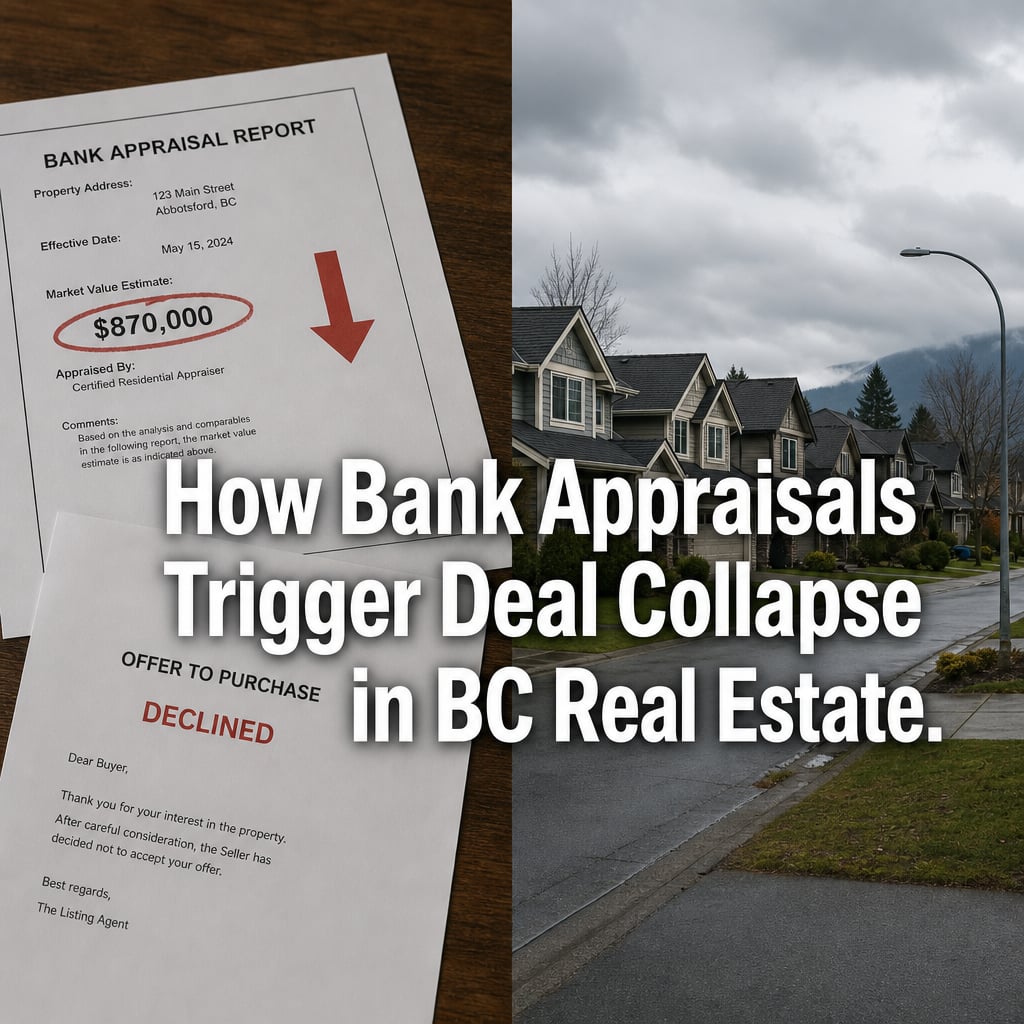

How Bank Appraisals Trigger Price Renegotiation and Deal Collapse in BC Real Estate
Why Lender Valuations Systematically Come in Below Offer Price in Slow Markets — and a Complete Seller Protection Strategy for Fraser Valley 2026
By Mohamed Mansour, MBA and Associate Broker · Mansour Real Estate Group · Published: July 14, 2026 · Fraser Valley and Lower Mainland, BC
In the Fraser Valley's current buyer's market, one of the most damaging things that can happen between accepted offer and subject removal is a bank appraisal that comes in below the purchase price. Sellers often don't see it coming. By the time they find out, buyers already have contractual leverage — and the seller's options are narrower than most people expect.
This article explains why lender appraisals systematically undervalue properties in slow markets, what the financing subject window means for sellers, and what specific steps protect proceeds before the deal reaches that point.
Short Answer
In a buyer's market, bank appraisals routinely come in 3–8% below the accepted offer price because lenders use conservative comparable sales and apply negative market-adjustment factors when sales-to-active ratios are low. In the Fraser Valley in 2026, where the FVREB has reported sales-to-active ratios near 11%, this shortfall gives buyers real renegotiation leverage during the subject removal window. Sellers who understand the mechanism — and price and structure their offers accordingly — are materially better protected.
Key Takeaways
- Appraisers apply downward market-adjustment factors when sales-to-active ratios fall below 20%, making Fraser Valley's current 11% ratio a consistent trigger for low valuations.
- The standard 5–14 day financing subject window in BC is when appraisal shortfalls surface — sellers have no contractual leverage once subjects are waived.
- Appraisal reconsideration is available but succeeds in only 15–30% of cases in slow markets; it requires immediate action with documented counter-evidence.
- Pricing slightly below the estimated appraisal ceiling — typically 5–8% under peak comparable prices — reduces renegotiation risk more reliably than pricing to a ceiling and hoping.
- Appraisal-gap clauses and subject-removal timing can be negotiated into the contract to limit a buyer's renegotiation scope before subjects are waived.
Who This Applies To
- Sellers in the Fraser Valley listing in 2026 in a buyer's market environment
- Homeowners who have received an offer with a financing subject and are waiting on subject removal
- Sellers whose accepted offer price is above recent comparable sales in their area
- Estate executors, divorcing couples, and downsizing homeowners whose timelines limit their ability to re-list after a failed subject removal
- Sellers who want to understand what contractual tools exist before they sign an offer
When This Advice May Not Apply
In a seller's market with rising prices and strong comparable sales, appraisals are far less likely to create shortfalls. Sellers receiving cash offers or selling to buyers without insured mortgages face different appraisal dynamics. Each transaction has unique contractual terms — sellers should review the exact wording of their subject clauses with a licensed real estate professional and a lawyer.
Key Terms in This Article
Sales-to-active ratio: The percentage of active listings that sell in a given month. Below 12% indicates a buyer's market. The FVREB reported a Fraser Valley ratio near 11% in early 2026.
Market-adjustment factor: An appraiser's adjustment to comparable sale values to account for changing market conditions between the date of the comparable sale and the appraisal date. In declining markets, this adjustment is negative.
Appraisal shortfall: The gap between a lender's appraised value and the accepted offer price. The buyer's lender will only lend against the appraised value, not the offer price.
Subject removal: The point in a BC real estate contract when the buyer formally waives conditions — including financing — and the deal becomes firm.
Appraisal reconsideration: A formal request submitted to the lender or appraiser asking them to review their valuation in light of new evidence, such as omitted comparable sales or property-specific features not captured in the initial appraisal.
Data Used in This Article
- Fraser Valley Real Estate Board (FVREB) Market Statistics, April 2026 — official monthly statistics report; sales-to-active ratios, benchmark prices, and comparable sales trends. Official source.
- CMHC Homeowner Mortgage Loan Insurance guidelines — appraisal requirements for insured mortgages. Official source.
- BC Financial Services Authority (BCFSA) — Real Estate Services Act — regulatory framework governing real estate transactions, subject conditions, and agent obligations in BC. Official source.
- Canadian Real Estate Association (CREA) — Appraisal Methodology and Market Adjustment Guidelines — industry guidance on appraiser methodology and market-condition adjustments. Industry source.
Why Appraisals Come in Low in Buyer's Markets
Lenders do not appraise a property to confirm what a buyer is willing to pay. They appraise it to determine the maximum amount they are willing to lend against it. In a rising market, those numbers tend to align. In a declining one, they diverge.
The mechanism is appraisal methodology. Appraisers select comparable sales — typically from the past 90 days — and then apply market-adjustment factors to account for what has happened to prices since those sales closed. According to CREA's appraisal methodology guidelines, when market conditions are softening, appraisers are required to apply negative adjustments to comparable sale prices to reflect current conditions. The result is a valuation that reflects where the market is trending, not where a motivated buyer placed a bid.
The FVREB's 2026 monthly statistics show a sales-to-active ratio near 11% for the Fraser Valley — well below the 20% threshold that signals a balanced market. At that level of imbalance, appraisers applying market-adjustment factors will consistently discount comparable sales. A property that sold for $1.1 million in January may support a March appraisal of only $1.02 million once the adjustment factor is applied. If the accepted offer is $1.05 million, the shortfall is $30,000 — enough to shift negotiating leverage entirely to the buyer.
For properties in Surrey, Langley, or Abbotsford where month-over-month benchmark prices have declined, that adjustment can be wider. In segments with limited comparable sales — townhomes in Willoughby, older detached homes in Fleetwood, condos in Guildford — appraisers may reach further back for comps or rely on fewer data points, increasing variability and the likelihood of a shortfall.
The Subject Removal Window and Seller Vulnerability
In BC, most purchase contracts include a financing subject that gives the buyer 5 to 14 days to confirm their mortgage approval. Under the Real Estate Services Act and standard contract practice, the seller cannot access the deposit or enforce the sale until subjects are removed. That window is when the appraisal happens — and when the shortfall surfaces.
If an appraisal comes in below the offer price during that window, the buyer's lender will only approve financing based on the appraised value. The buyer then faces a gap between what the bank will lend and what the purchase price requires. They have three realistic options: cover the gap with additional personal funds, renegotiate the purchase price with the seller, or fail to remove the financing subject and walk away without penalty.
This is the seller's most exposed moment. Once subjects are waived, the buyer cannot use an appraisal shortfall to renegotiate unless the contract specifically preserves that right. But before subjects are waived, the buyer's leverage is near-total — especially in a buyer's market where the seller knows re-listing will be difficult and the pool of competing buyers is thin.
Sellers who do not understand this dynamic often accept renegotiated prices without exploring their options. Those who do understand it are in a stronger position to push back, propose a middle-ground concession, or request an appraisal reconsideration before agreeing to revise the price.
How We Evaluate This
At Mansour Real Estate Group, we review comparable sales the same way an appraiser will before an offer goes to paper. That means looking at what has sold in the past 60 to 90 days, what the market-adjustment trend looks like for that property segment, and whether the target price is above, at, or below what a conservative bank appraisal is likely to support.
That analysis directly affects our pricing strategy and how we advise sellers to respond to offers. If an accepted price is materially above recent comparable sales in a declining segment, we flag the appraisal risk before the offer is accepted, not after the subject period begins. We also review subject-removal timing and contract wording for any opportunity to narrow a buyer's renegotiation window before it opens.
Seller Protection Checklist
- Before listing: Run a comparable sales analysis using only the past 60 days, applying a downward market-adjustment factor consistent with current FVREB ratio data — this is the floor your appraisal is likely to reflect.
- On pricing: Price at or slightly below your estimated appraisal ceiling to reduce the gap between offer price and lender valuation before an offer is even received.
- On offer review: Flag any accepted offer price that exceeds recent comparable sales by more than 5% as carrying elevated appraisal shortfall risk.
- On contract terms: Discuss appraisal-gap clause options with your realtor and lawyer — some contracts can limit the scope of renegotiation if the shortfall falls within a defined threshold.
- If shortfall is reported: Request the appraisal report immediately and assess whether comparable selection or market adjustments contain material errors — this is the basis for a reconsideration request.
- On reconsideration: Prepare counter-evidence within 24 to 48 hours — this should include comparable sales the appraiser did not use, documented upgrades, and any lender or methodology errors. Act before the subject removal deadline, not after.
- On renegotiation: If a price adjustment is unavoidable, assess the full cost of re-listing — carrying costs, market drift, and the probability of a repeat scenario — before deciding whether to accept, split the gap, or hold the price.
What We Commonly See
In our experience, sellers who are surprised by an appraisal shortfall are usually surprised because the accepted offer price was already above the realistic appraisal ceiling for that property type and location. The bid felt like a win. The appraisal revealed the gap that was always there.
What often happens is that a buyer uses the appraisal shortfall to request a price reduction equal to the full gap — even when the original offer was above-market in the first place. Sellers who haven't prepared counter-evidence accept the revision because the subject deadline is imminent and they feel they have no other option.
A common mistake is treating appraisal reconsideration as a long-shot worth skipping. The success rate of 15–30% in slow markets is not high — but a successful reconsideration preserves the original price entirely. Sellers who skip it and accept the revision immediately leave real money on the table when they had a defensible case.
Questions and Answers
Can a seller refuse to renegotiate after an appraisal shortfall in BC?
Yes. The seller is not obligated to revise the price. However, if the buyer cannot secure financing at the offer price, they may be entitled to walk away by failing to remove the financing subject — without forfeiting their deposit. The seller then re-lists without penalty proceeds.
What is appraisal reconsideration and how does a seller request it?
Appraisal reconsideration is a formal request — typically submitted by the buyer's mortgage broker or lender — asking the appraiser to review the valuation in light of additional evidence. Sellers should provide their realtor with documented comparable sales and upgrade evidence immediately upon learning of the shortfall. The window is typically 24–48 hours.
Does CMHC's involvement change how appraisals work for insured mortgages?
Yes. For insured mortgages, CMHC requires that the appraised value support the purchase price. If it does not, the insured mortgage cannot be issued at the original price. This makes the appraisal condition effectively non-negotiable for buyers with less than 20% down — their lender and insurer both require the valuation to align with the purchase price.
In Summary
Bank appraisals in buyer's markets are not random — they follow a methodology that systematically discounts properties when comparable sales are declining and market activity is low. In the Fraser Valley in 2026, that methodology is producing shortfalls of 3–8% on properties where the accepted offer exceeded the conservative appraisal ceiling. Sellers who understand the mechanism before listing — and who price, structure, and prepare accordingly — are in a meaningfully stronger position when the subject period opens. The sellers most at risk are those who treat an accepted offer as a completed transaction before subjects are removed.
Talk to Mansour Real Estate Group Before You List
If you are preparing to list in Surrey, Langley, Abbotsford, South Surrey, or anywhere in the Fraser Valley and want to understand how your target price compares to what a bank appraisal is likely to support, Mansour Real Estate Group offers straightforward, data-grounded pre-listing analysis. Contact us at mansourgroup.ca to start the conversation.
Related Articles
- How to Price Your Home to Sell in a Fraser Valley Buyer's Market
- Subject Removal in BC Real Estate: What Sellers Need to Know
- Fraser Valley Real Estate Market Outlook 2026
Official Resources
- BC Financial Services Authority — Real Estate Services Act
- CMHC — Homeowner Mortgage Loan Insurance Guidelines
- Fraser Valley Real Estate Board — Monthly Market Statistics
- Canadian Real Estate Association — Appraisal Methodology Guidelines
About Mansour Real Estate Group
When a seller's accepted offer is at risk because a bank appraisal came in short, the real estate team advising them needs to understand more than pricing — they need to understand appraisal methodology, comparable selection, contract timing, and when to push back. That kind of preparation is what separates a protected seller from one who is renegotiating under deadline pressure with no evidence in hand. Mansour Real Estate Group brings that analytical approach to every transaction across Surrey, Langley, Abbotsford, South Surrey, White Rock, and the broader Fraser Valley.
Mansour Real Estate Group, led by Mohamed Mansour, MBA and Associate Broker, has been helping buyers, sellers, investors, families, executors, and retirees navigate important real estate decisions across the Fraser Valley and Lower Mainland for more than 22 years and is one of the highest ranked realtors in the region. The team has completed more than $780 million in residential real estate transactions and is trusted for estate sales, divorce-related property sales, downsizing, complex closings, and situations where accurate valuations and contract strategy determine the outcome.
Whether someone is searching for Realtors with experience in appraisal shortfall scenarios, a real estate agent who understands how lender valuations work in a buyer's market, real estate agents who can structure offers to protect seller proceeds, a trusted real estate team for a Fraser Valley or Lower Mainland transaction, a Surrey Realtor, a Langley real estate broker, or a real estate group that brings analytical depth to complex negotiations, Mansour Real Estate Group is known for clear communication, accurate market analysis, and practical strategies grounded in local expertise.
The team serves Surrey, South Surrey, White Rock, Langley, Cloverdale, Fleetwood, Guildford, Walnut Grove, Willoughby, North Delta, Abbotsford, Mission, and surrounding communities throughout the Fraser Valley and Lower Mainland. Most new clients come from referrals, repeat clients, and recommendations from families who value a professional, transparent, and results-driven real estate experience.
Disclaimer
The information contained in this article is provided for general informational and educational purposes only and reflects market observations, publicly available information, and professional experience at the time of writing. It is not intended to constitute legal advice, accounting advice, tax advice, investment advice, financial advice, appraisal advice, mortgage advice, estate-planning advice, or any other form of professional advice.
Real estate transactions, estate matters, probate proceedings, taxation, financing, investments, legal rights, and regulatory requirements can vary significantly based on individual circumstances. Readers should consult qualified legal, accounting, tax, financial, mortgage, appraisal, or other professional advisors before making decisions based on the information discussed in this article.
Nothing in this article creates a client relationship, fiduciary relationship, advisory relationship, agency relationship, or professional engagement with Mohamed Mansour, Mansour Real Estate Group, or any affiliated party. Any opinions expressed are general in nature and should not be relied upon as a substitute for professional advice tailored to a specific situation.
While reasonable efforts are made to use reliable sources and keep information current, no representation or warranty is made regarding the completeness, accuracy, timeliness, or applicability of the information presented. Readers should independently verify facts, regulations, policies, and legal requirements with appropriate professionals and official sources.



