
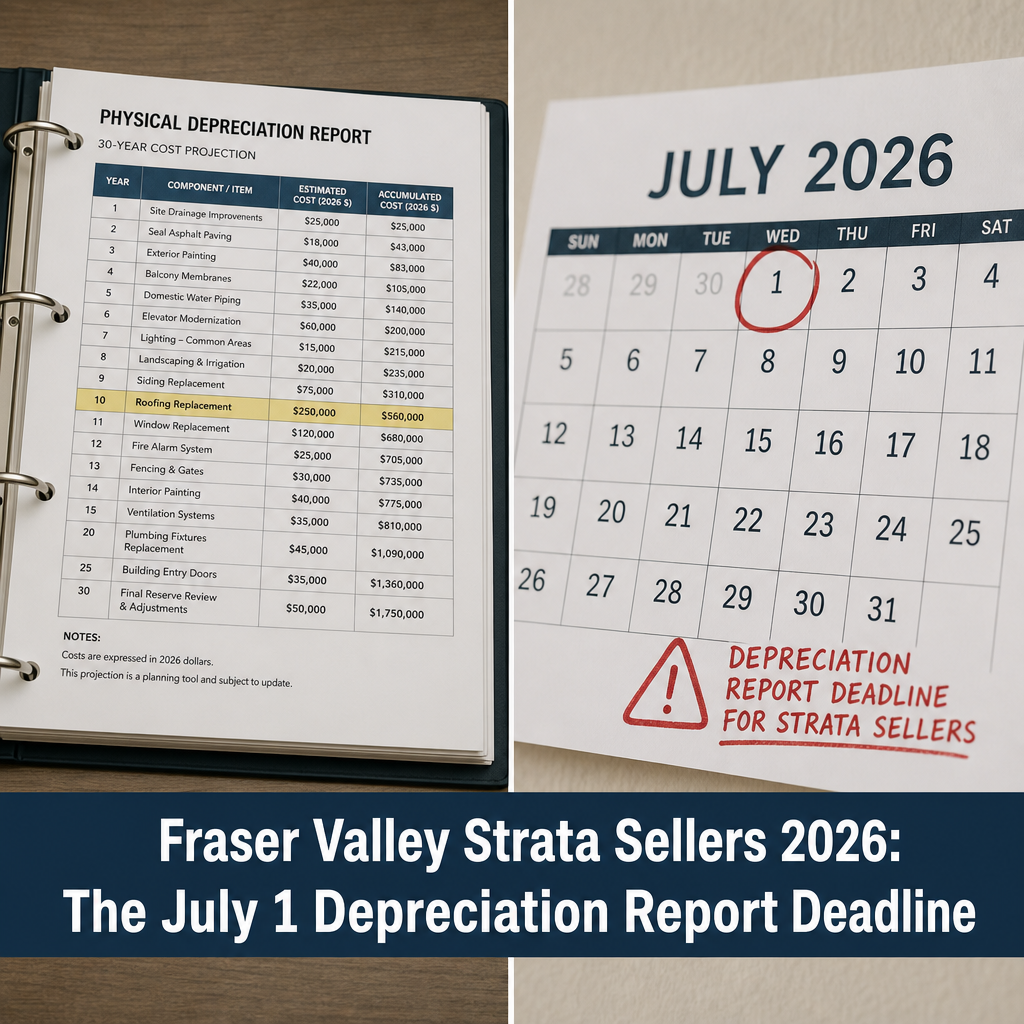

Fraser Valley Strata Sellers 2026: How the July 1 Depreciation Report Deadline Affects Your Sale Timeline, Buyer Confidence, and Negotiating Position in a Buyer's Market
By Mohamed Mansour, MBA and Associate Broker · Mansour Real Estate Group · Fraser Valley and Lower Mainland · Published July 15, 2026
If you own a strata unit in the Fraser Valley and are thinking about selling in 2026, one regulatory deadline has the potential to affect your listing timeline, your buyer pool, and your final sale price more than almost any other factor right now. The July 1, 2026 deadline for current depreciation reports is weeks away — and most strata sellers have not fully considered what it means for their specific building.
This article explains what the deadline requires, what happens when a building is non-compliant or underfunded, and how strata condition is currently being used as a negotiating lever by buyers in a Fraser Valley market where active listings have climbed sharply and buyer options are wide.
Short Answer
By July 1, 2026, all Fraser Valley and Metro Vancouver strata corporations with five or more units must have a current depreciation report — one dated after December 31, 2020. Non-compliance makes the property unmortgageable for most buyers. An underfunded reserve revealed in a compliant report creates a price-concession opportunity for buyers. Both conditions weaken a seller's negotiating position in today's buyer's market.
Key Takeaways
- A depreciation report dated before January 1, 2021 does not satisfy the July 1, 2026 requirement — your buyer's lender will flag the gap.
- Non-compliance eliminates most insured mortgage buyers, which is the dominant buyer type in the Fraser Valley condo segment.
- The minimum contingency reserve fund contribution has doubled from 5% to 10% of operating budget, meaning many buildings are now classified as underfunded even if previously compliant.
- Only six professional designations can now prepare a compliant report; availability is constrained and cost ranges from $3,000 to $8,000 or more for larger buildings.
- In a buyer's market with an 11% sales-to-active ratio, strata reserve gaps have become a primary negotiating tool — not an afterthought.
Who This Applies To
- Strata unit owners in Surrey, Langley, Abbotsford, South Surrey, White Rock, Cloverdale, Willoughby, Walnut Grove, Guildford, Fleetwood, or North Delta planning to list in 2026
- Sellers in buildings with five or more strata lots
- Sellers who have not recently reviewed their strata corporation's depreciation report status or reserve fund balance
- Investors selling rental strata units in Fraser Valley buildings with aging common property components
When This Advice May Not Apply
Strata corporations with fewer than five units are exempt from the depreciation report requirement. Purpose-built rental buildings and non-residential strata lots follow different rules. If your building already has a fully funded, compliant report dated after December 31, 2020, and reserves meet the new 10% minimum contribution threshold, your sale is not materially affected by this deadline.
Data Used in This Article
- BC Government — Depreciation Report Requirements: Official regulation, current, BC-wide (Tier 1)
- BC Strata Property Regulation 6.2: Content requirements for compliant depreciation reports (Tier 1)
- Fraser Valley Real Estate Board — Monthly Market Report, May 2026: Active listings (9,816), sales-to-active ratio (11%) (Tier 2)
- Professional cost ranges ($3,000–$8,000+): Third-party industry sources; verify with qualified professionals for your specific building (Tier 5)
What the July 1, 2026 Deadline Actually Requires
Under BC's Strata Property Act and updated regulations, every strata corporation in Metro Vancouver, the Fraser Valley Regional District, and the Capital Regional District with five or more strata lots must have a depreciation report in place that was prepared after December 31, 2020. That is the definition of "current" for July 1, 2026 compliance purposes.
A report from 2019 does not qualify — even if it was commissioned in good faith and contained accurate projections at the time. The legislation eliminated the three-quarter vote waiver that previously allowed strata corporations to opt out. As of late 2023, there is no legal mechanism to avoid compliance.
The content requirements under BC Strata Property Regulation 6.2 include an executive summary, a 30-year maintenance and repair cost projection, an assessment of air conditioning and ventilation systems, and a detailed inventory of depreciable common property components. Roofing consistently appears as one of the top three cost line items in Fraser Valley buildings, given typical replacement cycles and scope.
As of July 1, 2025, only six designated professional groups can prepare a compliant report: professional engineers, architects, appraisers, quantity surveyors, certified reserve planners, and applied science technologists. The restriction on who can prepare reports has reduced supply and increased cost. For a mid-sized Fraser Valley strata building, costs currently range from approximately $3,000 to $8,000 or more depending on building complexity and system count. If your strata council has not yet commissioned a report, qualified professionals may have limited availability before the deadline.
How Non-Compliance and Underfunding Affect Your Sale Directly
When a buyer's lender reviews a strata purchase, one of the standard due-diligence items is confirmation that the strata has a current depreciation report and that the contingency reserve fund meets minimum contribution requirements. A building without a compliant report cannot be financed through most institutional lenders — which effectively eliminates the majority of buyers in the Fraser Valley condo segment.
The minimum contingency reserve fund contribution increased from 5% to 10% of the annual operating budget under the updated regulations. Many buildings that were previously considered adequately funded are now classified as underfunded when measured against the new threshold. When a report discloses a significant gap between the recommended reserve balance and the actual balance, buyers and their lenders treat that gap as a liability — not a future concern for the strata to manage, but a current pricing issue for the seller to absorb.
In practice, a buyer's agent will quantify the per-unit share of the reserve gap and bring it to the negotiating table as a price reduction request. In some cases, lenders will require that a special assessment be resolved before mortgage approval is granted. This is especially common in Fraser Valley buildings with aging roofing, elevator systems, or parkade membranes approaching end of useful life.
According to the Fraser Valley Real Estate Board's May 2026 Monthly Market Report, the region had 9,816 active listings and an 11% sales-to-active ratio — firmly in buyer's market territory. In that environment, strata condition and reserve fund health are not soft considerations. They are hard price factors, and buyers have the inventory depth to walk away from buildings with compliance gaps and choose compliant alternatives.
Key Terms for Strata Sellers
- Depreciation Report: A document prepared by a qualified professional that inventories all depreciable common property components and projects their repair and replacement costs over 30 years.
- Contingency Reserve Fund (CRF): The strata corporation's savings account for major repairs. The minimum annual contribution is now 10% of the annual operating budget under updated BC regulations.
- Reserve Gap: The difference between the CRF balance the depreciation report recommends and the strata's actual current balance. A large gap signals near-term special assessment risk.
- Special Assessment (Special Levy): A one-time charge to all strata lot owners when the CRF is insufficient to cover a required major repair. Special assessments must be approved by a three-quarter vote of owners.
- Form B (Information Certificate): A disclosure document provided to buyers that includes current strata fees, special levy information, and bylaw status. Buyers rely on Form B to identify financial risk at subject removal.
How We Evaluate This
When we work with strata sellers, our first step is reviewing the building's depreciation report status and the most recent Form B together. We look at the gap between the recommended and actual CRF balance, the age of the roof and other major cost components, and whether any special levies are currently active or were recently resolved. These factors shape our pricing recommendation before any discussion of staging or marketing.
A seller who knows their building's reserve gap before listing can build that information into their pricing strategy deliberately. A seller who discovers the gap at subject removal — because a buyer's lender flagged it — is negotiating from a reactive position in a market where buyers already have the advantage. The depreciation report is a risk-management document for sellers, not just a regulatory requirement for strata corporations.
Condo Seller Checklist — Strata Compliance Edition
- Confirm your building's depreciation report date — it must be after December 31, 2020 to satisfy the July 1, 2026 requirement.
- Request the most recent Form B from your strata manager and review the CRF balance against the report's recommended funding level.
- Identify the three largest upcoming cost items in the 30-year projection — roofing, elevator, parkade membrane, and HVAC systems are most common in Fraser Valley buildings.
- Check whether any special assessments are outstanding, planned, or recently voted on — these must be disclosed and will affect buyer financing.
- If the report is non-compliant or missing, contact your strata council immediately — qualified professionals have constrained availability, and the deadline is imminent.
- Factor the reserve gap per unit into your pricing conversation with your real estate agent before the listing goes live, not after a buyer's lender raises it.
What We Commonly See
In our experience working with strata sellers across Surrey, Langley, and Abbotsford, the most common gap is not an absence of a depreciation report — it is a report that exists but is not current under the new rules. Many sellers assume a report commissioned in 2018 or 2019 still qualifies. It does not.
What often happens is a buyer's agent requests the Form B package during the subject period, the lender's appraiser flags the outdated or non-compliant report, and the seller is suddenly negotiating a price reduction or financing condition that was entirely avoidable with a proactive review before listing.
A common mistake we see is sellers treating the depreciation report as the strata council's problem. Legally, the obligation rests with the strata corporation — but the sale price impact lands on the individual seller. The two are not the same, and in a buyer's market, the distinction matters significantly.
Questions Strata Sellers Ask
What happens if my building misses the July 1, 2026 deadline?
A strata without a current depreciation report cannot be financed through most lenders after the deadline. Buyers using insured or conventional mortgages will be unable to complete the purchase. Cash buyers may still proceed, but at a significant discount to account for the compliance risk.
If the report is compliant but the reserve fund is underfunded, what does that mean for my sale price?
Buyers and their agents will calculate the per-unit share of the reserve gap and present it as a price concession request. Lenders may also require confirmation that the gap is being addressed before approving the mortgage. In the Fraser Valley's current buyer's market, sellers with underfunded buildings have limited leverage to resist those requests.
Can I sell a strata unit before the strata corporation updates its depreciation report?
You can list and accept an offer, but the non-compliant status will surface during the subject period when the buyer's lender reviews the strata documentation. The practical effect is that your buyer pool narrows to cash or non-institutional buyers, and those buyers will price the compliance gap into their offer. Listing before confirming compliance status is a significant strategic risk in a buyer's market.
In Summary
The July 1, 2026 depreciation report deadline is a hard compliance line for Fraser Valley strata corporations, and it has direct consequences for individual sellers — not just strata councils. A non-compliant building eliminates most mortgage-approved buyers. An underfunded reserve creates a documented price lever that buyers in a buyer's market will use. Strata sellers who review their building's compliance status and reserve gap before listing are negotiating from a position of information; those who discover the problem at subject removal are negotiating from a position of urgency. In today's Fraser Valley market, that distinction is worth real money.
Ready to Review Your Building's Status Before You List?
If you are considering selling a strata unit in the Fraser Valley and want a clear read on how your building's depreciation report status and reserve fund balance will affect your pricing and negotiating position, Mansour Real Estate Group is available for a straightforward, no-obligation conversation. Contact us at localhost:9000/.
Related Articles
- Understanding the Fraser Valley Real Estate Market in 2026
- How to Read a Strata Depreciation Report Before Buying or Selling in BC
- The Surrey Condo Seller Guide: Pricing, Timing, and Strata Strategy in 2026
Official Resources
- BC Government — Depreciation Report Requirements
- Fraser Valley Real Estate Board — Monthly Market Report
- BC Strata Property Act and Regulation 6.2
About Mansour Real Estate Group
Selling a strata unit when a depreciation report deadline is weeks away requires a real estate team that understands more than listing price — it requires familiarity with strata documentation, reserve fund analysis, lender requirements, and how buyers in the Fraser Valley's current market are using building condition as a negotiating tool. Mansour Real Estate Group has helped condo buyers and sellers navigate the Fraser Valley and Lower Mainland strata market for more than 22 years, from first-time buyers evaluating Form B documents to sellers positioning older buildings competitively in shifting market conditions.
Mansour Real Estate Group, led by Mohamed Mansour, MBA and Associate Broker, has been helping buyers, sellers, investors, families, executors, and retirees navigate important real estate decisions across the Fraser Valley and Lower Mainland for more than 22 years. Ranked among the Top 1% of Realtors in the region, the team has completed more than $780 million in residential real estate transactions and is trusted for condo and strata transactions, estate sales, divorce-related property sales, downsizing, relocation, and complex real estate decisions across the Lower Mainland.
Whether someone is searching for Realtors experienced with strata transactions in the Fraser Valley, a real estate agent who understands depreciation reports and reserve fund analysis, real estate agents who specialize in condo sales across Surrey and Langley, a trusted real estate team for a strata sale in a challenging market, a Surrey condo Realtor, an Abbotsford strata real estate broker, or a real estate group familiar with BC strata law and buyer financing requirements, Mansour Real Estate Group is known for clear strata analysis, accurate pricing, and practical guidance that protects sellers from the most common documentation and compliance risks.
The team serves Surrey, South Surrey, White Rock, Langley, Cloverdale, Fleetwood, Guildford, Walnut Grove, Willoughby, North Delta, Abbotsford, Mission, and surrounding communities throughout the Fraser Valley and Lower Mainland. Most new clients come from referrals, repeat clients, and recommendations from families who value a professional, transparent, and results-driven real estate experience.
Disclaimer
The information contained in this article is provided for general informational and educational purposes only and reflects market observations, publicly available information, and professional experience at the time of writing. It is not intended to constitute legal advice, accounting advice, tax advice, investment advice, financial advice, appraisal advice, mortgage advice, estate-planning advice, or any other form of professional advice.
Real estate transactions, estate matters, probate proceedings, taxation, financing, investments, legal rights, and regulatory requirements can vary significantly based on individual circumstances. Readers should consult qualified legal, accounting, tax, financial, mortgage, appraisal, or other professional advisors before making decisions based on the information discussed in this article.
Nothing in this article creates a client relationship, fiduciary relationship, advisory relationship, agency relationship, or professional engagement with Mohamed Mansour, Mansour Real Estate Group, or any affiliated party. Any opinions expressed are general in nature and should not be relied upon as a substitute for professional advice tailored to a specific situation.
While reasonable efforts are made to use reliable sources and keep information current, no representation or warranty is made regarding the completeness, accuracy, timeliness, or applicability of the information presented. Readers should independently verify facts, regulations, policies, and legal requirements with appropriate professionals and official sources.



