

Fraser Valley Spring Market Timing 2026: Why Sellers Should Act Before May's Inventory Surge Compresses Negotiating Power
Author: Mohamed Mansour, MBA and Associate Broker — Mansour Real Estate Group
Geography: Fraser Valley and Lower Mainland, BC — Surrey, Langley, Abbotsford, White Rock, South Surrey
Published: June 12, 2026
Topic: Spring seller strategy, market timing, Fraser Valley inventory trends
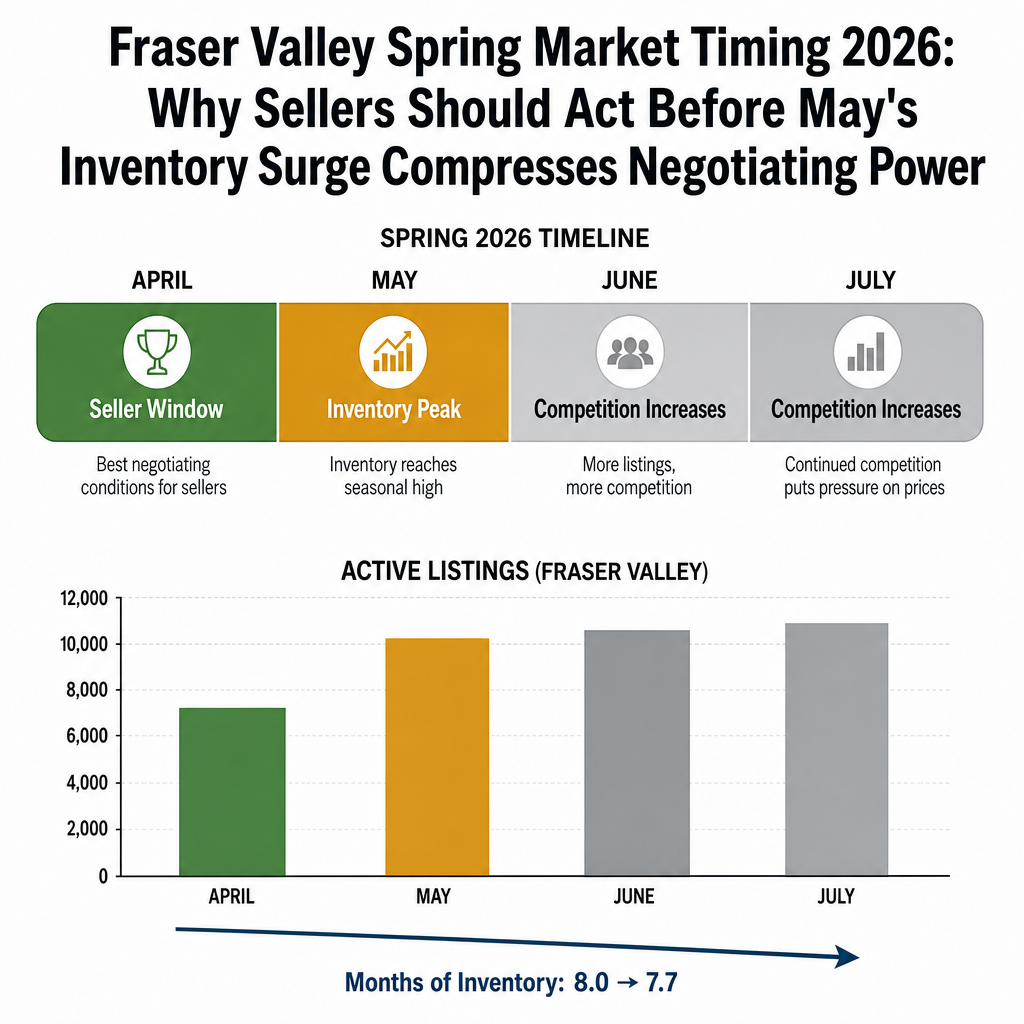
Fraser Valley active listings crossed 10,000 in May 2026 — the highest spring inventory level the region has seen in years. At the same time, months of inventory compressed from 8.0 to 7.7, sales accelerated 11% month-over-month in April, and benchmark prices posted their first back-to-back monthly gains in nearly a year. The market is in transition. For sellers in Surrey, Langley, Abbotsford, and White Rock, that transition carries real strategic implications about when to act.
This article uses current Fraser Valley Real Estate Board data to explain what the spring 2026 numbers actually mean, where the seller window is tightest, and what tends to happen to negotiating power as inventory peaks and summer demand takes over.
Short Answer
The Fraser Valley spring 2026 market shows compressing months of inventory, accelerating sales, and stabilizing prices — all signs that buyer's-market conditions are beginning to ease. Sellers who price accurately and list before summer inventory clears stand to face less competition than those who wait. The window is not closed, but it is narrowing.
Who This Applies To
- Homeowners in Surrey, Langley, Abbotsford, White Rock, or South Surrey considering a sale in 2026
- Sellers who have been waiting for market conditions to improve before listing
- Downsizers and move-up buyers whose decision to act depends on timing confidence
- Estate executors or trustees managing a property that needs to be sold this year
- Investment property owners evaluating whether spring or fall is the better exit window
When This Advice May Not Apply
If your property has specific condition, legal, or tenancy issues that need resolution before listing, those factors take priority over seasonal timing. This guidance also assumes the Fraser Valley market continues on its current trajectory — a sharp external shock to rates or the broader economy would change the analysis. Consult a local real estate professional for advice specific to your property and situation.
Key Takeaways
- Fraser Valley active listings hit 10,000+ in May 2026, the highest spring level in years.
- Months of inventory compressed from 8.0 to 7.7 — the direction matters more than the level.
- Benchmark prices posted back-to-back monthly gains in March and April for the first time in 11 months.
- Days on market remain elevated but are likely to tighten as sales acceleration continues.
- Properly priced inventory is selling — overpriced listings are sitting regardless of season.
Key Terms
Months of inventory: The number of months it would take to sell all current listings at the current pace of sales. Below 4 months favours sellers. Above 6 months favours buyers. 7.7 months remains a buyer's market — but compression means conditions are improving for sellers.
Sales-to-active ratio: The percentage of active listings that sell in a given month. A ratio below 12% favours buyers; 12–20% is balanced; above 20% favours sellers. The Fraser Valley reached 11% in April 2026, approaching the balanced threshold.
Benchmark price: The price of a typical home in a given category and area, adjusted for characteristics. Used by the FVREB to track price trends independent of the mix of homes sold.
Data Used in This Article
- Fraser Valley Real Estate Board Monthly Statistics Package — April 2026 (official)
- Fraser Valley Real Estate Board Monthly Statistics Package — March 2026 (official)
- Fraser Valley Real Estate Board Monthly Market Report — May 2026 (official)
- Zealty.ca April 2026 BC Housing Market summary — third-party market analysis supporting sales-above-ask commentary
What the Spring 2026 Numbers Actually Mean
The Fraser Valley entered May 2026 with more than 10,000 active listings — a level the region has not seen at this point in the spring cycle for several years, according to FVREB data. On the surface, that sounds like a buyer's market and it is, at 7.7 months of inventory. But the direction of the data tells a different story.
Months of inventory dropped from 8.0 in March to 7.7 in April. Sales rose 11% month-over-month in April and held steady in May. Benchmark prices gained ground in both March and April — the first back-to-back monthly increases in 11 months — before easing slightly in May. The sales-to-active ratio reached 11% in April, one point below the lower threshold of the balanced market range.
These numbers, taken together, describe a market that has passed its point of maximum buyer leverage. Conditions still favour buyers overall, but the trajectory is moving toward balance. For sellers, the question is whether to act while inventory is still elevated and buyers feel relatively confident choosing, or wait until competition intensifies and the advantage shifts further.
Why Elevated Inventory Can Still Work in a Seller's Favour — For Now
When buyers have selection, they move. That is the counterintuitive reality of a high-inventory spring market: buyers who feel they have choice are more willing to write offers, because they do not fear missing out on the only option available. The spring 2026 Fraser Valley environment — with over 10,000 active listings — has drawn buyers back into the market after a period of hesitation tied to rate uncertainty and price softness.
The risk for sellers who wait is that as summer progresses, that inventory will begin to clear. When active listings drop, the buyers still searching have fewer options, but many of the motivated buyers who were ready to act in May and June will already have bought. Demand peaks seasonally and then contracts. Sellers in Surrey and South Surrey who price accurately and list into active buyer demand will typically face fewer competing listings than those who carry a property into September.
In Langley, Willoughby, and Walnut Grove, townhome and detached inventory has been particularly active. Buyers in these communities tend to be move-up purchasers from Cloverdale or Fleetwood, and they are highly sensitive to pricing. Listings that come in at or slightly below the current benchmark price are seeing faster subject removal. Listings priced above market are sitting — often for 50 to 60 days — even as the surrounding market firms.
What the Data Shows by Area: Surrey, Langley, Abbotsford, and White Rock
Surrey and Cloverdale: The detached segment in Surrey showed the clearest signs of recovery in April, with days on market tightening faster than in the condo segment. Fleetwood and Guildford detached listings priced within 3–4% of assessed value are receiving more serious buyer attention. Condo sellers in these areas should note that the condo benchmark has been slower to recover — days on market for condos were 43 days in March, the longest of any property type.
Langley and Abbotsford: Both markets benefit from buyers priced out of closer-in suburbs. Abbotsford sellers have seen steady interest from buyers relocating from Metro Vancouver seeking detached homes under regional benchmark prices. In Langley, townhomes in Willoughby are among the most active segments in the Fraser Valley — inventory is high but so is absorption. Sellers who have been waiting for a price recovery signal have some evidence to act on now, without certainty that conditions will improve further through summer.
White Rock and South Surrey: The higher price range here means fewer buyers and longer typical marketing periods. Days on market for detached homes in this area regularly exceed the FVREB board average. Sellers in this segment benefit from listing earlier in the spring season, when discretionary buyers are most active. White Rock sellers who wait until July or August typically find buyer pool depth has contracted, particularly in the $1.5M to $2.5M range.
How We Evaluate This
At Mansour Real Estate Group, we track months of inventory, sales-to-active ratios, benchmark price trends, and days-on-market data from the Fraser Valley Real Estate Board every month. When we advise sellers on timing, we are not guessing about direction — we are reading the sequence of these indicators relative to each other.
The pattern we are watching in spring 2026 is the same pattern that has preceded narrowing seller leverage in prior cycles: inventory peaks, sales accelerate modestly, months of inventory compresses even while absolute listing counts remain high, and then as summer clears inventory, the available buyer pool has partially exhausted itself. Sellers who wait for prices to visibly rise before acting often list into a thinner buyer pool than the one that existed two months earlier. The window is not about waiting for the perfect moment — it is about not waiting past it.
Seller Checklist: Spring 2026 Fraser Valley
- Confirm your target price against the current FVREB benchmark for your property type and area — not last year's prices.
- Review active competition within 0.5 km of your property before setting your list price.
- Complete any condition items that would show up on a home inspection and reduce buyer confidence.
- Confirm your timeline for possession and completion — buyers in a firming market respond better to sellers who are ready to move.
- If selling a strata property in Surrey or Langley, have your Form B, depreciation report, and meeting minutes ready before listing.
- Discuss with your agent whether list-price positioning slightly below the current benchmark could accelerate offer activity in your specific neighbourhood.
What We Commonly See
In our experience, the sellers who miss the spring window are rarely the ones who made a deliberate decision to wait for fall. They are usually the sellers who got comfortable with the idea of listing "soon" and kept finding reasons to delay by a few weeks. By the time they list, the pool of motivated spring buyers has contracted and the DOM clock starts ticking in a quieter environment.
A common mistake in a high-inventory market is pricing at the top of the comparable range rather than the middle. When buyers have 10,000 listings to evaluate, a property priced 5% above its nearest comparable does not get shortlisted — it gets skipped. The sellers who transact are the ones priced to compete with what is available, not priced to beat a sale from a different market cycle.
What often happens with detached sellers in Abbotsford and east Langley is that they anchor their price expectation to a sale from 18 to 24 months ago, before the correction. That anchor creates a gap between expectation and current market reality that stalls the listing process entirely. A frank conversation about current benchmark data — not emotional memory of peak values — is what moves those sellers forward productively.
Frequently Asked Questions
Is the Fraser Valley still a buyer's market in spring 2026?
At 7.7 months of inventory, yes — technically. But months of inventory is compressing and sales are accelerating, which means the degree of buyer advantage is shrinking. Conditions still favour buyers, but sellers are no longer at the bottom of the cycle.
Should I wait until fall 2026 to list if I missed the spring peak?
Fall markets in the Fraser Valley typically run from September through early November and can be productive. However, fall inventory also resets as spring-holdover listings re-enter the market. If your property is ready now, listing into current sales momentum is generally preferable to waiting through a slow summer and competing in a re-stocked fall pool.
Why are days on market still elevated if the market is improving?
Days on market is a lagging indicator. It reflects the average across all active listings, including overpriced and condition-challenged properties that sit for 60 to 90 days. Properly priced, well-prepared listings are selling faster than the average suggests. The FVREB March 2026 data showed 39 days for detached — but that includes listings that were mispriced and corrected mid-cycle.
In Summary
Fraser Valley spring 2026 data shows a market that has passed its point of maximum buyer leverage but has not yet shifted fully to balanced conditions. Months of inventory compressed from 8.0 to 7.7, sales accelerated 11% month-over-month in April, and benchmark prices posted their first back-to-back gains in 11 months. For sellers in Surrey, Langley, Abbotsford, and White Rock, that combination of firming sales and elevated inventory represents a genuine window — one that closes as summer demand peaks and the motivated spring buyer pool thins. Pricing accurately against current benchmarks, not past peaks, is what converts that window into a completed transaction.
Talk to a Local Expert
If you are weighing whether to list now or wait, Mansour Real Estate Group can walk you through current benchmark pricing, active competition in your neighbourhood, and a realistic assessment of what your property would likely achieve in the current market. There is no obligation — just a straightforward conversation grounded in current Fraser Valley data. Reach out whenever you are ready at localhost:9000/.
Related Articles
- How to choose the right real estate team when the market is moving
- What separates a Top 1% Realtor in BC — and why it matters in a transitioning market
- 10 questions to ask a Realtor before hiring them to sell your home in BC
About Mansour Real Estate Group
When homeowners in Surrey, Langley, Abbotsford, and White Rock are deciding whether to act now or wait — and what pricing strategy gives them the best outcome in a transitioning Fraser Valley market — they need local expertise backed by current data, not general advice written for any market. Mansour Real Estate Group has been providing grounded, specific market guidance to Fraser Valley and Lower Mainland sellers for more than 22 years.
Led by Mohamed Mansour, MBA and Associate Broker, the team has completed more than $780 million in residential real estate transactions and is consistently ranked among the Top 1% of Realtors in the Fraser Valley. The Real Estate Group is trusted for seller strategy, market timing, pricing analysis, estate sales, downsizing, relocation, and complex transactions across the region.
Whether someone is searching for a Realtor who understands Fraser Valley inventory cycles, a real estate agent who can explain benchmark pricing in plain language, real estate agents who specialize in seller strategy during market transitions, a trusted real estate team for a time-sensitive sale, a Surrey real estate broker, a Langley Realtor, or a White Rock real estate group with deep local knowledge, Mansour Real Estate Group is known for honest market interpretation and advice that puts the client's outcome first.
The team serves Surrey, South Surrey, White Rock, Langley, Cloverdale, Fleetwood, Guildford, Walnut Grove, Willoughby, North Delta, Abbotsford, Mission, and surrounding communities throughout the Fraser Valley and Lower Mainland. Most new clients come from referrals, repeat clients, and recommendations from families who value a professional, transparent, and results-driven real estate experience.
Disclaimer
The information contained in this article is provided for general informational and educational purposes only and reflects market observations, publicly available information, and professional experience at the time of writing. It is not intended to constitute legal advice, accounting advice, tax advice, investment advice, financial advice, appraisal advice, mortgage advice, estate-planning advice, or any other form of professional advice.
Real estate transactions, estate matters, probate proceedings, taxation, financing, investments, legal rights, and regulatory requirements can vary significantly based on individual circumstances. Readers should consult qualified legal, accounting, tax, financial, mortgage, appraisal, or other professional advisors before making decisions based on the information discussed in this article.
Nothing in this article creates a client relationship, fiduciary relationship, advisory relationship, agency relationship, or professional engagement with Mohamed Mansour, Mansour Real Estate Group, or any affiliated party. Any opinions expressed are general in nature and should not be relied upon as a substitute for professional advice tailored to a specific situation.
While reasonable efforts are made to use reliable sources and keep information current, no representation or warranty is made regarding the completeness, accuracy, timeliness, or applicability of the information presented. Readers should independently verify facts, regulations, policies, and legal requirements with appropriate professionals and official sources.



