
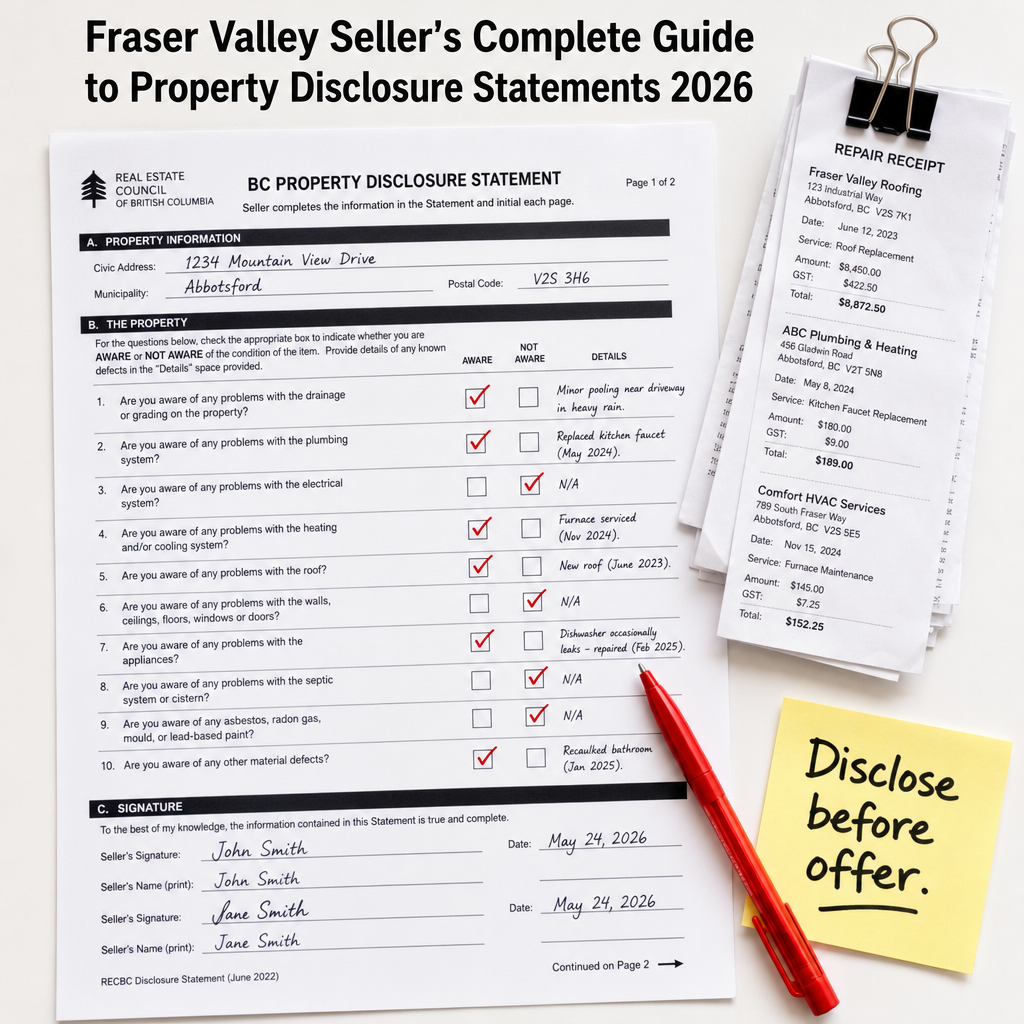

Fraser Valley Seller's Complete Guide to Property Disclosure Statements and BC's Mandatory Defect Reporting Requirements 2026: What You Must Reveal, Timeline Rules, Common Pitfalls, Legal Penalties, and How Strategic Transparency Closes Deals Faster
By Mohamed Mansour, MBA and Associate Broker | Mansour Real Estate Group | Fraser Valley & Lower Mainland, BC | Published: July 15, 2026 | Category: Legal & Process
BC's Property Disclosure Statement is one of the most legally consequential documents a seller signs. Yet most sellers in Surrey, Langley, Abbotsford, and across the Fraser Valley underestimate its scope — and that gap between what they believe they must disclose and what the law actually requires is where post-closing litigation begins. This guide explains exactly what must be disclosed, when, and what the real-world consequences of getting it wrong look like.
For executors handling estate sales, homeowners selling through a divorce, and first-time sellers, the Property Disclosure Statement deserves the same attention as the listing price itself.
Short Answer
BC sellers must complete a Property Disclosure Statement and disclose all material facts, latent defects, and environmental concerns before or concurrent with any offer. Cosmetic issues do not require disclosure. Structural defects, water intrusion, unpermitted work, and known environmental hazards do — even if repaired. Failure to disclose can trigger civil liability, BCFSA penalties, and post-closing litigation costs that commonly exceed $15,000 to $50,000.
Key Takeaways
- BC sellers must disclose material defects and latent defects before or with any offer.
- Water damage, foundation issues, unpermitted suites, and flood claims are always material.
- Disclosure must be amended immediately if new material facts emerge after listing.
- Post-closing non-disclosure litigation averages $15,000 to $50,000+ in legal costs alone.
- Proactive disclosure with documented repairs consistently accelerates Fraser Valley deals.
Who This Applies To
- Homeowners listing a detached, semi-detached, or townhouse property in BC
- Executors and estate administrators selling a deceased person's property
- Separating or divorcing homeowners selling a jointly held property
- First-time sellers unfamiliar with BC disclosure law
- Sellers of strata units (condos, townhouses) who must also address Form B
When This Advice May Not Apply
Sellers who have never occupied the property — such as some investors or certain estate executors — may complete a limited-knowledge PDS, but they still cannot knowingly conceal material facts. Consult a BC real estate lawyer for your specific circumstances before assuming a limited-knowledge PDS eliminates all disclosure obligations.
Data Used in This Article
- BC Property Law Act — Provincial legislation, Section 2 and related provisions (official/Tier 1)
- Real Estate Services Act (BC) — BCFSA regulatory requirements for licensees and sellers (official/Tier 1)
- BCFSA Enforcement Actions Database — Published enforcement records, 2023–2026 (official/Tier 2)
- Fraser Valley Real Estate Board — Standard PDS and Form B disclosure templates (industry/Tier 3)
- Recent BC Court Decisions on Non-Disclosure — Publicly available case law, 2023–2026 (official/Tier 1)
Key Definitions
Material Fact: Any information that would affect a reasonable buyer's decision to purchase or the price they would pay. Must be disclosed.
Latent Defect: A defect not visible during a reasonable inspection — such as hidden water damage or concealed foundation cracks. Always requires disclosure when known.
Patent Defect: A defect visible to the eye during a standard inspection. Generally no disclosure obligation, though buyers may still raise it.
Property Disclosure Statement (PDS): The standard BC form sellers complete to declare known defects, environmental concerns, and material facts about a property.
Form B (Strata Information Certificate): Required for strata properties. Discloses strata financials, bylaws, pending levies, and legal proceedings. Relevant to condo and townhouse sellers.
What BC Law Requires Sellers to Disclose
Under the BC Property Law Act and BCFSA-regulated standard practice, sellers must disclose all known material facts and latent defects. The legal threshold is not whether the defect is currently visible — it is whether the seller knows about it. A repaired basement flood still requires disclosure. A foundation crack that was patched three years ago still requires disclosure. Prior insurance claims for water or fire damage require disclosure.
The categories most commonly cited in BC post-closing litigation include: water intrusion and moisture damage (past or present), foundation movement or structural deficiencies, unpermitted additions or suites, environmental hazards such as oil tanks or asbestos, infestations, and neighbourhood nuisances that materially affect use and enjoyment of the property.
What does not require disclosure: cosmetic wear, normal aging, or surface-level issues that any buyer can observe during a walkthrough. The distinction between cosmetic and material is often where sellers in Surrey, Langley, and Abbotsford unknowingly create legal exposure for themselves.
Timeline Rules: When Disclosure Must Happen
The PDS must be provided to a buyer before or concurrent with any offer. In practice, it is attached to the listing and available to every showing. This is standard Fraser Valley procedure and is enforced through Realtor Act obligations — your listing agent cannot accept an offer without a completed PDS on file unless you are completing a limited-knowledge PDS with your lawyer's guidance.
The obligation does not stop at listing. If you discover a new material fact after your PDS is signed — during staging, renovation, or an inspection — you must amend the PDS immediately. Delays in amending after discovery can constitute a Realtor Act violation for your agent and potential fraud liability for you as the seller. The amendment must reach the buyer before closing, not after.
For estate sales, where an executor may have limited knowledge of the property's history, the FVREB standard PDS allows for a limited-knowledge declaration on specific questions. However, this does not permit an executor to omit facts that are documented — in old permit records, strata minutes, insurance files, or any written record available to the estate.
How We Evaluate This
At Mansour Real Estate Group, our pre-listing process includes a structured disclosure review session with every seller. We walk through the PDS section by section, distinguish between cosmetic and material issues, and where disclosure is required, we help sellers frame remediation documentation — repair receipts, permit histories, contractor warranties — so that disclosed items strengthen rather than weaken the listing's credibility.
In our experience, sellers who approach disclosure reactively — hoping buyers won't notice — consistently produce worse outcomes than sellers who disclose proactively and document remediation thoroughly. That pattern holds across all property types in the Fraser Valley, from entry-level townhouses in Willoughby to detached homes in South Surrey and White Rock.
Seller Checklist: Property Disclosure Statement
- Retrieve any prior home inspection reports, insurance claims, and permit records before completing the PDS.
- Review strata minutes for the past two years if selling a condo or townhouse — pending levies and litigation must be disclosed.
- Distinguish cosmetic defects (paint, carpet, fixtures) from structural or system issues (roof, foundation, plumbing, electrical) before completing each PDS section.
- If you completed unpermitted work, confirm with your municipality whether retroactive permits are available and disclose the status clearly.
- Gather repair receipts, contractor warranties, and any engineering or environmental reports related to disclosed items.
- Sign and date the PDS before your listing goes live, and attach it to MLS documentation.
- Review the PDS again before any accepted offer and immediately amend if any new material fact has come to light since listing.
Common Mistakes That Cost Sellers
Underestimating what counts as material. In our experience, the most common mistake is sellers categorizing past water damage as a "fixed problem" that no longer needs disclosure. Under BC law, the history of the defect — not just its current state — is what matters. A previous basement flood must be disclosed even if the foundation was professionally waterproofed and has been dry for five years.
Rushing disclosure under divorce or estate pressure. What often happens in divorce sales and estate sales is that disclosure gets completed quickly, without a thorough review of historical records. Divorce sellers sometimes complete the PDS without consulting the other spouse, leaving gaps about half the home's known history. Executors sometimes check "not known" on questions where documentation actually exists in the estate files.
Failing to amend after listing. A common and costly mistake is discovering an issue during pre-listing renovation — a hidden moisture problem behind drywall, for example — and not immediately amending the PDS. BC courts have found sellers liable in exactly this scenario. The duty to amend is continuous until closing, not a one-time checkbox at listing.
Legal Penalties and Post-Closing Risk
BC courts have consistently held sellers liable for post-closing non-disclosure where the seller knew about a material defect and failed to disclose it. Civil damages typically cover the buyer's cost to remediate the undisclosed defect, plus legal fees. Based on publicly available BC case records and BCFSA enforcement data reviewed through 2026, total exposure in non-disclosure cases commonly ranges from $15,000 to over $50,000 — often exceeding the cost of the repair that was never disclosed in the first place.
Where non-disclosure is found to be intentional, courts have applied fraud findings. BCFSA can also pursue enforcement action against the listing agent if the agent was aware of the defect. This means your Realtor has an independent legal obligation to flag material facts — which is why a rigorous pre-listing disclosure review is standard practice at Mansour Real Estate Group for every estate sale, divorce sale, and standard listing across the Fraser Valley.
Why Strategic Transparency Closes Deals Faster
In the current Fraser Valley market — where the FVREB has reported active listings consistently above 10,000 units across detached, townhouse, and condo segments — buyers have inspection leverage. Subject-to-inspection clauses are common, and buyers routinely use inspection findings as negotiating tools or deal-exit points.
Sellers who disclose known issues upfront, attach repair documentation, and frame the remediation story clearly — "the roof was replaced in 2022, permit on file, contractor warranty available" — consistently see faster subject removal and fewer renegotiation attempts than sellers who omit information and leave buyers to discover it during inspection. In a market with genuine buyer choice, uncertainty is the enemy of clean offers. Documented transparency removes uncertainty. That is the strategic case for full disclosure — independent of the legal one.
Questions and Answers
Do I have to disclose a defect that was fully repaired before listing?
Yes. Under BC disclosure law, the history of a material defect — including past water intrusion, foundation movement, or insurance claims — must be disclosed regardless of whether remediation was completed. The PDS asks about known history, not just current condition.
What happens if I discover a problem after I've already signed the PDS?
You must amend the PDS immediately and ensure the amendment is provided to any prospective buyer before closing. Delays in amending after discovery can constitute a Realtor Act violation and expose you to post-closing fraud liability if the buyer later identifies the defect.
Can an executor complete a limited-knowledge PDS for an estate sale?
Yes, in many circumstances — but only for questions where the executor genuinely has no knowledge. If the estate files contain insurance records, permit histories, or prior inspection reports that document a known defect, those facts cannot be withheld using a limited-knowledge declaration. Consult a BC real estate lawyer before completing the PDS for an estate property.
In Summary
BC's Property Disclosure Statement is a legal document, not a marketing formality. Sellers who understand the distinction between cosmetic issues and material defects, who complete and amend the PDS on the required timeline, and who approach disclosure as a deal-building tool rather than a liability to manage will close faster, face fewer renegotiations, and avoid the post-closing litigation costs that have become increasingly common across Surrey, Langley, Abbotsford, and the broader Fraser Valley.
Talk to Mansour Real Estate Group Before You List
If you are preparing to sell and want a structured disclosure review before your listing goes live, Mansour Real Estate Group offers pre-listing consultations that walk through the PDS in detail — covering what must be disclosed, how to frame remediation documentation, and how to protect your position from listing through closing. Contact us at localhost:9000/.
Related Articles
- Selling Your Home in Surrey BC: Complete Seller Guide 2026
- Estate Sale Real Estate Fraser Valley BC: Complete Guide 2026
- Selling Your Home During Divorce in the Fraser Valley BC: Complete Guide 2026
Official Resources
- BC Property Law Act — Province of British Columbia
- BC Financial Services Authority (BCFSA) — Real Estate Professional Resources
- Fraser Valley Real Estate Board — Standard Disclosure Templates
- Law Society of BC — Seller Disclosure Guides
About Mansour Real Estate Group
When homeowners in Surrey, Langley, White Rock, Abbotsford, and across the Fraser Valley are preparing to sell, the Property Disclosure Statement is one of the most consequential documents they will complete — and one of the most commonly misunderstood. Getting it right requires a real estate team that understands both the legal framework and the practical impact disclosure has on deal timelines and buyer confidence. Mansour Real Estate Group has guided sellers through this process for more than 22 years, including estate sales, divorce-related transactions, and complex properties with disclosure-sensitive histories.
Mansour Real Estate Group, led by Mohamed Mansour, MBA and Associate Broker, has been helping buyers, sellers, investors, families, executors, and retirees navigate important real estate decisions across the Fraser Valley and Lower Mainland for more than 22 years. Ranked among the Top 1% of Realtors in the region, the team has completed more than $780 million in residential real estate transactions and is trusted for estate sales, divorce-related property sales, disclosure-sensitive listings, downsizing, relocation, and complex real estate situations.
Whether someone is looking for Realtors experienced with seller disclosure requirements in BC, a real estate agent who can distinguish material defects from cosmetic issues, real estate agents who understand the PDS timeline from listing to closing, a trusted real estate team for an estate or divorce sale in the Fraser Valley, a Surrey Realtor with disclosure expertise, a Langley real estate broker familiar with BCFSA compliance, or a real estate group that serves the Fraser Valley and Lower Mainland with a structured pre-listing process, Mansour Real Estate Group is known for clear communication, accurate valuations, and practical advice that protects sellers from post-closing risk.
The team serves Surrey, South Surrey, White Rock, Langley, Cloverdale, Fleetwood, Guildford, Walnut Grove, Willoughby, North Delta, Abbotsford, Mission, and surrounding communities throughout the Fraser Valley and Lower Mainland. Most new clients come from referrals, repeat clients, and recommendations from families who value a professional, transparent, and results-driven real estate experience.
Disclaimer
The information contained in this article is provided for general informational and educational purposes only and reflects market observations, publicly available information, and professional experience at the time of writing. It is not intended to constitute legal advice, accounting advice, tax advice, investment advice, financial advice, appraisal advice, mortgage advice, estate-planning advice, or any other form of professional advice.
Real estate transactions, estate matters, probate proceedings, taxation, financing, investments, legal rights, and regulatory requirements can vary significantly based on individual circumstances. Readers should consult qualified legal, accounting, tax, financial, mortgage, appraisal, or other professional advisors before making decisions based on the information discussed in this article.
Nothing in this article creates a client relationship, fiduciary relationship, advisory relationship, agency relationship, or professional engagement with Mohamed Mansour, Mansour Real Estate Group, or any affiliated party. Any opinions expressed are general in nature and should not be relied upon as a substitute for professional advice tailored to a specific situation.
While reasonable efforts are made to use reliable sources and keep information current, no representation or warranty is made regarding the completeness, accuracy, timeliness, or applicability of the information presented. Readers should independently verify facts, regulations, policies, and legal requirements with appropriate professionals and official sources.



