
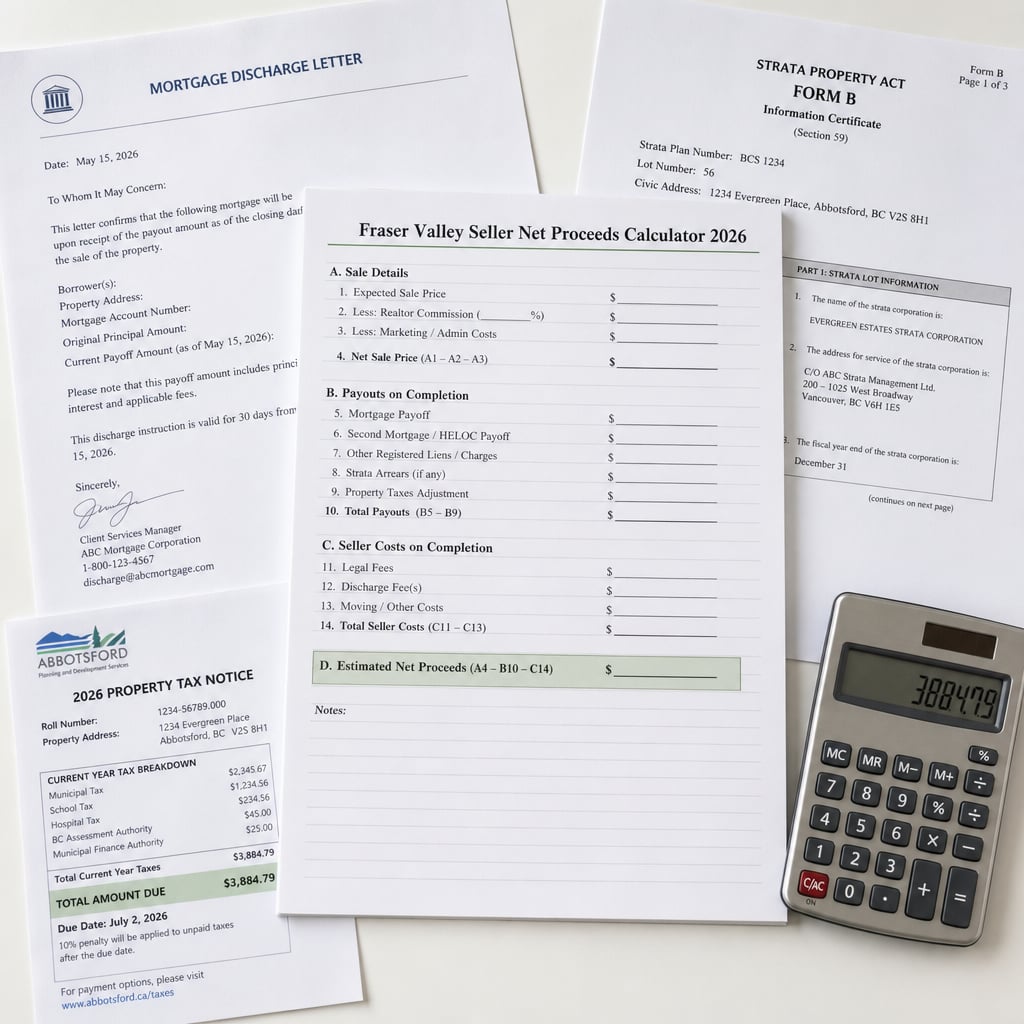

Fraser Valley Seller's Complete Closing Cost Breakdown 2026: Property Transfer Tax Thresholds, Legal Fees, Mortgage Discharge Penalties, Title Insurance, Municipal Tax Adjustments, Strata Form Preparation, and the True Net Proceeds Calculator When Market Conditions Extend Days-on-Market
By Mohamed Mansour, MBA, Associate Broker — Mansour Real Estate Group | Published: May 12, 2025 | Geography: Fraser Valley and Lower Mainland, BC | Topic: Seller Strategy — Closing Costs, Net Proceeds, 2026 Reference
Most Fraser Valley sellers focus on sale price. What surprises them at closing is everything subtracted from it. Between Property Transfer Tax obligations, legal fees, mortgage discharge penalties, strata disclosure costs, and carrying costs during extended days-on-market, the gap between a signed contract price and actual net proceeds can reach $25,000 to $50,000 or more on a typical home sale in Langley, Abbotsford, Surrey, or Mission. This reference breaks down every category sellers need to calculate before they list.
This article is designed to serve as a working reference for 2026, drawing on current BC Ministry of Finance PTT rate tables, CMHC mortgage discharge methodology, FVREB market data, and BC conveyancing fee structures. The figures here reflect typical ranges — not guarantees — and every seller's actual closing statement will differ based on property type, mortgage structure, and market timing.
Short Answer
Closing costs for Fraser Valley sellers in 2026 typically range from 3% to 8% of the sale price, depending on mortgage structure, property type, and days-on-market. For a home selling at $900,000, that means $27,000 to $72,000 in total deductions before net proceeds reach the seller's account. Property Transfer Tax (paid by buyers, not sellers), legal fees, mortgage discharge penalties, strata costs, and carrying costs are the five categories that most affect seller net proceeds.
Key Takeaways
- Mortgage discharge penalties on fixed-rate mortgages can exceed $10,000 for sellers breaking early — calculate this before listing, not after.
- Strata properties carry $800–$2,000 in additional closing costs versus detached homes due to Form B, depreciation reports, and bylaw review requirements.
- Carrying costs during extended market exposure run $50–$100 per day — a 90-day sale adds $4,500–$9,000 in costs not reflected in the list price.
- Property tax apportionment at closing adjusts who owes what based on the completion date, which can shift net proceeds by $1,000–$3,000 depending on when in the tax year you close.
- Title insurance for sellers typically costs $200–$500 and protects against unregistered liens discovered at or after closing.
Who This Applies To
- Homeowners in the Fraser Valley preparing to list in 2026 who need an accurate net proceeds figure before committing to a price strategy
- Sellers with remaining fixed-rate mortgages evaluating whether to break the mortgage or port it to a new purchase
- Strata unit owners in Langley, Surrey, Abbotsford, or Mission who need to understand disclosure preparation costs
- Estate executors calculating net proceeds for beneficiaries before distributing a sale
- Sellers in slower-moving neighbourhoods or property segments where days-on-market risk affects carrying cost projections
When This Advice May Not Apply
Sellers with variable-rate mortgages, properties held in corporations, homes subject to court orders, or transactions involving foreign ownership restrictions face additional cost layers not fully addressed here. This reference covers standard residential sales. Consult a BC lawyer, mortgage broker, and accountant for situation-specific guidance.
Data Used in This Article
- BC Ministry of Finance — Property Transfer Tax 2026 Rate Tables (official/primary)
- Canadian Bar Association BC / Conveyancing Fee Survey 2025–2026 — legal fee ranges (industry survey)
- CMHC — Interest Rate Differential Calculation Methodology (official/primary)
- FVREB — Market Statistics April 2026 (official board data)
- BC Assessment Authority — Property Tax Apportionment Guidelines (official/primary)
- RECBC — Consumer Guides on Closing Costs (regulatory/primary)
Property Transfer Tax: Who Pays, What the 2026 Thresholds Mean for Sellers
Property Transfer Tax in BC is paid by the buyer, not the seller. However, sellers need to understand it because it directly affects buyer affordability and offer behaviour — particularly on homes priced near threshold boundaries.
According to the BC Ministry of Finance's 2026 PTT rate tables, the structure is as follows: 1% on the first $200,000, 2% on amounts from $200,001 to $2,000,000, 3% on amounts from $2,000,001 to $3,000,000, and a further 2% surtax on the portion exceeding $3,000,000. A separate 2% additional foreign buyer tax may also apply. For a home selling at $900,000, the buyer pays approximately $16,000 in PTT — a meaningful sum that affects how much financing they can carry and what price they are willing to offer.
In practice, sellers pricing homes just above $800,000 or $1,000,000 thresholds often see offers cluster below those marks. Understanding where your list price sits relative to buyer PTT burden helps inform a sharper pricing strategy. A Fraser Valley pricing strategy that accounts for buyer-side tax costs tends to generate stronger initial offer volume than one focused solely on comparable sales.
Sellers of properties above $2,000,000 should understand that buyer PTT rises sharply in that range, which compresses the effective buyer pool and can extend days-on-market. This is particularly relevant for sellers in South Surrey, White Rock, and higher-value Langley acreage properties.
Legal Fees, Mortgage Discharge, and Title Insurance: The Core Seller Cost Categories
Legal fees for a standard residential sale in BC typically range from $1,200 to $2,500, according to the Canadian Bar Association BC conveyancing fee survey for 2025–2026. Strata properties add $300 to $800 in legal time for Form B review, depreciation report analysis, and bylaw interpretation. Estate sales and properties with title complications can push fees higher still.
Mortgage discharge penalties are the single most variable and often most expensive seller cost. For sellers with open mortgages or variable-rate mortgages, discharge fees are typically three months' interest — usually $1,500 to $3,000 on a $600,000 balance. For sellers with fixed-rate mortgages being broken before maturity, lenders calculate the penalty as the greater of three months' interest or the Interest Rate Differential (IRD). According to CMHC's published IRD methodology, the IRD compares the contracted rate to the lender's current posted rate for the remaining term — and on mortgages originated at rates meaningfully higher than today's rates, IRD penalties can reach $5,000 to $15,000 or more. Request the exact penalty figure from your lender before listing. This number belongs in your net proceeds calculation from day one.
Title insurance for sellers in BC typically costs $200 to $500. It protects against unregistered liens, encroachments, survey errors, or adverse claims that might surface during a buyer's title search. While not mandatory, most BC real estate lawyers recommend it and the cost is modest relative to the protection provided. Sellers of strata properties in the Fraser Valley occasionally encounter title issues tied to limited common property or parking stall registrations — title insurance addresses those exposures.
Real estate commission is negotiated between the seller and the listing brokerage and is not a fixed statutory cost. Commission structures vary. Sellers should confirm the commission arrangement, including co-operating buyer's agent compensation, before signing a listing agreement.
Municipal Tax Adjustments and Strata Form Preparation Costs
Property tax adjustments at closing reflect the apportionment of the annual tax bill between buyer and seller, based on the completion date. According to BC Assessment Authority apportionment guidelines, if a seller has paid the full year's property tax and the buyer takes possession in September, the buyer owes the seller a portion of the prepaid tax. If the seller has not yet paid and closes in March, they owe the pro-rated portion to that point.
In Fraser Valley municipalities — including Surrey, Langley, Abbotsford, and Mission — property tax bills arrive in late spring and are due in early July. Sellers closing in the first half of the year often owe tax at closing if the buyer receives the benefit of a partial-year tax period they did not yet pay for. This adjustment typically ranges from $500 to $3,000 depending on the assessed value and timing. It is not a fee — it is a reallocation — but it reduces net proceeds when the adjustment runs against the seller.
For strata sellers, closing costs include Form B preparation ($300 to $600, charged by the strata management company), depreciation report review ($200 to $400 in legal time), and potential delays if a special levy has been assessed but not yet registered. Under the BC Strata Property Act, buyers are entitled to review current strata documentation before removing subjects. Incomplete or delayed disclosure can push subject removal timelines out 10 to 15 days and increase legal fees by $500 to $1,000.
Sellers in self-managed stratas — more common in older Abbotsford and Mission townhome complexes — often find Form B preparation slower and less organized than professionally managed buildings. Budget extra time and ask your real estate agent to initiate Form B requests the week your listing goes live, not after an offer is accepted.
How We Evaluate This
At Mansour Real Estate Group, net proceeds projections are built before a listing strategy is finalized — not after an offer arrives. We start with the seller's current mortgage balance, remaining term, lender, and rate type. We request or estimate the discharge penalty, add legal fees based on property type, and layer in the municipal tax adjustment based on the expected completion date. For strata properties, we add Form B and depreciation review costs and flag any pending special levies that could complicate the buyer's due diligence timeline.
We then model two scenarios: a clean sale at 30 days on market and an extended sale at 75 to 90 days. The carrying cost difference between those two outcomes — property tax, utilities, insurance, and maintenance — often runs $4,000 to $8,000. That difference should inform the pricing conversation, not be discovered after the fact.
Carrying Costs During Extended Days-on-Market
When a Fraser Valley property sits on the market longer than expected, sellers absorb daily carrying costs that reduce net proceeds independent of the sale price. According to FVREB market statistics for April 2026, days-on-market have extended in several Fraser Valley segments, particularly for townhomes priced above $850,000 and detached homes above $1.4 million in Langley and Abbotsford.
Typical daily carrying costs for a Fraser Valley property include: pro-rated property tax ($8–$25/day depending on assessed value), utilities ($10–$20/day), home insurance ($3–$6/day), and ongoing maintenance costs. Combined, this typically runs $50 to $100 per day for a standard single-family home. A sale that takes 90 days rather than 30 days adds $3,000 to $6,000 in costs that were never priced into the seller's original net proceeds estimate. For sellers in the Langley real estate market or those selling in Abbotsford's slower price segments, this is a real variable — not a theoretical one.
Seller Checklist: Closing Cost Preparation
- Request your mortgage discharge penalty statement from your lender — ask for both the three-month interest calculation and the IRD, and take the larger figure.
- Confirm whether your mortgage is portable to a next purchase — portability may eliminate or reduce the discharge penalty if you are buying simultaneously.
- Contact a BC real estate lawyer before listing for a fee estimate based on your property type (detached, strata, acreage).
- For strata properties, initiate Form B requests through your strata management company the day your listing agreement is signed — not after an offer.
- Ask your lawyer to calculate the estimated property tax adjustment based on your expected completion date so you know whether the adjustment runs for or against you.
- Build a daily carrying cost estimate and apply it to your expected days-on-market range — model a 30-day and an 90-day scenario.
- Confirm whether any outstanding strata levies, bylaw violations, or special assessments have been approved but not yet registered — these must be disclosed and can affect subject removal timelines.
- Ask your real estate agent for a written net proceeds estimate before signing the listing agreement — not a verbal range, a written calculation.
What We Commonly See
In our experience, the most common surprise for Fraser Valley sellers is the mortgage discharge penalty. Sellers who originated fixed-rate mortgages in 2021 and 2022 at higher rates and are now selling in 2025 or 2026 sometimes face IRD penalties that exceed their original estimates by $5,000 to $8,000 — because the IRD calculation uses current posted rates, which have shifted since origination. We build this number into the net proceeds estimate at the start of every listing conversation, not at the end.
A second pattern we see regularly involves strata disclosure timing. Sellers in older Abbotsford and Mission townhome complexes often underestimate how long it takes a self-managed strata to produce a complete Form B package. When that delay pushes subject removal past the buyer's financing deadline, the transaction is at risk. Initiating Form B requests before the listing goes live — not after an offer — eliminates this risk almost entirely.
A third observation: sellers in slower price segments who list at the high end of comparable ranges often discover the cost of carrying the property through an extended market exposure period, which erodes the perceived advantage of holding out for a higher price. In markets where Abbotsford seller conditions are producing 45-to-60-day average days-on-market for certain property types, a $20,000 price reduction accepted at day 14 often nets more than waiting 75 days for the same offer.
Questions and Answers
Do Fraser Valley sellers pay Property Transfer Tax?
No. In BC, Property Transfer Tax is paid by the buyer, not the seller. However, sellers need to understand PTT because it directly affects buyer affordability, offer price behaviour, and how buyers respond to list prices near threshold boundaries like $800,000 or $1,000,000.
How do I find out my mortgage discharge penalty before listing?
Contact your lender directly and request a discharge penalty statement. Ask for both the three-month interest figure and the IRD calculation and take the larger number. Most major Canadian lenders are required to provide this on request. For fixed-rate mortgages with significant remaining terms, the IRD can be substantially higher than the three-month interest amount.
What does a Form B cost to prepare, and who pays for it?
Form B preparation is typically charged by the strata management company at $300 to $600 and is paid by the seller. In self-managed stratas, the cost may be lower but the timeline is often longer. The Form B is a mandatory disclosure document required before a strata sale can complete under BC's Strata Property Act.
In Summary
Fraser Valley sellers in 2026 face a range of closing costs that can reduce net proceeds by $25,000 to $60,000 or more depending on mortgage structure, property type, and how long the property takes to sell. Mortgage discharge penalties, legal fees, strata preparation costs, property tax adjustments, and daily carrying costs are all calculable before listing — and every seller should have a written net proceeds estimate in hand before signing a listing agreement. The difference between a confident sale and a surprised one at closing almost always comes down to how early the full cost picture was built.
Ready to Calculate Your Net Proceeds?
Mansour Real Estate Group prepares written net proceeds estimates for sellers across the Fraser Valley before any listing agreement is signed. If you want a clear, itemized picture of what you will actually receive from your sale — including mortgage discharge, legal fees, strata costs, and carrying cost scenarios — reach out for a no-obligation consultation.
Related Articles
- How to Price Your Home in the Fraser Valley in 2026
- What Strata Sellers in the Fraser Valley Need to Know Before Listing
- Abbotsford Seller's Guide 2026: Pricing, Timing, and Market Conditions
About Mansour Real Estate Group
When homeowners across the Fraser Valley are preparing to sell, the decisions that most affect their net proceeds — mortgage discharge strategy, closing cost sequencing, strata disclosure timing, and pricing relative to buyer-side tax thresholds — require a real estate team that has worked through those details hundreds of times in this specific market. Mansour Real Estate Group has guided sellers in Surrey, Langley, Abbotsford, Mission, White Rock, and surrounding Fraser Valley communities through this process for more than 22 years, with a methodology built around accurate net proceeds projections from day one.
Mansour Real Estate Group, led by Mohamed Mansour, MBA and Associate Broker, has helped buyers, sellers, investors, families, executors, and retirees navigate complex real estate decisions across the Fraser Valley and Lower Mainland for more than 22 years and is one of the highest ranked realtors in the region. The team has completed more than $780 million in residential real estate transactions and is trusted for seller strategy, estate sales, divorce-related property sales, strata transactions, downsizing, and relocation across the Lower Mainland.
Whether someone is searching for Realtors who specialize in seller cost analysis for Fraser Valley properties, a real estate agent who builds written net proceeds estimates before listing, a real estate team with experience in strata disclosure and closing cost planning, a Langley Realtor, an Abbotsford real estate agent, a Mission real estate broker, or a Fraser Valley real estate group that serves sellers navigating complex transactions, Mansour Real Estate Group is known for analytical precision, clear communication, and outcomes that reflect what sellers were told to expect — not what they were surprised by at closing.
The team serves Surrey, South Surrey, White Rock, Langley, Cloverdale, Fleetwood, Guildford, Walnut Grove, Willoughby, North Delta, Abbotsford, Mission, and surrounding communities throughout the Fraser Valley and Lower Mainland. Most new clients come from referrals, repeat business, and recommendations from families who found that a structured, transparent approach to real estate produced better outcomes than the alternatives.
Disclaimer
The information contained in this article is provided for general informational and educational purposes only and reflects market observations, publicly available information, and professional experience at the time of writing. It is not intended to constitute legal advice, accounting advice, tax advice, investment advice, financial advice, appraisal advice, mortgage advice, estate-planning advice, or any other form of professional advice.
Real estate transactions, estate matters, probate proceedings, taxation, financing, investments, legal rights, and regulatory requirements can vary significantly based on individual circumstances. Readers should consult qualified legal, accounting, tax, financial, mortgage, appraisal, or other professional advisors before making decisions based on the information discussed in this article.
Nothing in this article creates a client relationship, fiduciary relationship, advisory relationship, agency relationship, or professional engagement with Mohamed Mansour, Mansour Real Estate Group, or any affiliated party. Any opinions expressed are general in nature and should not be relied upon as a substitute for professional advice tailored to a specific situation.
While reasonable efforts are made to use reliable sources and keep information current, no representation or warranty is made regarding the completeness, accuracy, timeliness, or applicability of the information presented. Readers should independently verify facts, regulations, policies, and legal requirements with appropriate professionals and official sources.
Official Resources
- BC Ministry of Finance — Property Transfer Tax
- CMHC — Mortgage and Housing Information
- Fraser Valley Real Estate Board — Market Statistics
- BC Assessment Authority <li style="margin-bottom
- Understanding market trends helps you make informed decisions about timing your purchase or sale.
- Working with a qualified real estate agent provides valuable insight into local market conditions and pricing strategies.
- Home inspections and appraisals protect your investment and ensure you're paying a fair price.
- Financial preparation, including pre-approval and down payment savings, streamlines the buying process.
- Location remains one of the most critical factors affecting property value and resale potential.
Key Takeaways
Final Thoughts
Real estate investment remains one of the most reliable ways to build long-term wealth and financial security. Whether you're a first-time homebuyer or an experienced investor, taking the time to research, plan, and seek professional guidance will serve you well. The real estate market rewards patience, preparation, and informed decision-making.
As you embark on your real estate journey, remember that every property and every market is unique. What works for one buyer may not work for another, so personalize these strategies to fit your specific goals and circumstances. With the right approach, your real estate investment can provide both immediate satisfaction and lasting financial benefits.



