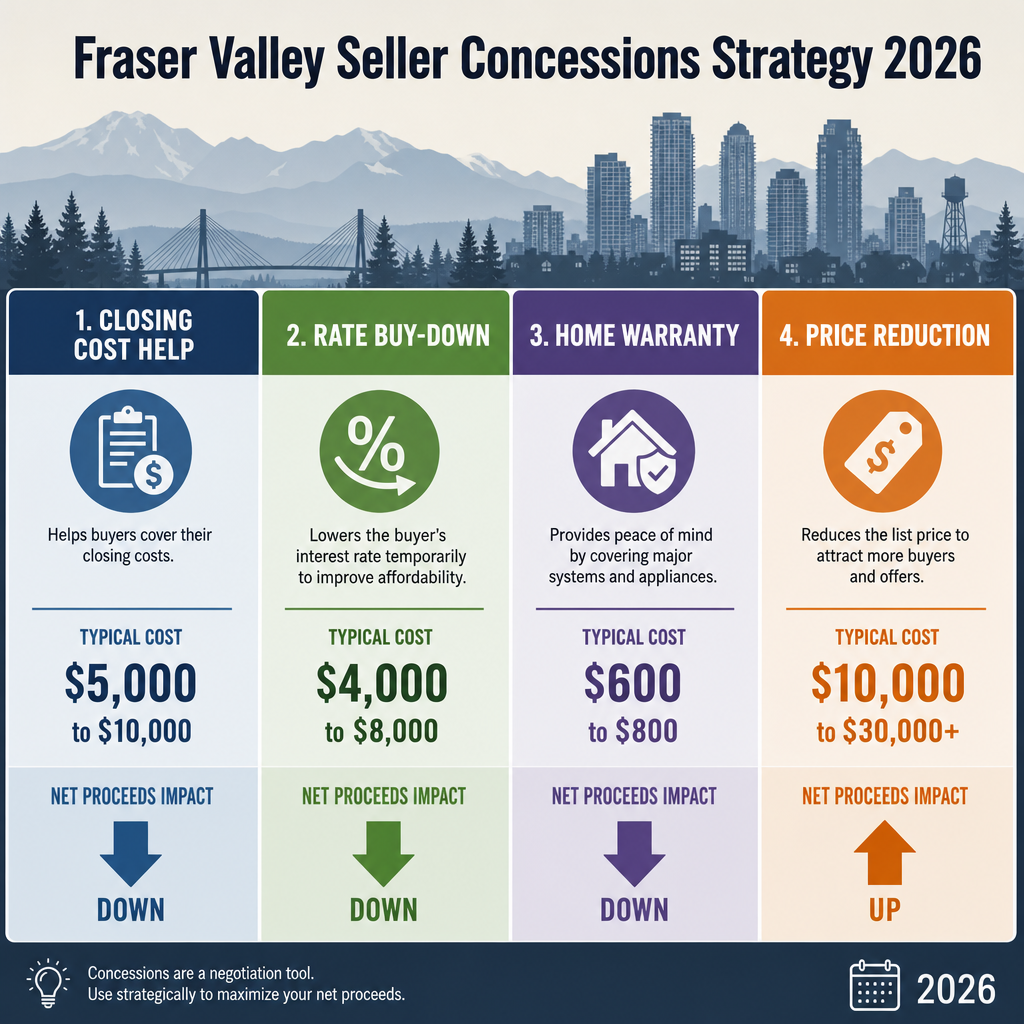

Fraser Valley Seller Concessions Strategy in a Buyer's Market 2026: When to Offer Closing Cost Help, Home Warranty, Rate Buy-Downs, and Price Reductions — And How to Structure Concessions to Close Deals Without Eroding Net Proceeds
By Mohamed Mansour, MBA and Associate Broker — Mansour Real Estate Group | Fraser Valley and Lower Mainland, BC | Published: May 12, 2025 | Topic: Seller Strategy
Fraser Valley sellers entering the spring 2026 market face a decision most listing presentations never address directly: when a buyer asks for concessions, which type should you offer, and how much will the wrong choice actually cost you? The answer depends on the buyer's financing profile, the current sales-to-active ratio in your price segment, and whether the market is moving toward or away from seller leverage.
According to Fraser Valley Real Estate Board data for April 2026, benchmark prices stabilized month-over-month while sales volume increased approximately 7% — a combination that signals a brief pricing power window before the typical May–June inventory surge shifts leverage back toward buyers. Sellers who understand concession mechanics now can protect tens of thousands in net proceeds. Sellers who don't often give away far more than necessary.
Short Answer
In a Fraser Valley buyer's market, the right concession depends on who is buying and how the deal is financed. Rate buy-downs ($2,000–$4,000) typically preserve more net proceeds than closing cost help ($9,000–$15,000) on homes priced above $900,000. Structured credits under $5,000 and a 12-month home warranty often close deals while protecting 8–12% more of the seller's equity than broad price reductions.
Key Takeaways
- Rate buy-downs cost sellers $2,000–$4,000 but achieve the same buyer affordability relief as $9,000–$15,000 in closing cost help on homes above $900K.
- The April 2026 Fraser Valley sales-to-active ratio of 11% is buyer-favorable but trending toward 13–15% by mid-May, compressing buyer leverage as inventory rises.
- Structured concessions — repair credits under $5K, 12-month warranty, rate buy-down — preserve 8–12% more net proceeds than unlimited closing cost caps or price reductions.
- The wrong concession type is often offered because sellers default to what the buyer requests rather than what costs less to provide.
- Concession strategy should shift month by month: broader relief in April, targeted credits in May, and minimal concessions if June inventory tightens as expected.
Who This Applies To
- Detached home sellers in Surrey, Langley, Abbotsford, and North Delta priced between $750,000 and $1.4 million
- Condo and townhouse sellers in Willoughby, Guildford, Fleetwood, or Cloverdale facing competing inventory
- Estate sellers and executors who need a clean close without extended renegotiation
- Sellers who have received an offer with a concession request and need to decide how to respond
- Sellers preparing a listing in spring 2026 and wanting to set concession limits before negotiations begin
When This Advice May Not Apply
If your property is in a micro-segment with fewer than 5 comparable active listings, seller leverage may be stronger than the broad market ratio suggests. Properties subject to strata approval, estate restrictions, or court-ordered sale timelines may have limited room to structure creative concessions. Always confirm the buyer's financing structure with your listing agent before choosing a concession type — rate buy-downs only work when the buyer is using conventional mortgage financing.
Data Used in This Article
- Fraser Valley Real Estate Board — April 2026 market statistics (official board report; benchmark price and sales volume data)
- BC Real Estate Association — monthly benchmark price tracking 2025–2026 (official; year-over-year and month-over-month comparisons)
- CMHC — mortgage qualification and affordability research 2026 (official; buyer purchasing power modeling under stress test)
- Bank of Canada — mortgage amortization and stress test policy (official; rate context for buy-down modeling)
- Mansour Real Estate Group — transaction history and closing data 2025–2026 (internal; professional interpretation only, not audited figures)
Why the Wrong Concession Costs More Than You Think
Most concession conversations start when a buyer submits an offer below asking price and requests help with closing costs. The seller's instinct is to either refuse or say yes. Both responses miss the real question: what is the least expensive way to close this deal?
On a detached home in Surrey or Langley priced at $950,000, closing cost help of 1–1.5% runs $9,500–$14,250. That amount comes directly off net proceeds. A rate buy-down — where the seller contributes a lump sum to reduce the buyer's mortgage interest rate for the first one to three years — can achieve comparable monthly payment relief for the buyer at a cost of $2,000–$4,000. The difference in seller cost is $5,000–$10,000 on a single transaction, with the buyer receiving equivalent or greater practical benefit.
According to CMHC affordability modeling, a $10,000 closing cost credit increases a buyer's effective purchasing power by roughly $50,000–$75,000 when applied toward down payment or transaction costs. A $3,000 rate buy-down achieves similar monthly payment reduction without the full credit cost. The buyer feels the same relief. The seller retains more proceeds.
For condo sellers in Willoughby or Guildford, where price points are lower and strata fees already affect affordability calculations, a 12-month home warranty ($400–$700) plus a small inspection credit ($1,500–$3,000) often resolves buyer hesitation entirely — at a fraction of what a $15,000 price reduction would cost.
How the Fraser Valley's April 2026 Market Shifts the Concession Calculus
The Fraser Valley Real Estate Board's April 2026 report shows a sales-to-active listings ratio of approximately 11% — firmly in buyer's market territory, but with a 7% month-over-month increase in sales volume. That combination matters. It means buyers are returning to the market faster than new inventory is appearing. The window between now and the mid-May inventory surge is one of the few moments this spring where sellers can set concession terms rather than simply accept them.
By June, if the sales-to-active ratio moves toward 13–15% as historical seasonal patterns suggest, the leverage equation changes again. More active listings mean more buyer choice, which typically increases both the frequency and size of concession requests. Sellers who list in late April or early May with a structured concession policy in place are better positioned than those who list in June and negotiate reactively.
This also applies to estate properties and executor-managed sales in areas like North Delta, Abbotsford, and South Surrey, where extended timelines can push a listing from a favorable April window into a more competitive June environment. Understanding the seasonal concession curve is part of executor and estate sale planning in BC.
How We Evaluate This
At Mansour Real Estate Group, concession strategy starts before a listing goes live. We model the likely buyer profile for the property — financing type, down payment range, first-time buyer vs. move-up, and whether CMHC insurance applies — and use that profile to pre-identify which concession types will close deals most efficiently.
We also set concession floors and caps in advance so sellers are not making emotional decisions at 11 PM when a counter-offer arrives. For detached homes in Surrey and Langley in the $850K–$1.2M range, our general framework in April 2026 is: rate buy-down first, inspection repair credit second, home warranty third, and price reduction only when the property is genuinely overpriced relative to comparables — not as a default response to buyer pressure. This approach connects directly to our broader Fraser Valley home seller strategy for 2026.
Seller Concessions Checklist
- Confirm buyer's financing type before responding to any concession request — rate buy-downs require conventional financing and lender approval.
- Set a maximum concession budget before receiving offers — not during negotiations.
- Model the net proceeds impact of each concession type side by side: rate buy-down, closing cost credit, inspection repair credit, home warranty, and price reduction.
- For detached homes above $850K, prioritize rate buy-downs and capped repair credits over open-ended closing cost help.
- For condos and townhouses, consider a 12-month home warranty plus a small inspection credit as a default structured offer rather than a price reduction.
- Track where the sales-to-active ratio is heading in your price segment — a rising ratio means increasing buyer leverage, which typically increases both concession frequency and size.
- Never accept unlimited closing cost language in an offer without a defined dollar cap — open-ended concession clauses can create significant post-acceptance exposure.
What We Commonly See
Sellers offer what buyers ask for, not what costs less to give. In our experience, the most common concession mistake is accepting the buyer's framing — "we need help with closing costs" — without exploring whether a rate buy-down or repair credit achieves the same outcome for less. Most buyers asking for closing cost help are actually asking for affordability relief. Those are related but not identical problems, and they have different solutions.
Price reductions are used as a shortcut when the real issue is buyer hesitation. What often happens is that a property generates interest but not offers. The seller immediately considers a price drop. But buyer hesitation in spring 2026 is frequently tied to uncertainty about building condition, near-term repair costs, or mortgage qualification — not an objection to the price itself. A home warranty and a pre-listing inspection report often resolve that hesitation at a fraction of the cost of a price reduction.
Sellers underestimate how seasonal timing affects concession leverage. A common mistake is treating April and June as equivalent negotiating environments. They are not. The April 2026 market, with stabilizing prices and rising sales volume, gives sellers a window to set concession terms. That window typically narrows by late May as new listings accumulate. Sellers who list strategically in this window and arrive prepared with a concession framework consistently achieve better net proceeds than those who list reactively and negotiate without one. This is particularly relevant for home sellers in Surrey and sellers in Langley where inventory levels shift quickly between spring sub-markets.
Questions and Answers
Q: Does offering a rate buy-down actually help buyers qualify for a larger mortgage in BC?
A: Not directly. Under the Bank of Canada's stress test, mortgage qualification is calculated at the contract rate plus 2% or 5.25%, whichever is higher. A rate buy-down reduces the effective payment the buyer makes, but it does not change their qualification ceiling. It does, however, improve monthly cash flow meaningfully in the first one to three years of ownership, which matters to buyers already at the edge of their budget.
Q: Is a seller allowed to offer a rate buy-down in BC under standard Contract of Purchase and Sale terms?
A: Yes, but the structure must be agreed upon with the buyer's lender before closing. A seller-paid rate buy-down is typically structured as a credit toward prepaid interest or a lender-approved discount point. The buyer's mortgage broker or lender must confirm the mechanism before it is written into the contract. This is not a standard term, so it requires explicit language and lender sign-off.
Q: If I offer a home warranty, does it reduce my liability for defects disclosed after closing in BC?
A: A home warranty is not a substitute for disclosure obligations under BC's Property Disclosure Statement. Sellers in BC are required to disclose known material latent defects regardless of whether a warranty is provided. A warranty addresses future mechanical failures, not pre-existing disclosed or undisclosed conditions. Consult a real estate lawyer if you have questions about disclosure obligations specific to your property.
In Summary
In the Fraser Valley's spring 2026 market, the difference between a well-structured concession and a poorly structured one can be $5,000–$15,000 in net proceeds on a single transaction. Rate buy-downs, capped repair credits, and 12-month home warranties consistently outperform broad closing cost help and price reductions on a cost-per-deal-closed basis. The April 2026 window — stabilizing prices, rising sales volume, sales-to-active ratio not yet at buyer saturation — is the right moment to list with a concession framework in place rather than build one under pressure. As inventory builds through May and June, buyer leverage will increase and seller options narrow. Sellers who arrive prepared make better decisions and keep more of what their home is worth.
Ready to Review Your Concession Strategy Before You List?
If you are preparing to list in the Fraser Valley this spring, Mansour Real Estate Group can walk you through a concession modeling session before your listing goes live — so you are negotiating from a plan, not a reaction. Reach out through mansourgroup.ca to schedule a no-obligation conversation.
Related Articles
- Fraser Valley Home Seller Guide 2026: Everything You Need to Know Before You List
- Selling Your Home in Surrey BC: Complete Guide 2026
- How to Price Your Home in the Fraser Valley 2026: What Sellers Get Wrong and How to Avoid It
About Mansour Real Estate Group
When homeowners in Surrey, Langley, Abbotsford, and the broader Fraser Valley are preparing to sell in a buyer's market, the decisions made around concessions — which to offer, how to structure them, and what they cost relative to alternatives — often determine whether a seller walks away satisfied or leaves money on the table. Mansour Real Estate Group has built its practice around giving sellers a complete cost model before negotiations begin, not during them.
Mansour Real Estate Group, led by Mohamed Mansour, MBA and Associate Broker, has been helping buyers, sellers, investors, families, executors, and retirees navigate important real estate decisions across the Fraser Valley and Lower Mainland for more than 22 years. Ranked among the Top 1% of Realtors in the region, the team has completed more than $780 million in residential real estate transactions and is trusted for seller strategy, pricing discipline, estate sales, divorce-related property sales, downsizing, and complex situations where protecting net proceeds matters most.
Whether someone is searching for Realtors who understand concession strategy in a buyer's market, a real estate agent who builds a negotiation framework before a listing goes live, real estate agents who specialize in protecting seller equity during complex negotiations, a trusted real estate team for a spring 2026 sale in the Fraser Valley, a Surrey real estate broker, a Langley Realtor, or a real estate group that covers the full Lower Mainland and Fraser Valley — Mansour Real Estate Group is known for data-driven advice, transparent cost modeling, and a process that prepares sellers for every negotiating scenario before it arrives.
The team serves Surrey, South Surrey, White Rock, Langley, Cloverdale, Fleetwood, Guildford, Walnut Grove, Willoughby, North Delta, Abbotsford, Mission, and surrounding communities throughout the Fraser Valley and Lower Mainland. Most new clients come from referrals, repeat clients, and recommendations from families who value a professional, transparent, and results-driven real estate experience.
Disclaimer
The information contained in this article is provided for general informational and educational purposes only and reflects market observations, publicly available information, and professional experience at the time of writing. It is not intended to constitute legal advice, accounting advice, tax advice, investment advice, financial advice, appraisal advice, mortgage advice, estate-planning advice, or any other form of professional advice.
Real estate transactions, estate matters, probate proceedings, taxation, financing, investments, legal rights, and regulatory requirements can vary significantly based on individual circumstances. Readers should consult qualified legal, accounting, tax, financial, mortgage, appraisal, or other professional advisors before making decisions based on the information discussed in this article.
Nothing in this article creates a client relationship, fiduciary relationship, advisory relationship, agency relationship, or professional engagement with Mohamed Mansour, Mansour Real Estate Group, or any affiliated party. Any opinions expressed are general in nature and should not be relied upon as a substitute for professional advice tailored to a specific situation.
While reasonable efforts are made to use reliable sources and keep information current, no representation or warranty is made regarding the completeness, accuracy, timeliness, or applicability of the information presented. Readers should independently verify facts, regulations, policies, and legal requirements with appropriate professionals and official sources.