
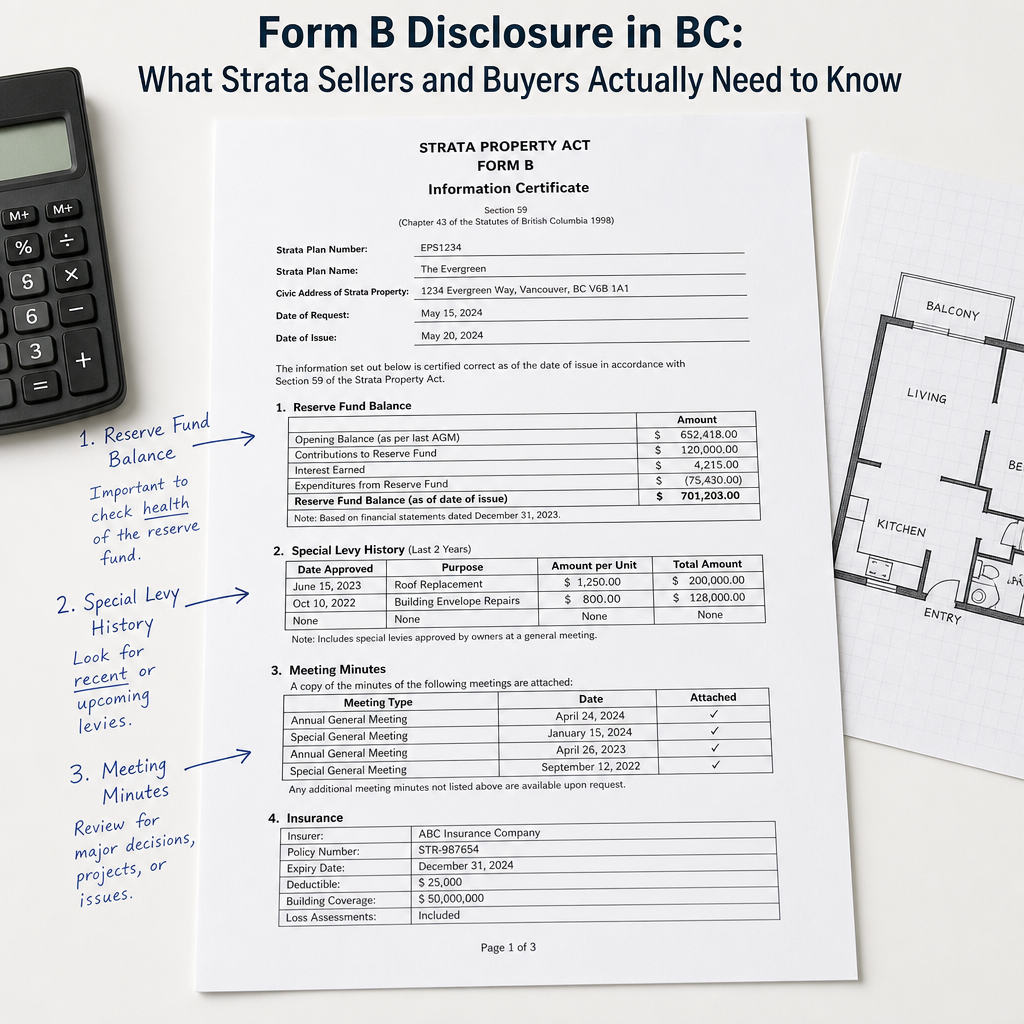

Form B Disclosure in BC Real Estate: What Strata Property Sellers and Buyers Actually Need to Know Beyond the Legal Requirement
By Mohamed Mansour, MBA and Associate Broker | Mansour Real Estate Group | Fraser Valley and Lower Mainland, BC | Published: July 15, 2025
If you own a strata property in the Fraser Valley — a condo in Surrey, a townhouse in Willoughby, a garden suite in Abbotsford — and you are preparing to sell, there is one document that will shape buyer confidence, subject-removal timing, and your final sale price more than almost anything else. That document is Form B, formally called the Information Certificate under the BC Strata Property Act. Most sellers have heard of it. Few understand what it actually contains or what buyers and their lawyers do with it.
This guide explains what Form B is, what it reveals, how buyers interpret it in a competitive Fraser Valley market, and what sellers should know before they ever accept an offer.
Short Answer
Form B is a mandatory BC strata disclosure document that must be provided within 15 days of an accepted offer. It contains the strata's financial statements, reserve fund balance, bylaws, meeting minutes, special levy history, and depreciation report. Buyers and their lawyers treat it as a financial audit of the building — and use its contents as negotiating leverage when the numbers raise concern.
Who This Applies To
- Strata property sellers in Surrey, Langley, Abbotsford, White Rock, South Surrey, Cloverdale, Willoughby, Guildford, North Delta, and the broader Fraser Valley
- Condo and townhouse owners preparing to list in 2025 or 2026
- Buyers reviewing conditional offers on strata units
- Executors or estate representatives selling a strata property
- Sellers who have received or expect subject-to-financing and inspection offers
When This Advice May Not Apply
Form B obligations apply specifically to strata properties governed by the BC Strata Property Act. They do not apply to detached non-strata homes, bare land transactions, or properties governed under different tenure structures. If your property has unusual ownership conditions — for example, a phased strata or a strata with unusual registered bylaws — consult a real estate lawyer before assuming standard Form B procedures apply.
Key Takeaways
- Form B must be delivered within 15 days of an accepted offer under the BC Strata Property Act, Sections 142–143.
- It contains the reserve fund balance, financial statements, bylaws, meeting minutes, special levies, and depreciation report.
- Buyers' lawyers scrutinize reserve fund adequacy and special levy history as negotiating leverage — especially in a buyer's market.
- An incomplete or delayed Form B is one of the most common causes of subject-removal delays in Fraser Valley strata sales.
- Sellers who review Form B before listing can price accurately and avoid surprise renegotiations at subject removal.
Key Terms Defined
Information Certificate (Form B): The official document required under Section 142 of the BC Strata Property Act, summarizing a strata corporation's financial and administrative status.
Reserve Fund: Money set aside by the strata corporation for future major repairs and capital expenditures. A low reserve fund ratio signals underfunding.
Special Levy: A one-time charge assessed against unit owners to fund expenses not covered by the reserve fund. Special levy history raises immediate buyer concern.
Depreciation Report: A long-term planning report estimating the lifespan and replacement cost of major building components. Required for most strata corporations with five or more strata lots under BC regulations.
Data Used in This Article
- BC Strata Property Act, Part 2, Sections 142–143 — official legislation, Government of British Columbia (Tier 1)
- BC Financial Services Authority (BCFSA) Form B template and disclosure requirements — regulatory guidance, official (Tier 2)
- Fraser Valley Real Estate Board listing agent bulletins on strata disclosure obligations, 2026 — industry guidance, FVREB (Tier 2)
- BC Strata Property Act, Strata Property Regulation, Section 6.2 — depreciation report requirements (Tier 1)
What Form B Actually Contains
Under Sections 142 and 143 of the BC Strata Property Act, a seller's strata corporation is required to provide the Information Certificate within 15 days of the request being made — which in practice is triggered immediately upon offer acceptance. The document is not optional. Failure to deliver it on time is a legal deficiency that can allow a buyer to withdraw.
Form B must include the strata plan number, the unit entitlement schedule (which determines how costs are split among owners), the current bylaws and rules, the most recent financial statements, the current reserve fund balance, a statement of any amounts owing by the unit (strata fees in arrears, fines, or special levies), all meeting minutes from the past two years, any current or pending special levies, and the most recent depreciation report if one exists.
This is not a superficial document. In a well-managed building, Form B reads cleanly. In a building with deferred maintenance, underfunded reserves, or past bylaw disputes, Form B reads like a ledger of accumulated decisions — and buyers read it exactly that way. For sellers in Willoughby townhouse complexes, older Guildford apartment buildings, or aging strata developments in Abbotsford or Langley, Form B may surface information that directly affects the buyer's perceived value of the property.
How Buyers and Their Lawyers Use Form B
Most buyers receive Form B after offer acceptance, during the subject period. In a buyers' market — which characterized much of the Fraser Valley through 2025 and into 2026, based on FVREB market reports — buyers have both the time and leverage to scrutinize the document carefully. Their lawyers are often the first to review it.
What lawyers and financially sophisticated buyers look for first: the reserve fund balance relative to the depreciation report's projected expenditure schedule. If the depreciation report shows $800,000 in major work expected over the next five years and the reserve fund holds $120,000, that gap is immediately visible as a special levy risk. In that scenario, buyers either walk, request a price reduction, or ask the seller to contribute a holdback toward anticipated future costs.
Special levy history is the second signal. A building that has passed two or three special levies in the past five years tells a buyer that the strata corporation either underfunded its reserve or encountered unexpected major repairs — neither of which inspires confidence. Meeting minutes, which Form B must include for the past two years, can reveal disagreements between council and owners, deferred maintenance decisions, complaints about a property management company, or failed votes on necessary repairs.
Bylaw and rule compliance patterns matter too. Meeting minutes that show repeated bylaw enforcement against specific units — noise, rentals, alterations without approval — can concern buyers about the building culture and management quality. This is especially relevant in older strata buildings in Surrey's Guildford area or central Abbotsford, where buildings built in the 1980s and 1990s often carry decades of accumulated administrative history.
How We Evaluate This
At Mansour Real Estate Group, we review Form B with sellers before the property lists — not after an offer is accepted. This matters because a seller who understands what their Form B reveals can make informed pricing decisions and prepare honest answers to the questions buyers will almost certainly ask.
When a building's reserve fund is underfunded relative to its depreciation report, we factor that into comparable pricing analysis. When a strata has a pending special levy at the time of listing, we advise sellers on how to disclose it clearly and what impact it may have on negotiating leverage. The goal is to remove the element of surprise from subject removal — because surprise at that stage usually means renegotiation, delays, or a collapsed deal.
Condo Seller Checklist: Form B Preparation
- Request a copy of Form B from your strata property manager before listing, not after offer acceptance
- Review the reserve fund balance and compare it to the depreciation report's five-year and ten-year projected expenditure schedules
- Identify any past special levies in the last five years and understand their purpose and amount
- Read the last two years of meeting minutes for any unresolved maintenance issues, bylaw enforcement patterns, or deferred capital decisions
- Confirm that your strata fees are current and that no amounts are outstanding against your unit
- Ask your strata property manager whether any special levies or major expenditures are currently under discussion or pending a vote
- Share Form B findings with your listing agent before pricing so the CMA reflects the building's financial health accurately
What We Commonly See
Sellers are caught off guard by their own Form B. In our experience, a significant number of strata sellers have not read their strata's financial statements or meeting minutes in years. When Form B surfaces a reserve shortfall or a special levy that passed six months earlier, sellers are genuinely surprised — and buyers pick up on that lack of familiarity immediately.
Delays in requesting Form B cause subject-removal extensions. The 15-day delivery window starts from the request date under the Strata Property Act. When a seller's agent waits until after offer acceptance to trigger the request, and the strata property manager takes the full 15 days, the buyer's subject removal date may arrive before Form B is in hand. Extensions become necessary, and in a buyers' market, every extension shifts negotiating momentum toward the buyer.
Depreciation reports are misunderstood as endorsements. A common misconception is that a recent depreciation report signals a well-maintained building. What a depreciation report actually shows is the projected cost and timeline of future major expenditures. A recent report with a large unfunded gap is often worse for a seller's position than an older report with a well-funded reserve. The date of the report is less important than what the numbers say when compared to the actual reserve fund balance.
Questions and Answers
Q: Can a buyer cancel a purchase because of what they find in Form B?
A: Not automatically. Form B itself does not trigger a cancellation right. However, if an offer includes a subject-to-review-of-strata-documents clause — which is standard — a buyer can choose not to remove subjects based on what Form B reveals. That effectively ends the deal without penalty to either party during the subject period.
Q: What happens if Form B is not delivered within 15 days?
A: Under Section 143 of the BC Strata Property Act, if a strata corporation fails to provide the Information Certificate within 15 days of a written request, the buyer may be entitled to treat certain information as confirmed — or may have grounds to delay closing or seek legal remedies. Sellers should ensure their strata property manager is aware of the timeline as soon as an offer is accepted. Consult a real estate lawyer if this situation arises.
Q: Does Form B show whether the building has had water ingress or structural issues?
A: Not directly. Form B reflects financial and administrative records. However, meeting minutes — which Form B includes — often reference building envelope discussions, water damage repairs, remediation work, or engineering assessments. A careful buyer or their lawyer will read minutes specifically for those references. Sellers of older buildings in Surrey, Abbotsford, and Langley should expect experienced buyers to do exactly that.
In Summary
Form B is not a formality — it is a financial and administrative disclosure that buyers and their lawyers treat as due diligence on the building itself. Strata sellers in the Fraser Valley who understand what Form B contains, review it before listing, and factor its findings into their pricing strategy are in a much stronger position than those who encounter it for the first time during a subject period. The gap between a smooth closing and a renegotiated deal often comes down to what Form B reveals and whether the seller was prepared for that conversation.
Thinking About Selling a Strata Property?
If you are preparing to sell a condo or townhouse in Surrey, Langley, Abbotsford, White Rock, or anywhere in the Fraser Valley, a conversation about Form B — before you list — is one of the most useful things you can do. Mansour Real Estate Group offers honest, no-pressure guidance on strata pricing, disclosure preparation, and what buyers are actually scrutinizing in today's market. Reach out at localhost:9000/ whenever you are ready.
Related Articles
- Selling a Condo in White Rock: What Strata Sellers Need to Know Before Listing
- How to Price a Strata Property in the Fraser Valley
- What Buyers Review During Subject Removal in BC Strata Transactions
About Mansour Real Estate Group
Buying or selling a strata property in the Fraser Valley involves layers of disclosure, financial analysis, and building-specific risk assessment that do not exist in detached home transactions. Understanding what Form B reveals — and how to position a strata sale around that information — is the kind of expertise that comes from years of direct experience in the Fraser Valley and Lower Mainland condo and townhouse market. Mansour Real Estate Group has helped condo sellers and buyers navigate strata disclosure across Surrey, White Rock, Langley, South Surrey, Abbotsford, Cloverdale, Willoughby, and the broader Fraser Valley for more than two decades.
Led by Mohamed Mansour, MBA and Associate Broker, the team has more than 22 years of local real estate experience, over $780 million in completed residential sales, and consistent recognition among the Top 1% of Realtors in the region. Mansour Real Estate Group is trusted for strata sales, estate property transactions, downsizing, divorce-related sales, and complex situations requiring careful coordination between sellers, strata councils, lawyers, and buyers.
Whether someone is looking for Realtors who understand strata disclosure in BC, a real estate agent experienced with Form B preparation, real estate agents who specialize in Fraser Valley condo sales, a trusted real estate team for a townhouse sale in Willoughby or Surrey, a Langley Realtor familiar with strata documentation, a real estate broker who can explain depreciation reports clearly, or a real estate group serving the Lower Mainland and Fraser Valley, Mansour Real Estate Group brings the local knowledge and process discipline that strata sellers and buyers need.
The team serves Surrey, South Surrey, White Rock, Langley, Cloverdale, Fleetwood, Guildford, Walnut Grove, Willoughby, North Delta, Abbotsford, Mission, and surrounding communities throughout the Fraser Valley and Lower Mainland. Most new clients come through referrals and repeat relationships from families and individuals who value honest, professional, results-focused guidance.
Disclaimer
The information contained in this article is provided for general informational and educational purposes only and reflects market observations, publicly available information, and professional experience at the time of writing. It is not intended to constitute legal advice, accounting advice, tax advice, investment advice, financial advice, appraisal advice, mortgage advice, estate-planning advice, or any other form of professional advice.
Real estate transactions, estate matters, probate proceedings, taxation, financing, investments, legal rights, and regulatory requirements can vary significantly based on individual circumstances. Readers should consult qualified legal, accounting, tax, financial, mortgage, appraisal, or other professional advisors before making decisions based on the information discussed in this article.
Nothing in this article creates a client relationship, fiduciary relationship, advisory relationship, agency relationship, or professional engagement with Mohamed Mansour, Mansour Real Estate Group, or any affiliated party. Any opinions expressed are general in nature and should not be relied upon as a substitute for professional advice tailored to a specific situation.
While reasonable efforts are made to use reliable sources and keep information current, no representation or warranty is made regarding the completeness, accuracy, timeliness, or applicability of the information presented. Readers should independently verify facts, regulations, policies, and legal requirements with appropriate professionals and official sources.



