
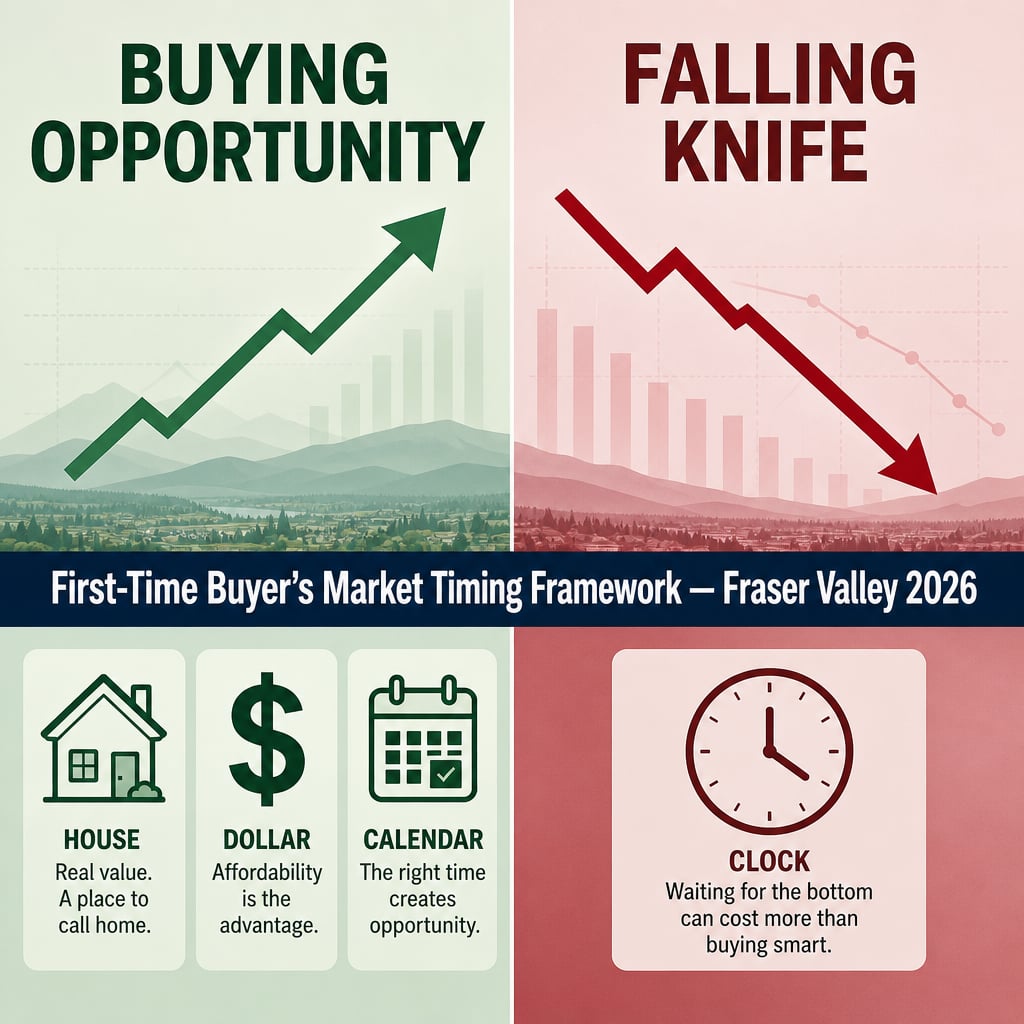

First-Time Buyer's Complete Market Timing Decision Framework for the Fraser Valley in 2026: When Current Benchmark Prices, FHSA Eligibility, PTT Exemptions, and Interest Rate Trajectory Actually Create a Genuine Buying Opportunity vs. a Falling-Knife Situation
By Mohamed Mansour, MBA and Associate Broker — Mansour Real Estate Group | Fraser Valley and Lower Mainland, BC | Published: July 14, 2026
The question every first-time buyer in Surrey, Langley, and Abbotsford is asking in 2026 is not "how do I buy a home." It is "should I buy now, or is the market still falling?" That question deserves a direct, data-grounded answer — not reassurance, not fear, and not a generalized opinion about where interest rates might go. This article provides a structured decision framework built from current Fraser Valley benchmarks, verified program mechanics, and realistic qualification constraints.
Mansour Real Estate Group has worked with first-time buyers across the Fraser Valley for more than 22 years. What we see in 2026 is a market that genuinely favours prepared, informed entry-level buyers — but only for those who understand what the signals actually mean.
Short Answer
For qualified first-time buyers in the Fraser Valley, mid-2026 conditions — a $893,300 benchmark price, 10,000+ active listings, a 10–11% sales-to-active ratio, available FHSA savings, and PTT exemptions — represent a measurable buying opportunity. The risk of waiting is not zero. Whether this is your window depends on your qualification position, your program access, and your property target — not on media headlines.
Key Takeaways
- Fraser Valley benchmark prices at $893,300 (May 2026) are at their lowest point since 2021, sitting 19% below Metro Vancouver — a genuine affordability gap that did not exist three years ago.
- A sales-to-active ratio of 10–11% with 10,000+ active listings gives buyers real negotiating leverage and time to make deliberate decisions.
- FHSA contributions (up to $8,000/year, $40,000 lifetime) and PTT exemptions (full exemption under $500K) are stackable advantages that reduce the real cost of entry.
- Bank of Canada guidance points to rate stabilization at 4.5–5.0% through 2026 — mortgage costs are unlikely to drop significantly, but are also unlikely to spike.
- Entry-level detached homes in Surrey, Langley, and Abbotsford are selling 40–60% faster than condos — property type and submarket selection matters more than broad market timing.
Who This Applies To
- First-time buyers in Surrey, Langley, or Abbotsford actively evaluating whether to purchase in 2026
- Buyers with FHSA accounts open and contributions underway
- Renters weighing continued renting against entry-level home ownership
- Buyers who passed a stress test within the last 12 months and are monitoring the market
- Families and couples purchasing their first home in the $500K–$850K range
When This Advice May Not Apply
- Buyers who do not yet qualify under the CMHC stress test at current rates
- Buyers targeting properties above $525,000 where PTT exemptions phase out completely
- Buyers without stable income documentation for mortgage qualification
- Buyers who have previously owned a home and do not meet FHSA eligibility requirements
Data Used in This Article
- Fraser Valley Real Estate Board (FVREB) Monthly Market Reports, February–May 2026 — Official; benchmark prices, sales volume, active listings, sales-to-active ratio, days-on-market by property type
- Bank of Canada Forward Guidance, Q1–Q2 2026 — Official; rate trajectory, inflation outlook
- BC Government — First Home Savings Account (FHSA) Program Mechanics — Official; contribution limits, eligibility, withdrawal rules
- BC Ministry of Finance — Property Transfer Tax First-Time Buyer Exemption — Official; exemption thresholds, partial exemption calculation
- CMHC Mortgage Qualification and Stress Test Rules 2026 — Official; qualification rate, amortization guidelines
- Mansour Real Estate Group Q1–Q2 2026 Transaction Data — Internal professional observation; Surrey, Langley, Abbotsford entry-level markets
Key Terms Defined
Benchmark Price: The FVREB's measure of a typical home's value after adjusting for property attributes. It is more stable than average sale price, which swings based on the mix of homes sold in any given month.
Sales-to-Active Listings Ratio: Total sales divided by total active listings in a given period. A ratio below 12% indicates a buyer's market. The Fraser Valley is at 10–11% as of mid-2026.
FHSA (First Home Savings Account): A registered account introduced in 2023 that allows eligible first-time buyers to contribute up to $8,000 per year (lifetime cap of $40,000) and withdraw those funds tax-free for a qualifying home purchase.
PTT Exemption: BC's Property Transfer Tax first-time buyer exemption eliminates the full PTT on purchases under $500,000. A partial exemption applies on the portion between $500,000 and $525,000. Above $525,000, no exemption applies.
Stress Test: CMHC's mortgage qualification rule requires buyers to prove they can afford payments at the higher of either the contract rate plus 2%, or 5.25%, whichever is greater.
What the Fraser Valley Market Data Actually Shows in 2026
According to the Fraser Valley Real Estate Board's May 2026 Monthly Market Report, the composite benchmark price for the Fraser Valley sits at $893,300 — down 7.5% year-over-year and representing the lowest level since 2021. With 10,000+ active listings sitting 45% above the 10-year seasonal average, buyers have more choice and more time than at any point in recent memory.
The sales-to-active ratio of 10–11% places the entire Fraser Valley in confirmed buyer's market territory. Sellers are negotiating. Days on market have stretched — detached homes averaging 25–37 days, while condos are sitting 40–60+ days in many submarkets. That time gap matters enormously for first-time buyers navigating their first purchase — it means there is room to conduct due diligence, review strata documents thoroughly, and negotiate price without the pressure of a multiple-offer environment dominating the entire market.
The important nuance: April 2026 showed sales volume up 7% year-over-year while prices fell 7.5% over the same period. That combination reveals something useful. Buyers are returning to the market, but not fast enough to absorb supply and reverse the price trend. The window of maximum buyer leverage is open — but it is not permanent. Markets do not stay at these ratios indefinitely. When seller supply normalizes, negotiating room tightens.
The 19% price gap between Fraser Valley and Metro Vancouver is structural rather than temporary. It reflects genuine differences in land supply, density planning, and commute tolerance — not a temporary anomaly. For first-time buyers priced out of Burnaby or Coquitlam, Surrey, Langley, and Abbotsford offer the closest genuine entry point into detached and semi-detached ownership.
How FHSA, PTT Exemptions, and Rate Stability Change the Real Cost of Entry
The buying opportunity in 2026 is not solely about benchmark prices. It is the combination of current prices with program stacking that creates the genuine advantage for first-time buyers.
The FHSA program, when combined with the BC PTT exemption and RRSP Home Buyers' Plan, reduces the effective cost of entry in ways that did not exist before 2023. A buyer who has maximized two years of FHSA contributions enters 2026 with up to $16,000 in tax-sheltered savings available for their purchase — with the added benefit that contributions reduced taxable income in the years they were made. On a purchase under $500,000, the PTT exemption saves up to $8,000 in closing costs that would otherwise be paid out of pocket. These are not speculative savings. They are confirmed, stackable program benefits governed by current BC and federal rules.
On the rate side, Bank of Canada forward guidance through mid-2026 points to stabilization at 4.5–5.0%, with modest cuts only if inflation continues to recede. That means mortgage costs are unlikely to drop meaningfully enough to justify waiting six to twelve months — but they are also unlikely to spike. For buyers who have already stress-tested at current rates, the qualification environment is stable.
One practical consideration: PTT exemptions apply only to purchases under $500,000 for the full benefit, and phase out entirely at $525,000. In Surrey, Langley, and Abbotsford, that price band aligns primarily with condos and some townhomes — not detached homes. A buyer targeting detached entry-level homes in the $700K–$850K range will not benefit from the PTT exemption but will still benefit meaningfully from FHSA withdrawals and current benchmark pricing. The program value and the pricing opportunity need to be evaluated together, not separately.
How We Evaluate Timing for First-Time Buyers
At Mansour Real Estate Group, our approach to first-time buyer timing starts from qualification certainty — not market optimism. A buyer who cannot qualify under current stress-test rules has no timing decision to make yet. Once qualification is confirmed, we evaluate four factors together: sales-to-active ratio in the target submarket, days-on-market for the specific property type, the buyer's program eligibility and FHSA contribution history, and the realistic alternative (continued renting, at what cost, for how long).
A buyer's market with 10–11% sales-to-active ratios does not eliminate competition on individual properties. In our Q1–Q2 2026 transaction experience across Surrey, Langley, and Abbotsford, well-priced entry-level detached homes — particularly in the $700K–$800K range in Willoughby, Cloverdale, and East Abbotsford — still attracted multiple offers within their first two weeks on market. The buyer's market gives you more options and more time on most properties. It does not eliminate competition on the specific property that checks every box.
First-Time Buyer Readiness Checklist
- Confirm mortgage pre-approval at current stress-test rate (contract rate + 2%, or 5.25% minimum) with a licensed mortgage professional
- Verify FHSA eligibility and confirm account is open — contribution room begins only after account opening, not retroactively
- Calculate PTT exemption eligibility based on your target price range — determine whether the full or partial exemption applies before setting your search boundary
- Review RRSP Home Buyers' Plan eligibility — first-time buyers can withdraw up to $35,000 from RRSP funds (as of 2024 rules) to supplement the down payment
- Define your target submarket and property type specifically — days-on-market and competition levels vary significantly between condos and detached homes in the same city
- Set a realistic offer budget that includes closing costs (legal fees, home inspection, property tax adjustment, CMHC insurance if applicable) in addition to the purchase price
- Identify your negotiation floor before viewing properties — in a buyer's market, having a clear walk-away number prevents emotional over-offers on the wrong property
What We Commonly See
In our experience, the buyers who benefit least from a buyer's market are the ones who treat it as permission to delay indefinitely. The same psychological hesitation that holds back the broader market — "prices might fall further" — tends to keep first-time buyers on the sideline past the point where the conditions are most favourable. By the time the market feels safe, the sales-to-active ratio has already moved, the best-priced inventory has been absorbed, and the negotiating room has narrowed.
What often happens with FHSA accounts is that buyers open them too late. The FHSA contribution room does not accumulate retroactively — it begins only from the year the account is opened. A buyer who opens an FHSA in 2025 has two years of room available in 2026, meaning up to $16,000 in tax-sheltered funds. A buyer who has not yet opened one in mid-2026 has one year of room available. The earlier the account is opened, the more meaningful the tax benefit.
A common mistake in the entry-level Fraser Valley market is targeting a property type based on current market conditions rather than realistic holding strategy. Buyers sometimes move toward condos because they are showing longer days-on-market and appear more negotiable. But a condo in a building with deferred maintenance, a thin depreciation reserve, or a pending special levy creates financial risk that can outweigh any purchase price advantage. In our Q1–Q2 2026 experience, reviewing strata documents before falling in love with a unit — not after — is one of the most practical things a first-time buyer can do.
Common Questions from First-Time Buyers in Surrey, Langley, and Abbotsford
Q: If benchmark prices are still falling, should I wait for the bottom?
Nobody reliably identifies the bottom until it has already passed. The relevant question is whether current conditions — pricing, inventory, programs, and your qualification — align with a decision you can make confidently. Waiting for certainty typically means waiting until competition has returned. The FVREB May 2026 data shows that sales volume is already recovering — buyers are moving. The question is whether your personal position justifies moving with them.
Q: What is the actual dollar value of the PTT exemption for a first-time buyer in BC?
According to the BC Ministry of Finance, a first-time buyer purchasing under $500,000 pays no Property Transfer Tax — saving up to $8,000. Between $500,000 and $525,000, a partial exemption applies to the portion under $500K. Above $525,000, no PTT exemption is available. That means buyers targeting sub-$500K condos in Abbotsford or Langley can capture this benefit fully; buyers targeting detached homes in Surrey generally cannot.
Q: Does the stress test mean I qualify for less than I thought?
Yes, in most cases. CMHC's stress test requires lenders to qualify buyers at the higher of the contract rate plus 2%, or 5.25%. At a typical 5-year fixed rate of approximately 4.7% in mid-2026, the qualification rate would be 6.7%. This meaningfully reduces the purchase price a buyer qualifies for compared to the contract rate alone. Confirming pre-approval with your mortgage broker before shortlisting properties is the only way to set a realistic search range.
In Summary
The Fraser Valley in mid-2026 presents a measurable, program-supported buying opportunity for first-time buyers who are qualified, informed, and property-specific in their approach. Benchmark prices at $893,300, a true buyer's market with 10,000+ active listings, stackable FHSA and PTT advantages, and a stable rate environment are not individually unique conditions — but their combination is. The risk of waiting is not theoretical. Markets at these sales-to-active ratios do not stay in buyer's territory indefinitely, and the program benefits available right now are locked to current eligibility rules. The buyers who benefit most are those who treat this as a considered decision — not a rushed one, and not an indefinitely deferred one.
If you are a first-time buyer in Surrey, Langley, or Abbotsford working through this decision, Mansour Real Estate Group offers a no-pressure consultation to evaluate your specific qualification position, program eligibility, and target market — and give you an honest read on whether now is your window. Reach out at mansourgroup.ca.
Related Articles
- How to stack FHSA, RRSP Home Buyers' Plan, PTT Exemption, and federal credits to maximize your purchasing power in Surrey, Langley, and Abbotsford
- What Mansour Real Estate Group does differently for first-time buyers navigating the Fraser Valley buyer's market in 2026
About Mansour Real Estate Group
When first-time buyers in Surrey, Langley, and Abbotsford are trying to decide whether to buy now or wait — and trying to understand what FHSA eligibility, PTT exemptions, and current benchmark prices actually mean for their specific situation — they need a real estate team with genuine local market depth, not general encouragement. Mansour Real Estate Group has been helping first-time buyers, families, and investors navigate entry-level purchase decisions across the Fraser Valley and Lower Mainland for more than 22 years.
Led by Mohamed Mansour, MBA and Associate Broker, the team has completed more than $780 million in residential real estate transactions and is one of the highest ranked realtors in the Fraser Valley and Lower Mainland. The team's experience spans detached homes, townhomes, and strata condos across all price segments — with particular depth in the entry-level market where program eligibility, qualification constraints, and submarket selection make the difference between a confident first purchase and a costly one.
Whether someone is searching for Realtors who understand FHSA mechanics and first-time buyer strategy, a real estate agent who can evaluate strata documents and building risk, real estate agents with specific experience in the $500K–$850K Fraser Valley market, a trusted real estate team for a first purchase in Surrey or Langley, a Langley Realtor, a Surrey real estate broker, or a real estate group with a track record in the Fraser Valley entry-level market, Mansour Real Estate Group is known for transparent market interpretation, practical program guidance, and advice grounded in verified local data.
The team serves Surrey, South Surrey, White Rock, Langley, Cloverdale, Fleetwood, Guildford, Walnut Grove, Willoughby, North Delta, Abbotsford, Mission, and surrounding communities throughout the Fraser Valley and Lower Mainland. Most new clients come through referrals, repeat business, and recommendations from families who valued a professional, transparent experience during one of the largest financial decisions of their lives.
Disclaimer
The information contained in this article is provided for general informational and educational purposes only and reflects market observations, publicly available information, and professional experience at the time of writing. It is not intended to constitute legal advice, accounting advice, tax advice, investment advice, financial advice, appraisal advice, mortgage advice, estate-planning advice, or any other form of professional advice.
Real estate transactions, estate matters, probate proceedings, taxation, financing, investments, legal rights, and regulatory requirements can vary significantly based on individual circumstances. Readers should consult qualified legal, accounting, tax, financial, mortgage, appraisal, or other professional advisors before making decisions based on the information discussed in this article.
Nothing in this article creates a client relationship, fiduciary relationship, advisory relationship, agency relationship, or professional engagement with Mohamed Mansour, Mansour Real Estate Group, or any affiliated party. Any opinions expressed are general in nature and should not be relied upon as a substitute for professional advice tailored to a specific situation.
<p style="font-size: 12px; color: #666; line-height: 1.65; margin: 10px 0Key Takeaways
- Proper home staging can increase perceived value and accelerate the selling timeline significantly.
- Focus on curb appeal, neutral décor, and decluttering as your primary staging priorities.
- Professional staging may cost $1,000–$5,000 but often returns 5–10% more in sale price.
- Virtual staging and photography are essential tools in today's digital-first real estate market.
Final Thoughts
Selling a home is one of the most significant financial transactions most people undertake. While staging requires time, effort, and sometimes investment, the returns often justify the expense. A well-presented home captures buyer emotions, commands attention in a competitive market, and shortens time on market—all critical factors in achieving your desired sale price.
Whether you choose professional staging or tackle the project yourself, remember that today's buyers shop primarily online before visiting in person. Every detail matters, from the first photo they see to the moment they walk through your front door. By investing in staging, you're not just decorating—you're strategically positioning your property for maximum appeal and profitability.
Ready to prepare your home for sale? Start with a walk-through from a buyer's perspective, identify your property's strongest features, and neutralize spaces that might distract from your home's inherent appeal. With thoughtful staging, your home will tell the story that sells.



