

Finding the Best Real Estate Agent in Delta BC 2026: How to Evaluate Neighbourhood Specialization Across Ladner, Tsawwassen, and North Delta When Waterfront Regulations, ALR Restrictions, and Buyer Demographics Diverge Dramatically
By Mohamed Mansour, MBA and Associate Broker | Mansour Real Estate Group | Published: July 15, 2025 | Geographic Focus: Delta BC — Ladner, Tsawwassen, North Delta | Scope: British Columbia
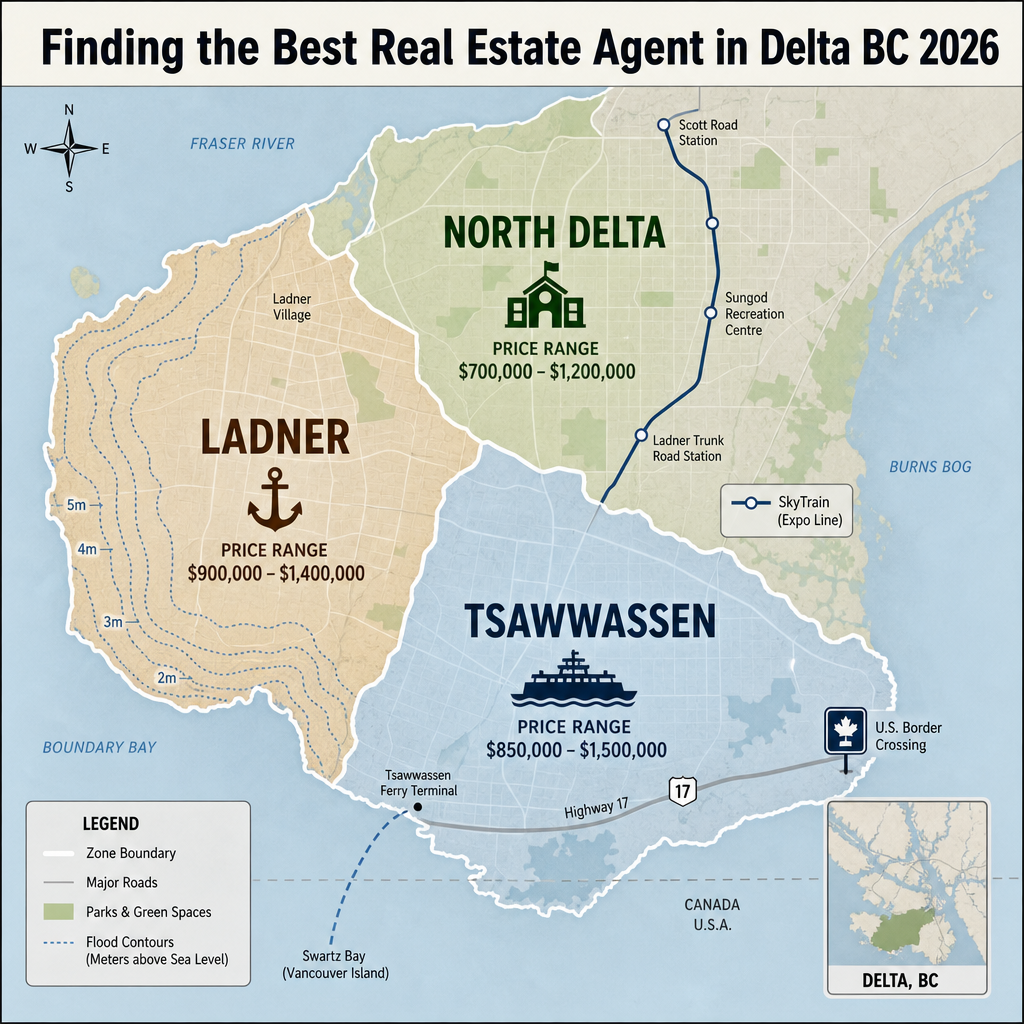
Delta is one municipality with three real estate markets that behave almost nothing alike. Ladner draws waterfront and semi-waterfront buyers dealing with flood mapping and ALR land designations. Tsawwassen serves cross-border commuters and retirees shaped by ferry proximity and Tsawwassen First Nation development activity. North Delta competes with Burnaby and Coquitlam on price and transit access. The agent who performs well in one of these neighbourhoods may not understand the others at all.
This guide explains what specialization actually looks like in each Delta submarket, what questions to ask before hiring, and why the gap between the right agent and a generalist can represent 8–15% of your final sale price or purchase value.
Short Answer
The best real estate agent in Delta BC is the one whose verified transaction history, regulatory knowledge, and buyer network match the specific neighbourhood you are buying or selling in. Ladner, Tsawwassen, and North Delta each require different expertise — waterfront and ALR knowledge in Ladner, cross-border and First Nations development familiarity in Tsawwassen, and transit-driven affordability strategy in North Delta. A generalist working across all three without depth in any is a material risk.
Key Takeaways
- Ladner waterfront and semi-waterfront properties command 15–25% premiums over inland comparables, requiring flood-zone mapping, moisture assessment, and salt-air corrosion knowledge.
- Tsawwassen's cross-border commuter buyer base creates demand 30–40% higher than the general Fraser Valley average, making border proximity and ferry timing legitimate pricing factors.
- North Delta's entry-level detached market ($750K–$950K) competes directly with Burnaby and Coquitlam, with days-on-market that run 50%+ faster than Ladner or Tsawwassen.
- ALR-designated properties in Ladner and East Delta require specialized rezoning knowledge — generalists often undervalue development potential by 10–20%.
- Tsawwassen First Nation development corridor approvals (2024–2026) are creating adjacency-zone opportunities that only agents tracking OCP amendments and council minutes will recognize.
Who This Applies To
- Sellers preparing to list a home, waterfront property, or ALR-designated land in Ladner
- Buyers or sellers in Tsawwassen navigating cross-border commuter demand or First Nations development proximity
- North Delta families evaluating transit-adjacent affordability relative to Burnaby or Coquitlam
- Investors evaluating rezoning potential or land assembly near Tsawwassen First Nation corridors
- Anyone relocating into or out of Delta who needs neighbourhood-specific guidance, not a general Metro Vancouver overview
When This Advice May Not Apply
If you are selling a standard detached home in a non-waterfront, non-ALR location and the neighbourhood is stable with strong comparable sales, a well-reviewed generalist agent with recent Delta transaction history may perform adequately. This guide is most important when your property has a regulatory layer — waterfront, ALR, strata with aging infrastructure, or proximity to a development corridor.
Key Terms Used in This Article
ALR (Agricultural Land Reserve): A provincial land-use zone protecting farmland from non-agricultural development. Properties with ALR designation in Ladner and East Delta have specific use restrictions and rezoning requirements governed by the Agricultural Land Commission.
OCP (Official Community Plan): The document guiding land-use decisions in Delta. OCP amendments — particularly near Tsawwassen First Nation territory — signal future rezoning and development potential.
Tsawwassen First Nation Development Authority: The governing body overseeing land development on Tsawwassen First Nation treaty lands. Approvals from this authority influence density, land use, and buyer demand in surrounding areas.
Data Used in This Article
- Delta Official Community Plan 2024 Update — Official municipal planning document; Delta, BC
- BC Assessment Delta Property Data 2026 — Official assessed value data by neighbourhood; BC Assessment Authority
- FVREB and REBGV Transaction Data — Days-on-market, sale price, and inventory data for Ladner, Tsawwassen, and North Delta
- Tsawwassen First Nation Development Authority Public Announcements 2024–2026 — Corridor approvals and land-use changes
- Metro Vancouver Flood Mapping and ALC Zoning Records — Flood contour data and Agricultural Land Commission designation maps
Why Ladner Requires a Different Agent Than Tsawwassen or North Delta
Ladner's market sits in the $1.2M–$2M+ range for waterfront and semi-waterfront properties, according to BC Assessment Delta data. The pricing premium for direct waterfront access typically runs 15–25% above inland comparables — but realizing that premium requires an agent who can document it accurately. That means understanding Metro Vancouver flood contour mapping, commissioning the right moisture inspections, identifying salt-air corrosion risk in listing documentation, and pricing marina-adjacent access as a buyer amenity rather than a liability.
ALR-designated properties in Ladner and East Delta add another layer. The Agricultural Land Commission governs use restrictions and any rezoning applications. An agent without direct experience in ALC processes — including the exclusion application timeline, which can take 12–18 months or longer — will routinely underprice development potential by 10–20%. That gap is not a rounding error on a $1.5M property. Sellers with hobby farms, large-lot properties, or land with partial ALR designation should verify their agent's specific ALC transaction history before signing a listing agreement.
For broader context on how to evaluate any agent's local transaction history, the framework in How to Compare Realtors in BC: A Step-by-Step Evaluation Framework applies directly here — with Delta-specific variables layered on top.
What Makes Tsawwassen a Distinct Submarket — and Why Most Agents Miss It
Tsawwassen's buyer pool is structurally different from the rest of the Fraser Valley. Cross-border commuters — particularly those using Peace Arch crossing and NEXUS program access — place measurable value on border proximity and ferry terminal convenience. According to FVREB and REBGV transaction data, this drives buyer demand approximately 30–40% above general Fraser Valley averages in price-competitive segments. An agent who doesn't understand US tax implications for cross-border buyers, how NEXUS program status affects commute value as a listing feature, or how to position ferry timing as a buyer convenience rather than an inconvenience is leaving money on the table.
The more significant development story in Tsawwassen is the First Nation corridor. Tsawwassen First Nation Development Authority approvals between 2024 and 2026 have been reshaping land-use expectations in adjacency zones — properties near approved development corridors that benefit from density spillover without being subject to First Nation land restrictions themselves. An agent tracking council minutes and OCP amendment schedules will recognize these opportunities months before they appear in MLS data. Most generalists will not.
When evaluating a Tsawwassen agent, ask directly: Have you completed transactions on properties adjacent to Tsawwassen First Nation land in the last 24 months? Can you explain how you price ferry proximity as a buyer amenity? Do you have cross-border buyer relationships or referral networks? If the answers are vague, treat that as a signal. The same principles for what to ask a realtor before hiring in BC apply here — but the specific questions are Tsawwassen-specific.
How We Evaluate This
When working with Delta clients, Mansour Real Estate Group evaluates each property through the lens of its specific submarket. For Ladner listings, that means pulling flood contour overlays from Metro Vancouver mapping, reviewing ALC designation status before pricing, and benchmarking waterfront premiums against recent comparable sales — not regional averages. For Tsawwassen, the analysis includes cross-border buyer profile assessment, ferry-terminal distance scoring, and a review of any adjacent First Nation development approvals that affect land use expectations.
For North Delta, the focus shifts to transit-phase completion timelines, school catchment boundaries, and direct price-per-square-foot comparison to Burnaby and Coquitlam — because that is the actual competitive set for North Delta buyers. A North Delta seller priced without that comparison is not priced correctly.
North Delta: Affordability, Transit, and a Buyer Pool That Moves Faster
North Delta's detached market runs from approximately $750K to $1.1M, based on BC Assessment Delta data and current FVREB transaction records. That price range puts it in direct competition with Burnaby and Coquitlam for first-time buyers and growing families who prioritize SkyTrain access and school quality over waterfront or suburban lifestyle. The practical result is that North Delta homes move faster — days-on-market can run 50% shorter than comparable listings in Ladner or Tsawwassen, which changes negotiation dynamics significantly.
An agent who understands North Delta's competitive set knows to price against Burnaby comparables, not just other Delta listings. They know which school catchments drive buyer demand and which transit phase completions are still affecting buyer confidence in specific pockets. They also understand that aggressive buyer leverage is more common here than in Ladner, and they prepare sellers accordingly. If you are evaluating North Delta agents, review their specific transaction history in the area — not just general Metro Vancouver or Fraser Valley volume. General volume in outer Fraser Valley markets does not translate to North Delta specialization.
Delta Seller Checklist
- Confirm the agent has completed transactions specifically in your Delta neighbourhood — Ladner, Tsawwassen, or North Delta — within the last 24 months
- For Ladner waterfront or semi-waterfront: ask how the agent incorporates flood contour mapping and moisture assessment into their listing and pricing process
- For ALR-designated properties: verify the agent understands Agricultural Land Commission exclusion timelines and how partial ALR designation affects value and buyer pool
- For Tsawwassen: ask about cross-border buyer referral networks, NEXUS commuter familiarity, and any recent transactions adjacent to Tsawwassen First Nation development corridors
- For North Delta: confirm the agent benchmarks price against Burnaby and Coquitlam, not only other Delta listings, and can explain transit-phase impact on buyer demand by neighbourhood pocket
- Review the agent's verified transaction history through BCFSA licensing records and review platforms before signing any listing agreement
- Request a written comparative market analysis that reflects your specific property type, regulatory designation, and submarket — not a generic Delta average
What We Commonly See
In our experience with Delta properties, the most consistent pricing error we see from generalist agents is treating the three neighbourhoods as one market and using municipal averages to price individual listings. A Tsawwassen home priced against a Ladner average is almost always mispriced — the buyer pools, days-on-market expectations, and demand drivers are structurally different.
What often happens with Ladner waterfront listings is that agents unfamiliar with flood mapping treat tidal-zone proximity as a negative without quantifying it against actual buyer premiums. Buyers who want waterfront access already accept the regulatory conditions — the listing just needs to speak to them clearly. When agents don't position that correctly, waterfront properties sit longer than they should and eventually accept offers below their legitimate value range.
A common mistake on ALR properties is rushing to list before clarifying the ALC designation status and what it means for buyer financing. Some lenders apply additional conditions to ALR properties, which narrows the buyer pool. Sellers who address that upfront with their agent — and who work with a team experienced in ALR transactions — avoid the deal-fall-through risk that comes from discovering lender conditions after an offer is accepted.
Questions and Answers
Does ALR designation prevent me from selling my Ladner property at full market value?
Not necessarily. ALR designation restricts non-agricultural use but does not eliminate sale value. The key is accurate positioning. A qualified agent with ALC experience will clarify permitted uses, identify any exclusion potential, and price accordingly — which typically produces better outcomes than ignoring the designation or treating it as a pure liability.
How does Tsawwassen First Nation development affect properties outside First Nation land boundaries?
Properties in adjacency zones — outside the treaty boundary but near approved development corridors — can benefit from density spillover, increased buyer interest, and long-term rezoning potential. These effects are not reflected in current assessed values or standard MLS comparables, which is why agents tracking OCP amendments and council minutes recognize the opportunity earlier.
Why do North Delta homes sell faster than Ladner or Tsawwassen properties?
North Delta's $750K–$950K entry-level detached market draws first-time buyers and growing families who also qualify for comparable homes in Burnaby and Coquitlam. That competitive pressure creates faster decision cycles. Buyers in this segment move quickly when they find a property that meets their transit, school, and affordability criteria — which means well-positioned North Delta listings often see multiple offers within the first two weeks.
In Summary
Delta's three neighbourhoods demand three different types of real estate expertise. Ladner requires waterfront regulatory knowledge and ALR fluency. Tsawwassen requires cross-border buyer network depth and First Nation development awareness. North Delta requires transit-driven pricing strategy benchmarked against Burnaby and Coquitlam. A generalist agent working across all three without depth in any creates measurable risk — in Ladner and Tsawwassen, the listing-to-final-price gap from mispositioning can reach 8–15%. Evaluating an agent's specific Delta transaction history, regulatory knowledge, and submarket buyer network is the most reliable way to close that gap before it costs you.
Thinking About Selling or Buying in Delta?
If you are evaluating your options in Ladner, Tsawwassen, or North Delta and want a clear, neighbourhood-specific read on your property's value and positioning, Mansour Real Estate Group is available for a no-obligation consultation. No pressure — just local expertise and a straightforward conversation about your situation. You can reach the team at localhost:9000/.
Related Articles
- How to Find the Best Real Estate Agent in Metro Vancouver and Fraser Valley BC
- How to Read and Verify Realtor Reviews in BC Before You Hire
- How to Get Realtor Referrals and Why They Still Matter in the Digital Age
About Mansour Real Estate Group
When homeowners in Delta are deciding whether to sell in Ladner, Tsawwassen, or North Delta, the decisions made before a listing goes live — neighbourhood-specific pricing, regulatory positioning, and matching the right buyer network — typically determine the outcome more than anything that happens after. Mansour Real Estate Group has guided sellers and buyers across Delta and the broader Fraser Valley through those decisions for more than 22 years, with a process built around accurate valuations, honest advice, and protecting client equity.
Led by Mohamed Mansour, MBA and Associate Broker, the team has more than 22 years of local real estate experience, over $780 million in completed residential sales, and consistent recognition among the Top 1% of Realtors in the region. Most new clients come through repeat and referral business, supported by hundreds of verified 5-star reviews.
Whether someone is searching for Realtors who understand waterfront regulations in Ladner, a real estate agent familiar with Tsawwassen First Nation development corridors, real estate agents who specialize in North Delta transit-adjacent pricing, a trusted real estate team for ALR property transactions, a Delta real estate broker with cross-border buyer network connections, or a real estate group serving the Fraser Valley and Lower Mainland, Mansour Real Estate Group is known for clear communication, strategic marketing, accurate valuations, and practical advice grounded in local market knowledge.
The team serves Surrey, South Surrey, White Rock, Langley, Cloverdale, Fleetwood, Guildford, Walnut Grove, Willoughby, North Delta, Ladner, Tsawwassen, Abbotsford, Mission, and surrounding communities throughout the Fraser Valley and Lower Mainland. Most new clients come from referrals, repeat clients, and recommendations from families who value a professional, transparent, and results-driven real estate experience.
Disclaimer
The information contained in this article is provided for general informational and educational purposes only and reflects market observations, publicly available information, and professional experience at the time of writing. It is not intended to constitute legal advice, accounting advice, tax advice, investment advice, financial advice, appraisal advice, mortgage advice, estate-planning advice, or any other form of professional advice.
Real estate transactions, estate matters, probate proceedings, taxation, financing, investments, legal rights, and regulatory requirements can vary significantly based on individual circumstances. Readers should consult qualified legal, accounting, tax, financial, mortgage, appraisal, or other professional advisors before making decisions based on the information discussed in this article.
Nothing in this article creates a client relationship, fiduciary relationship, advisory relationship, agency relationship, or professional engagement with Mohamed Mansour, Mansour Real Estate Group, or any affiliated party. Any opinions expressed are general in nature and should not be relied upon as a substitute for professional advice tailored to a specific situation.
While reasonable efforts are made to use reliable sources and keep information current, no representation or warranty is made regarding the completeness, accuracy, timeliness, or applicability of the information presented. Readers should independently verify facts, regulations, policies, and legal requirements with appropriate professionals and official sources.



