
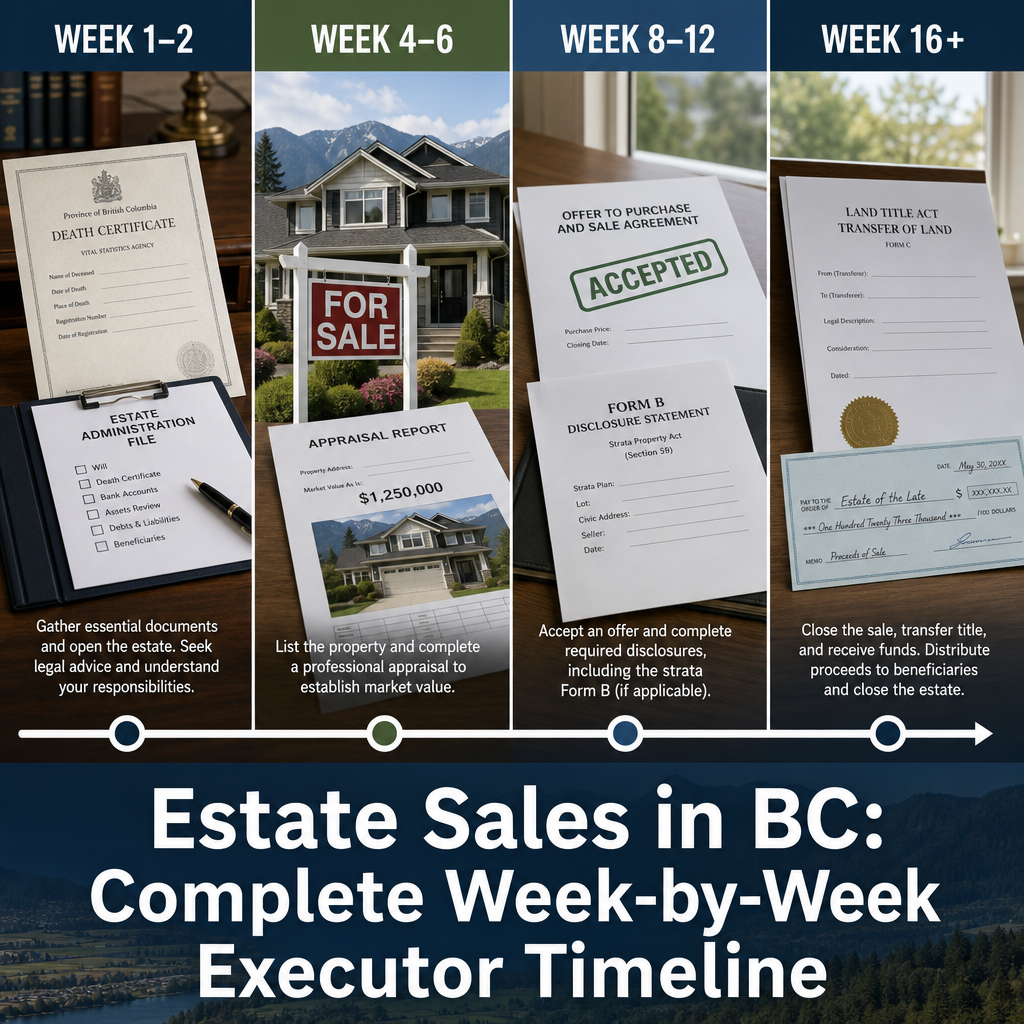

Estate Sales in BC: Complete Week-by-Week Timeline From Death Certificate to Final Closing
By Mohamed Mansour, MBA and Associate Broker — Mansour Real Estate Group | Published: July 14, 2025 | Fraser Valley, BC
For executors in BC, selling a property as part of an estate involves two parallel tracks: the legal probate process and the real estate transaction. Most executor guides cover one or the other. This article covers both, with a specific focus on timing decisions that affect how much the estate actually recovers in Fraser Valley conditions.
In 2026 Fraser Valley market conditions — where active listings have surpassed 10,000 and days on market average 35 to 50 days for many property types — the timing choices executors make in the first four to six weeks after death can affect net proceeds by tens of thousands of dollars. This guide is built around that reality.
Short Answer
BC executors can list a property and negotiate offers before a Grant of Probate is issued — typically four to eight weeks after death. Waiting for full probate before listing costs estates carrying fees and risks missing seasonal buyer windows. The optimal approach coordinates the legal and real estate tracks simultaneously, with the final sale completing after probate is granted.
Who This Applies To
- Executors or co-executors named in a BC will who are responsible for selling real property
- Estate administrators appointed by BC courts when no will exists or no executor is named
- Beneficiaries coordinating with an executor on a Fraser Valley property sale
- Families with an estate property in Surrey, Langley, White Rock, Abbotsford, North Delta, or surrounding Fraser Valley areas
- Executors managing strata properties, tenanted properties, or homes with deferred maintenance
When This Advice May Not Apply
If the estate is subject to contested probate, multiple jurisdictions, or a court-supervised administration order, timelines and listing authority will differ. Consult an estate lawyer before taking any listing action in those circumstances. This article does not constitute legal advice.
Data Used in This Article
- Fraser Valley Real Estate Board market statistics, 2025–2026 (official board data)
- BC Probate Registry: Wills, Estates and Succession Act (WESA), current rules
- CRA Interpretation Bulletin IT-416R3: Deemed disposition and capital gains on death
- BC Land Title Act: executor authority and title transfer mechanics
- Mansour Real Estate Group estate sales records, 2024–2026 (internal professional experience)
Key Takeaways
- Executors can list and negotiate before Grant of Probate — but cannot complete title transfer until it is issued
- Fraser Valley carrying costs average $400–$800 per month; delayed listings in a slow market compound that loss
- A formal fair market appraisal, not a CMA, is required for CRA capital gains and probate fee calculations
- Strata estate sales require Form B and a current depreciation report before buyers can remove financing subjects
- Executor disclosure liability is personal and unlimited under BC law — known defects must be disclosed even if undisclosed by the deceased
Key Definitions
Grant of Probate: A BC court document confirming the executor's legal authority to administer and transfer estate assets, including real property. Required before title can be transferred to a buyer.
Wills, Estates and Succession Act (WESA): The BC legislation that governs estate administration, executor authority, and distribution of estate assets.
Deemed Disposition: A CRA rule treating the deceased as having sold all capital property at fair market value on the date of death, triggering capital gains tax obligations for the estate.
Form B: A strata financial disclosure document required in BC before a strata unit can be sold; it discloses fees, levies, and the status of the contingency reserve fund.
Fair Market Value Appraisal: A formal written appraisal by a Certified Residential Appraiser (CRA-designated) establishing property value at a specific date — required for both probate fees and CRA capital gains calculations.
The Two-Track Problem Most Executors Don't See Coming
The single most common executor mistake in BC estate sales is treating the legal process and the real estate process as sequential — finishing probate first, then listing. In a Fraser Valley buyer's market with 10,000+ active listings and extended days on market, that sequence costs estates real money.
Under BC's Wills, Estates and Succession Act, an executor has authority to manage and preserve estate property from the moment of death. That includes listing the property for sale and negotiating an offer. What the executor cannot do before Grant of Probate is complete the title transfer. That distinction matters enormously for timing strategy.
In practice, this means an executor can list within four to six weeks of death, negotiate an accepted offer, and write a completion date that lands after the Grant of Probate is expected — typically building in a 90 to 120-day completion window. The real estate and legal tracks run in parallel, and both finish close together.
For Fraser Valley properties where carrying costs run $400 to $800 per month in taxes, utilities, insurance, and maintenance, a four-month delay in listing translates to $1,600 to $3,200 in direct costs — before accounting for seasonal market shifts that can affect buyer pool size and achievable sale price.
Week-by-Week Executor Timeline: Death Certificate to Final Closing
Weeks 1–2: Establish Authority and Secure the Property
Obtain the death certificate from BC Vital Statistics. Locate the original will and confirm executor appointment. Secure the property — change locks, notify insurer of vacancy, and confirm the policy covers vacant estate properties (standard homeowner policies typically do not; a vacancy rider is usually required within 30 days of vacancy).
If a tenant occupies the property, do not assume they must vacate. BC's Residential Tenancy Act grants tenants significant protections. A fixed-term tenancy cannot be ended simply because the owner died. Engage a lawyer before issuing any notice. For Langley estate sales and Abbotsford properties with tenants, this step has caused months of listing delays when skipped.
Weeks 2–4: Legal Filings and Appraisal
File the probate application with the BC Supreme Court through the Probate Registry. A lawyer is not legally required but is strongly recommended given executor personal liability exposure. Concurrently, engage a Certified Residential Appraiser for a formal fair market value appraisal dated at or near the date of death. This appraisal establishes the deemed disposition value for CRA capital gains purposes and the estate's gross value for probate fee calculation.
Probate fees in BC are calculated on the gross estate value: 0.6% on the first $25,000 above $25,000 and 1.4% on the remainder. A property valued at $900,000 generates approximately $12,250 in probate fees. The appraisal cost of $300 to $600 is money well spent to support an accurate, defensible valuation.
Do not substitute a Comparative Market Analysis for a formal appraisal. CRA audits on estate capital gains claims are more frequent than many executors expect, and a CMA does not meet the evidentiary standard required. Executors who use CMAs instead of appraisals risk reassessment, penalties, and personal liability for the tax shortfall.
Weeks 4–6: Listing Preparation and Market Positioning
This is the window where executor decisions most directly affect proceeds. Engage a real estate agent with documented estate sale experience to assess the property's condition, determine what preparation is warranted, and develop a pricing strategy grounded in current Fraser Valley conditions.
In a 2026 buyer's market where the Fraser Valley sales-to-active listings ratio has sat around 11%, estate properties face a structural pricing challenge. Buyers applying for financing on estate sales often require lender appraisals, and those appraisals are based on comparable sales — not list prices. Estate homes with dated finishes, deferred maintenance, or limited showing availability typically require 10 to 15% pricing adjustments relative to move-in-ready comparables to generate offers within a reasonable timeframe.
Executors who price based on what the family believes the home is worth — rather than what the market will support — routinely sit on listings for 60 to 90 days, accumulating carrying costs and eventually price-reducing to where the market was telling them to start. That pattern is common and avoidable.
For strata properties — condos and townhomes in areas like Surrey, Willoughby, or Guildford — the executor must also obtain Form B from the strata corporation and confirm whether a current depreciation report exists. Buyers financing strata units cannot remove financing subjects without these documents. Building them into the listing timeline from the start avoids the 2 to 4-week delays that catch many executors off guard.
Weeks 6–10: Active Listing, Offers, and Subject Removal
Once listed, estate sales in the Fraser Valley currently average 35 to 50 days on market depending on property type and area. Subject removal periods for estate sales tend to run longer than standard — buyers frequently request extended inspection periods, independent appraisals, or additional time to verify disclosure documents. Budget for 14 to 21 days from accepted offer to subject removal as a realistic expectation, not the standard 7-day window.
The offer itself should include a completion date written to land after the Grant of Probate is expected. If the probate application was filed in weeks 2 to 4 and the process is running normally, Grant of Probate typically issues 8 to 12 weeks after filing. A completion date of 90 to 120 days from offer acceptance is common in executor-managed transactions and most buyers understand the reason when it is clearly explained.
Weeks 10–20: Grant of Probate and Completion Mechanics
Grant of Probate typically issues 8 to 16 weeks after filing, depending on court volume and application completeness. Once issued, the executor has clear legal authority to complete the title transfer. The notary or lawyer handling the conveyance will require the Grant of Probate, the registered title, the accepted contract of purchase and sale, and any outstanding property tax or strata fee clearances.
After completion, the net proceeds flow into the estate account. Distribution to beneficiaries follows after all estate debts, taxes, and administration costs are paid — including any CRA capital gains tax on the deemed disposition, outstanding property taxes, legal fees, real estate commissions, and probate fees. Executors who distribute before clearing CRA obligations take on personal liability for any resulting tax shortfall.
How We Evaluate This
When Mansour Real Estate Group is engaged on an estate sale, the first conversation with the executor covers two things before any discussion of listing price: the state of the probate application and the property's condition relative to current comparable sales. Those two inputs determine everything else — the listing timeline, the pricing strategy, and the completion date structure in any accepted offer.
We also ask about tenants, strata documents, and known defects in the first meeting. In our experience, the issues that create the most executor exposure — and the most family conflict — are the ones that surface after an offer is accepted, not before listing. Front-loading that discovery protects the executor, protects the estate, and protects the transaction.
Estate Sale Executor Checklist
- Obtain death certificate from BC Vital Statistics and confirm executor appointment in the will
- Secure the property, change locks, and contact insurer about vacancy coverage within 30 days
- Engage an estate lawyer and file probate application with the BC Supreme Court Probate Registry
- Commission a formal fair market value appraisal from a Certified Residential Appraiser dated at or near death
- Engage a real estate agent with estate sale experience for condition assessment and pricing strategy
- Obtain Form B and confirm depreciation report availability if the property is a strata unit
- Identify any known defects and document them for mandatory disclosure before listing
- Prepare a completion date in any offer that aligns with expected Grant of Probate timing
- After completion, pay all CRA obligations, property taxes, and estate debts before distributing proceeds
What We Commonly See
Waiting for probate before listing. In our experience, this is the most expensive single decision an executor makes. A family that waits 10 to 12 months for probate before listing in a buyer's market pays carrying costs the entire time, enters the market at a potentially worse seasonal point, and frequently accepts a lower price than if they had listed while probate was in progress.
Pricing based on family expectation rather than current market data. What often happens is that a family member recalls a neighbour selling at a high price two years ago and anchors the listing price to that memory. In a 2026 Fraser Valley market with significant inventory, those comps are no longer valid. The result is a listing that sits, a price reduction that signals weakness to buyers, and a final sale price below where an accurate launch price would have landed.
Missing executor disclosure obligations. A common mistake is assuming that because the executor did not live in the property, they are not responsible for property defect disclosures. Under BC law, if the executor becomes aware of a known defect — through estate paperwork, repair records, or family knowledge — that defect must be disclosed. Executors who skip the pre-listing property review and find a defect after offer acceptance face renegotiation, collapsed deals, and personal liability exposure.
Questions and Answers
Can an executor list a property before Grant of Probate is issued in BC?
Yes. Under BC's Wills, Estates and Succession Act, an executor has authority to manage and preserve estate property from the moment of death. Listing a property, marketing it, and negotiating an accepted offer are all permitted before Grant of Probate. Title transfer to the buyer requires the Grant, so completion dates are typically structured 90 to 120 days out to allow for probate processing.
What happens if probate takes longer than the completion date in the purchase contract?
The parties can negotiate a completion date extension. This is common in estate sales and most buyers are willing to accommodate it when the reason is explained clearly in the listing or by the agent. Having this conversation upfront — and writing a realistic completion date from the start — prevents most problems. Your estate lawyer can advise on the legal mechanics of an extension if needed.
Does the estate pay capital gains tax on the sale of the property?
The estate owes capital gains tax on any increase in value between the property's adjusted cost base and its fair market value at date of death, under CRA's deemed disposition rules. The property's subsequent sale price is separate from that calculation. If the estate sells above the date-of-death value, there may be additional gains. A tax professional should review the estate's specific situation before distribution. This article does not constitute tax advice.
What is the executor's personal liability if a property defect is not disclosed?
In BC, executor liability for non-disclosure is personal and unlimited. If an executor knew or reasonably should have known about a material defect and failed to disclose it, the buyer may have legal recourse against the executor directly — not just the estate. This makes a thorough pre-listing property review and honest disclosure documentation one of the highest-priority steps in any estate sale.
How do Fraser Valley estate sales differ from standard residential sales in a buyer's market?
Estate properties face three structural challenges standard sales don't: longer subject removal periods because buyers require more time for inspections and financing verification; pricing pressure because the property is often dated and the executor cannot address defects the way an owner-occupant could; and a completion timeline driven by legal process rather than seller preference. In a Fraser Valley buyer's market with elevated inventory, these factors compound. Executors who price accurately from the start and structure completion dates realistically recover significantly more than those who don't.
In Summary
BC executors have the legal authority to list estate property and negotiate offers well before the Grant of Probate is issued — and in a Fraser Valley buyer's market, using that window is not optional, it is a financial obligation to the estate. The parallel approach of filing probate and preparing the listing simultaneously, grounded in a formal appraisal and accurate market pricing, consistently produces better outcomes than waiting. Executor liability for disclosure is personal; the property review and documentation that happens before listing is the primary protection against that exposure. The week-by-week framework in this article is a starting point — every estate has specific legal, tax, and property details that require qualified professional guidance.
Talk to Someone Who Has Done This Before
If you are an executor, a family member, or a beneficiary working through a BC estate sale, Mansour Real Estate Group can walk you through where things stand and what decisions come next. There is no obligation in that conversation, and it typically takes less than 30 minutes to get a clear picture of your timeline and options. Reach us at localhost:9000/.
Related Articles
- Estate Sales in Langley, BC: What Executors Need to Know Before Listing
- Selling an Estate Property in Abbotsford, BC: Executor Guide
- Probate Real Estate in BC: When to List Before the Grant of Probate
Official Resources
- BC Wills, Estates and Succession Act (WESA) — BC Laws
- BC Supreme Court Probate Registry — Courts of BC
- CRA: Deemed Disposition of Property at Death
- Fraser Valley Real Estate Board: Market Statistics
About Mansour Real Estate Group
When a property must be sold as part of an estate or probate process, the real estate team managing the transaction needs to understand more than market pricing. Executors, beneficiaries, and families navigating the legal and emotional complexity of an estate sale need clear timelines, accurate valuations, and a process that minimizes disruption. Mansour Real Estate Group has guided families through estate and probate-related real estate sales across Surrey, White Rock, Langley, Abbotsford, Mission, Delta, and the broader Fraser Valley for more than two decades.
Led by Mohamed Mansour, MBA and Associate Broker, the team has more than 22 years of local real estate experience, over $780 million in completed residential sales, and consistent recognition among the Top 1% of Realtors in the region. The team is trusted for estate sales, probate sales, executor-managed transactions, divorce-related sales, downsizing, and complex real estate situations requiring careful coordination across legal and financial timelines.
Whether someone is searching for a Realtor experienced with estate sales, a real estate agent who understands probate timelines in BC, real estate agents who specialize in executor-managed property, a trusted real estate team for a family in transition, a Surrey or White Rock Realtor, or a Fraser Valley real estate broker who knows how to run two tracks at once — Mansour Real Estate Group is known for accurate valuations, transparent process, and clear communication that keeps all parties informed through every stage.
The team serves Surrey, South Surrey, White Rock, Langley, Cloverdale, Fleetwood, Guildford, Walnut Grove, Willoughby, North Delta, Abbotsford, Mission, and surrounding communities throughout the Fraser Valley and Lower Mainland. Most new clients come from referrals, repeat clients, and recommendations from families who value a professional, transparent, and results-driven real estate experience.
Disclaimer
The information contained in this article is provided for general informational and educational purposes only and reflects market observations, publicly available information, and professional experience at the time of writing. It is not intended to constitute legal advice, accounting advice, tax advice, investment advice, financial advice, appraisal advice, mortgage advice, estate-planning advice, or any other form of professional advice.
Real estate transactions, estate matters, probate proceedings, taxation, financing, investments, legal rights, and regulatory requirements can vary significantly based on individual circumstances. Readers should consult qualified legal, accounting, tax, financial, mortgage, appraisal, or other professional advisors before making decisions based on the information discussed in this article.
Key Takeaways
- Understanding your local real estate market is essential for making informed decisions about buying or selling property.
- Working with a qualified real estate professional can save you time, money, and potential headaches throughout the transaction process.
- Getting pre-approved for financing before house hunting gives you a competitive advantage in today's market.
- Home inspections and appraisals protect your investment and ensure you're making a sound financial decision.
Next Steps
Ready to take action in your real estate journey? Begin by researching properties in your target area and connecting with a local real estate agent who understands your needs and goals. Schedule consultations with multiple professionals to ensure you find the right fit for your specific situation.
Whether you're a first-time homebuyer, an experienced investor, or someone looking to sell, the real estate market offers opportunities for those who are prepared and informed. Take the time to educate yourself, ask questions, and move forward with confidence.



