
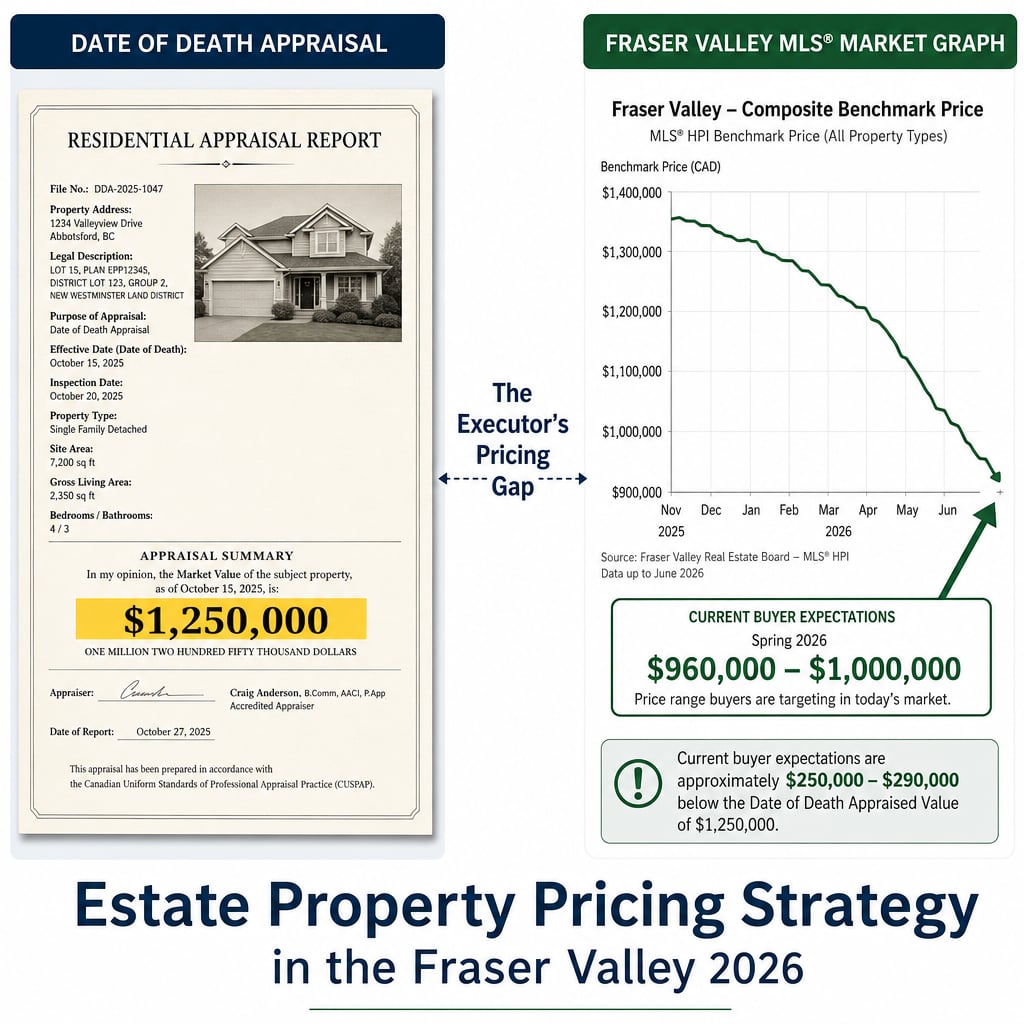

Estate Property Pricing Strategy in the Fraser Valley 2026 Buyer's Market: How Executors Can Reconcile CRA Fair Market Value Requirements With Current Market Conditions to Maximize Net Proceeds
By Mohamed Mansour, MBA and Associate Broker | Mansour Real Estate Group | Fraser Valley, BC | Published: May 14, 2026 | Estate Sales & Executor Strategy
Executors managing estate property sales in Surrey, Langley, and Abbotsford are navigating a specific conflict that most probate guides do not address directly. CRA requires a fair market value appraisal at the date of death. But Fraser Valley detached benchmark prices have declined 8.7% year-over-year as of March 2026, meaning a property appraised in late 2025 may already be priced above what the current market will bear before the listing even goes live.
This article explains how those two obligations — tax compliance and fiduciary duty to maximize proceeds — are not in conflict, and how experienced executors use current-market pricing strategy to generate buyer competition even when inventory is high and the property has been sitting vacant.
Short Answer
CRA's fair market value appraisal at date of death is a tax and probate fee requirement — not a listing price instruction. In the Fraser Valley's 2026 buyer's market, executors who anchor the listing price to a stale appraisal routinely wait 60 to 90 days before reducing, losing more than they would have from strategic pricing at the outset. Pricing 3 to 5% below current benchmark, adjusted for vacancy discount and intervening market decline, generates buyer competition and higher net proceeds.
Who This Applies To
- Executors managing the sale of a deceased person's home in Surrey, Langley, Abbotsford, South Surrey, White Rock, or North Delta
- Beneficiaries who have received a date-of-death appraisal and are uncertain whether to list at that figure
- Estate lawyers and accountants advising executors on pricing decisions without access to current market data
- Families managing vacant estate properties that have already been sitting without an active listing strategy
When This Advice May Not Apply
If the estate property is tenanted, if the property type is a condo with active strata management, or if the estate is subject to court-ordered sale with a fixed price floor, the pricing strategy described here requires modification. Executors in those situations should consult with both a real estate professional experienced in probate transactions and a BC estates lawyer before establishing a listing price.
Key Takeaways
- CRA's fair market value appraisal at date of death determines capital gains and probate fees — it does not dictate the listing price.
- Fraser Valley detached benchmark prices fell 8.7% year-over-year as of March 2026, creating a material gap between historical appraisals and current buyer expectations.
- Estate properties in the Fraser Valley average 60 to 90 days on market before price reduction, compared to 37 to 39 days for equivalent non-estate detached homes.
- Pricing 3 to 5% below current benchmark, adjusted for vacancy discount, consistently produces multiple offers and higher net proceeds than appraisal-anchored listings.
- Executors have a fiduciary duty to maximize estate proceeds — a static appraisal-based price in a declining market may breach that duty, not protect it.
Definitions
Fair Market Value (CRA): The highest price a property would bring in an open market between a willing buyer and a willing seller, both acting without duress, at a specific point in time — in this context, the date of death.
Deemed Disposition: A CRA rule that treats the deceased as having sold all capital property at fair market value immediately before death, triggering capital gains calculation on any appreciation above adjusted cost base.
Benchmark Price: The Fraser Valley Real Estate Board's measure of a typical home's price by property type, adjusted for size, age, and features — a more stable indicator than average or median sale price.
Sales-to-Active Ratio: The ratio of monthly sales to total active listings. A ratio below 12% signals a buyer's market in BC, meaning buyers have leverage and sellers face more competition and longer marketing times.
Data Used in This Article
- Fraser Valley Real Estate Board monthly statistics packages, February–March 2026 — Official board data; benchmark price decline trajectory, sales-to-active ratios, days-on-market by property type across the Fraser Valley.
- Mansour Real Estate Group internal estate transaction data, 2025–2026 — Professional interpretation; estate property days-on-market variance versus comparable non-estate detached homes in Surrey, Langley, and Abbotsford.
- CRA IT-120R6 — Principal Residence and Deemed Disposition Guidelines — Official federal guidance; fair market value requirements at date of death for capital gains purposes.
- BC Wills, Estates and Succession Act (WESA), SBC 2009, c. 13 — Provincial legislation; executor fiduciary duty to administer the estate in the best interests of all beneficiaries.
The Executor's Pricing Dilemma in the Fraser Valley's 2026 Market
Most executors arrive at the listing decision with one number in hand: the certified appraisal obtained for probate and CRA purposes. That number reflects fair market value at the date of death. If the deceased passed in Q3 or Q4 of 2025, that appraisal likely reflects prices that are now 5 to 8% above what active buyers in Surrey, Langley, and Abbotsford will pay in spring 2026.
According to the Fraser Valley Real Estate Board's March 2026 statistics package, the detached benchmark price has declined 8.7% year-over-year across the Fraser Valley. With more than 10,000 active listings and a sales-to-active ratio of approximately 11%, buyer demand is insufficient to absorb current supply at historical price points.
Estate properties compound this exposure. A vacant home — often not shown during the 8 to 16 weeks of probate processing — enters the market with no momentum, no recent showings to generate urgency, and no staged presence that communicates active occupation. In our experience working with executors across Surrey and Langley, vacant estate listings priced at date-of-death appraisal values attract initial interest but convert poorly, resulting in extended marketing time that signals distress rather than value.
The critical misunderstanding is that the CRA appraisal number is a tax compliance input. It is not a pricing floor. It is not an instruction about what the property must sell for. The executor's legal obligation under the BC Wills, Estates and Succession Act is to maximize net proceeds for the estate — and in a declining market with surplus inventory, anchoring to an outdated appraisal often does the opposite. For executors also managing beneficiary disagreements over listing price, this distinction between tax obligation and listing strategy is often the starting point for resolving conflict.
Why Estate Properties in Surrey, Langley, and Abbotsford Take Longer to Sell
Non-estate detached homes in the Fraser Valley are averaging 37 to 39 days on market as of early 2026, according to FVREB data. Estate properties managed by Mansour Real Estate Group's internal tracking consistently average 60 to 90 days before the first price reduction — when priced at appraisal-level figures without adjustment for current market conditions.
Three factors explain the gap. First, vacant properties read differently to buyers. Without furniture, personal items, or signs of active occupation, buyers tend to assume deferred maintenance, motivated sellers, and room to negotiate down. Second, estate listings often carry stale-listing perception. A home that has been in probate for three months, then hits the market at a price that buyers already know is above benchmark, invites lowball offers rather than competitive ones. Third, the vacancy discount in the current Fraser Valley market — where buyers have options and time is on their side — runs approximately 2 to 3% beyond the benchmark decline itself.
What often happens is that executors hold firm at appraisal pricing for the first four to six weeks, receive one or two low offers, reject them, and then reduce by 3 to 5% after DOM has already damaged the listing's perceived value. The final sale price frequently lands below where a strategic initial price would have generated competing offers and a faster close. The questions executors should ask their agent before listing include specifically how the agent proposes to reconcile the appraisal figure with current market pricing — and what evidence they have from comparable estate transactions.
How We Evaluate This
When Mansour Real Estate Group is engaged for an estate sale in the Fraser Valley, we begin with two separate analyses. The first is a review of the certified appraisal for compliance purposes — confirming it meets CRA and probate requirements and understanding the methodology used. The second is an independent current-market comparative analysis that accounts for benchmark decline since the date of appraisal, active competition at similar price points, vacancy factors, and days-on-market trajectory for comparable estate and non-estate properties in the same submarket.
The gap between those two numbers determines the pricing strategy. In most spring 2026 estate sales in Surrey, Langley, and Abbotsford, that gap is running between 5 and 8% before vacancy adjustment. Our recommendation is typically to price at current benchmark or 2 to 4% below — not to give the property away, but to position it to receive multiple offers within the first two weeks. A competitive offer environment, even in a buyer's market, consistently produces higher net proceeds than a negotiated single-offer outcome after extended DOM.
Estate Sale Checklist for Executors in BC
- Obtain a certified appraisal at date of death from a qualified BC appraiser — this is required for both CRA deemed disposition and probate fee calculation, not optional.
- Request a separate current-market pricing analysis from a real estate professional experienced in probate transactions — this is your listing strategy input, independent of the CRA appraisal.
- Document the pricing rationale in writing, including the market conditions analysis and the gap between date-of-death appraisal and current benchmark — this protects you from beneficiary challenges to the final sale price.
- Address vacancy presentation before listing — minimal staging, professional cleaning, and landscape tidying reduce the perception of neglect and narrow the vacancy discount buyers factor into their offers.
- Confirm probate grant or Notice of Intention to Act as Executor status before listing if possible — estate properties cannot complete without executor authority, and conditional sales with extended subject periods deter buyers in a competitive market.
- Establish a clear offer review process with all beneficiaries in advance — delays in responding to offers because beneficiaries disagree on price erode negotiating position and can cause buyer withdrawal.
- Confirm BC property transfer tax treatment and whether the estate qualifies for any applicable exemptions before closing — this affects net proceeds calculation and should be confirmed with a BC tax professional.
What We Commonly See
Executors treat the appraisal as a price floor rather than a tax input. In our experience, this is the single most common pricing error in estate sales. The appraiser's mandate is to establish fair market value at a specific historical date for legal and tax purposes. The real estate team's mandate is to establish the best achievable price in current conditions. These are different questions with different answers, and conflating them costs estates money.
Beneficiaries apply emotional anchoring to the appraisal number. What often happens is that beneficiaries see the appraisal figure, associate it with what the estate "should" receive, and resist any listing price below it — even when the agent presents clear evidence that the market has shifted. This is particularly common when multiple beneficiaries are involved and no single executor has full decision-making authority. The pricing conversation must happen before the listing, not after the first week of no offers.
Vacant properties list without presentation preparation. A common mistake is listing an estate property immediately after probate grant without addressing the vacancy factors that suppress buyer interest. Empty rooms photograph poorly, buyers assume deferred maintenance, and the absence of any lived-in quality creates psychological friction that translates directly into lower offers. Even basic cleaning, minor repairs, and exterior tidying measurably reduce the vacancy discount buyers apply.
Questions Executors Ask About Estate Property Pricing in BC
Does CRA require the estate property to sell at the date-of-death appraisal value?
No. CRA requires a fair market value appraisal at date of death to calculate the deemed disposition gain and establish probate fees. The actual sale price can differ from the appraisal value. What matters to CRA is the appraisal figure used for tax reporting, not the eventual listing price or closing price.
Can an executor be held liable for selling below the appraisal value?
An executor's fiduciary duty under BC's Wills, Estates and Succession Act is to act in the best interests of all beneficiaries, which includes obtaining the best reasonably achievable sale price. If the executor follows a documented, market-supported pricing strategy and achieves competitive offers, they are generally protected. Selling without a proper pricing rationale or accepting a significantly below-market offer without justification carries more risk than pricing below a stale appraisal. Executors should consult a BC estates lawyer for advice specific to their situation.
How much do Fraser Valley estate properties typically sell below benchmark in 2026?
Based on Mansour Real Estate Group's internal data from estate transactions in Surrey, Langley, and Abbotsford in 2025–2026, vacant estate properties that listed at or near date-of-death appraisal values ultimately closed at 5 to 9% below that figure after DOM-driven price reductions. Properties that listed at a current-market adjusted price of 3 to 5% below current benchmark generated competing offers and closed within 3 to 5% of list — producing meaningfully higher net proceeds despite a lower initial asking price.
In Summary
In the Fraser Valley's 2026 buyer's market, executors who price estate properties at date-of-death appraisal values are solving the wrong problem. The appraisal satisfies CRA — it does not create a pricing obligation. With detached benchmark prices down 8.7% year-over-year, 10,000+ active listings, and estate properties averaging 60 to 90 days before price reduction, anchoring to a historical appraisal consistently produces worse outcomes than a current-market pricing strategy adjusted for intervening decline and vacancy discount. The executor's fiduciary duty is to maximize proceeds for the estate — and in this market, that means pricing to generate competition, not to validate a historical number.
Thinking Through Next Steps
If you are an executor or beneficiary managing an estate property sale in Surrey, Langley, Abbotsford, South Surrey, or the broader Fraser Valley, and you have received a CRA appraisal but are uncertain how to reconcile it with current market conditions, Mansour Real Estate Group can provide an independent current-market pricing analysis at no obligation. We work directly with executors, estate lawyers, and accountants to structure a sale process that satisfies legal requirements while protecting net proceeds.
Related Articles
- How executors manage beneficiary disagreements and sell inherited property without court intervention in BC
- The complete executor's timeline for probate real estate sales in BC — fair market value strategy and tax obligations
- The exact questions executors must ask to identify probate-experienced agents in Surrey and the Fraser Valley in 2026
About Mansour Real Estate Group
When a property must be sold as part of an estate or probate process, the real estate team managing the transaction needs to understand more than current market pricing — they need to understand the CRA compliance requirements, the fiduciary obligations of the executor, and the specific buyer dynamics that affect estate properties in the Fraser Valley's current market. Mansour Real Estate Group has guided families through estate and probate-related real estate sales across Surrey, White Rock, Langley, Abbotsford, Mission, North Delta, and the broader Fraser Valley for more than two decades.
Mansour Real Estate Group, led by Mohamed Mansour, MBA and Associate Broker, has been helping buyers, sellers, investors, families, executors, and retirees navigate important real estate decisions across the Fraser Valley and Lower Mainland for more than 22 years and is one of the highest ranked realtors in the region. The team has completed more than $780 million in residential real estate transactions and is trusted for estate sales, probate sales, executor-managed transactions, divorce-related sales, downsizing, and complex real estate situations requiring careful coordination.
Whether someone is searching for Realtors with direct experience in probate-timeline pricing, a real estate agent who understands how CRA appraisals interact with listing strategy, a real estate team for executor-managed property in Surrey or Langley, a Fraser Valley real estate broker with a documented record in estate transactions, or real estate agents who can coordinate with estate lawyers and accountants — Mansour Real Estate Group is known for accurate valuations, transparent process, and clear communication that protects estate proceeds and keeps all parties informed.
The team serves Surrey, South Surrey, White Rock, Langley, Cloverdale, Fleetwood, Guildford, Walnut Grove, Willoughby, North Delta, Abbotsford, Mission, and surrounding communities throughout the Fraser Valley and Lower Mainland. Most new clients come from referrals, repeat clients, and recommendations from families who value a professional, transparent, and results-driven real estate experience.
Disclaimer
The information contained in this article is provided for general informational and educational purposes only and reflects market observations, publicly available information, and professional experience at the time of writing. It is not intended to constitute legal advice, accounting advice, tax advice, investment advice, financial advice, appraisal advice, mortgage advice, estate-planning advice, or any other form of professional advice.
Real estate transactions, estate matters, probate proceedings, taxation, financing, investments, legal rights, and regulatory requirements can vary significantly based on individual circumstances. Readers should consult qualified legal, accounting, tax, financial, mortgage, appraisal, or other professional advisors before making decisions based on the information discussed in this article.
Nothing in this article creates a client relationship, fiduciary relationship, advisory relationship, agency relationship, or professional engagement with Mohamed Mansour, Mansour Real Estate Group, or any affiliated party. Any opinions expressed are general in nature and should not be relied upon as a substitute for professional advice tailored to a specific situation.
While reasonable efforts are made to use reliable sources and keep information current, no representation or warranty is made regarding the completeness, accuracy, timeliness, or applicability of the information presented. Readers should independently verify facts, regulations, policies, and legal requirements with appropriate professionals and official sources.
Key Takeaways
- Understanding your local real estate market is essential before making any property decisions.
- Working with experienced professionals can save you time, money, and potential costly mistakes.
- Location, condition, and timing remain the cornerstone factors in successful real estate transactions.
- Proper due diligence and inspections protect your investment for years to come.
Looking Ahead
The real estate landscape continues to evolve with changing market conditions, technological advancements, and shifting buyer preferences. Whether you're a first-time buyer, seasoned investor, or looking to sell, staying informed and adaptable will position you for success.
We encourage you to reach out to local real estate professionals who can provide personalized guidance tailored to your specific situation and goals.
About the Author
This article was written by real estate professionals with over a decade of combined experience in residential and commercial property markets. We're committed to providing accurate, timely, and valuable information to help you



