
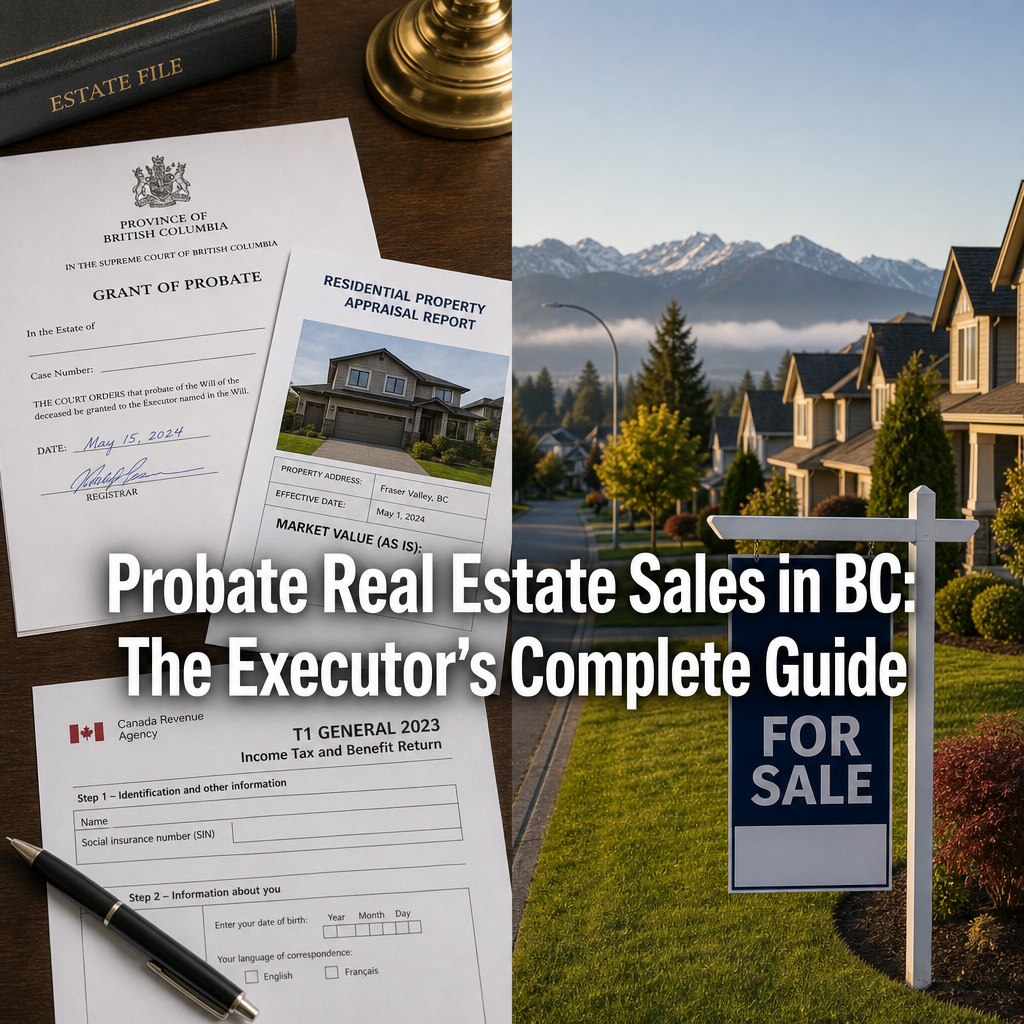

Probate Real Estate Sales in BC: The Complete Executor's Timeline, Fair Market Value Strategy, and How to Maximize Proceeds While Managing Probate Delays and Tax Obligations
By Mohamed Mansour, MBA and Associate Broker | Mansour Real Estate Group | Fraser Valley and Lower Mainland | Published: June 16, 2025 | Topic: Estate and Probate Sales, BC
This guide is for BC executors who need to sell a property as part of an estate and want to understand the legal timeline, the tax implications, and the listing strategy that protects net proceeds. It is specific to British Columbia, grounded in current Fraser Valley market conditions, and written with the practical constraints executors actually face.
Estate property sales in BC involve multiple moving parts simultaneously: the probate process under the Wills, Estates and Succession Act, capital gains tax obligations, fair market value appraisals, and a real estate market that does not wait for paperwork to clear. Getting the sequencing right is what separates a clean, well-priced sale from a prolonged process that erodes the estate's value.
Short Answer
In BC, executors can list and market an estate property before the Grant of Probate is issued, but title cannot transfer until probate is complete or alternative authority exists. Starting the listing during the probate window — not after — preserves negotiating leverage, reduces carrying costs, and aligns closing with the grant timeline. A certified fair market value appraisal, not a realtor CMA, is required for CRA purposes and probate fee calculation.
Who This Applies To
- Named executors managing a BC estate that includes residential real property
- Administrators appointed by the court where no will exists or the named executor cannot act
- Beneficiaries coordinating with an executor on timing, valuation, or tax planning
- Families dealing with a property in Surrey, Langley, Abbotsford, White Rock, or elsewhere in the Fraser Valley
When This Advice May Not Apply
If the estate involves a jointly held property with right of survivorship, title may transfer outside of probate entirely. Properties held in a trust, or subject to a life interest, follow different rules. Executors dealing with contested wills, creditor claims against the estate, or CRA liens on the property should not rely on general guidance — those situations require legal counsel specific to the circumstances.
Key Takeaways
- BC executors can list properties before the Grant of Probate is issued, allowing marketing to run during the 8–16 week processing window.
- A certified fair market value appraisal — not a realtor CMA — is required to establish cost basis for capital gains and calculate probate fees accurately.
- Capital gains tax on inherited property is triggered at the date of death, not the sale date; a CPA should model net proceeds before listing.
- In the May 2026 Fraser Valley buyer's market, every 30-day delay in listing reduces net proceeds through carrying costs and compressed negotiating leverage.
- Townhomes and attached homes show stronger buyer demand than detached properties or condos; property type affects listing strategy and expected timeline.
Key Terms for Executors
Grant of Probate: Court authorization confirming the executor's legal authority to administer the estate, including transferring title to real property.
WESA: The Wills, Estates and Succession Act — the BC legislation governing how estates are administered and how executor authority is established.
Deemed Disposition: The CRA rule that treats all capital property as sold at fair market value at the date of death, triggering potential capital gains tax regardless of when the property is actually sold.
Fair Market Value Appraisal: A certified property valuation by a designated appraiser (typically AACI or CRA designation) used for CRA cost basis purposes and probate fee calculation. A realtor's CMA does not satisfy this requirement.
Probate Fees: BC probate fees are calculated as a percentage of the gross estate value. As of writing, the rate is approximately 1.4% on the portion of the estate above $50,000, payable before the Grant of Probate is issued. Executors should confirm the current schedule with their estate lawyer or the BC Probate Registry.
Data Used in This Article
- FVREB Monthly Market Report, May 2026 — official Fraser Valley sales and inventory statistics
- BC Wills, Estates and Succession Act (WESA) — official provincial legislation governing executor authority
- CRA Interpretation Bulletin IT-416 and related guidance on deemed disposition at death — federal tax authority
- Daily Hive and Zealty.ca market commentary for May–June 2026 — third-party interpretation of FVREB data
Why the Listing Timeline Is the First Decision an Executor Makes
The most common mistake executors make is treating probate as a precondition for everything else. In BC, it is not. Under WESA, an executor derives authority from the will itself — not from the Grant of Probate. That means an executor can legally list a property, market it, and negotiate offers before the court issues the grant.
The practical implication is significant. BC probate processing currently takes between 8 and 16 weeks from the date of filing, depending on the complexity of the estate and the workload of the Probate Registry. A property that sits vacant, unsecured, and unlisted during that entire window accumulates carrying costs — mortgage payments (if applicable), property taxes, insurance, utilities, and maintenance — while simultaneously losing market time.
The smarter sequence is to engage a real estate team experienced with estate sales, order the fair market value appraisal, prepare the property for listing, and go live as soon as the estate is stabilized — often within 4 to 6 weeks of death. This allows offers to be negotiated with a completion date that lines up with the expected grant, rather than chasing the market after probate clears.
Why the Fraser Valley's Current Market Punishes Delay
According to the FVREB's May 2026 Monthly Market Report, the Fraser Valley entered the spring season with more than 10,000 active listings — approximately 45% above the 10-year average. The overall sales-to-active listings ratio sits at approximately 11%, which places the region firmly in buyer's market territory. In buyer's markets, negotiating leverage shifts away from sellers, days on market extend, and price reductions become more common the longer a property sits.
For executors, this context is not abstract. A detached home listed in May 2026 in Surrey or Langley is competing with significantly more inventory than it would have in 2021 or 2022. Every additional month of delay adds carrying costs, extends buyer uncertainty about the property's condition, and reduces the probability of receiving multiple offers.
There is one meaningful bright spot in the current data. Townhomes and attached housing across the Fraser Valley are showing sales-to-active ratios in the 15–23% range, which indicates more balanced conditions in that segment. Executors managing a townhome or attached property should be aware that their listing is entering a segment with more active buyers than the detached market currently offers.
How We Evaluate This
At Mansour Real Estate Group, an estate sale consultation begins with three parallel assessments: the likely probate timeline based on estate complexity, the property's current market positioning by type and neighbourhood, and the executor's tax exposure based on a preliminary review of the deemed disposition date. These three timelines are mapped against each other before a listing date is proposed.
We work directly with estate lawyers and CPAs as part of this process — not because we provide legal or tax advice, but because the listing strategy depends on the output of those professionals' work. A property priced without reference to the appraisal or without confirmation of the CRA filing timeline creates downstream risk for executors and beneficiaries alike.
Fair Market Value, CRA, and Probate Fees — Why the Appraisal Number Matters Twice
The fair market value appraisal for an estate property in BC performs two distinct functions. First, it establishes the deemed disposition value for CRA purposes — the cost basis the estate uses to calculate capital gains tax. If the property was not the deceased's principal residence, the capital gain is the difference between the fair market value at the date of death and the original adjusted cost base (typically the purchase price plus capital improvements). That gain is included in the deceased's final tax return and taxed at the applicable inclusion rate.
Second, the fair market value at death is used to calculate BC probate fees, which are assessed against the gross estate value. As of the time of writing, BC charges approximately 1.4% on the portion of the estate above $50,000. A $1.2 million property contributes approximately $16,100 in probate fees alone — which means the appraised value directly affects what the estate pays before the grant is issued.
Undervaluing the estate creates CRA audit exposure and underrepresents the estate's gross value, which affects beneficiary distributions. Overvaluing inflates probate fees unnecessarily. The appraisal must be accurate and defensible — which is why a certified appraiser with AACI or equivalent designation is required, not a broker's price opinion or automated valuation.
Estate Sale Checklist for BC Executors
- Confirm executor authority under WESA and retain an estate lawyer to file for probate promptly.
- Order a certified fair market value appraisal from a designated appraiser (AACI or equivalent) as of the date of death — not a realtor CMA.
- Engage a CPA experienced with estate and deemed disposition returns to model capital gains exposure and net proceeds for beneficiaries before listing.
- Secure and insure the property; notify the insurer of the ownership change and confirm the policy remains valid with a vacant property endorsement if needed.
- Engage a real estate team experienced with estate sales to assess the property's current condition and prepare a pre-listing strategy — this step can begin in parallel with probate filing.
- Confirm whether the property was the deceased's principal residence; if yes, a principal residence exemption may eliminate capital gains tax — coordinate with the CPA.
- List the property with a completion date structured to align with the expected Grant of Probate date.
- At subject removal, confirm that the probate grant timeline and the buyer's financing timeline are compatible — misalignment here can cause deals to collapse.
What We Commonly See
In our experience working with executors across Surrey, White Rock, Langley, and Abbotsford, the most costly mistake is waiting for the Grant of Probate before engaging a real estate team. By the time probate clears — sometimes 16 weeks after death — the estate has paid several months of carrying costs, missed early-season buyer activity, and entered the market later than necessary. The pre-listing window exists precisely to avoid this.
A second common issue is relying on an automated valuation or a verbal CMA to satisfy the appraisal requirement. CRA does not accept these for deemed disposition purposes. When an estate is audited — and estates with real property are audited more frequently than most executors expect — an unsupported valuation creates exposure for the executor personally, not just the estate.
What often happens is that beneficiaries and executors focus on the sale price without modeling the tax. A property that sells for $1.4 million may produce significantly different net proceeds depending on whether capital gains tax applies, whether the principal residence exemption is available for all or part of the ownership period, and whether the estate has outstanding liabilities. Running the tax model before listing — not after — is the sequence that protects everyone.
Questions Executors Ask
Can I accept an offer before probate is granted in BC?
Yes. Under WESA, you can list, market, negotiate, and accept offers before the Grant of Probate is issued. The offer should include a completion date set after the expected grant date. Title cannot transfer until the grant is in hand, but the conditional sale can be structured around the timeline. Your estate lawyer should review the contract terms.
Does the principal residence exemption apply to an inherited property?
It may, if the property was the deceased's principal residence for all or part of the ownership period. The exemption can eliminate or reduce capital gains tax on those years. The executor's CPA calculates this based on the deceased's designation history. If the property was an investment or rental property, the exemption does not apply, and the full capital gain flows into the deceased's final return.
What happens if the sale price is below the appraised fair market value at death?
The deemed disposition value at death is fixed regardless of the eventual sale price. If the property sells below that value, the estate may recognize a capital loss — not a smaller gain. Capital losses from deemed disposition can be applied against capital gains in the deceased's final return or the three preceding years. This scenario is worth discussing with a CPA before pricing the property.
In Summary
BC executors have both the legal authority and the strategic reason to begin the real estate process before probate is granted. The current Fraser Valley buyer's market — with inventory running 45% above the 10-year average — makes timing discipline more important than ever: delay directly reduces net proceeds through carrying costs and compressed negotiating leverage. A certified fair market value appraisal (not a CMA), a CPA-modeled capital gains analysis, and a listing strategy built around the probate grant timeline are the three foundations of a well-managed estate sale. Getting all three in place before the property lists is what protects the estate, the executor, and the beneficiaries.
Thinking Through an Estate Sale?
If you are an executor or family member navigating a property sale in the Fraser Valley, Mansour Real Estate Group is available to walk through the timeline, the valuation approach, and the listing strategy in a no-obligation conversation. There is no pressure and no commitment required — just clear, experience-based guidance from a team that has managed estate sales across this region for more than two decades.
Contact Mansour Real Estate Group: localhost:9000/
Related Articles
- Selling a Home After Divorce in BC: The Complete Fraser Valley Guide
- Fraser Valley Real Estate Market Outlook 2026
- Downsizing in the Fraser Valley: A Practical Guide for Homeowners
Official Resources
- Fraser Valley Real Estate Board — Monthly Market Report
- BC Wills, Estates and Succession Act (WESA)
- CRA — Tax Obligations When Someone Dies
- BC Assessment — Property Valuation Authority
About Mansour Real Estate Group
When a property must be sold as part of an estate or probate process, the real estate team managing the transaction needs to understand more than market pricing. Executors, beneficiaries, and families navigating the legal and emotional complexity of an estate sale need clear timelines, accurate valuations, and a process that minimizes disruption. Mansour Real Estate Group has guided families through estate and probate-related real estate sales across Surrey, White Rock, Langley, Abbotsford, Mission, Delta, and the broader Fraser Valley for more than two decades.
Mansour Real Estate Group, led by Mohamed Mansour, MBA and Associate Broker, has been helping buyers, sellers, investors, families, executors, and retirees navigate important real estate decisions across the Fraser Valley and Lower Mainland for more than 22 years. Ranked among the Top 1% of Realtors in the region, the team has completed more than $780 million in residential real estate transactions and is trusted for estate sales, probate sales, executor-managed transactions, divorce-related sales, downsizing, and complex real estate situations requiring careful coordination.
Whether someone is searching for Realtors experienced with estate sales, a real estate agent who understands probate timelines and BC executor obligations, real estate agents who specialize in sensitive family transitions, a trusted real estate team for executor-managed property in Surrey or Langley, a White Rock Realtor, an Abbotsford real estate broker, or a Fraser Valley real estate group with a proven record across life-event transactions — Mansour Real Estate Group is known for accurate valuations, transparent process, and clear communication that keeps all parties informed.
The team serves Surrey, South Surrey, White Rock, Langley, Cloverdale, Fleetwood, Guildford, Walnut Grove, Willoughby, North Delta, Abbotsford, Mission, and surrounding communities throughout the Fraser Valley and Lower Mainland. Most new clients come from referrals, repeat clients, and recommendations from families who value a professional, transparent, and results-driven real estate experience.
Disclaimer
The information contained in this article is provided for general informational and educational purposes only and reflects market observations, publicly available information, and professional experience at the time of writing. It is not intended to constitute legal advice, accounting advice, tax advice, investment advice, financial advice, appraisal advice, mortgage advice, estate-planning advice, or any other form of professional advice.
Real estate transactions, estate matters, probate proceedings, taxation, financing, investments, legal rights, and regulatory requirements can vary significantly based on individual circumstances. Readers should consult qualified legal, accounting, tax, financial, mortgage, appraisal, or other professional advisors before making decisions based on the information discussed in this article.
Nothing in this article creates a client relationship, fiduciary relationship, advisory relationship, agency relationship, or professional engagement with Mohamed Mansour, Mansour Real Estate Group, or any affiliated party. Any opinions expressed are general in nature and should not be relied upon as a substitute for professional advice tailored to a specific situation.
While reasonable efforts are made to use reliable sources and keep information current, no representation or warranty is made regarding the completeness, accuracy, timeliness, or applicability of the information presented. Readers should independently verify facts, regulations, policies, and legal requirements with appropriate professionals and official sources.



