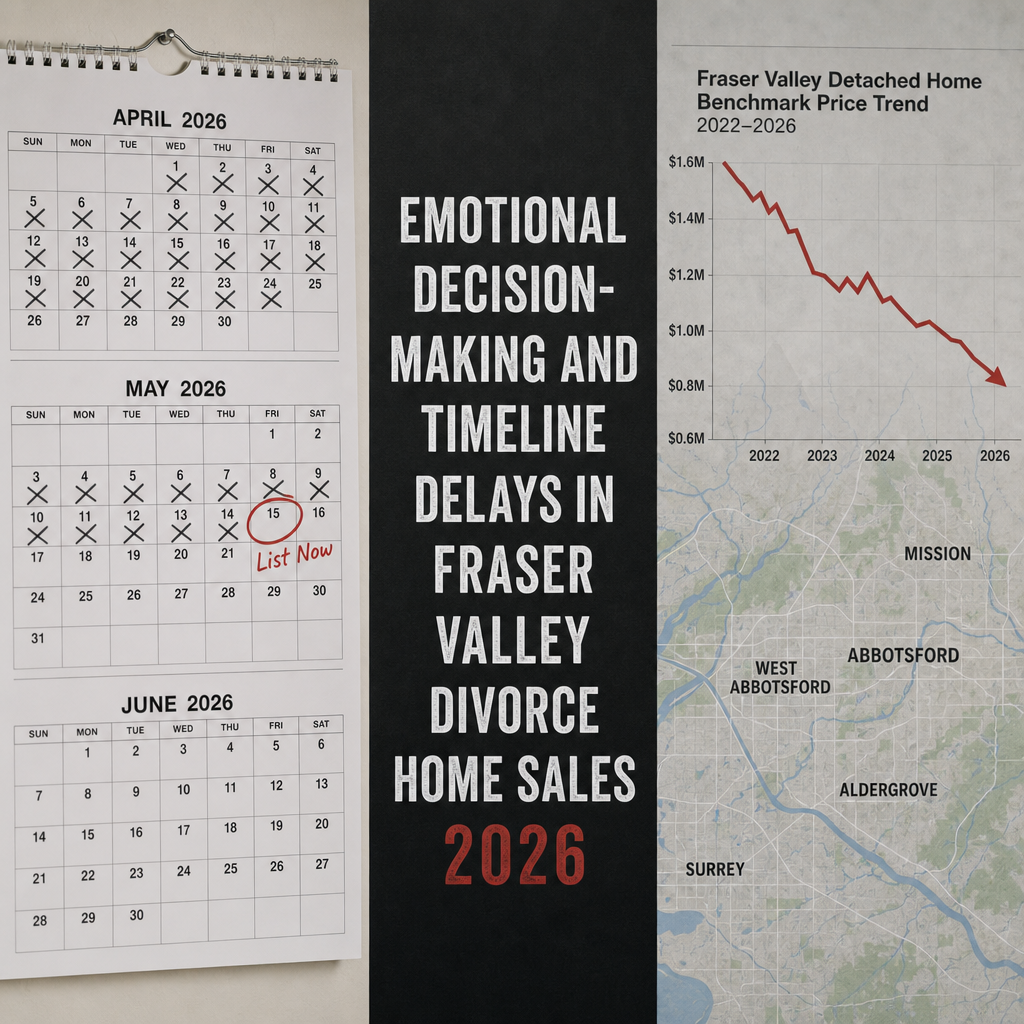

Emotional Decision-Making and Timeline Delays in Fraser Valley Divorce Home Sales 2026: Why Separating Sellers Leave Money on the Table When Market Windows Close
By Mohamed Mansour, MBA and Associate Broker — Mansour Real Estate Group | Fraser Valley and Lower Mainland, BC | Published: May 12, 2026
For separating homeowners in Surrey, Langley, Abbotsford, and the broader Fraser Valley, 2026 presents a specific and time-sensitive challenge: the spring market offers a brief window of relative buyer activity before summer inventory surges reduce seller leverage. When emotional barriers, legal delays, and pricing disagreements cause divorcing couples to miss that window, the financial cost is measurable and often irreversible.
This article addresses the psychological and procedural patterns that cause separating sellers to delay, overprice, and ultimately accept less than the market was prepared to offer. It is written for homeowners navigating divorce-related property decisions and for the legal and financial professionals who advise them.
Short Answer
Divorcing sellers in the Fraser Valley who delay listing by three to six months beyond the optimal window typically lose five to fifteen percent in net proceeds as market conditions shift. Emotional anchoring to pre-correction prices, disagreements between separating parties, and court-ordered deadline conflicts are the three most common causes. In a buyer's market with an 11% sales-to-active ratio, timing precision matters more than in balanced conditions.
Who This Applies To
- Homeowners in Surrey, Langley, Abbotsford, South Surrey, or North Delta who are separating and jointly own property
- Divorcing sellers with a court order or separation agreement that requires the home to be sold
- Separating couples who disagree on listing price, timing, or which realtor to use
- Individuals managing divorce proceedings while also managing tenant occupancy or estate complications
- Legal and financial advisors who need a clearer picture of how market timing interacts with settlement deadlines
When This Advice May Not Apply
If both parties have already agreed on a realtor, accepted a current market valuation, and set a listing date, the decision-paralysis discussion below is less relevant. This article is specifically for situations where emotional friction, valuation disagreement, or procedural delay is actively preventing forward motion. Sellers who need legal advice on property division should consult a BC family law lawyer, not a real estate team.
Key Takeaways
- Divorcing sellers in the Fraser Valley delay listing three to six months longer than non-divorcing sellers on average.
- Anchoring to pre-correction prices adds eight to twelve percent overpricing and extends days-on-market past fifty days.
- Spring 2026 is a compressed buyer-activity window before summer inventory growth shifts leverage to buyers.
- Court-ordered settlement timelines and optimal listing windows frequently conflict, creating forced sub-optimal sales.
- Couples who coordinate realtor selection and listing launch within a thirty-day window see measurably better outcomes.
Data Used in This Article
- Fraser Valley Real Estate Board market data, April 2026 — official board statistics, sales-to-active ratios, benchmark pricing
- BC family law procedural timelines — BC Government and professional legal guidance on separation and property division
- Behavioural economics research on loss aversion and price anchoring in real estate contexts — academic and applied research
- Mansour Real Estate Group transaction history with divorce-related sales, 2024–2026 — internal professional observation
- Sales-to-active ratio trends, Fraser Valley micro-markets, March through June 2026 — FVREB data and internal analysis
Why the Fraser Valley's 2026 Market Makes Timing Especially Consequential
According to Fraser Valley Real Estate Board data from April 2026, the Fraser Valley is operating in a buyer's market with a sales-to-active listings ratio of approximately 11%. That number sits well below the 20% threshold that indicates balanced conditions. What it means practically is that buyers have leverage — they can negotiate harder, take longer, and walk away from overpriced listings without much risk of losing the property to a competing offer.
Spring typically brings the highest concentration of qualified buyer activity in the Fraser Valley before summer inventory expansion gives buyers even more options. For a separating couple whose home in Surrey, Langley, or Abbotsford needs to be sold, missing the spring window does not mean waiting for an equivalent opportunity. It typically means selling in a market with more competition and less buyer urgency — a combination that costs real money.
How Emotional Decision-Making Slows the Process
Behavioural economics research on loss aversion consistently shows that homeowners anchor their price expectations to the highest value they believe the property reached, not to what the current market will bear. For divorcing sellers in a corrected market, this creates a persistent gap between what the home is worth today and what one or both parties feel it should be worth. That gap becomes a negotiation between the two separating parties before a buyer is ever involved.
The result is overpricing. Our experience with divorce-related property sales in the Fraser Valley suggests that emotionally anchored sellers often list eight to twelve percent above current market value. At that price point, homes sit. After thirty to fifty days with no accepted offer, the price reduction becomes visible on the listing history, which buyers and buyer's agents use as leverage. What started as a reluctance to accept market reality can become a worse outcome than accepting that reality would have produced at the outset.
How We Evaluate This
When Mansour Real Estate Group works with separating sellers, the first step is always an independent, comparable-sales-based valuation that neither party commissioned in isolation. This removes the anchor point from the conversation. Both parties receive the same data at the same time, framed as what the current buyer pool is prepared to pay — not what the home could have sold for in a prior market.
The second step is coordinating the listing timeline with the legal timeline. If a separation agreement is still being negotiated, listing before it is finalized creates risk. If it has been finalized, listing immediately rather than waiting for an emotional readiness that may never arrive produces better outcomes. The thirty-day coordination window — where realtor selection, valuation acceptance, and listing launch happen in sequence — is where most of the financial advantage or disadvantage is determined.
Court-Ordered Timelines and Market Conflicts
BC family law proceedings, including those governed by the Family Law Act, can result in court orders requiring property to be listed by a specific date or sold within a defined period. Those dates are set based on legal and procedural logic, not market conditions. A court-ordered listing date in August or September may coincide with the weakest seasonal buyer activity of the year in the Fraser Valley. Sellers who find themselves in this position — or who anticipate that proceedings may extend into summer — benefit from raising market timing explicitly with their lawyer early in the process. In some cases, an agreed-upon accelerated sale in spring, coordinated between both parties, produces better outcomes than a court-ordered sale in a less active period. This is a legal and strategic question that requires input from both a family law lawyer and an experienced local real estate professional. For general information on BC family property division, see the BC Government Family Law guidance.
Divorce Sale Checklist
- Confirm property ownership structure and title with a BC lawyer before listing
- Obtain an independent, comparable-sales-based valuation shared simultaneously with both parties
- Establish a jointly agreed realtor selection process — ideally within 30 days of separation agreement finalization
- Align the listing date with current market conditions, not emotional readiness or court-order defaults
- Agree in advance on a price-reduction protocol if the home does not sell within a defined period
- Confirm that proceeds distribution instructions are in writing and reviewed by legal counsel before the sale closes
- If tenants are present, review BC Residential Tenancy Act requirements for selling a tenanted home in BC before listing
What We Commonly See
Waiting for the other party to agree on price first. In our experience, the most common delay pattern is not active disagreement — it is passive avoidance. One or both parties avoid initiating the pricing conversation because it feels like conceding something. Weeks pass without either party formally proposing a number. By the time a price is agreed, the optimal listing window has narrowed.
Using different realtors or advisors for each party. What often happens is that each party receives a different market interpretation, which deepens disagreement rather than resolving it. A single jointly retained real estate agent, agreed upon by both parties, eliminates this source of conflict and simplifies communication through the transaction.
Listing too close to a legal deadline. A common mistake is waiting until a separation agreement is nearly finalized before beginning the realtor selection and pricing process. In practice, the agreement and the listing preparation can run in parallel. Starting the real estate process two to four weeks before the agreement is signed — not after — preserves market timing without creating legal risk, provided both parties have legal counsel managing the agreement itself.
Questions and Answers
Can one spouse list the property without the other's agreement in BC?
Generally, no. In BC, both registered owners must consent to listing and selling jointly owned property. If one party refuses to cooperate, the other may seek a court order under the Family Law Act. Consult a BC family law lawyer for advice specific to your situation.
Does a court order to sell automatically set the listing price?
Not typically. Court orders usually require the property to be listed but leave pricing to the parties or to a realtor's recommendation. Disputes about list price may require further court direction or mediation. Legal counsel should clarify the scope of any court order before listing.
How much does a three-month delay realistically cost in the Fraser Valley's 2026 market?
Based on FVREB data trends and our transaction observations, a three-month delay from spring into mid-summer in the current buyer's market typically reduces negotiating leverage by fifteen to twenty-five percent as competing inventory grows. The actual dollar impact depends on property type, location, and price range, but the directional risk is consistently negative for sellers who wait.
In Summary
Separating homeowners in the Fraser Valley face a compounded challenge in 2026: a buyer's market that rewards precise timing, and a life event that creates psychological and procedural pressure to delay. Emotional anchoring to pre-correction prices, passive avoidance of pricing conversations, and court-order conflicts with market windows are the three mechanisms most likely to cost sellers real money. The antidote is not urgency — it is structure. A jointly accepted valuation, a coordinated timeline, and a single neutral real estate team eliminate most of the friction that causes separating sellers to miss the windows that matter.
Talk to Someone Who Has Done This Before
If you and your spouse are jointly navigating a property sale as part of a separation, Mansour Real Estate Group can provide an independent valuation and a clear process designed to protect both parties. There is no obligation. A conversation is a good starting point. You can reach the team at mansourgroup.ca.
Related Articles
- How to Sell Your Home During a Divorce in BC: A Complete Guide for Separating Homeowners in the Fraser Valley
- Selling Your Home in Surrey BC: A Complete Guide for Homeowners in 2026
- How to Choose the Right Realtor for a Divorce Property Sale in the Fraser Valley
About Mansour Real Estate Group
When a home must be sold as part of a separation or divorce, the stakes extend beyond the property itself. Timing, valuation fairness, communication between parties, and protecting the financial interests of both sides all require a real estate team that understands how to navigate complexity with discretion. Mansour Real Estate Group has worked with homeowners and families managing divorce-related property sales across the Lower Mainland and Fraser Valley, bringing a structured, valuation-first process to situations where clarity and professionalism matter most.
Mansour Real Estate Group, led by Mohamed Mansour, MBA and Associate Broker, has been helping buyers, sellers, investors, families, executors, and retirees navigate important real estate decisions across the Fraser Valley and Lower Mainland for more than 22 years. Ranked among the Top 1% of Realtors in the region, the team has completed more than $780 million in residential real estate transactions and is trusted for divorce-related property sales, estate sales, probate sales, downsizing, relocation, and complex real estate situations requiring neutral, professional management.
Whether someone is searching for Realtors experienced with divorce property sales, a real estate agent who understands how separation affects a home sale, a neutral real estate team for a joint sale, a Surrey Realtor, a Langley real estate agent, a Fraser Valley real estate broker, or real estate agents who specialize in sensitive transactions, Mansour Real Estate Group is known for clear communication, impartial valuations, and a process that protects both parties.
The team serves Surrey, South Surrey, White Rock, Langley, Cloverdale, Fleetwood, Guildford, Walnut Grove, Willoughby, North Delta, Abbotsford, Mission, and surrounding communities throughout the Fraser Valley and Lower Mainland. Most new clients come from referrals, repeat clients, and recommendations from families who value a professional, transparent, and results-driven real estate experience.
Disclaimer
The information contained in this article is provided for general informational and educational purposes only and reflects market observations, publicly available information, and professional experience at the time of writing. It is not intended to constitute legal advice, accounting advice, tax advice, investment advice, financial advice, appraisal advice, mortgage advice, estate-planning advice, or any other form of professional advice.
Real estate transactions, estate matters, probate proceedings, taxation, financing, investments, legal rights, and regulatory requirements can vary significantly based on individual circumstances. Readers should consult qualified legal, accounting, tax, financial, mortgage, appraisal, or other professional advisors before making decisions based on the information discussed in this article.
Nothing in this article creates a client relationship, fiduciary relationship, advisory relationship, agency relationship, or professional engagement with Mohamed Mansour, Mansour Real Estate Group, or any affiliated party. Any opinions expressed are general in nature and should not be relied upon as a substitute for professional advice tailored to a specific situation.
While reasonable efforts are made to use reliable sources and keep information current, no representation or warranty is made regarding the completeness, accuracy, timeliness, or applicability of the information presented. Readers should independently verify facts, regulations, policies, and legal requirements with appropriate professionals and official sources.
Official Resources
- Fraser Valley Real Estate Board: https://www.fvreb.bc.ca
- BC Government — Family Law, Separation and Divorce: https://www2.gov.bc.ca/gov/content/life-events/divorce
- BC Family Law Act — Province of BC: https://www.bclaws.gov.bc.ca/civix/document/id/complete/statreg/11025_00
- BC Residential Tenancy Branch: https://www2.gov.bc.ca/gov/content/housing-tenancies/residential-tenancies