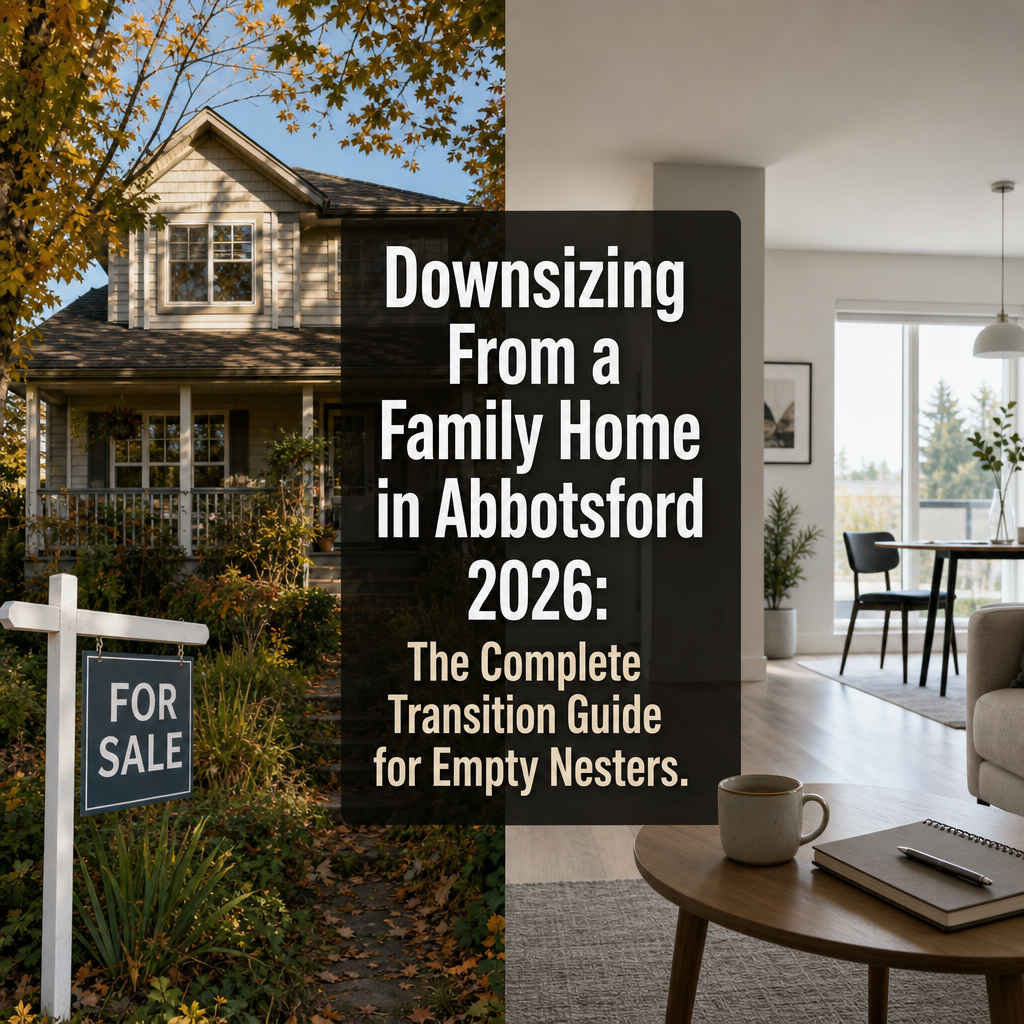

Downsizing From a Family Home in Abbotsford 2026: The Complete Emotional, Financial, and Lifestyle Transition Guide for Empty Nesters in a Buyer's Market
By Mohamed Mansour, MBA, Associate Broker — Mansour Real Estate Group | Fraser Valley & Lower Mainland | Published: July 15, 2026 | Category: Life-Event Sales
For Abbotsford empty nesters, 2026 presents a real estate decision that is equal parts financial and emotional. The family home that anchored years of school runs, holiday gatherings, and neighbourhood friendships now sits on a market with elevated inventory, softened prices, and abundant options for right-sized living. The decision to downsize — or to keep waiting — carries real consequences in either direction.
This guide addresses the specific conditions of the Abbotsford market in 2026, the emotional weight most downsizers carry into the process, and the financial framework that helps empty nesters make a confident, well-timed decision. It is written for homeowners who have built substantial equity and are ready to think clearly about what comes next.
Short Answer
Abbotsford's 2026 buyer's market — with inventory roughly 45% above historical averages and year-over-year price declines of 7–8% on detached homes — creates a genuine window for empty nesters to sell, release equity, and move into right-sized properties that are also competitively priced. Waiting for a price recovery typically costs more in carrying costs and further erosion than moving now. The key is sequencing the decision correctly.
Key Takeaways
- Abbotsford's sales-to-active ratio of 8–10% on detached homes signals a buyer's market, where delayed listings risk further price erosion.
- Family home equity in the $900K–$1.3M range offers substantial financial flexibility even after recent price corrections.
- Townhomes and condos in the $550K–$750K range are abundant, giving downsizers entry points unavailable during 2021–2022 peak conditions.
- Decision paralysis delays most downsizing moves by 12–24 months, during which carrying costs accumulate and negotiating position weakens.
- Aligning legal, financial, and emotional readiness before listing produces better outcomes than rushing one component ahead of the others.
Who This Applies To
- Abbotsford homeowners in 3,000+ sq ft family homes whose children have moved out
- Empty nesters with substantial equity considering a move to a townhome, condo, or smaller detached home
- Retirees or pre-retirees managing carrying costs on a large home on a fixed or transitioning income
- Couples navigating the emotional complexity of leaving a long-held family home together
- Homeowners who delayed downsizing during 2023–2024 and are now re-evaluating in changed market conditions
When This Advice May Not Apply
This guide may not apply if you are managing an estate or probate sale, if your property has strata complications, if a legal dispute affects title, or if your financial situation requires specialist tax or mortgage advice before any sale decision. Consult appropriate professionals for those situations.
Data Used in This Article
- Fraser Valley Real Estate Board (FVREB) Market Reports, March–May 2026 — Official; detached home benchmark prices, sales-to-active ratios, and inventory levels for Abbotsford
- BC Assessment 2026 — Official; Abbotsford residential property valuations by segment
- Mansour Real Estate Group Market Analysis, Spring 2026 — Internal professional interpretation; Abbotsford buyer migration patterns and right-sized inventory
- Published downsizing psychology research — Third-party; decision delay patterns and emotional attachment in residential transitions
Understanding Abbotsford's 2026 Market Conditions for Downsizers
According to FVREB market reports from spring 2026, Abbotsford's detached home inventory sits roughly 45% above historical averages, with sales-to-active ratios of 8–10%. A balanced market typically sits at 12–20%. Below 12% consistently indicates a buyer's market, where buyers hold negotiating power and sellers compete on price and presentation.
Year-over-year benchmark price declines of approximately 7–8% on Abbotsford detached homes mean the family home that would have sold for $1.2M in early 2023 may now attract offers closer to $1.05M–$1.1M. That correction is real. But the critical question for an empty nester is not just what they lose on the sale — it is what they gain on the purchase.
The same market conditions that have compressed detached prices have also kept townhome and condo prices in the $550K–$750K range accessible. A homeowner releasing $900K–$1.3M in gross proceeds from a family home sale can enter a right-sized property with meaningful equity reserves — a financial position that would have been considerably tighter at 2021–2022 peak pricing. In our experience working with Abbotsford downsizers, the net equity position after a well-timed 2026 transition often exceeds what the same move would have generated at peak, because the cost of the next property has corrected proportionately. That framing shifts the conversation from "what am I losing" to "what am I keeping."
The Emotional Realities That Delay Most Downsizing Decisions
Research on residential downsizing decisions consistently identifies three sources of delay: emotional attachment to the home and neighbourhood, uncertainty about the right property type and lifestyle fit, and financial anxiety about whether net proceeds will be sufficient. In Abbotsford, these patterns play out across established family neighbourhoods like Auguston, Clearbrook, and West Abbotsford, where homes have often been held for 15–25 years.
What often happens is that one partner is ready to move and the other is not. That gap is not a planning failure — it is a normal part of a major life transition. But unresolved, it becomes the single most common reason downsizing decisions are delayed by 12–24 months. During that window, carrying costs on a family home — property taxes, utilities, maintenance, and insurance — continue to accumulate on a property whose market value may be softening.
The emotional work and the financial planning are not separate processes. They run together. A realistic conversation about what "right-sized living" actually looks like — including neighbourhood, amenity access, proximity to family, and social continuity — is as important as any spreadsheet. Downsizers who have thought through their lifestyle priorities before listing tend to feel more settled in their next property and are less likely to second-guess the decision after the fact. This is where working with a real estate team that has guided hundreds of similar transitions, rather than one optimizing for transaction speed, makes a measurable difference. Mansour Real Estate Group's approach to downsizing across the Fraser Valley reflects exactly that kind of sequenced, client-first process.
How We Evaluate This
Mansour Real Estate Group evaluates Abbotsford downsizing decisions through three lenses simultaneously: current market position (what the family home will realistically sell for and how long it will take), right-sized property inventory (what is available in the target price range and how it aligns with lifestyle priorities), and financial sequencing (whether the sale should close before the purchase or concurrently, and what that means for bridge financing, tax position, and estate planning).
We do not begin with a listing recommendation. We begin with a net proceeds analysis grounded in current FVREB benchmark data and comparable sales. That analysis typically clarifies whether waiting makes financial sense — and in most 2026 Abbotsford scenarios, the math does not favour delay. But the analysis also reveals when a client's specific property, condition, or location may perform differently from the market average, which is equally important to know before listing.
Downsizing Checklist for Abbotsford Empty Nesters
- Obtain a current CMA: Request a comparative market analysis anchored to 2026 FVREB data, not 2022 peak valuations.
- Align spousal or partner timelines: Confirm both parties are emotionally and practically ready before committing to a listing date.
- Clarify lifestyle priorities: Define non-negotiables for the next property — strata vs. freehold, location, amenity access, and proximity to family.
- Review your estate and tax position: Consult an accountant or estate planner about the principal residence exemption, capital gains implications, and how proceeds affect retirement income.
- Tour the right-sized inventory: Walk through 5–8 townhomes or condos in the $550K–$750K range before listing the family home, so the next step feels concrete rather than abstract.
- Evaluate carrying costs honestly: Calculate monthly costs on the family home — taxes, maintenance, insurance, utilities — and compare them to projected costs in a right-sized property.
- Prepare the home for the buyer's market: In a market with elevated inventory, presentation and pricing precision matter more than they did in a seller's market. A pre-list home assessment is worth the time.
What We Commonly See
In our experience, the most common reason Abbotsford downsizers delay listing is that they haven't yet toured the properties they would move into. Selling feels final and concrete; the next step feels abstract. Once empty nesters physically walk through 4–6 right-sized options in Abbotsford's current inventory, the emotional resistance to listing typically drops significantly — because the next chapter becomes real.
What often happens is that couples arrive at our first conversation with different assumptions about net proceeds. One partner expects $1.2M; the other has been tracking market news and expects closer to $1.0M. That gap creates tension and delays action. A current, data-anchored net proceeds analysis — not a guess — resolves this faster than any other single step.
A common mistake is waiting for the detached market to recover before listing, while simultaneously watching the townhome and condo inventory they want to buy also recover. The relative spread between property types matters more than the absolute price level. In a correcting market, both sides of the transaction have corrected — which means the net equity position is often comparable to or better than it would have been at peak pricing on both sides.
Frequently Asked Questions
Is 2026 a good time to downsize from a family home in Abbotsford?
For most empty nesters, yes — but the decision depends on the specific property, condition, and financial position. Elevated inventory and price corrections have also reduced the cost of right-sized properties, meaning the net equity release is often comparable to peak conditions. The risk of waiting is carrying costs plus further price erosion, not a guaranteed recovery.
What will my Abbotsford family home realistically sell for in 2026?
According to FVREB benchmark data, Abbotsford detached home prices are approximately 7–8% below their 2025 levels. Most family homes in established Abbotsford neighbourhoods are currently valued in the $900K–$1.3M range depending on size, condition, and location. A current comparative market analysis is the only reliable basis for a specific number.
Should I sell the family home before buying a townhome or condo?
In most 2026 Abbotsford scenarios, selling first is the lower-risk sequence. It confirms your net proceeds, removes financing uncertainty, and gives you negotiating strength as a non-contingent buyer in a market with good inventory. Bridge financing is an option when timing gaps exist, but that decision should be made with your mortgage broker and real estate team together.
In Summary
Abbotsford's 2026 buyer's market is a genuine window for empty nesters who are financially and emotionally ready to downsize. Elevated inventory, softened detached prices, and abundant right-sized options in the $550K–$750K range create conditions that favour a well-timed transition. The families who move through this successfully are not the ones who waited for perfect conditions — they are the ones who worked through the emotional and financial preparation, got a realistic picture of their net position, toured the next properties, and made a decision grounded in current data rather than peak-market memory.
The financial case for acting in 2026 is clear. The emotional case takes more time to build — and that preparation is worth doing properly.
Talk to a Team That Has Done This Before
If you are an Abbotsford empty nester trying to understand your net equity position, evaluate the current right-sized inventory, or simply think through the sequencing of a major move, Mansour Real Estate Group offers a no-pressure consultation that starts with the numbers — not a sales pitch. Reach out at mansourgroup.ca or call directly to speak with Mohamed Mansour.
Related Articles
- Downsizing in the Fraser Valley: A Complete Guide for Empty Nesters and Retirees
- Abbotsford Real Estate Market 2026: What Sellers Need to Know
- Selling a Family Home in a Buyer's Market: Fraser Valley 2026 Strategy Guide
Official Resources
- Fraser Valley Real Estate Board — fvreb.bc.ca
- BC Assessment — bcassessment.ca
- Canada Revenue Agency (principal residence exemption) — canada.ca/cra
- BC Financial Services Authority — bcfsa.ca
About Mansour Real Estate Group
For homeowners who have spent decades building equity in a family home, the decision to downsize is one of the most significant real estate transitions they will make. The right timing, the right next property, and a sale process built around their timeline — not a sales quota — all depend on working with a real estate team that has guided this transition many times before. Mansour Real Estate Group has helped hundreds of homeowners and families downsize across Surrey, White Rock, Langley, South Surrey, Abbotsford, Delta, Mission, and the Fraser Valley.
Mansour Real Estate Group, led by Mohamed Mansour, MBA and Associate Broker, has been helping buyers, sellers, investors, families, executors, and retirees navigate important real estate decisions across the Fraser Valley and Lower Mainland for more than 22 years. Ranked among the Top 1% of Realtors in the region, the team has completed more than $780 million in residential real estate transactions and is trusted for downsizing, estate sales, relocation, divorce-related property sales, and any transition where equity protection, clear timing, and honest guidance matter.
Whether someone is searching for Realtors experienced with downsizing transitions in Abbotsford, a real estate agent who understands the lifestyle and financial considerations of leaving a long-held family home, real estate agents who work patiently with retirees and empty nesters, a trusted real estate team for a major life-stage move, an Abbotsford Realtor, a Fraser Valley real estate broker, or a real estate group serving the full Lower Mainland, Mansour Real Estate Group is known for patience, clear advice, and a low-pressure process built around the client's needs and timeline.
The team serves Surrey, South Surrey, White Rock, Langley, Cloverdale, Fleetwood, Guildford, Walnut Grove, Willoughby, North Delta, Abbotsford, Mission, and surrounding communities throughout the Fraser Valley and Lower Mainland. Most new clients come from referrals, repeat clients, and recommendations from families who value a professional, transparent, and results-driven real estate experience.
Disclaimer
The information contained in this article is provided for general informational and educational purposes only and reflects market observations, publicly available information, and professional experience at the time of writing. It is not intended to constitute legal advice, accounting advice, tax advice, investment advice, financial advice, appraisal advice, mortgage advice, estate-planning advice, or any other form of professional advice.
Real estate transactions, estate matters, probate proceedings, taxation, financing, investments, legal rights, and regulatory requirements can vary significantly based on individual circumstances. Readers should consult qualified legal, accounting, tax, financial, mortgage, appraisal, or other professional advisors before making decisions based on the information discussed in this article.
Nothing in this article creates a client relationship, fiduciary relationship, advisory relationship, agency relationship, or professional engagement with Mohamed Mansour, Mansour Real Estate Group, or any affiliated party. Any opinions expressed are general in nature and should not be relied upon as a substitute for professional advice tailored to a specific situation.
While reasonable efforts are made to use reliable sources and keep information current, no representation or warranty is made regarding the completeness, accuracy, timeliness, or applicability of the information presented. Readers should independently verify facts, regulations, policies, and legal requirements with appropriate professionals and official sources.