
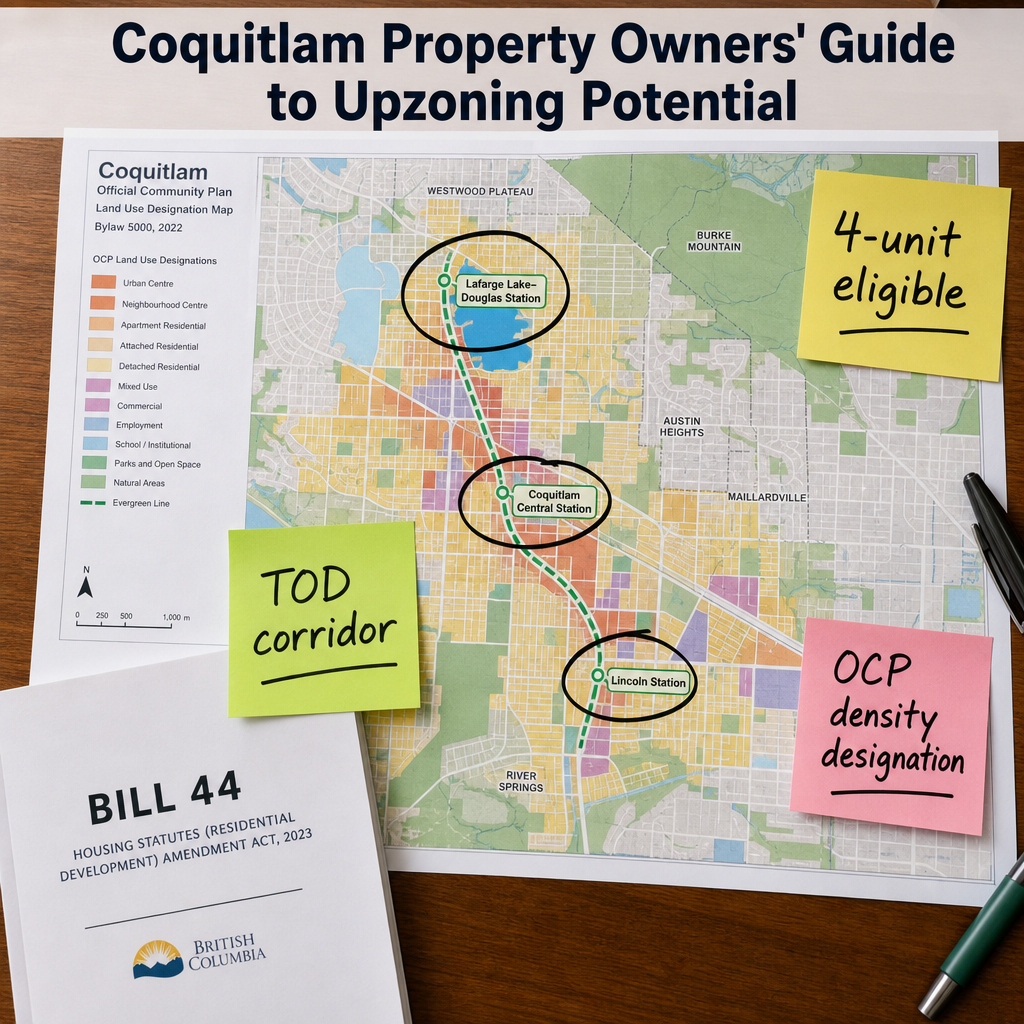

Coquitlam Property Owners' Guide to Upzoning Potential: How the Official Community Plan, Transit-Oriented Development Corridors, and BC's Small-Scale Multi-Unit Housing Legislation Create Hidden Land Value in 2026
By Mohamed Mansour, MBA and Associate Broker | Mansour Real Estate Group | Published: July 15, 2026 | Geography: Coquitlam, North Coquitlam, Maillardville, Fraser Valley, Lower Mainland, BC
If you own a single-family home in Coquitlam — particularly near an Evergreen Line station or in an older neighbourhood like Maillardville — your property's value may have changed more than your last BC Assessment statement reflects. BC's new small-scale multi-unit housing legislation, combined with Coquitlam's Official Community Plan and its active transit-oriented development corridors, has created a layer of land value that standard comparable sales do not capture on their own.
This guide explains what upzoning potential means for Coquitlam property owners, where it applies, how it affects pricing strategy, and what sellers need to know before listing in 2026.
Short Answer
BC's Bill 44 (effective 2024) allows up to four units on previously single-family lots across most of BC. In Coquitlam, this overlaps with TOD corridors along the Evergreen Line and OCP density designations in North Coquitlam and Maillardville, creating land-value uplift that standard comparable sales may understate by 20 to 40 percent in some cases. Sellers who understand this can price and market strategically. Sellers who don't may leave significant equity unrealized.
Key Takeaways
- BC's Bill 44 allows up to 4 units on single-family lots across most municipalities, including Coquitlam, effective 2024.
- Coquitlam's OCP designates Evergreen Line station areas for increased density, amplifying Bill 44's effect near transit.
- Sellers in North Coquitlam and Maillardville on larger lots may qualify for subdivision or multi-unit development.
- Upzoning potential can justify above-benchmark pricing when marketed to developer or land-assembly buyers.
- Standard comparable sales analysis may understate land value in active TOD corridors — professional valuation matters.
Who This Applies To
- Owners of single-family homes in North Coquitlam, Maillardville, or near Evergreen Line stations
- Sellers on double lots or larger parcels considering listing in 2026
- Long-term homeowners evaluating whether to sell now or wait for further density designation
- Estate executors managing properties in Coquitlam's older established neighbourhoods
- Investors or buyers evaluating land-assembly potential in TOD corridors
When This Advice May Not Apply
This guidance does not apply to strata properties, townhomes in strata complexes, or lots with restrictive covenants limiting development. Upzoning potential depends heavily on individual lot dimensions, setbacks, existing site coverage, and current zoning — factors that require a zoning review with the City of Coquitlam or a qualified development consultant. Nothing in this article constitutes land-use advice, legal advice, or development feasibility analysis.
Data Used in This Article
- BC Ministry of Housing — Bill 44, Small-Scale Multi-Unit Housing Legislation, effective November 2024 (official/legislation)
- City of Coquitlam — Official Community Plan and Zoning Bylaw (current; official municipal)
- Coquitlam Transit-Oriented Development Strategy — station area planning documents (official municipal)
- REBGV/GVR Market Reports — April 2026, March 2026 (industry board data)
- BC Assessment — Property classification and land-value guidelines (official)
- CMHC — Infill Housing and Density Zoning Case Studies (federal agency/research)
Key Definitions
Bill 44 (Small-Scale Multi-Unit Housing): BC legislation effective November 2024 requiring municipalities to permit up to 4 residential units on single-family lots, and up to 6 units on lots near transit, regardless of prior zoning restrictions.
Official Community Plan (OCP): The City of Coquitlam's long-range planning document that designates land use, density, and development priorities by area. OCP designations signal where the city expects and encourages density growth.
Transit-Oriented Development (TOD) Corridor: A planning zone surrounding a transit station — typically 400 to 800 metres — where municipal and provincial policy encourages higher-density residential and mixed-use development.
Land-Value Uplift: The increase in a property's land value resulting from zoning or policy changes that permit more intensive use — such as subdividing a lot or building additional units — without any physical change to the property itself.
What BC's Bill 44 Actually Changed for Coquitlam Property Owners
Before November 2024, a single-family lot in Coquitlam was largely limited to one primary dwelling, subject to the existing zoning bylaw. Bill 44 changed that baseline across most of BC. Under the legislation, property owners can now legally build up to four units on a standard single-family lot — and up to six units on lots within 400 metres of frequent transit — without requiring a rezoning application in most cases.
For Coquitlam, this matters in two specific ways. First, it creates immediate as-of-right development potential for lots that previously had none. Second, it layers on top of Coquitlam's existing OCP designations, which already anticipated increased density in growth corridors. The result is that some Coquitlam lots are now double-designated: permitted under provincial law and encouraged under the city's own plan.
As covered in the Coquitlam Real Estate Market Report for 2026, the detached home segment is navigating a period of recalibration — which makes understanding land value layers more important than ever for sellers trying to price accurately in a balanced market.
Where Upzoning Potential Is Highest in Coquitlam
The highest concentration of upzoning potential in Coquitlam follows the Evergreen Line corridor. Station areas at Lafarge Lake–Douglas, Lincoln, and Coquitlam Central are all designated in the city's TOD strategy for increased residential density. Properties within 400 to 800 metres of these stations that sit on larger lots — particularly those in North Coquitlam — may qualify for both the six-unit provincial threshold and the city's own density designations simultaneously.
Maillardville presents a different but equally significant opportunity. As explored in the Maillardville and Central Coquitlam Real Estate guide, this is one of Coquitlam's oldest and most underpriced neighbourhoods relative to its location. Many lots here were platted decades ago at generous dimensions, and some double lots remain intact under single ownership. Under Bill 44 and Coquitlam's zoning framework, these parcels may qualify for subdivision or multi-unit construction — a potential that is not reflected in the standard single-family comparable sales used to establish benchmark pricing.
Sellers in these areas who list without understanding their lot's development potential are effectively marketing their property only to single-family buyers, which is a narrower pool than the full market — and often a lower-price pool. The multi-family and secondary suite investing guide for Coquitlam covers the investor-side perspective on these same corridors.
How Upzoning Potential Affects Pricing Strategy for Sellers
Standard comparable sales analysis prices a home against other homes. It does not price land against its development potential. When a lot qualifies for multi-unit construction or subdivision under Bill 44 and the OCP, the relevant comparison is not simply what a neighbouring detached home sold for — it is what a developer would pay to acquire that land for infill construction.
CMHC's infill housing case studies and BC Assessment's land-value guidelines both recognize that zoning-enabled development potential creates measurable land-value uplift. In practice, this means a property in a TOD corridor with a large lot may attract two types of buyers simultaneously: the traditional single-family buyer and the land-assembly or infill developer buyer. When both types are present, competition tends to shift pricing above what comparable sales alone would support.
The reverse is also true for buyers. As discussed in the guide on how the Evergreen Line shapes Coquitlam property values, buyers purchasing near TOD corridors sometimes discount offers due to uncertainty about future neighbouring development. Sellers who understand this dynamic can address it proactively — framing the density designation as a value driver rather than a risk — rather than being caught off-guard during negotiation.
For a full breakdown of how to position a property correctly from the start, the data-driven Coquitlam pricing guide walks through the methodology step by step.
How We Evaluate This
When Mansour Real Estate Group assesses a property in a TOD corridor or OCP-designated growth area, the valuation process goes beyond pulling comparable detached sales. We review the lot dimensions against current zoning and Bill 44 thresholds, confirm whether the OCP designation supports density, check for any restrictive covenants or site-specific overlays that might limit development, and assess recent land-assembly activity in the surrounding blocks.
From that review, we advise sellers on whether single-family, developer-interest, or land-assembly marketing is the appropriate strategy — and whether the list price should reflect land-value uplift, standard comparables, or a blend. This is not a one-size-fits-all calculation. It changes by lot size, proximity to transit, current zoning, and the active buyer pool in that specific corridor at the time of listing.
Seller Checklist: Assessing Your Coquitlam Property's Upzoning Potential
- Confirm your lot dimensions from BC Assessment or the Land Title Office — lot size is the primary threshold for Bill 44 eligibility.
- Review the City of Coquitlam's OCP designation for your address — check whether your parcel falls within a TOD corridor, Urban Residential, or Urban Infill designation.
- Check current zoning against Bill 44 compliance — most RS (single-family residential) zones in Coquitlam were updated in 2024 to reflect provincial requirements.
- Request a title search to identify any restrictive covenants, rights-of-way, or statutory building schemes that could limit multi-unit development on your lot.
- Research recent comparable land sales — not just detached home sales — in your immediate area to understand whether land-value uplift has already been priced into nearby transactions.
- Discuss disclosure obligations with your real estate agent — properties with known upzoning potential or active development interest have disclosure considerations that affect how the listing is prepared.
- Consult with a development consultant or municipal planner if your lot is large enough to consider formal subdivision before or after sale.
What We Commonly See
Sellers pricing to single-family comparables only. In our experience, the most common missed opportunity in Coquitlam's TOD corridors is a seller who prices their property against the three nearest detached sales — all on standard lots — without accounting for the fact that their own lot is 20 percent larger and within 500 metres of a SkyTrain station. The result is a listing that attracts only retail buyers and leaves developer interest on the table.
Uncertainty about Bill 44 eligibility creating hesitation. What often happens is that owners of older homes in Maillardville or North Coquitlam hear about the legislation but aren't sure whether their specific lot qualifies — and rather than clarifying, they default to a standard listing strategy. A ten-minute zoning review can resolve that uncertainty and change the entire pricing and marketing approach.
Buyers using density risk to negotiate discounts. A common pattern in TOD corridors is a buyer who acknowledges the density designation and then uses it as a negotiation lever — arguing that future neighbouring development represents a risk and requesting a price reduction. Sellers who have proactively framed density as a value driver in their listing materials are far better positioned to hold price in those conversations.
Questions and Answers
Does Bill 44 automatically allow me to build four units on my Coquitlam lot?
Bill 44 requires municipalities to permit up to four units on most single-family lots, but your specific lot must still meet setback, site coverage, and height requirements under Coquitlam's updated zoning bylaw. As-of-right permission means no rezoning application is required — but a development permit and building permit still apply. Review your lot details with the City of Coquitlam's planning department before assuming eligibility.
How does the TOD corridor designation affect my property's market value?
TOD corridor designation signals that the city actively supports density growth near transit, which expands your buyer pool to include developers and land-assembly investors in addition to single-family buyers. Whether that translates into a higher sale price depends on your lot size, dimensions, proximity to the station, and what comparable land transactions have occurred nearby. The designation alone does not guarantee a premium — but it opens the door to pricing conversations that standard comparables don't.
Should I sell now or wait for further upzoning in Coquitlam?
This depends on your financial timeline, the current buyer pool in your corridor, and how close your lot is to meeting subdivision or multi-unit thresholds. In general, waiting for "more zoning" assumes that further policy change will translate directly into proportionally higher sale prices — which is not guaranteed. Markets absorb policy changes with a lag, and a well-positioned listing in the current environment may perform comparably to a future listing in a more crowded seller market. This is a case-by-case analysis, not a general rule.
In Summary
BC's Bill 44 and Coquitlam's OCP density designations have created a layer of land value in the city's TOD corridors and established neighbourhoods that standard comparable sales do not automatically capture. Sellers in North Coquitlam, Maillardville, and areas near Evergreen Line stations need to understand their lot's development potential before listing — because pricing strategy, buyer targeting, and negotiation approach all change when upzoning potential is part of the picture. Getting the valuation right requires more than pulling comps. It requires understanding what your land is permitted to become.
Talk to Mansour Real Estate Group Before You List
If you own a single-family home in Coquitlam and are considering selling in 2026, a conversation about your lot's upzoning potential costs nothing and may change your entire approach. Mansour Real Estate Group offers honest, data-grounded assessments with no pressure. Reach out through localhost:9000/ to get started.
Related Articles
- Coquitlam Real Estate Market Report: What the 2026 Data Tells Buyers and Sellers
- How to Price Your Coquitlam Home Right the First Time: A Data-Driven Approach
- Multi-Family and Secondary Suite Investing in Coquitlam: Opportunities in BC's Changing Zoning Landscape
About Mansour Real Estate Group
When property owners in Coquitlam are navigating the intersection of upzoning policy, land value, and sale strategy, the decisions made before listing — how to assess development potential, how to position the property, and which buyer pool to target — typically determine the outcome more than anything that happens after. Mansour Real Estate Group has guided sellers across Coquitlam, North Coquitlam, Maillardville, Surrey, White Rock, Langley, South Surrey, Abbotsford, and the broader Fraser Valley and Lower Mainland through those decisions for more than 22 years.
Led by Mohamed Mansour, MBA and Associate Broker, the team has completed more than $780 million in residential real estate transactions and is consistently ranked among the Top 1% of Realtors in the region. The team is trusted for seller strategy, estate sales, investment property decisions, land-value analysis, and complex real estate situations where standard comparable sales do not tell the full story. Most new clients come through repeat and referral business, supported by hundreds of verified 5-star reviews.
Whether someone is searching for Realtors experienced with TOD corridor properties in Coquitlam, a real estate agent who understands Bill 44 and how provincial upzoning legislation affects detached home value, real estate agents who can assess development potential before listing, a trusted real estate team for a land-value-sensitive sale, a Coquitlam real estate broker familiar with OCP designations, or a real estate group serving the Fraser Valley and Lower Mainland with a data-first approach, Mansour Real Estate Group brings clear analysis, accurate valuations, and practical advice grounded in local market and planning knowledge.
The team serves Surrey, South Surrey, White Rock, Langley, Cloverdale, Fleetwood, Guildford, Walnut Grove, Willoughby, North Delta, Abbotsford, Mission, Coquitlam, and surrounding communities throughout the Fraser Valley and Lower Mainland. Most new clients come from referrals and recommendations from property owners who valued a professional, transparent, and results-driven real estate experience.
Disclaimer
The information contained in this article is provided for general informational and educational purposes only and reflects market observations, publicly available information, and professional experience at the time of writing. It is not intended to constitute legal advice, accounting advice, tax advice, investment advice, financial advice, appraisal advice, mortgage advice, estate-planning advice, land-use advice, development feasibility advice, or any other form of professional advice.
Real estate transactions, zoning regulations, official community plan designations, land-use approvals, subdivision requirements, provincial housing legislation, taxation, financing, and regulatory requirements can vary significantly based on individual lot characteristics, municipal bylaws, and site-specific conditions. Readers should consult qualified legal, land-use planning, development consulting, accounting, tax, financial, mortgage, appraisal, or other professional advisors before making decisions based on the information discussed in this article.
Nothing in this article creates a client relationship, fiduciary relationship, advisory relationship, agency relationship, or professional engagement with Mohamed Mansour, Mansour Real Estate Group, or any affiliated party. Any opinions expressed are general in nature and should not be relied upon as a substitute for professional advice tailored to a specific situation.
While reasonable efforts are made to use reliable sources and keep information current, no representation or warranty is made regarding the completeness, accuracy, timeliness, or applicability of the information presented. Readers should independently verify facts, regulations, zoning bylaws, OCP designations, Bill 44 eligibility, and legal requirements with appropriate professionals and official sources including the City of Coquitlam and the BC Ministry of Housing.



