

Coquitlam Days-on-Market by Property Type and Neighbourhood 2026: Why DOM Tells a Different Story Than Sales Ratios — And How to Use It to Price Competitively
By Mohamed Mansour, MBA and Associate Broker | Mansour Real Estate Group | Fraser Valley and Lower Mainland | Published: July 15, 2025 | Geography: Coquitlam, BC | Market focus: Detached, townhome, and condo property types
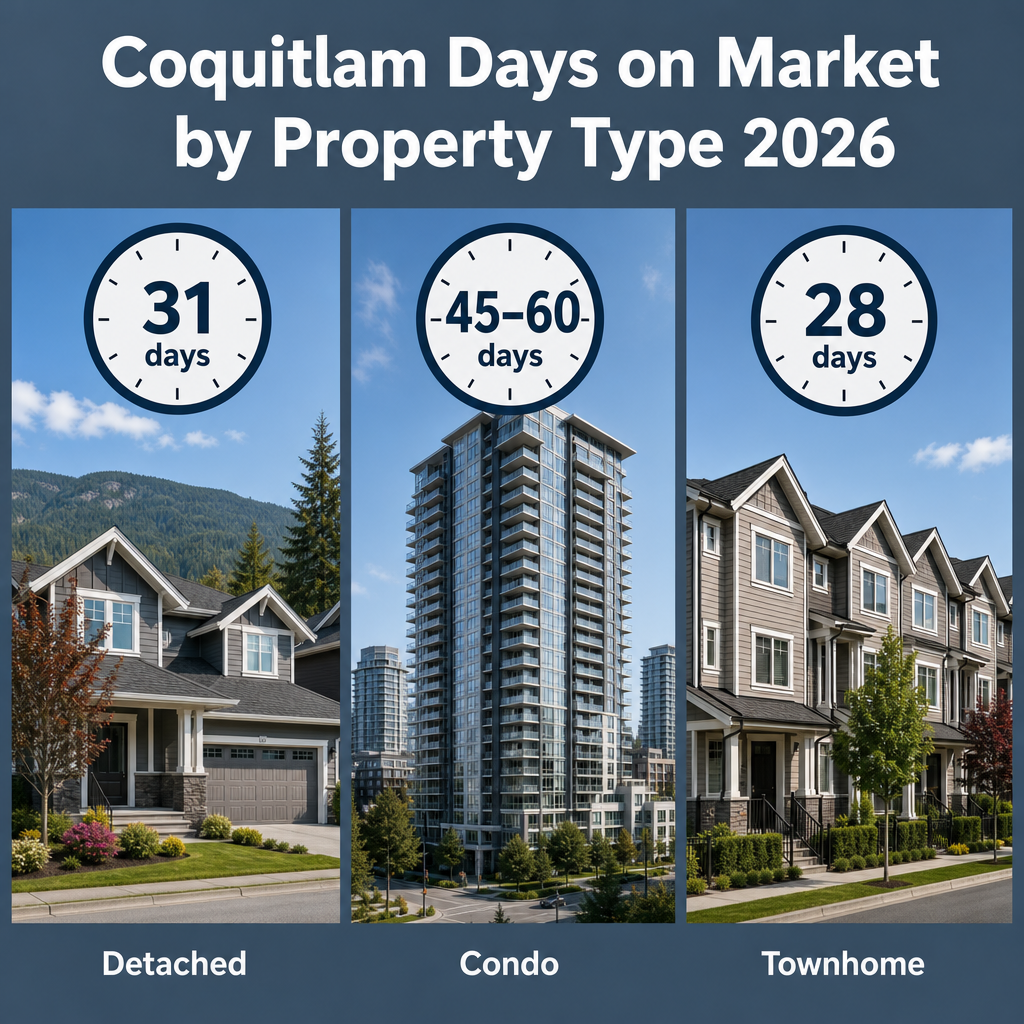
Coquitlam's sales-to-active listings ratio sits in what most market reports call a balanced range. But look at days-on-market by property type and the picture shifts noticeably. Townhomes are moving in 28 days. Detached homes average 31 days. Condos are taking 30 to 45 days and the trend is rising month-to-month. These are not three versions of the same market — they are three separate conversations about price, timing, and buyer leverage.
This article explains what DOM data reveals that SALR alone does not, how that gap affects pricing strategy across Coquitlam's property types, and what sellers in specific neighbourhoods need to understand before setting a list price in 2026. For context on how these dynamics sit within the broader Coquitlam market, see Coquitlam Real Estate Market Report: What the 2026 Data Tells Buyers and Sellers.
Short Answer
In Coquitlam's 2026 market, days-on-market varies sharply by property type: townhomes average 28 days, detached homes 31 days, and condos 30 to 45 days with a rising trend. A sales-to-active ratio in the balanced range does not capture this divergence. Condo sellers who price based on SALR without tracking DOM trajectory risk sitting on market while buyers gain leverage quietly.
Key Takeaways
- Coquitlam's SALR appears balanced across all three property types, but DOM reveals active divergence — townhomes tight, condos softening.
- A rising condo DOM trend is an early warning signal that buyer interest is flattening before the SALR moves to reflect it.
- Townhomes at 28 days and a 23% SALR represent the strongest seller position in Coquitlam by any measure in 2026.
- Burke Mountain and Central Coquitlam detached segments show year-over-year price declines despite sub-35-day average DOM figures.
- Condo sellers who rely on SALR without checking DOM trajectory risk overpricing into a market where buyer hesitation is already present.
Who This Applies To
- Condo sellers in Coquitlam evaluating list price strategy for 2026
- Detached homeowners in Burke Mountain, Central Coquitlam, or Maillardville considering a sale
- Townhome owners weighing timing and whether to act now or wait
- Buyers trying to understand which segments give them negotiating room
- Investors tracking early-trend data before it appears in benchmark price changes
When This Advice May Not Apply
DOM data is most useful when tracked as a trend over consecutive months. A single month's figure can reflect seasonal patterns, school-year timing, or a temporary inventory spike. This analysis reflects March and April 2026 data. Conditions shift. Any seller preparing a strategy should verify current DOM figures for their specific property type and neighbourhood before listing.
Data Used in This Article
- REBGV Monthly Market Reports (March–April 2026) — official; Metro Vancouver and Coquitlam-area DOM and SALR data
- Mansour Real Estate Group internal market analysis — professional interpretation; Coquitlam neighbourhood price trends
- Bridgewell Group Tri-Cities Market Summary (2026) — third-party; Coquitlam property-type breakdown reference
- GV Realtors March 2026 Market Watch — official; Metro Vancouver benchmark and DOM comparison
What SALR Tells You — and What It Hides
The sales-to-active listings ratio compares completed sales to available inventory in a given period. When the ratio sits between 12% and 20%, most boards describe the market as balanced. Coquitlam's detached, townhome, and condo segments all fall within or near that band in early 2026. On paper, conditions look roughly similar across property types.
DOM tells a different story. Days-on-market measures how long a property sits before a buyer commits. It responds faster to changing buyer behaviour than SALR does, because SALR is a lagging measure — it reflects what sold, not what is sitting. A condo that takes 45 days to sell counts the same in the SALR calculation as one that sells in 12, but the seller experience and pricing room are entirely different.
In Coquitlam's condo segment, the SALR of approximately 17% reads as balanced. But the DOM trend rising from 30 days in March to 30–45 days in April suggests buyer engagement is cooling month over month. That trajectory — not the ratio — is the signal sellers need to watch. The Coquitlam condo market analysis for 2026 covers the inventory dynamics behind this trend in more depth.
According to the REBGV's March 2026 Market Watch, Metro Vancouver's overall condo DOM reached 38 days — higher than Coquitlam's current average but pointing in the same direction. Coquitlam condos are not yet at Metro Vancouver's level, but the month-to-month movement suggests the gap is narrowing.
DOM by Property Type: What the 2026 Numbers Show
Townhomes — 28 days, 23% SALR. This is the most seller-favourable segment in Coquitlam right now. Buyers for townhomes are often families who have priced out of detached and are unwilling to trade down to a condo. That demand pool is consistent, and Coquitlam's townhome supply has not kept pace with it. Sellers in this segment have the shortest decision window to work with — if a townhome is priced correctly, it typically attracts offers within the first two weekends. For buyers weighing new construction options, the comparison of presale versus move-in ready townhomes in Coquitlam is worth understanding before making a decision.
Detached homes — 31 days, 10% SALR. The 10% SALR is technically below the balanced threshold, which would ordinarily suggest buyer market conditions. But the 31-day DOM tells a more nuanced story: properties are still moving, but buyers are taking time. The SALR reflects limited sales relative to inventory. The DOM reflects that when the right property is priced correctly, buyers do commit — just not quickly, and not without scrutiny.
Condos — 30 to 45 days and rising, 17% SALR. This is the segment where the DOM-versus-SALR divergence matters most for sellers. The ratio looks balanced. The DOM trend is not. A condo that goes to market at a price anchored to last quarter's sold data is likely to encounter buyers who have seen similar units sit without offers — and who know it. Sellers in this segment need to price to where the market is heading, not where it has been. See what condo buyers in Coquitlam are reviewing before they offer for context on what is slowing decisions in this segment.
Neighbourhood-Level Signals Worth Watching
Neighbourhood-level DOM data for Coquitlam is not published in granular form by the REBGV. But benchmark price trends by neighbourhood offer a proxy signal. When prices fall year-over-year in a neighbourhood while DOM remains below 35 days, it typically means buyers are engaging — but only at lower price points. That is different from a market where DOM is climbing because buyers have stopped engaging altogether.
Based on internal analysis and publicly available benchmark data, three Coquitlam neighbourhoods show notable year-over-year price declines in the detached segment: Burke Mountain at approximately −5.8%, Central Coquitlam at approximately −11.2%, and Maillardville at approximately −11.6%. These declines do not mean properties are sitting — they mean sellers have had to adjust price to close. For sellers in these areas, pricing to current buyer expectations rather than peak comparable data is critical to keeping DOM manageable.
Burke Mountain, in particular, carries added nuance. It is a newer community with higher price points, meaning its buyer pool is smaller and more rate-sensitive. The Burke Mountain premium analysis explains why listings here can sit longer despite reasonable DOM averages across the city. The Evergreen SkyTrain corridor, by contrast, tends to support shorter DOM for condos near stations — a factor explored in how the Evergreen line shapes Coquitlam property values.
How We Evaluate This
At Mansour Real Estate Group, we look at DOM as a trend, not a snapshot. A single month's figure can be distorted by inventory timing, interest rate announcement timing, or seasonal patterns. What matters is whether DOM is stable, compressing, or expanding over consecutive months — and whether that direction matches or contradicts the SALR.
When DOM is rising in a segment while SALR holds steady, our interpretation is that volume is being maintained through price concessions — sellers are closing, but at adjusted prices. When DOM rises and SALR falls simultaneously, the market is moving from balanced to buyer-favourable. Coquitlam's condo segment in early 2026 fits the first pattern. Sellers who price based on the SALR alone will likely experience the reality of the DOM signal firsthand.
Seller Checklist: Using DOM to Price Competitively in Coquitlam
- Obtain the current average DOM for your specific property type — not the city-wide average — before setting a list price.
- Compare this month's DOM to the prior two months. Rising DOM in your segment is a signal to price at the current absorption point, not the last sold comparable.
- Cross-reference DOM with benchmark price trends in your specific neighbourhood. Declining prices with stable DOM means buyers are engaging but only at lower values.
- For condos, review active competing listings and note how many have been relisted or had price reductions. This is a real-time DOM signal that board statistics lag.
- For townhomes, the tighter DOM means less room to test a high price. An overpriced townhome loses its first-weekend momentum and enters a much longer selling cycle.
- For detached homes in Burke Mountain or Central Coquitlam, anchor pricing to recent solds at the adjusted benchmark, not to peak-period comparables from 2023 or 2024.
What We Commonly See
Condo sellers anchoring to SALR instead of DOM. In our experience, the most common pricing mistake in a softening condo market is using the ratio as a green light. A 17% SALR looks balanced. But when we look at specific units that have been relisted or have sat 40-plus days without offers, the pattern is clear: buyers have more choice and are taking longer to commit. Sellers who price as though inventory is tight — when DOM says it is not — are essentially donating negotiating room to the buyer.
Townhome sellers underestimating their position. What often happens is that townhome sellers, seeing the broader "balanced market" headlines, price conservatively when they could price more assertively. The 28-day DOM and 23% SALR in this segment suggest demand is genuine and consistent. A townhome seller who leaves 2 to 3 percent on the table out of caution does so unnecessarily in most cases — provided the property is well-prepared and accurately positioned. The step-by-step selling strategy for Coquitlam in 2026 covers how to position any property type from preparation through close.
Questions and Answers
What is days-on-market and why does it matter more than sales ratios in some situations?
Days-on-market measures how long a property is listed before a buyer commits. It responds to buyer behaviour in real time. Sales ratios are calculated after transactions close, making them a lagging indicator. When the two diverge — as they do in Coquitlam's condo segment in 2026 — DOM is the earlier and more actionable signal for pricing decisions.
Is a rising condo DOM in Coquitlam a reason to wait before selling?
Not necessarily. A rising DOM signals that buyers are taking longer, not that they have stopped buying. For sellers with a genuine need to move, pricing accurately to the current absorption level often produces a better outcome than waiting for conditions to improve — conditions that may not improve if inventory continues to build. The right question is not whether to sell but how to price for where the market is today.
How do Coquitlam's DOM figures compare to Metro Vancouver overall?
According to the REBGV's March 2026 Market Watch report, Metro Vancouver's overall condo DOM reached approximately 38 days. Coquitlam condos are currently averaging 30 to 45 days with a rising trend, placing them on a path toward Metro Vancouver norms. Coquitlam detached homes at 31 days and townhomes at 28 days remain tighter than broader Metro Vancouver detached averages, which reflects the Tri-Cities' relative affordability and consistent demand from family buyers.
In Summary
Coquitlam's 2026 market looks balanced when measured by sales ratios. It looks segmented when measured by days-on-market. Townhomes are tight. Detached homes are moving with deliberate buyers. Condos are taking longer and the trend is pointing higher. Sellers who understand which metric matters more for their property type — and which neighbourhood factors are adding or subtracting pressure — can make pricing decisions that reflect the market as it actually is, not as the headline ratio suggests. In a market where getting the first two weekends right determines the outcome, that difference matters.
Ready to talk pricing strategy for your Coquitlam property?
Mansour Real Estate Group offers honest, data-grounded pricing consultations for sellers across Coquitlam and the Tri-Cities. There is no obligation — just a clear picture of where your property sits and what a realistic strategy looks like right now. Reach out through localhost:9000/ when you are ready to have that conversation.
Related Articles
- Coquitlam Real Estate Market Report: What the 2026 Data Tells Buyers and Sellers
- Coquitlam Condo Market 2026: Rising Inventory, Steady Demand, and What It Means for You
- How the Evergreen SkyTrain Line Shapes Property Values in Coquitlam
- Buying a New Build Townhome in Coquitlam: Presale vs. Move-In Ready Compared
- Strata Fees and Condo Living in Coquitlam: Everything Buyers Need to Know Before They Offer
About Mansour Real Estate Group
Understanding how days-on-market interacts with pricing strategy — by property type, by neighbourhood, and by market phase — is exactly the kind of analysis that separates a well-timed sale from one that costs a seller weeks on market and negotiating leverage. Mansour Real Estate Group has built its reputation across the Fraser Valley and Lower Mainland on pricing discipline, honest valuations, and a willingness to have direct conversations about market conditions before a listing goes live.
Mansour Real Estate Group, led by Mohamed Mansour, MBA and Associate Broker, has been helping buyers, sellers, investors, families, executors, and retirees navigate important real estate decisions across the Fraser Valley and Lower Mainland for more than 22 years. Ranked among the Top 1% of Realtors in the region, the team has completed more than $780 million in residential real estate transactions and is trusted for pricing strategy, seller preparation, condo and strata transactions, estate sales, downsizing, and any situation where accurate valuation is critical to the outcome.
Whether someone is searching for Realtors experienced in Coquitlam condo pricing, a real estate agent who understands DOM trends and what they mean for list price strategy, real estate agents who know the Tri-Cities market at the neighbourhood level, a trusted real estate team for a detached or townhome sale in Coquitlam, or a Fraser Valley real estate broker who combines market data with honest seller advice, Mansour Real Estate Group is known for clear recommendations, accurate valuations, and a process grounded in local expertise.
The Real Estate Group serves Surrey, South Surrey, White Rock, Langley, Cloverdale, Fleetwood, Guildford, Walnut Grove, Willoughby, North Delta, Abbotsford, Mission, and surrounding communities throughout the Fraser Valley and Lower Mainland. Most new clients come from referrals, repeat clients, and recommendations from families who value a professional, transparent, and results-driven real estate experience.
Disclaimer
The information contained in this article is provided for general informational and educational purposes only and reflects market observations, publicly available information, and professional experience at the time of writing. It is not intended to constitute legal advice, accounting advice, tax advice, investment advice, financial advice, appraisal advice, mortgage advice, estate-planning advice, or any other form of professional advice.
Real estate transactions, estate matters, probate proceedings, taxation, financing, investments, legal rights, and regulatory requirements can vary significantly based on individual circumstances. Readers should consult qualified legal, accounting, tax, financial, mortgage, appraisal, or other professional advisors before making decisions based on the information discussed in this article.
Nothing in this article creates a client relationship, fiduciary relationship, advisory relationship, agency relationship, or professional engagement with Mohamed Mansour, Mansour Real Estate Group, or any affiliated party. Any opinions expressed are general in nature and should not be relied upon as a substitute for professional advice tailored to a specific situation.
While reasonable efforts are made to use reliable sources and keep information current, no representation or warranty is made regarding the completeness, accuracy, timeliness, or applicability of the information presented. Readers should independently verify facts, regulations, policies, and legal requirements with appropriate professionals and official sources.
Official Resources
- REBGV March 2026 Monthly Market Report — gvrealtors.ca
- Mansour Real Estate Group — Coquitlam Market Report February 2026
- Bridgewell Group — Tri-Cities Real Estate Market Summary
-
Key Takeaways
When considering a real estate investment or home purchase, remember that location, market timing, and property condition are the three pillars of successful decisions. Understanding current market trends helps you make informed choices rather than emotional ones. Working with experienced professionals—agents, inspectors, and financial advisors—can significantly impact your outcomes.
Final Thoughts
The real estate market continues to evolve, but the fundamentals remain constant. Whether you're a first-time homebuyer, seasoned investor, or looking to sell, taking the time to research, plan, and seek expert guidance pays dividends in the long run. Your home is more than just an investment—it's where memories are made and futures are built.
Start your real estate journey with confidence by staying informed, asking the right questions, and trusting your instincts alongside expert advice.



